
How Using Emotional Marketing in Content Can Help Drive Way More Sales
Whether you care to admit it or not, the decisions you make today will be driven by your emotions. In emotional marketing, we talk a lot about using psychological triggers to get customers to click, convert, engage, etc.
“By leveraging common psychological triggers all people have,” you might hear, “you can drive more sales.”
While it may feel like we make decisions with our minds, using logic and reasoning, the “mental triggers” we hear about are tied more to emotion than anything else.
Case in point, Antonio Damasio spent time studying individuals with damage to the area of the brain where emotions were generated and processed.
While these subjects functioned just like anyone else, they couldn’t feel emotion.
The other thing they had in common was they all had trouble with making decisions.
Even simple decisions about what to eat proved difficult.
While they could describe what they should be doing using logic and reason, most decisions couldn’t be settled with simple rationale.
Without emotion, they weren’t able to make a choice.
This is supported by data from Gerard Zaltman, author of “How Customers Think: Essential Insights into the Mind of the Market.”
Zaltman found that 95% of cognition happens beyond our conscious brain, instead coming from our subconscious, emotional brain.

Emotions are an X factor you can’t control, but you can’t afford to ignore them in your content marketing.
Why is Emotion Marketing so Effective?
When you make an emotional connection with your audience, it’s incredibly easy to steer them to the desired outcome.
You’ve formed an emotional bond, however brief and fleeting, that makes them open to ideas and suggestions. It creates a certain level of trust that’s virtually impossible to artificially manifest.
Rob Walker and Joshua Glen found firsthand what an emotional connection can do.
In one experiment, they bought hundreds of items from thrift stores and similar locations — all cheaply priced.
The duo wanted to see if they could sell the products using an emotional connection through the power of stories alone.
With 200 writers on board, they generated fictional stories for the products and used those stories to sell the thrift store items at auction on eBay.

They raised just under $8,000, which was a profit of approximately 2,700%.
And they did it all using that emotional connection through storytelling.
That’s not to say there isn’t a place for the logical or the rational in decision making.
This is where marketers often leverage the theory of dual processing in psychological marketing.
The theory holds that the brain processes thoughts and decisions on two levels.
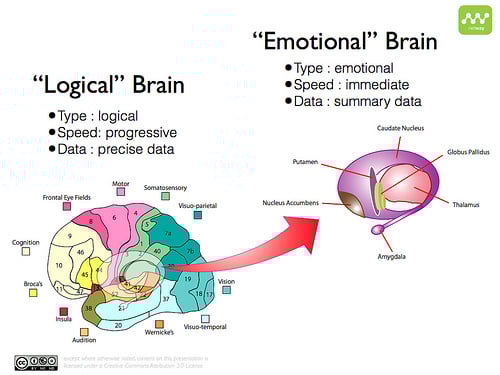
The first level is that of emotion, which processes automatically, unconsciously, and provides a rapid response when we need it with virtually no effort.
The second level is the more deliberate and conscious thought process, where we handle decisions with reason and logic. It happens far slower than the emotional response.
In most cases, we fire back with a ready response from our emotions and then try to consciously rationalize it.
Think about some big-brand rivalries and preferences will surface in your mind.
How do you feel when you look at this major brand comparison?

Here’s another common one that has people divided, sometimes within the same family:

And then there’s this brand rivalry we know all too well.

In each of these, you likely have an opinion almost instantly about which you prefer, but it’s not because you have a logical reason.
It’s typically tied to emotion and/or experience; how you feel using their products, or how the brands left you feeling after an experience or reading a news article.
The brain then tries to rationalize that emotional response.
For example, your emotional response goes straight to Coke and then your brain works to rationalize the decision by deciding that it tastes better in a can, it’s fizzier, has a stronger bite than Pepsi, etc.
So, while you might feel like you’re making a rational choice about your beverage, it’s really just an emotional one.
The most successful marketers know how to lean on the emotional over logic in order to make their content draw in the audience.
That’s why nearly a third of marketers report significant profit gains when running emotional campaigns, but the number of successful campaigns dips if you introduce logic into the marketing.
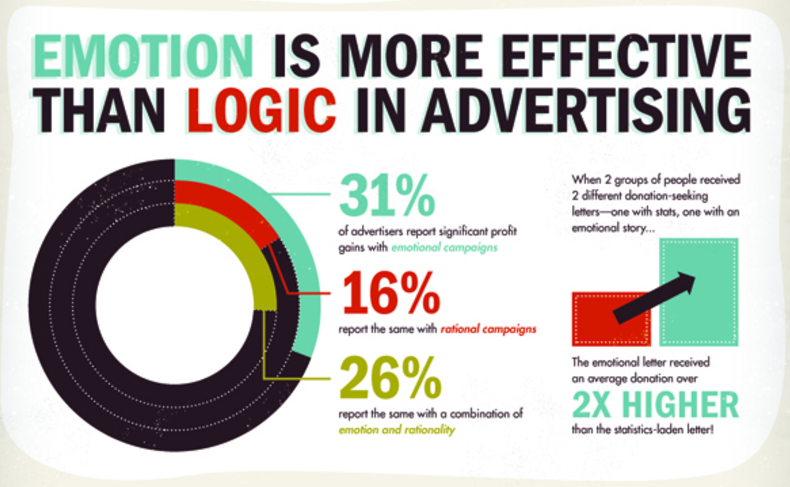
And those results get sliced in half when marketers switch to logic over emotion.
Emotion Marketing Doesn’t Guarantee Successful Engagement
We experience a laundry list of emotions every day.
Is it really as simple as leveraging some emotion to make content more effective?
Yes and no.
Emotion is certainly important, but there are also other factors like timing, exposure, the format of the content, how it’s presented, who produced or shared it, etc.
Despite understanding the role emotion plays in content, we still haven’t quite perfected a formula for what makes content go viral.
Though we’ve gotten pretty close.
Brands have long tried to inflate the consumer’s emotional response through manufactured content; some met with great success.
Take, for example, Intel’s five-part “Meet the Makers” series.
The videos profile a person around the world who uses Intel’s technology to create new experiences and build new technology that makes a difference in the world.

Like 13-year-old Shubham Banerrjee, who used Intel’s technology to build an affordable Braille printer.

And of course, some companies try to leverage emotion and create viral campaigns that just don’t take off.
CIO reported a number of failed viral marketing campaigns, such as “Walmarting Across America.”
In this blog, two average Americans travel across the country visiting Walmart locations, reporting their interactions on a blog along the way.
After countless upbeat entries about how people loved working for the company, it was discovered that the trip was paid for by Walmart and the entire thing was a campaign created and managed by the company’s PR firm.
That didn’t receive a warm reception from the blogosphere, which deemed the content to be a “flog” or fake blog.
Which Emotions Attract the Most Marketing Engagement in Content?
Many emotions fuel our behaviors and our decisions, especially our purchase decisions.
Some more than others — especially when they’re authentic.
A study was done by Buzzsumo analyzing the top 10,000 most-shared articles on the web. Those articles were then mapped to emotions to see which emotions had the greatest influence on content.
The most popular:
- Awe (25%)
- Laughter (17%)
- Amusement (15%)
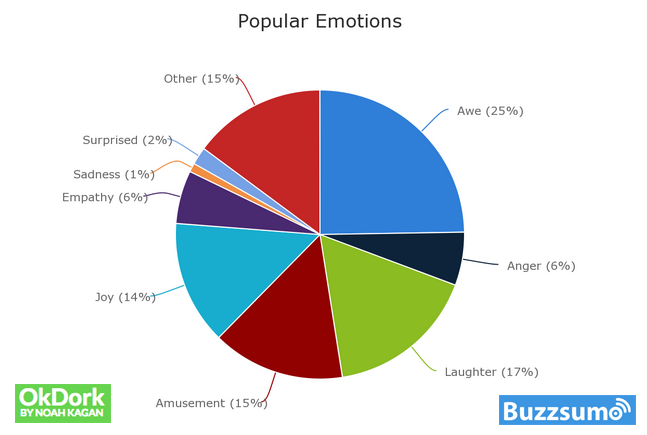
Conversely, the least popular were sadness and anger, totaling just 7% of the content that was most shared.
Two researchers at Wharton also wanted to dig deeper into virally shared content to find commonalities and better understand what makes that content spread.
What they found was the emotional element, and some very specific results tied to emotions.
- Content is far more likely to be shared when it makes people feel good or it creates positive feelings such as leaving them entertained.
- Facts or data that shock people or leave them in awe were more likely to be shared.
- Instilling fear or anxiety pushes engagement higher, from comments being posted to content being shared.
- People most commonly shared content that incited anger, leaving comments as well.
While some emotions are more likely to engage than others, every audience is different. What drives one to action may do very little for another.
This modern adaptation of Robert Plutchik’s Wheel of Emotion, illustrated by CopyPress, shows the range under eight primary emotions: joy, trust, fear, surprise, sadness, disgust, anger, and anticipation.
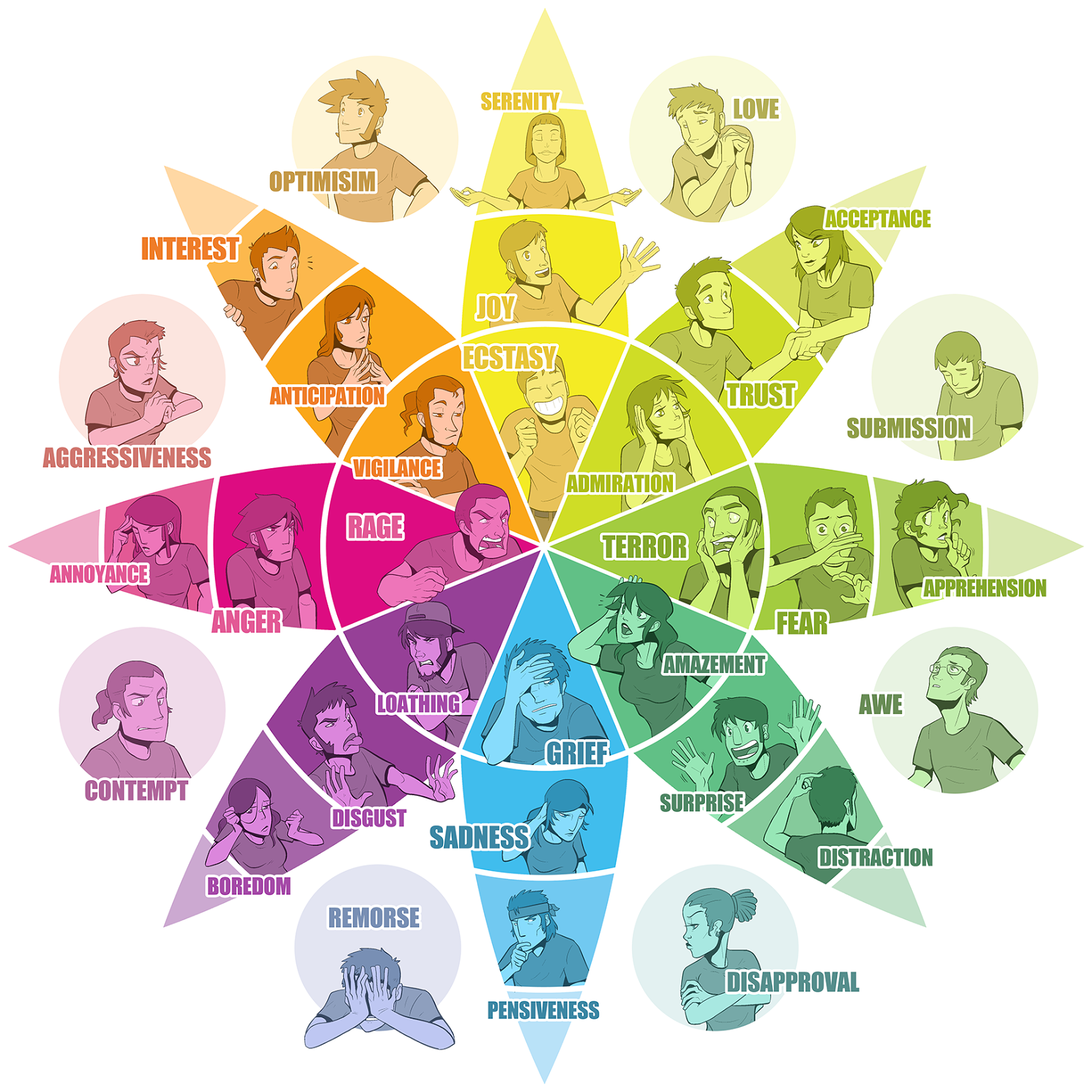
For content to be widely shared and have an impact on your audience, it needs to leverage one or more of these emotions.
The proof is on the web, not only in the statistics I shared above, but also in the popularity of user communities that regularly share content.
Just look at Reddit and some of the most popular subreddits by subscriber count. Each can be tied back to emotions (some more obviously than others) like anticipation, awe, joy, and more.
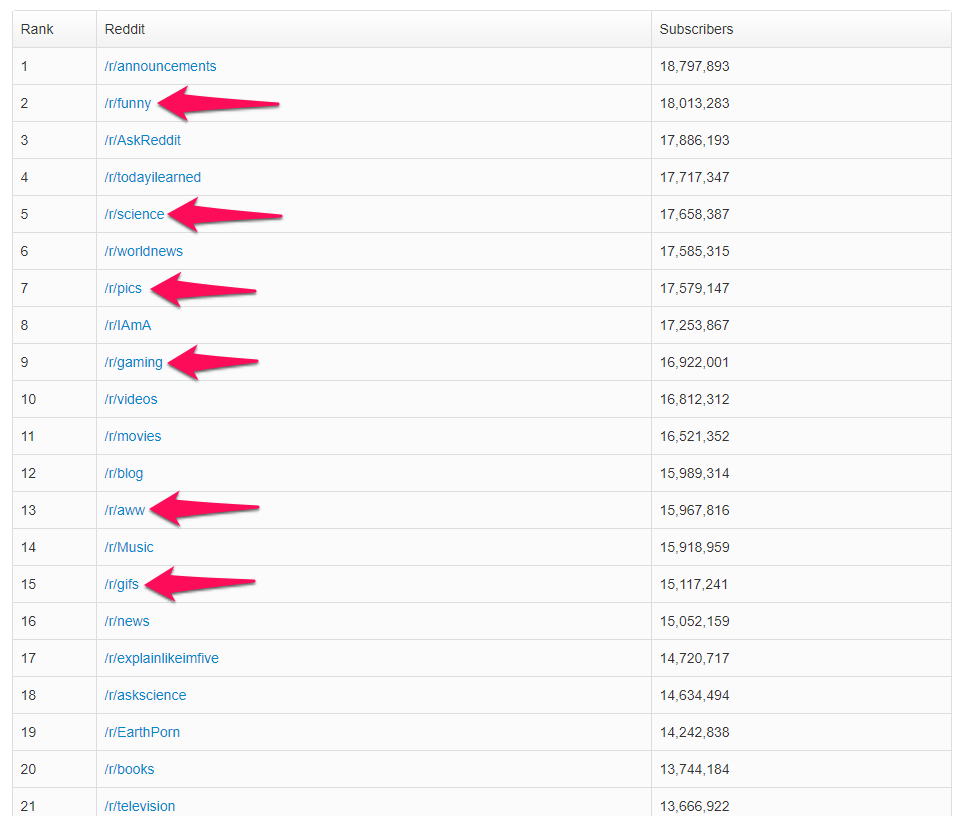
Here’s how some of those emotions can play into the engagement with your audience:
Anxiety May Cause Uncertainty For Customers
You don’t want your audience to make bad decisions. Bad decisions can lead to buyer’s remorse, which can paint your brand and the overall experience in a negative light.
But it can be helpful if you leave the audience a bit more open to influence.
A Berkeley study revealed that anxiety can be linked to difficulty in using information around us to make decisions. When we experience uncertainty, it becomes harder to make decisions and our judgment is clouded.
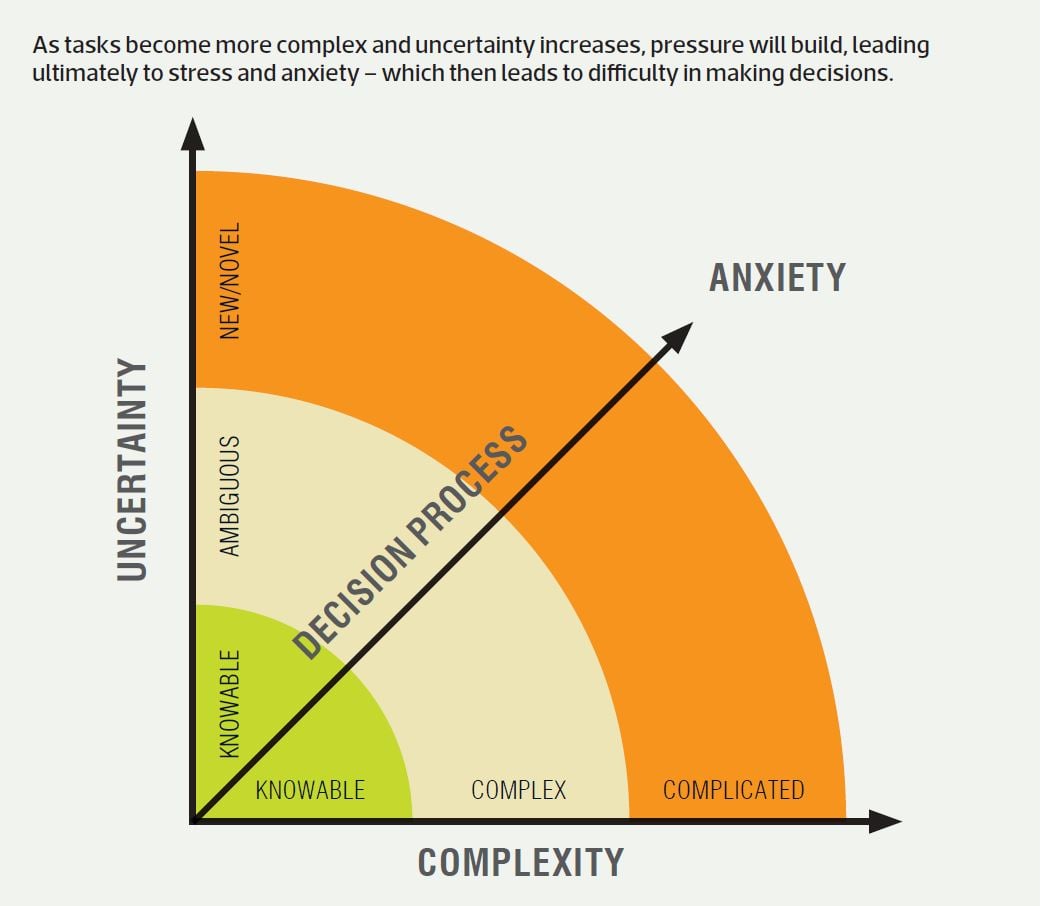
Still, anxiety can also spur people to act as a result of that uncertainty.
Take a two-year study by Wharton Ph.D. student Alison Wood Brooks and a Harvard Business School professor.
They found that upon increasing the anxiety of certain subjects with video footage, 90% of the “anxious” participants opted to seek advice and were more likely to take it.
Only 72% of the participants in a neutral state, who viewed a different video, sought advice.
Capture the Focus of Your Emotional Marketing Audience With Awe
Awe is comparable to wonder, but it doesn’t always fall under the umbrella of joy or humor.
It’s intended to captivate the audience and keep them riveted.
You often see this kind of hook in headlines that seem so earth-shatteringly significant that no one in their right mind would want to miss it.
Here’s a good example of that kind of awe used in content when Dropbox first launched.

Co-founder Drew Houston submitted his product to the website Digg, hoping to get some visibility from the social bookmarking site. That headline helped significantly.
Another great example of using Awe to capture attention is a video produced by Texas Armoring Corporation.
To emphasize the quality of the company’s bullet-resistant glass, the CEO crouched behind one of TAC’s glass panels while several rounds were fired at it from an AK-47.
Awe can impact decision making as much as anxiety.
A study from Stanford University found that people experiencing awe are more focused on the present and less distracted by other things in life. They also tend to be more giving of their time.
When you have their attention and their focus, they’re more likely to have time to rationalize a decision.
Drive People to Action With Laughter and Joy Through Emotional Marketing
While joy and laughter can have their lines blurred, they’re really two different emotions when it comes to your content.
Because while laughter often leads to joy, not everything that is joyful is laugh-out-loud funny.
Still, next to awe, joy, laughter, and amusement were the highest contributors to social sharing and engagement in the above studies.
That influence goes all the way back to early childhood.
As babies, out first emotional action not long after being born is to respond to the smile of our parents with our own smile.

Per psychoanalyst Donald Winnicott, joy and amusement are hardwired into us from birth.
His studies tell us that our innate desire for joy increases when it’s shared. That’s the nature of the “social smile.”
That explains why these feelings or emotions are such huge drivers behind the virality of content. Happiness, overall, is a huge driver for content sharing.
In fact, Jonah Berger’s study of the most-shared articles in the New York Times (around 7,000 articles) revealed the same kind of results around emotion.
The more positive the article, the more likely it was to go viral.
Brands have worked “joy marketing” into their strategies for decades, aiming to make their audience feel warm, comfortable, and happy.
That’s the intent of campaigns like P&G’s highly successful and viral “Thank You, Mom” campaigns that are injected with a lot of emotion (especially joy) when celebrating the strength of mothers.

Joy can take a lot of forms, though, and it doesn’t have to be commercially intended to elicit a direct sale.
Look at what Beringer Vineyards did with influencer marketing.
Russian Instagram sensations Murad and Nataly Osmann built a following of more than 4.5 million people with photos featuring them holding hands at locations around the globe during their world travels.
They attached the hashtag #FollowMeTo on those posts.

The couple teamed up with Beringer Vineyards to create some images meant to inspire joy, love, and of course the sense of adventure the couple already shared with their hashtag.

Immediate Gains in Emotional Marketing From Anger
Anger may be perceived as a negative emotion by some, but it can have positive influences as well as positive outcomes when leveraged in the right way.
A leading researcher in the study of anger, Dr. Carol Tavris, draws a parallel between anger and how it impacted society over the years.
Women’s suffrage, for example, developed from anger and frustration.
Anger can be empowering for the individual, bringing a sense of clarity and positive-forward momentum. It gives people a feeling of direction and control according to a study from Carnegie Mellon.
In the previously mentioned study on content shares in the New York Times, negatively perceived emotions like anger are equally associated with the virality of content.
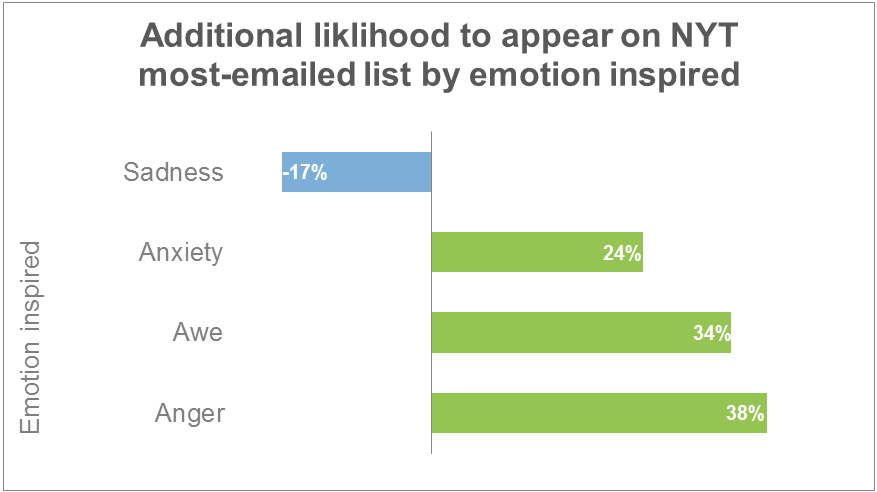
In fact, Berger’s study of the New York Times content found that content which incites feelings of frustration or anger is 34% more likely to be featured on the Time’s most emailed list than the average article.
Now, I’m not suggesting that you deliberately create controversy by taking shots at readers or picking fights.
The key with using anger in content is to frame an issue that incites anger or frustration in a way that’s constructive.
You have to be thought-provoking and engaging.
This interactive graph from the New York Times is an example of how content can lead to frustration and anger over economic or societal issues.
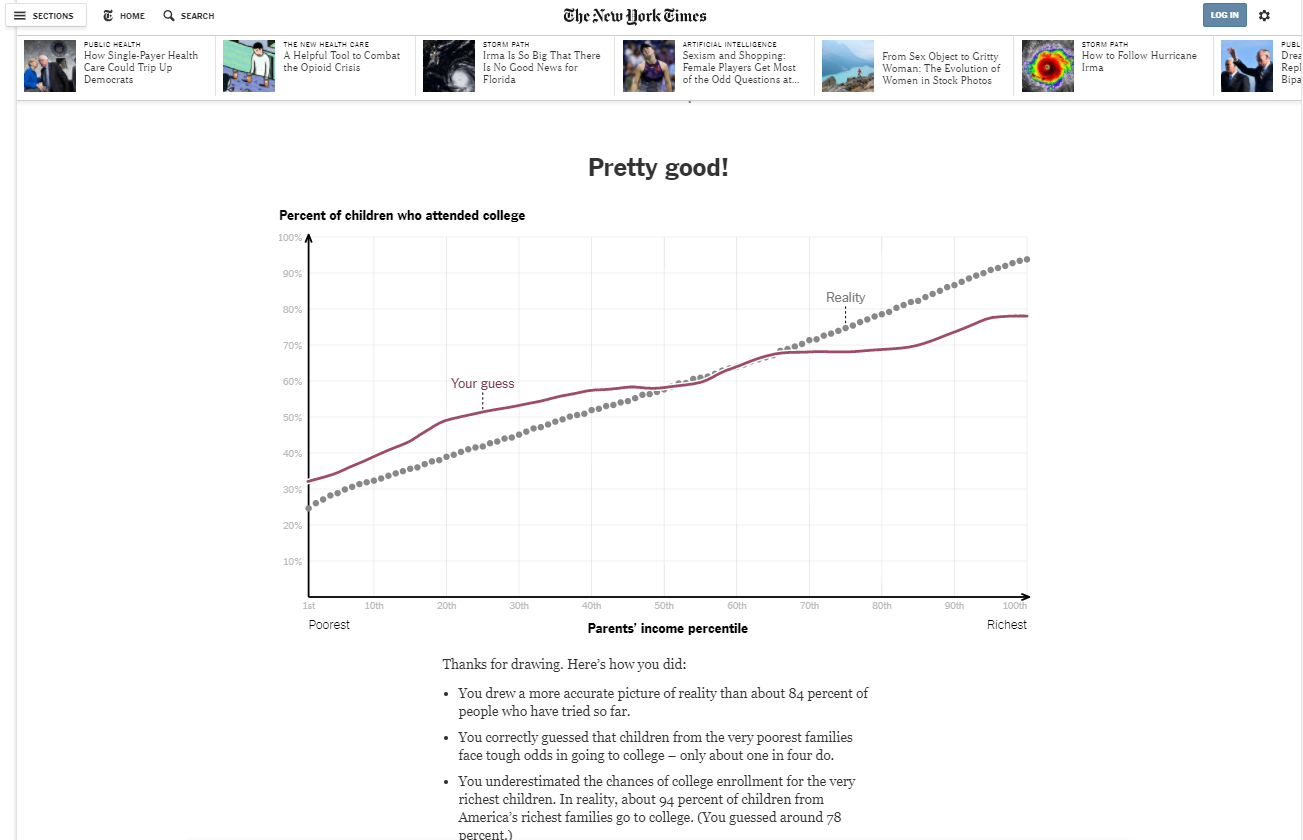
This piece of content is simple, yet it provokes engagement as well as thought when results are revealed in comparison to what an individual perceives to be the truth.
Using the Right Emotional Marketing Words in Content
The difference between logic and emotion in content comes down to the words we use and how we position statements and information.
It’s just like the laundry list of power words used to improve conversion, or terms commonly used in e-commerce to get customers to buy more products.
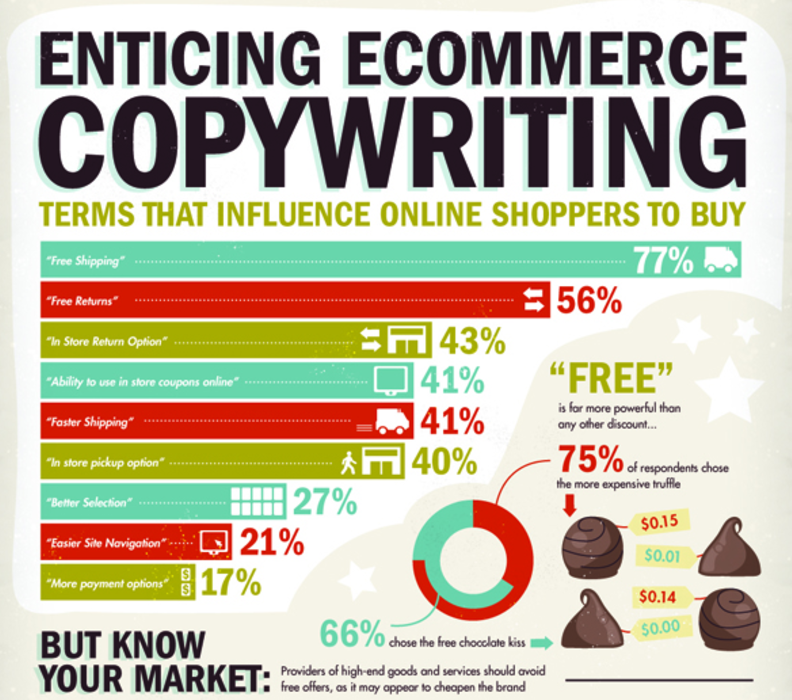
When creating copy and content, you have to be acutely aware of whether you’re taking a rational or emotional approach to the information you’re sharing.
You need to think about the response you want to elicit to help guide your content development to make the right kind of psychological and emotional connection with your audience.
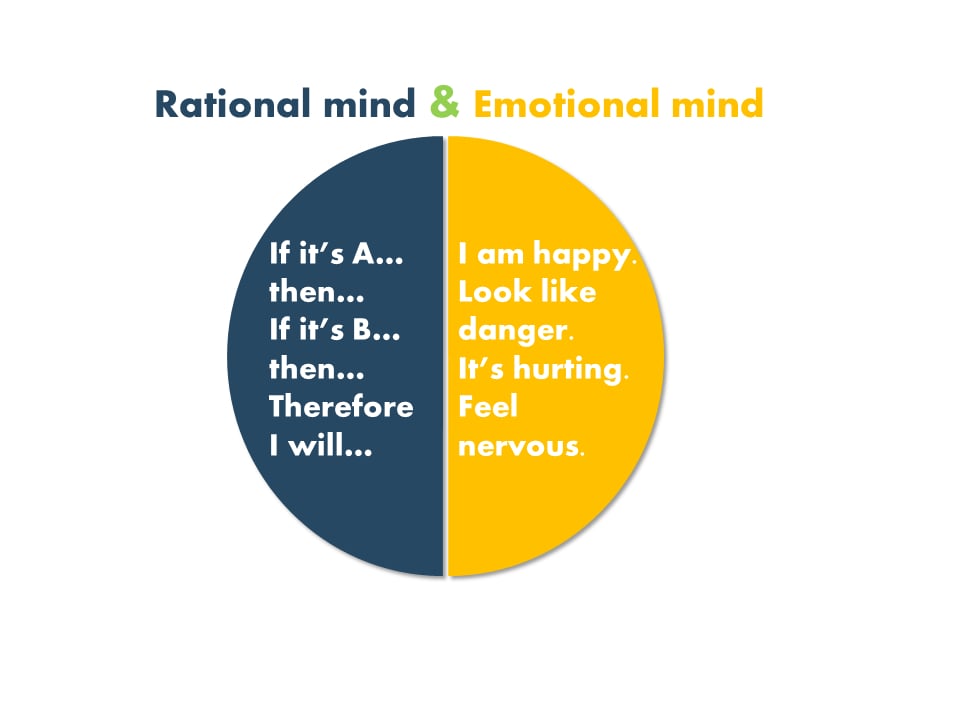
The context of your copy can remain the same.
By changing the words you use, however, you can make content appeal more to the emotions of the audience and prospective customer.
The simplest approach to finding the right high-emotion words takes only three steps:
- Think about the action you want your audience to take when they read your content.
- Decide what kind of emotional state will drive that action. What would make them do what you want them to do?
- Choose emotionally persuasive words appropriate to the action and the emotion.
What you’ll find in researching the right words is that emotionally persuasive and impactful words tend to be abrupt. It’s the short, concise, basic words that appeal most to our emotions over our intellect.
Just look at this list from the Persuasion Revolution.
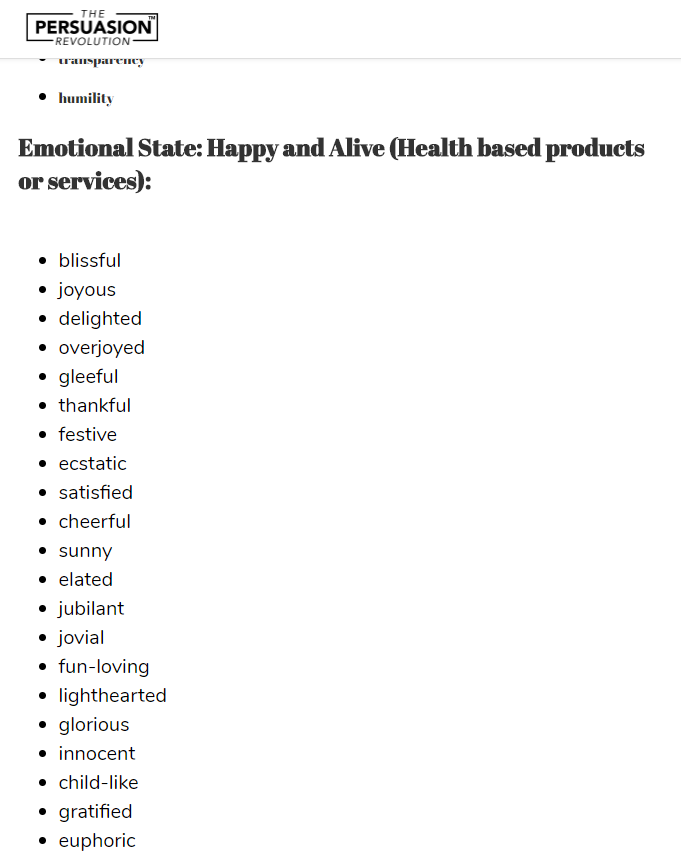
The majority of this emotionally weighted list (and there are over 350 items) is made up of shorter words.
The rational mind, on the other hand, tends to associate with longer and more complex words.
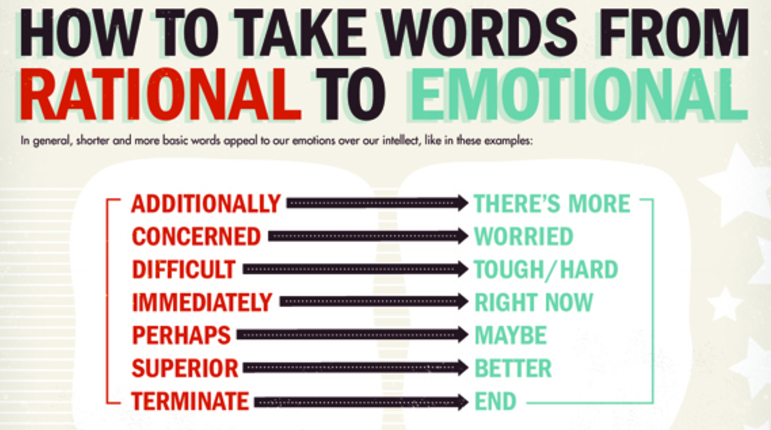
You Can’t Assume When it Comes to Emotional Marketing
It’s not easy to make that emotional connection with your audience. You have to know them.
Like anything else in marketing, your decisions and the content you create needs to be based on data. In this case, that data is your audience research.
That same research that tells you what topics to create, where your audience spends their time, and the content they prefer to view, can clue you into how to make that emotional connection.
You just need to expand your buyer personas.

In this case, you want to build up the psychological profile of your audience. You can achieve this by asking the right questions to help steer your content research and production.
- What do they find humorous?
- What are the pain points that frustrate them?
- What topics make them angry?
- What are common problems they speak about?
- What kind of content is being shared that clearly pleases them or brings joy?
Your research could turn up a common topic or theme that appears frequently in the content they read and share.
For example, you might discover that a certain segment or demographic in your audience has a strong affinity to family values, or health and wellness.
Turn that into a content campaign that shares the feel-good side of your company.
Delve into the family life of your employees, how your company supports the work/life balance, or better health initiatives.
Google is well known for its company structure, promoting flexible schedules, support of family time, personal projects, and a focus on work/life balance.
The company often shares behind-the-scenes images (visual content) showing off employees enjoying what they do. Here’s an example from Google Sydney’s offices:

That can influence a positive emotional response toward the brand when targeted segments see that content.
Emotional Marketing Works in the B2B Process
Don’t get caught up with the dated idea that emotion is only applicable to consumer-focused businesses.
Emotional marketing has its place in the B2B world as well.
You may be dealing with a longer buying process between one or more organizations, but the decisions are still made (and fueled by) people who are absolutely driven by emotion.
That includes emotions like:
- Awe: over what a solution is capable of and feeling empowered to bring that solution to the workplace.
- Anticipation: in finding a piece of the puzzle in a product or service that will help the company achieve its next goal or milestone.
- Fear: in purchase decisions that could reflect on the individual, resulting in a personal risk associated with a B2B purchase.
- Joy: in knowing that a B2B purchase is likely to lead to a positive outcome that will reflect positively on the individual.
Emotion absolutely influences B2B purchases, and in some cases, emotion matters even more than logic and reason.
Conclusion
You hold a great deal of influence with your audience when you’re able to tap into their emotions.
Once you understand your audience, you can better determine their emotional state.
From there, make the decision about whether you need to influence and exploit emotions that are already present, or if you want to create or give rise to emotions the audience wasn’t initially expecting or experiencing.
Even the most (seemingly) rational decisions are influenced by emotion — and that applies to everyone.
When you learn how to leverage that emotion in your content, you will see increases in engagement, social action, and conversions within your funnel.
How do you use emotion in your content and copy?
The post How Using Emotional Marketing in Content Can Help Drive Way More Sales appeared first on Neil Patel.