Helio Castroneves has signed a one-year contract extension with Meyer Shank Racing that will bring the four-time Indianapolis 500 winner back for a 26th full IndyCar season.
Astros manager Dusty Baker said Yordan Alvarez had shortness of breath, which was made worse by the smoke in the air after the Braves shot off fireworks at Truist Park.
Rep. Burgess Owens, R-Utah, emphasized the importance of November’s midterm elections on “The Ingraham Angle,” saying there needs to be a new Republican Party.
REP. BURGESS OWENS: Let me just give kudos to the American people, something that I don’t think many of us realized that happened. We had a miracle the last turn-around, even though we lost the Senate, the House and the presidency. We flipped, as a country, 15 seats and did not lose one incumbent.
You see people like myself and [Rep. Kat Cammack] that are new congresspeople that represent this new Congress that is all about America First. We’re not ashamed of who we are, and we’re not ashamed of our past. We talk about how to be inclusive to each other. This is the new Republican Party and we have an opportunity this go-around to add on to that.
Former Vice President Mike Pence said Friday that he did not take any classified information or materials with him after he left office in January 2021.
The comment comes as FBI officials found classified and “top secret” information among boxes of documents during a raid at former President Donald Trump’s private Florida estate, Mar-a-Lago last week. The raid was part of a larger investigation into whether Trump mishandled classified information or potentially violated the Espionage Act.
During an interview with the Associated Press, Pence was specifically asked if he retained any such documents or information.
The former president, who some believe could be pursuing the Republican nomination for the presidency in 2024, said he would not rush to judge Trump over the FBI’s findings, however.
“I honestly don’t want to prejudge it before until we know all the facts,” Pence said about the raid. He also called for transparency by the Justice Department for the “unprecedented action.”
“The concern that millions of Americans felt is only going to be resolved with daylight,” he continued. “I know that’s not customary in an investigation. But this is unprecedented action by the Justice Department, and I think it merits an unprecedented transparency.”
The former vice president also addressed Wyoming Rep. Liz Cheney’s primary loss to Trump-endorsed challenger Harriet Hageman. Cheney is a vocal critic of Trump and is one of the Republicans on the House Committee Investigating the Capitol Riots on January 6th.
“The people of Wyoming have spoken,” Pence answered, walking his typical fine line of addressing the issue without speaking ill of his former boss or offending Republicans who supported her. “And, you know, I accept their judgment about the kind of representation they want on Capitol Hill.”
“And I appreciate the conservative stance Congresswoman Cheney has taken over the years,” he added. “But I’ve been disappointed in the partisan taint of the Jan. 6 committee from early on.”
The committee has repeatedly called forth former Trump administration officials to testify on the events on Jan. 6, 2021, to determine if Trump played a role in advocating for an invasion of the Capitol building that resulted in several deaths.
Committee members have also sought Pence’s testimony before they wrap up their investigative report next month.
“Beyond my concerns about the partisan nature of the Jan. 6 committee, there are profound constitutional issues that have to be considered,” he said. “No vice president has ever been summoned to testify before the Congress of the United States.”
The interview came as Pence spent two days in Iowa, a state usually visited by potential presidential candidates as its caucus kicks off primary elections. Winners of the Iowa Caucus typically use that early momentum to bolster fundraising and gain polling leads that will help them in other state primaries.
I am a Software Engineer with 3 + years of experience having in-depth knowledge of software development life cycles, system architecture, and development tools with a passion to solve problems creatively and embrace unknowns. I have extensive experience building scalable and innovative backend services and solutions. I am looking for backend role in Golang and engineering oriented culture to do quality work.
A motivated individual with 2+ years of experience as a software engineer having
in-depth knowledge of programming languages, software development life cycles,
system architecture and development tools.I have extensive experience building
scalable and innovative back-end services and solutions.I have a great learning enthusiasm.Seeking a backend role in Node.Js Frameworks Nestjs/ExpressJs in a diverse culture to do quality work.
Generally Intelligent is an AI research company working directly on building human-level general machine intelligence that can learn naturally in the that way humans do. Our mission is to understand the fundamentals of learning and build safe, humane machine intelligence. Here are our open roles: ML Research Engineer (SF, Full-time): https://jobs.lever.co/generallyintelligent/c2f4a435-1eef-489… ML Engineer (Remote, Contract … Continue reading Generally Intelligent (YC S17) Is Hiring Machine Learning Engineers
You might have noticed the top search results aren’t just links anymore.
That’s becauseGoogle search results are now full of many features, including the knowledge graph, people also ask questions, and one of my favorite features —the featured snippet.
Why do I love featured snippets so much? Because they provide readers with valuable information right in the search results, making them convenient and useful.
They aren’t just helpful for the average person, though. Featured snippets allow marketers to outrank competitors, boost conversions, and drive tons of targeted traffic.
In fact, the featured snippet is sometimes called “Position 0” because it shows up before traditional search results.
Here’s another reason why I love them: featured snippets account for 35.1 percent of total clicks, which means you need to optimize for them if you want traffic.
Want to snag the coveted featured snippet spot? Here’s what you need to know.
What is a Google Featured Snippet?
Featured snippets are extended search results that appear at the top of Google and provide users with a quick answer to their questions. Featured snippets are generally in the form of a list, chart, or video and often appear for informational or long-form search queries.
Rather than the standard one or two-line meta description, users see more text, sometimes including bullet points and longer explanations.
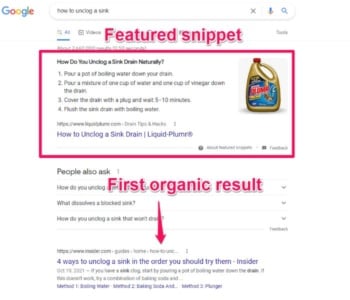
Here’s an example:
Just look at how much space a featured snippet takes up!
Featured snippets dominate the SERPs, occupying almost all the space above the fold in some cases.
They also give you tons of exposure, and keep your website visible. Plus, they’ll boost your company’s credibility.
The best part? You don’t have to pay extra advertising fees to rank for them.
You don’t have to be number one in your industry, either.
According to Getstat, 70 percent of snippets come from sites that aren’t in the top-ranking organic position.
Any company, regardless of size or budget, can earn a spot at position zero if you do it right.
Featured snippets can also answer questions with an extended paragraph, like this:
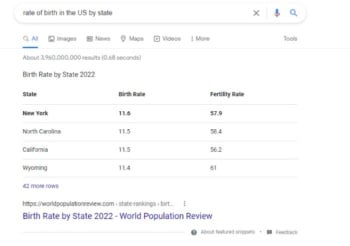
There are also table and chart featured snippets.
Table snippets provide answers in the form of — you guessed it — tables. They usually look something like this:
Note: There are other features, like rich answers and structured data, which change the look of your site in the SERPs. Those aren’t snippets, though they are closely related.
Tip #1: Use Google To Uncover Featured Snippet Opportunities
One of the best ways to find snippet opportunities is to think like your audience.
Snippets often show up for information and long-form search queries, so what questions does your audience ask?
Put yourself in the shoes of someone new to marketing who may not understand common terms or acronyms.
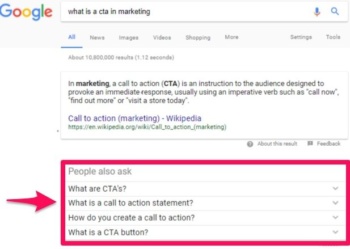
For example, I searched, “What is a CTA in marketing?”
There’s a featured snippet in the form of a paragraph.
Other terms you search might have a list—and who knows — the featured content might already be yours.
If it isn’t, check out ideas under the “People also ask” section.
These are questions related to the search you already entered. Expand the phrase by clicking the arrows on the right and read the answers.
Next, you’ll want to update or create new content that provides the answer to the main question and people also ask.
When creating your content, be clear and two the point. The faster you provide the info users want, the more likely you’ll land the snippet.
Tip #2: Find Content Ideas On Answer The Public
Since questions are most likely to bring up featured snippets, focus on answering how, what, when, where, why, or who.
The best place to find out the types of questions people might be asking about a particular topic is Answer the Public.
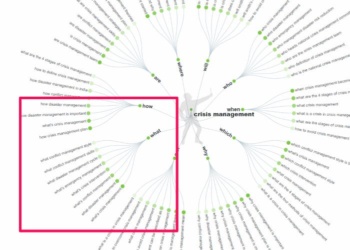
Let’s say you want to learn more about crisis management.
Just type in your query, and you’ll receive tons of suggestions for questions related to the topic. Snag a few of those questions and answer them in your content.
Start by choosing which angle you want to take. In this example, I’d likely choose “what” because there are a lot of basic questions I can answer and probably grab the featured snippet.
Keep in mind that you may want to do some keyword research before you do this to make sure the words you’re searching are SEO-friendly.
Tip #3: Do Keyword Research
Keyword research is crucial to landing those featured snippet spots.
It’s a good idea to use a keyword research tool or two to determine whether a search query will bring up featured results.
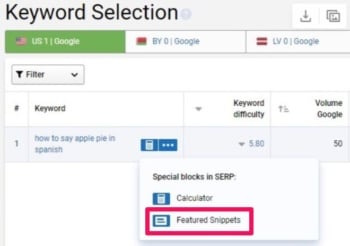
I like Serpstat because it lets me easily see which keywords bring up featured snippets on the results page.
Just type in a domain, keyword, or link, and hover over each result to see if featured snippets come up for each.
This is awesome for uncovering which featured snippets your competitors currently rank for.
Plus, if you already rank high for a particular keyword, you can see if Google currently brings up featured snippets for those keywords.
If they do, try to rank for it by identifying (and answering) the questions people have about that topic.
Then, just format your content to include tags related to those questions.
Tip #4: Answer Multiple Questions
I’ve found that once a page ranks for one featured snippet, it’s more likely to be featured in other related search queries.
That’s huge because it creates a snowball effect where you can earn more and more snippets.
Rather than working to optimize dozens of articles for snippets, aim to update a handful and really dig deep into the answer.
Define main terms, explore steps if the topic lends itself to that format, and answer as many of the “people also ask” questions as you can.
This creates a highly valuable piece of content that both users and search engines will like.
Tip #5: Stay Within The Optimal Word Count
Featured snippets are longer than your standard search result, but they also aim to answer users’ questions as quickly as possible.
Keep your section tight and concise so that Google can easily feature your content.
Section off your lists, paragraphs, and steps rather than letting them all run together.
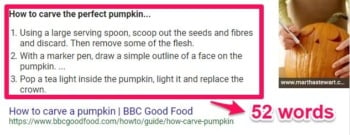
Just look at this list — it’s only 52 words long!
According to Semrush, this is a normal length for a featured snippet. Their analysis found that “[t]he most common length of content in featured snippets is between 40-50 words.”
Due to this, aim to keep each content section no longer than 50 words and no shorter than 40.
Tip #6: Use Headers
Headers often appear as a larger font used to break up sections in content. On the back end, they use HTML to tell Google the importance of each heading.
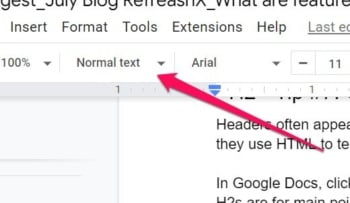
In Google Docs, click “normal text” and choose headings from the drop-down. H1 is your title, H2s are for main points, H3s are for supporting points under H2s, and so forth.
If you add “Step 1, Step 2” or “Rule 1, Rule 2” to each heading phrase, Google will place them in chronological order if you snag a list snippet.
Tip #7: Add A “How-To” Section To Your Website
Another way to snag snippets is to add a how-to section to your site. Since so many featured snippets cover detailed informational content, you have a far better chance of landing the coveted spot 0.
Some websites are creating entire sections on their sites that are specifically for giving answers to their readers’ questions.
Creating a section on your site makes it easier for users to find your content that solves specific issues.
If you don’t want to create a “how-to” section, a Q&A or frequently asked question section could also work. Just remember to keep the content short and answer questions fast.
Tip #8: Add High-Quality Images And Video
Many people learn visually, so adding photos and images can help you rank for featured snippets. (Google also includes images in featured snippets, which takes up more SERP space!)
Adding images to each step is quite simple using a tool like Canva. Their library has tons of stock photos, templates, and many icons you can use to create professional-looking images quickly.
Even better, you can use it to create videos. Here’s an example from their video template section:
According to Video Explainers, sites that use video are 53 percent more likely to show up on the first page of Google.
Trying video marketing is worth the effort, and it’s easier than ever with Canva or your smartphone.
A simple way to improve video performance is to add voice transcripts for all your videos. Google recognizes the text and might choose it for a featured snippet.
You should also make sure that your video content is high quality.
I try to add transcripts for almost all of my videos, like this one:
I then add the full transcript below the video in the description.
FAQs
What are featured snippets?
Featured snippets are expanded search results that answer users’ questions right in the search results. Featured snippets can be lists, paragraphs, or charts.
Do I have to pay for featured snippets?
No, Google chooses the most relevant source as a featured snippet; it is not an ad.
How do I optimize for featured snippets?
To land featured snippets, aim to answer questions quickly, use headers, and stay within 50 to 60 characters. Answering questions in the “people also asked” section of Google for your keyword can also help.
Are featured snippets the same as structured data?
No, featured snippets are expanded search results selected by Google. Structured data is a way to organize and code information on a page so Google can better understand the information.
As marketers, our job is to capitalize on what’s popular in the “here and now.”
When big news hits, how does the data get interpreted? One great way to figure out what is popular is with Google Trends.
This tool identifies current and existing trends in search marketing. You can then take what you’ve learned and apply it to any (and all) of your marketing strategies.
This article will help you understand how to use Google Trends and the specific steps you can take to maximize your efforts.
What is Google Trends?
Google Trends is an incredible tool that helps marketers identify trending topics across varying industries. While initially created for journalists, the world of journalism and marketing have a lot in common.
Both the journalist and the marketer are vying for attention. Whatever it is they’re trying to do, they want to get the attention of as many people as possible using information that is relevant and interesting to the audience.
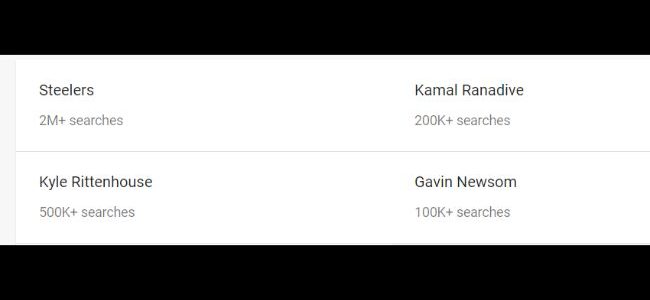
For example, in October 2021, the Pittsburgh Steelers are the number one trending search on Google. This could be due to a recent football game during the busy football season.
Google tells us this is a popular topic, so it might be a good idea to create some content around that topic. Of course, there are a million other factors that go into deciding what content to create, but Google Trends at least tells us what is popular.
If you have a specific topic that you want to cover but aren’t sure if it’s trending, you can search for it in the search bar at the top.
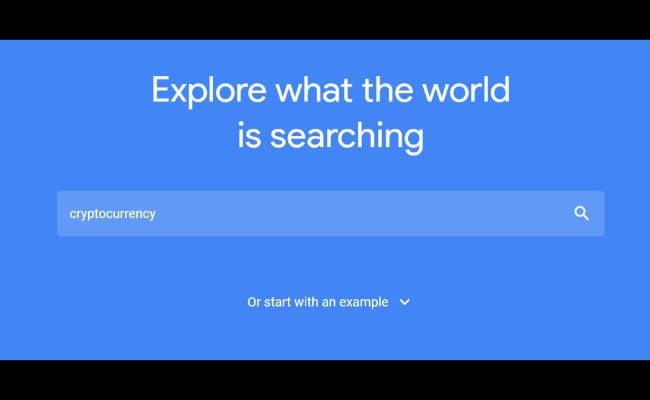
For example, I decided to search “cryptocurrency” to see what Google had to say.
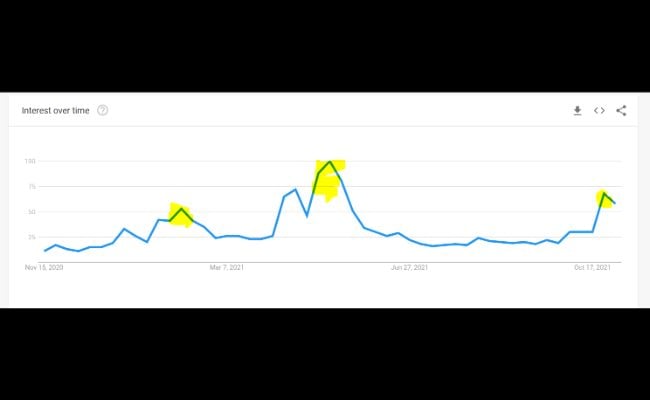
As you can see, you get a chart ranging from 0 to 100, with 100 being incredibly high interest and 0 being nearly no interest.
A few times across the last two years, cryptocurrency has spiked as a highly searched keyword on Google. This could be due to the release of new and popular coins or a lot more people getting established in crypto and keeping track of trends.
Why Should You Use Google Trends for Marketing?
Even if you aren’t involved in content creation, you should know how to use Google Trends. Marketers who use this tool do so because they understand the importance of capitalizing on trends.
We’re often very focused on producing the most evergreen content possible, but we should also work to maximize our efforts by finding the right time and place to put out a certain piece of content. Here’s how to use Google Trends:
Find Interesting Topics
Whether you’re a blogger, content marketer, or SEO professional, you need to find interesting topics people want to read about. In the SEO world, we’re so focused on our keywords and technical SEO that we sometimes forget that people actually want to read about topics that interest them.
A great way to find what interests people the most is Google Trends. The tool will tell you how much interest surrounds a specific search phrase so you can determine whether or not it’s worth creating content about it.
Keep in mind that not all popular trends are a good choice. To work, look for popular trends that are also related to your industry.
Inspire Creativity
Google Trends is not only useful for written content, but visual content as well. If you’re trying to figure out what to do with your social media or how to improve a featured image on your blog post, Google Trends can help you figure out what your audience wants to see.
By creating a relevant and interesting image, you’re not only generating attention for your content, but showing your target audience you understand them and know exactly what they want. This has many SEO-related benefits, too.
Identify (and Leverage) Seasonal Trends
If you’re in the travel, e-commerce, or tourism industries, your business might be seasonal. Identifying when to stock up on certain items can be difficult.
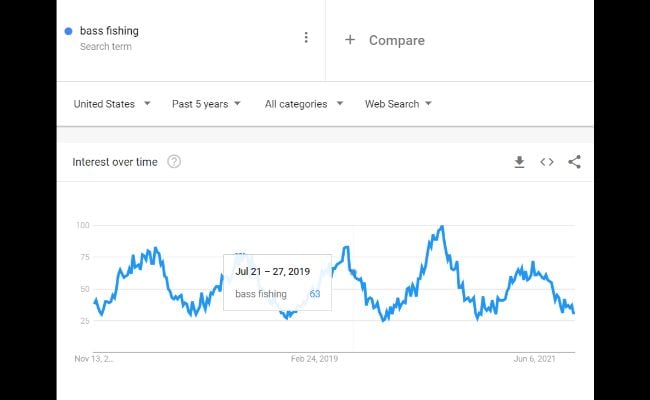
For example, let’s say you sell a piece of bass fishing equipment in your e-commerce store. You could use Google Trends to see when in the year bass fishing trends the most. Let’s take a look for ourselves.
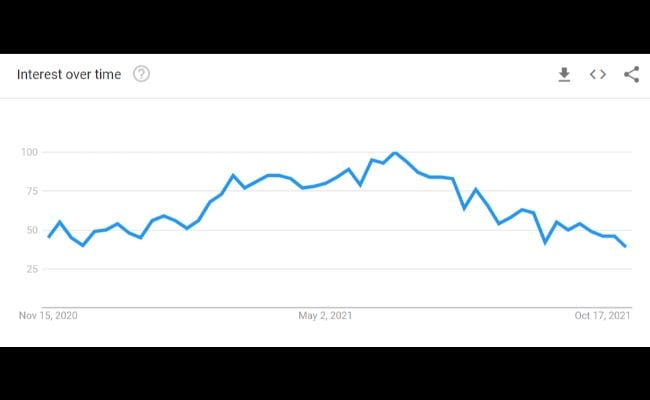
As you can see from the image, the interest in bass fishing gradually increases through the late winter and into spring. It peaks in early summer and then drops back down as you move into fall and winter again—at least in the Northern hemisphere.
This would tell an e-commerce store owner that it’s time to really start pushing your marketing campaigns in the late winter, because this is when interest is trending. You may also want to increase your inventory to prevent backorders.
5 Ways to Use Google Trends for Marketing
Now that you understand some of the motivation behind how to use Google Trends for SEO, let’s look at the actionable steps you can take to make a difference in your various marketing campaigns.
1. Get Ideas for Blog Posts
Google Trends is a great way to find new and exciting topics to write about. If you’re a writer, you know how challenging it can be to produce content your readers will love and will rank well on Google. Google Trends is a sure-fire method to find good topics because they tell you exactly what is trending.
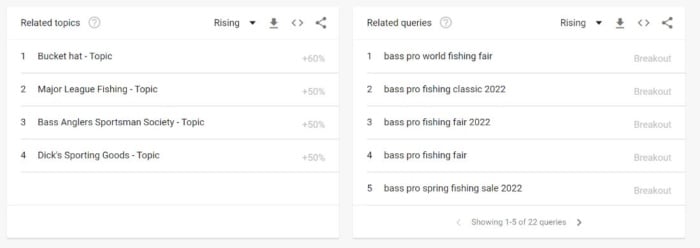
Best of all, they provide you with specific topics and queries around trending search phrases. Let’s stick with the bass fishing example and scroll down a little bit. One is related topics, and the other is related queries. Here’s what it looks like:
Now you can expand on the theme and write about related topics. Major League Fishing and Bass Anglers Sportsman Society were some top related topics. Based on that, perhaps they were trending since Major League Fishing launched in 2022. On top of that, it was Bass Pro’s 50th anniversary, making a big year in fishing overall.
It’s important to choose blog post topics based on trends if you’re writing something that is time-sensitive. If it’s not evergreen content, it needs to be completely relevant to your audience at the time you publish it.
2. Get Ideas for Social Media Campaigns
Google Trends searches aren’t only for organic search marketing; you can use them for social media as well. Building a large social following and constantly coming up with interesting content to promote is a tall task. Google Trends can help.
We can use the related queries section to identify trending topics and build creatives and copy around that. For example, we see a few searches relating to a bass pro fishing tournament. If we run a fishing e-commerce store, perhaps we want to create a social media campaign on that topic. We could use the tournament to draw attention to our brand and maybe mention professional fishers using gear or lures we offer.
Another interesting query is “winter bass fishing lures.” That is one of those seasonal examples I was talking about. Now might be a good time to create a social media campaign around our best fishing lures for the winter season. People are preparing to fish when it’s cold and we can use that to our advantage.
3. Use It to Improve SEO
One obvious area to use Google Trends for SEO is in organic search. It can also help with keyword research. Not everyone is using Google Trends, so you can use it to identify relevant keywords and then use free SEO tools like Ubersuggest to decide if it’s a valuable keyword or not.
Best of all, you can look at years’ worth of data so you can plan for the future by knowing whether or not a topic is evergreen enough to put in the time and effort.
If we take the same bass fishing keyword and spread it out across five years, it becomes more apparent that the trend will continue for years.
Each year the volume rises and falls during the same months. This can fuel your marketing strategy and help you prepare for the months ahead.
4. Find Long-tail Keywords for Paid Campaigns
Finding the right keywords for your paid campaigns is crucial to your success. It’s also important from a financial standpoint, because the sooner you find the right keywords, the sooner you can start capitalizing on paid ads.
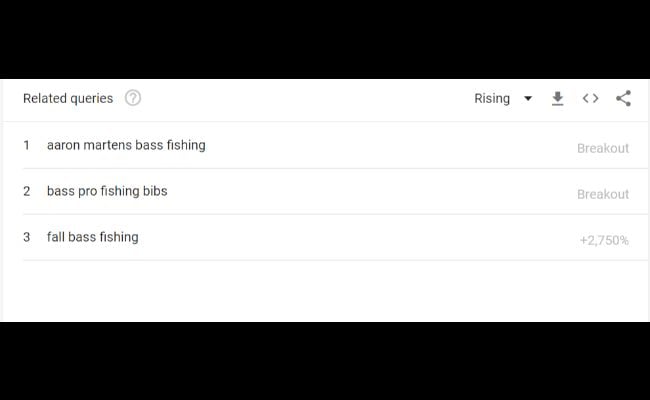
If we narrow our bass fishing search down to 90 days, it tells us more about what is trending right now.
There are three long-tail keywords, with one of them being “bass pro fishing bibs”. A bib is what fishers wear to cover their clothes when they get into the water. They also wear them when it’s getting cold as opposed to waders. This tells us fishers are looking for gear to help them keep warm as the temperatures start to drop.
If we’re not currently selling fishing bibs on our e-commerce store, this would also tell us that now is the time to do so. We may create a paid campaign around that type of product with an image of someone using a bib in a fall-like setting.
This would appeal to our target audience, and we know the term is trending, so there should be plenty of paid search volume.
5. Find Trending Topic Ideas for Webinars
When you’re creating a webinar, you want to reach the right people (those interested in what you have to offer) at the right time. Google Trends can help you do just that.
Sticking with the fishing theme, perhaps you’re selling a course on bass fishing and you’re using a free webinar to draw people in and get them to buy the course. You’ll want to use currently trending topics in social media and PPC advertising to get these people’s attention. You also need to know what anglers are actively searching for on the internet.
In comes Google Trends. The tool lays it all on the line for you to start speaking their language. There should be no need to guess or take chances between proper keyword research and Google Trends.
FAQs
Is Google Trends free to use?
Yes, it is a free tool from Google. Google Trends takes a quick look at what’s trending in the news, what people are currently searching for, and how things change over time. These searches can be based on season or geographic location.
Can Google Trends be used for SEO?
Google Trends is an excellent tool that can support SEO through niche content planning. Put in the keyword you’re curious about following and gain valuable insights into how many people are talking about that topic and other closely related topics. This allows you to curate a highly personalized SEO strategy.
Conclusion
Being able to identify trends is important for all marketers. No matter what industry you’re in, your target audience is actively searching for things on Google, and you need to figure out what those things are.
As marketers, our job is to capitalize on what’s popular in the “here and now.”
When big news hits, how does the data get interpreted? One great way to figure out what is popular is with Google Trends.
This tool identifies current and existing trends in search marketing. You can then take what you’ve learned and apply it to any (and all) of your marketing strategies.
This article will help you understand how to use Google Trends and the specific steps you can take to maximize your efforts.
What is Google Trends?
Google Trends is an incredible tool that helps marketers identify trending topics across varying industries. While initially created for journalists, the world of journalism and marketing have a lot in common.
Both the journalist and the marketer are vying for attention. Whatever it is they’re trying to do, they want to get the attention of as many people as possible using information that is relevant and interesting to the audience.
For example, in October 2021, the Pittsburgh Steelers are the number one trending search on Google. This could be due to a recent football game during the busy football season.
Google tells us this is a popular topic, so it might be a good idea to create some content around that topic. Of course, there are a million other factors that go into deciding what content to create, but Google Trends at least tells us what is popular.
If you have a specific topic that you want to cover but aren’t sure if it’s trending, you can search for it in the search bar at the top.
For example, I decided to search “cryptocurrency” to see what Google had to say.
As you can see, you get a chart ranging from 0 to 100, with 100 being incredibly high interest and 0 being nearly no interest.
A few times across the last two years, cryptocurrency has spiked as a highly searched keyword on Google. This could be due to the release of new and popular coins or a lot more people getting established in crypto and keeping track of trends.
Why Should You Use Google Trends for Marketing?
Even if you aren’t involved in content creation, you should know how to use Google Trends. Marketers who use this tool do so because they understand the importance of capitalizing on trends.
We’re often very focused on producing the most evergreen content possible, but we should also work to maximize our efforts by finding the right time and place to put out a certain piece of content. Here’s how to use Google Trends:
Find Interesting Topics
Whether you’re a blogger, content marketer, or SEO professional, you need to find interesting topics people want to read about. In the SEO world, we’re so focused on our keywords and technical SEO that we sometimes forget that people actually want to read about topics that interest them.
A great way to find what interests people the most is Google Trends. The tool will tell you how much interest surrounds a specific search phrase so you can determine whether or not it’s worth creating content about it.
Keep in mind that not all popular trends are a good choice. To work, look for popular trends that are also related to your industry.
Inspire Creativity
Google Trends is not only useful for written content, but visual content as well. If you’re trying to figure out what to do with your social media or how to improve a featured image on your blog post, Google Trends can help you figure out what your audience wants to see.
By creating a relevant and interesting image, you’re not only generating attention for your content, but showing your target audience you understand them and know exactly what they want. This has many SEO-related benefits, too.
Identify (and Leverage) Seasonal Trends
If you’re in the travel, e-commerce, or tourism industries, your business might be seasonal. Identifying when to stock up on certain items can be difficult.
For example, let’s say you sell a piece of bass fishing equipment in your e-commerce store. You could use Google Trends to see when in the year bass fishing trends the most. Let’s take a look for ourselves.
As you can see from the image, the interest in bass fishing gradually increases through the late winter and into spring. It peaks in early summer and then drops back down as you move into fall and winter again—at least in the Northern hemisphere.
This would tell an e-commerce store owner that it’s time to really start pushing your marketing campaigns in the late winter, because this is when interest is trending. You may also want to increase your inventory to prevent backorders.
5 Ways to Use Google Trends for Marketing
Now that you understand some of the motivation behind how to use Google Trends for SEO, let’s look at the actionable steps you can take to make a difference in your various marketing campaigns.
1. Get Ideas for Blog Posts
Google Trends is a great way to find new and exciting topics to write about. If you’re a writer, you know how challenging it can be to produce content your readers will love and will rank well on Google. Google Trends is a sure-fire method to find good topics because they tell you exactly what is trending.
Best of all, they provide you with specific topics and queries around trending search phrases. Let’s stick with the bass fishing example and scroll down a little bit. One is related topics, and the other is related queries. Here’s what it looks like:
Now you can expand on the theme and write about related topics. Major League Fishing and Bass Anglers Sportsman Society were some top related topics. Based on that, perhaps they were trending since Major League Fishing launched in 2022. On top of that, it was Bass Pro’s 50th anniversary, making a big year in fishing overall.
It’s important to choose blog post topics based on trends if you’re writing something that is time-sensitive. If it’s not evergreen content, it needs to be completely relevant to your audience at the time you publish it.
2. Get Ideas for Social Media Campaigns
Google Trends searches aren’t only for organic search marketing; you can use them for social media as well. Building a large social following and constantly coming up with interesting content to promote is a tall task. Google Trends can help.
We can use the related queries section to identify trending topics and build creatives and copy around that. For example, we see a few searches relating to a bass pro fishing tournament. If we run a fishing e-commerce store, perhaps we want to create a social media campaign on that topic. We could use the tournament to draw attention to our brand and maybe mention professional fishers using gear or lures we offer.
Another interesting query is “winter bass fishing lures.” That is one of those seasonal examples I was talking about. Now might be a good time to create a social media campaign around our best fishing lures for the winter season. People are preparing to fish when it’s cold and we can use that to our advantage.
3. Use It to Improve SEO
One obvious area to use Google Trends for SEO is in organic search. It can also help with keyword research. Not everyone is using Google Trends, so you can use it to identify relevant keywords and then use free SEO tools like Ubersuggest to decide if it’s a valuable keyword or not.
Best of all, you can look at years’ worth of data so you can plan for the future by knowing whether or not a topic is evergreen enough to put in the time and effort.
If we take the same bass fishing keyword and spread it out across five years, it becomes more apparent that the trend will continue for years.
Each year the volume rises and falls during the same months. This can fuel your marketing strategy and help you prepare for the months ahead.
4. Find Long-tail Keywords for Paid Campaigns
Finding the right keywords for your paid campaigns is crucial to your success. It’s also important from a financial standpoint, because the sooner you find the right keywords, the sooner you can start capitalizing on paid ads.
If we narrow our bass fishing search down to 90 days, it tells us more about what is trending right now.
There are three long-tail keywords, with one of them being “bass pro fishing bibs”. A bib is what fishers wear to cover their clothes when they get into the water. They also wear them when it’s getting cold as opposed to waders. This tells us fishers are looking for gear to help them keep warm as the temperatures start to drop.
If we’re not currently selling fishing bibs on our e-commerce store, this would also tell us that now is the time to do so. We may create a paid campaign around that type of product with an image of someone using a bib in a fall-like setting.
This would appeal to our target audience, and we know the term is trending, so there should be plenty of paid search volume.
5. Find Trending Topic Ideas for Webinars
When you’re creating a webinar, you want to reach the right people (those interested in what you have to offer) at the right time. Google Trends can help you do just that.
Sticking with the fishing theme, perhaps you’re selling a course on bass fishing and you’re using a free webinar to draw people in and get them to buy the course. You’ll want to use currently trending topics in social media and PPC advertising to get these people’s attention. You also need to know what anglers are actively searching for on the internet.
In comes Google Trends. The tool lays it all on the line for you to start speaking their language. There should be no need to guess or take chances between proper keyword research and Google Trends.
FAQs
Is Google Trends free to use?
Yes, it is a free tool from Google. Google Trends takes a quick look at what’s trending in the news, what people are currently searching for, and how things change over time. These searches can be based on season or geographic location.
Can Google Trends be used for SEO?
Google Trends is an excellent tool that can support SEO through niche content planning. Put in the keyword you’re curious about following and gain valuable insights into how many people are talking about that topic and other closely related topics. This allows you to curate a highly personalized SEO strategy.
Conclusion
Being able to identify trends is important for all marketers. No matter what industry you’re in, your target audience is actively searching for things on Google, and you need to figure out what those things are.
This website uses cookies to improve your experience. We'll assume you're ok with this, but you can opt-out if you wish.AcceptRejectRead More
Privacy & Cookies Policy
Privacy Overview
This website uses cookies to improve your experience while you navigate through the website. Out of these, the cookies that are categorized as necessary are stored on your browser as they are essential for the working of basic functionalities of the website. We also use third-party cookies that help us analyze and understand how you use this website. These cookies will be stored in your browser only with your consent. You also have the option to opt-out of these cookies. But opting out of some of these cookies may affect your browsing experience.
Necessary cookies are absolutely essential for the website to function properly. This category only includes cookies that ensures basic functionalities and security features of the website. These cookies do not store any personal information.
Any cookies that may not be particularly necessary for the website to function and is used specifically to collect user personal data via analytics, ads, other embedded contents are termed as non-necessary cookies. It is mandatory to procure user consent prior to running these cookies on your website.