
By now you have heard about the Coronavirus. The sad reality is that it is spreading quickly and will continue to spread for a while. Did you know that we are getting roughly 15,000 new cases a day and it’s growing fast? No one really knows how many people will be infected (or will pass …
Day: March 17, 2020
What The Coronavirus (COVID-19) Means For Marketers
By now you have heard about the Coronavirus.
The sad reality is that it is spreading quickly and will continue to spread for a while.
Did you know that we are getting roughly 13,000 new cases a day and it’s growing fast?
No one really knows how many people will be infected (or will pass away sadly), but it has caused the global stock markets to crash, which means as a business (or even a marketer), you will be affected.
And because my ad agency works with hundreds of companies in all the major sectors and we have 7 offices around the world, we are already starting to see how it is impacting marketing (I’ll share the data below).
So what does this mean for you?
Well, before I go into that, let me be clear on what marketers should NOT do.
Don’t exploit the situation
The first thing we are seeing is people trying to exploit fear.
What I mean by this is supplies are running low around the world. From masks and toilet paper to hand sanitizer and other basic necessities… I am seeing marketers buying them and then reselling them on eBay or running ads and selling them for 10-50x the price.
This isn’t entrepreneurship and this isn’t marketing. I highly recommend that you avoid exploiting the Coronavirus situation to make a quick buck.
Not only is it wrong but it is also very short-sighted. Sure you may be able to make a quick buck, but it won’t last… you are better off spending your time on anything that is long term.
So now that we got that out of the way, what does the Coronavirus mean for marketers?
Businesses are going to struggle for a while
Even if the virus slows down fast as the numbers have dropped in China, businesses are going to struggle for well over a year because they will have to make up for their losses.
For example, in China the virus caused retail sales to drop by 20.5% and the unemployment rate jumped to 6.2 in February.
When companies like Apple shut down their stores to help reduce the spread, it means less income and less profit. Sure they are able to pay their employees during their temporary shutdown, but not all companies have their bank balance and most won’t be able to do the same.
Just look at the travel industry. The virus is expected to lose them 820 billion dollars. Virgin Atlantic just asked their staff to take an 8-week unpaid leave.
The ports are also empty and the first rounds of layoffs have already started.
It’s estimated that in total COVID-19 will cost the global economy $2.7 trillion.
And not only are people losing money but they are losing traffic and conversions.
Organic traffic is down in most industries
As I mentioned above, we work with hundreds of clients in different industries through my agency. On top of that, we also have tons of data because of Ubersuggest.
Before I dive into the data, note that we didn’t focus on any one single country, we decide to look at the traffic stats from a global perspective. We also didn’t include data from sites with less than 5000 visitors a month as they tend to have drastic swings from a percentage perspective even when there are no global issues or algorithm updates.
We also don’t have data on every single industry, for example, we don’t really work with many restaurants nor do we purchase data for that category as local restaurants usually don’t have the biggest marketing budgets. We have data on most of the major ones, but again not all.
Now, from an SEO standpoint, last week we saw huge drops in organic traffic for most industries we are tracking. Just look at the chart below (compares last week to the previous week).
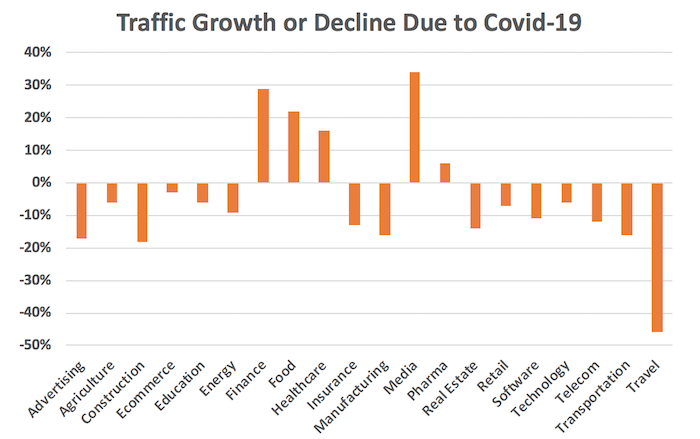
If you are in the news industry or financial space, your traffic skyrocketed.
And if you are in the travel industry, you saw massive drops in traffic.
You can’t tell by the chart, but e-commerce was a mixed bag, depending on what sites sold, traffic was either up or down. For example, if you were selling baby products like diapers or wipes then you saw a nice bump in traffic.
But if you were selling luxury goods like big-screen televisions you saw a drop in traffic.
Conversions were also down for most industries
From a conversion rate standpoint, we saw drops in most industries as well. Even the financial sector, which had big traffic booms in traffic, dropped in conversions.
Just look at the chart below (comparing last week to the previous week):
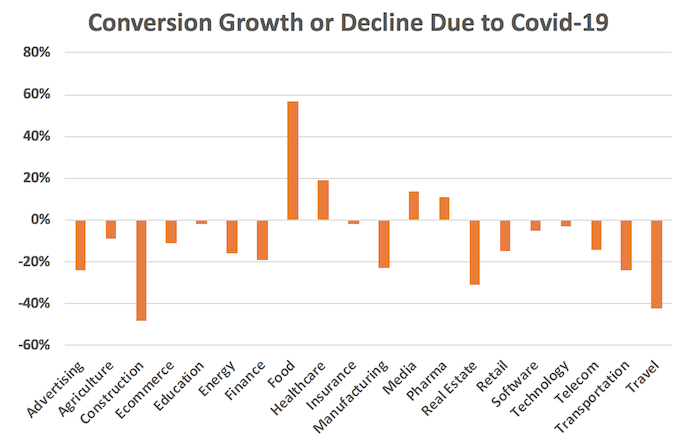
As for news (media) sites, they had a big conversion lift as many of them charge for people to read their updated information.
For example, you can only read a certain amount of content from the Washington Post for free until you see a message that looks like this:
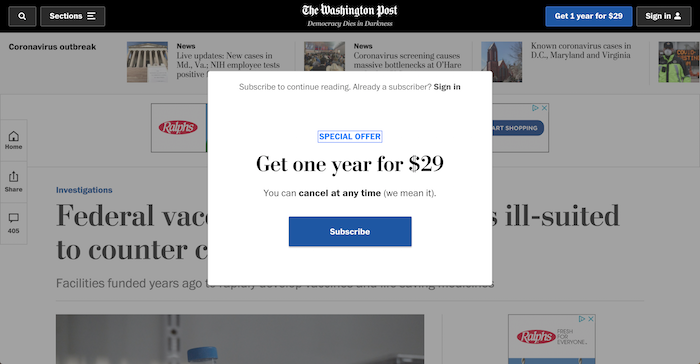
People didn’t want to miss out on Coronavirus, political and financial information with the turmoil, hence news sites saw a nice lift.
And with some sectors like travel, they are currently offering massive discounts, which is helping counteract some of their traffic declines. Overall, they are still seeing a massive revenue hit.
Pay-per-click data
We don’t have as much pay-per-click data as we do for SEO as Ubersuggest is mainly used for SEO purposes, but we haven’t seen big shifts in cost per click… even for things like the travel industry.
We don’t have a big enough sample size, but as I mentioned, costs haven’t come down much.
For example, even though we saw big dips in the number of people searching for things like flights or hotels, we didn’t see a drastic drop in CPC but we did see a big increase in cost per acquisition.
In other words, you can still roughly pay the same amount per click, but the cost per conversion has been going up for most industries… unless you are selling necessities like toilet paper.
So what does this mean for marketers?
Be fearful when others are greedy, and greedy when others are fearful
I didn’t come up with that saying, it’s actually a line from Warren Buffett.
You will see people cutting back because the economy is predicted to get hit by 2.7 trillion dollars and experts are saying that we are going to go into a recession.
You even have billionaire investors like Carl Ichan saying that the market has more room to go down and we should expect the sell-off has longer to go.
But what I’ve learned from going through two crashes (the dotcom crash in 2000 and the real estate crash in 2008) is that the best time to double down is when others are not.
During an economic downturn, you’ll find that you will have less competition, which means it is easier and faster to get results, and in some cases, you’ll be able to get deals, such as a potential reduction in pay-per-click advertising.
Just think of it this way: out of all the publicly traded companies in the United States, if the market keeps going down, many of them will struggle to pay off their debt, which has exploded to $75 trillion.
This means some companies will either go bankrupt, get bought out, or get bailed out by the government. Some may be able to cut costs enough to pay their bills, but for most, it will be too late.
Again, this just means less competition for you.
If you are lucky enough to be sitting on some cash during the recession this is the best time to buy out other companies. The ideal ones to buy are media companies.
The more eyeballs you control, the more power you will hold in the future. Plus, by controlling eyeballs, it gives you the ability to sell anything you want in the future.
It’s the reason I bought the KISSmetrics website for $500,000 a couple years ago. During their peak, they had 1,260,681 million unique visitors a month.
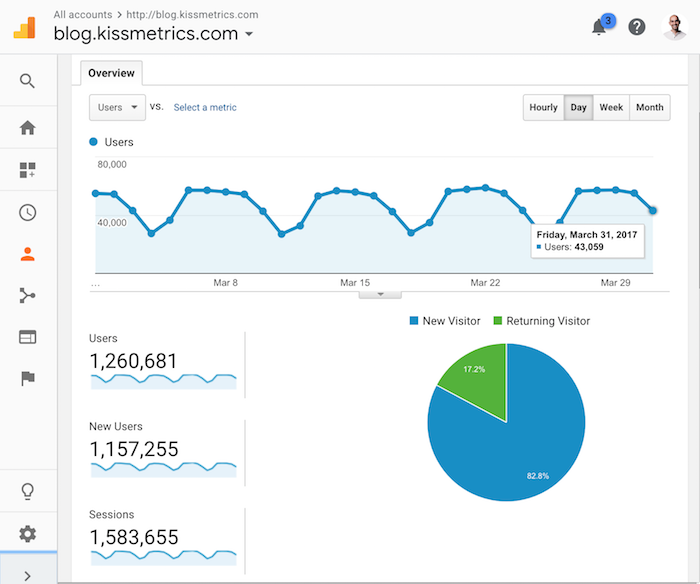
That’s a lot of traffic.
When I bought the site out, I was out a good amount of money for me, but the moment I merged it into the NeilPatel.com site, I increased my lead count by 19% and recuperated my investment in less than a year.
In other words, this is your opportunity to strike and gain market share.
So when you see your competitors closing down or slowing down on their marketing, the goal is to double down. You may not see the biggest return right away, but in the long term, you will.
Every time the market goes down by 20% or more it roughly takes 536 days to recover.
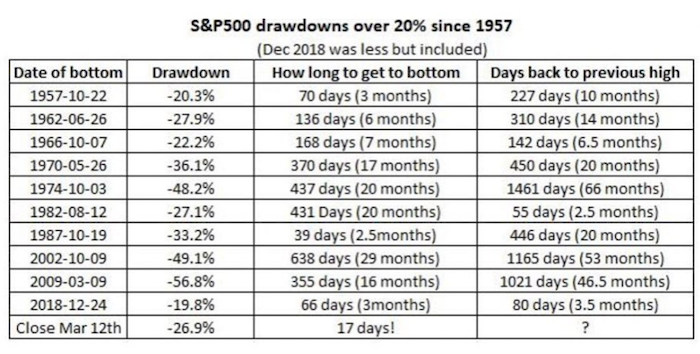
As we recover, you’ll see your revenue climb and the ROI from your marketing spend go through the roof.
Conclusion
Hopefully, the Coronavirus passes soon and it has minimal impact on lives. For the time being, try not to socialize with others too much or go into crowded places.
You should read this article by the Washington Post as it breaks down great simulations of how the Coronavirus will spread and what we can do to reduce the impact on the world.
And as for your marketing, this is the time for you to double down. Don’t be fearful when others are also afraid. Do what Warren Buffett does… be greedy when other people are fearful.
In other words, double down.
How have you seen the Coronavirus affect your traffic?
PS: Please be safe and, if possible, stay indoors.
PPS: To help out a bit, I’ve opened up the keyword ideas report on Ubersuggest as well as historical keyword data. I know many of you may be facing financial difficulty, so hopefully having the data helps you save a bit of money on marketing.
The post What The Coronavirus (COVID-19) Means For Marketers appeared first on Neil Patel.

Trump and the Stock Market
The post Trump and the Stock Market appeared first on WE TEACH MONEY LIFE SELF DEFENSE WITH FINANCIAL GOALS IN MIND.
The post Trump and the Stock Market appeared first on Buy It At A Bargain – Deals And Reviews.

Cent Stock Strategies
Cent Stock Strategies Why should the abundant men have all the enjoyable? If they recognize exactly how, the little financier can look for out big returns also …. Technical evaluation that utilizes data for projecting rate changes is one technique. Since it is challenging to track adjustments in portions of a cent, there just isn’t …
The post Cent Stock Strategies appeared first on Buy It At A Bargain – Deals And Reviews.
The post Cent Stock Strategies appeared first on WE TEACH MONEY LIFE SELF DEFENSE WITH FINANCIAL GOALS IN MIND.
The post Cent Stock Strategies appeared first on Buy It At A Bargain – Deals And Reviews.
New comment by snilsmitchell in "Ask HN: Freelancer? Seeking freelancer? (March 2020)"
SEEKING WORK – Remote (based in Barcelona)
UI/UX Designer, 7 years’ experience, 45+ successful projects completed, clients in 15 countries
Portfolio: sebas.design
I design digital products for web, mobile, and tablet. Worked on projects for Nokia, the United Nations, Conservation International, and Silicon Valley startups. 1 work product acquired by National Geographic.
— Services —
* UI Design: I create quality, minimal designs in the latest styles.
* UX Design: Expert in usability best practices, designing, conducting, and analysing UX research.
* Design process management
* Tools: Sketch, Figma, Illustrator, InVision, Zeplin, Framer
* Excellent communicator, written and verbally. I listen well and try to accomplish exactly what you need.
— Availability —
Freelance and contract, up to 40 hours/week.
Service Credit Report Cards – Little and also business Service Credit report Cards Contrasted
Service Credit Cards – Small and also company Business Credit Cards Compared When it comes to company credit report cards, the biggest percent of the market is little service proprietors. Credit scores card business have actually established company credit report cards with the little company in mind, however there are some distinctions in between service … Continue reading Service Credit Report Cards – Little and also business Service Credit report Cards Contrasted
Prevent The Problem Of Student Loan Bankruptcy
Prevent The Problem Of Student Loan Bankruptcy
University is intended to be an amazing time for young people, however is can likewise be an extremely difficult time as well for lots of factors. Obviously there are social and also scholastic stress, yet a vital part of going to university is having the ability to spend for it, therefore university student typically deal with the trouble of pupil finance insolvency.
Regarding Student Loan Bankruptcy
While lots of young people attempt to obtain university scholarships to decrease the possibilities of pupil financing personal bankruptcy, the fact is that scholarships frequently just cover a tiny portion of the expenses. The prices not just consist of the programs, however likewise living expenditures, whether they survive or off university. This is, certainly, unless it is a full-tuition scholarship.
Trainee finance insolvency is coming to be a lot more usual, since even more and also even more individuals are attempting to obtain right into discerning, pricey colleges. Their thinking is that if they get involved in these pricey universities, they will certainly have the ability to obtain even more respected tasks, and also therefore have the ability to repay their fundings.
This may function well for those that are entering into prominent occupation areas, however the fact is that can never ever be also particular, and also because of this trainee funding insolvency takes place. Young grownups can prevent pupil finance personal bankruptcy in a selection of means.
Of all, moms and dads ought to begin an university fund for their kids from an extremely young age. Including simply a bit of cash weekly or month can truly accumulate as well as reduced prices. When the kid comes of age to start functioning, while cash can go in the direction of getting points it can additionally be conserved in the direction of university.
If the individual that took the funding out in the initial location did not extensively review all of the terms behind that lending, trainee car loan insolvency can additionally take place. If they were incapable to pay the finance repayments on the needed basis, it can additionally happen.
Hence, the ideal method to prevent trainee funding personal bankruptcy is to pick an university that is a lot more within reach budget-wise. If an individual actually desires to go to an university, an additional alternative is to participate in just as a part-time trainee, as that will certainly reduce prices substantially.
While several young grownups attempt to obtain university scholarships to reduce the opportunities of pupil funding personal bankruptcy, the truth is that scholarships commonly just cover a tiny portion of the prices. When the kid comes of age to start functioning, while cash can go in the direction of getting points it can likewise be conserved in the direction of university.
Therefore, the ideal means to prevent pupil finance personal bankruptcy is to pick an university that is extra within reach budget-wise. If an individual truly desires to participate in an university, an additional alternative is to participate in just as a part-time trainee, as that will certainly reduce expenses substantially.
The post Prevent The Problem Of Student Loan Bankruptcy appeared first on ROI Credit Builders.
Prevent The Problem Of Student Loan Bankruptcy
Prevent The Problem Of Student Loan Bankruptcy
University is intended to be an amazing time for young people, however is can likewise be an extremely difficult time as well for lots of factors. Obviously there are social and also scholastic stress, yet a vital part of going to university is having the ability to spend for it, therefore university student typically deal with the trouble of pupil finance insolvency.
Regarding Student Loan Bankruptcy
While lots of young people attempt to obtain university scholarships to decrease the possibilities of pupil financing personal bankruptcy, the fact is that scholarships frequently just cover a tiny portion of the expenses. The prices not just consist of the programs, however likewise living expenditures, whether they survive or off university. This is, certainly, unless it is a full-tuition scholarship.
Trainee finance insolvency is coming to be a lot more usual, since even more and also even more individuals are attempting to obtain right into discerning, pricey colleges. Their thinking is that if they get involved in these pricey universities, they will certainly have the ability to obtain even more respected tasks, and also therefore have the ability to repay their fundings.
This may function well for those that are entering into prominent occupation areas, however the fact is that can never ever be also particular, and also because of this trainee funding insolvency takes place. Young grownups can prevent pupil finance personal bankruptcy in a selection of means.
Of all, moms and dads ought to begin an university fund for their kids from an extremely young age. Including simply a bit of cash weekly or month can truly accumulate as well as reduced prices. When the kid comes of age to start functioning, while cash can go in the direction of getting points it can additionally be conserved in the direction of university.
If the individual that took the funding out in the initial location did not extensively review all of the terms behind that lending, trainee car loan insolvency can additionally take place. If they were incapable to pay the finance repayments on the needed basis, it can additionally happen.
Hence, the ideal method to prevent trainee funding personal bankruptcy is to pick an university that is a lot more within reach budget-wise. If an individual actually desires to go to an university, an additional alternative is to participate in just as a part-time trainee, as that will certainly reduce prices substantially.
While several young grownups attempt to obtain university scholarships to reduce the opportunities of pupil funding personal bankruptcy, the truth is that scholarships commonly just cover a tiny portion of the prices. When the kid comes of age to start functioning, while cash can go in the direction of getting points it can likewise be conserved in the direction of university.
Therefore, the ideal means to prevent pupil finance personal bankruptcy is to pick an university that is extra within reach budget-wise. If an individual truly desires to participate in an university, an additional alternative is to participate in just as a part-time trainee, as that will certainly reduce expenses substantially.
The post Prevent The Problem Of Student Loan Bankruptcy appeared first on ROI Credit Builders.

Business Funding and the Next Recession
The Next Recession and Business Funding
The United States economy has been through any number of changes over the years. Our economic fortunes can depend on advances in technology, diplomatic ties (or cutting those ties), the weather, and more. Business credit, fortunately, is an asset which you can build even during economic downturns. However, you may need to get a little creative with it, and with other forms of business funding. These can even work for the next recession.
There have been five major economic downturns since the start of the twentieth century, plus a number of smaller ones. Some of those smaller downturns, in hindsight, were harbingers of the bigger ones to come.
The Great Depression vs. The Next Recession
Historically, the worst economic downturn – by far – was the Great Depression of 1929. Not only was it ugly in its own right, it was also an issue due to how starkly it contrasted to the 1920s. During the 1920s, until the Great Depression, the economy grew a staggering 42%! https://www.thebalance.com/the-great-depression-of-1929-3306033
The main issues causing the Great Depression were speculation in the stock market and fictitious reserves at banks.
The stock market had begun rising in 1924, and grew at a clip of 20% per year. The number of shares traded doubled to 5 million per day. Brokers would lend 80 – 90% of the price of the stock. Because of this, investors only had to put down 10 – 20%.
Furthermore, only one-third of the nation’s 24,000 banks belonged to the Federal Reserve System. By 1929, there were banks holding fictitious reserves. This happened because checks were counted as reserves before they cleared. As a result, these checks were double-counted by the sending bank and the receiving bank.
This economy, running like a house on fire, burned itself out. Between fictitious reserves and stock speculation, the 1929 economy was the equivalent of vaporware.
Black Thursday
The Great Depression kicked off with “Black Thursday,” October 24, 1929. Traders sold 12.9 million shares of stock in one day. This was triple the usual amount. Stock prices fell 23% in the first four days of the stock market crash of 1929. This started an economic depression that lasted 10 years.
Learn more here and get started toward growing small business credit, even in the next recession.
How It Relates to Today’s Business Funding
Fortunately, there are a number of safeguards in place to try to prevent much of what caused the big one. Bank reserves are handled more responsibly, and computers cut the chances of accidental double-counting. For business funding, this means banks and other lenders are more likely to be solvent in the future.
As for the stock market, such unbridled selling wouldn’t happen today, as controls are built in to stop runaway selloffs.
1970s Stagflation vs. The Next Recession
During the 1970s, the annual U.S. inflation rate rose in the 5 – 10% range. Contrast this to a 0 – 3% range typical of American peacetime. The Fed didn’t put a high priority on stopping inflation until Paul Volcker became chairman. And 1960s policymakers pushed to lower employment and keep it low, until at a certain point (about 4%), inflation started to take over. Nixonian wage and price freezes, and eliminating the good standard didn’t help, either.
But there were also supply issues, particularly with oil. In 1979, the price per barrel of West Texas Intermediate crude oil topped $100 (in 2016 dollars). It peaked at $117.71 the next April.
How It Relates to Today’s Business Funding
Stagflation is unlikely to recur, as there isn’t a second gold standard to untie the dollar from. And wage and price controls, proven to not work, likely won’t be tried again. Furthermore, the Fed works with a consistent plan these days. https://www.thebalance.com/what-is-stagflation-3305964
For business funding, this means lower interest percentage rates for when you need to pay back.
Learn more here and get started toward growing small business credit, even in the next recession.
1981 Recession to the Next Recession
From 1981 to 1982, net S&L income, which totaled $781 million in 1980, fell to negative $4.6 billion and $4.1 billion https://www.thebalance.com/fed-funds-rate-history-highs-lows-3306135
And from 1980 – 1983, 118 S&Ls with $43 billion in assets failed, costing the FSLIC an estimated $3.5 billion to resolve. https://www.fdic.gov/bank/historical/history/167_188.pdf
Also, there were also 493 voluntary mergers and 259 supervisory mergers of savings and loan institutions. By the end of 1982, there were 415 S&Ls with total assets of $220 billion. And these were insolvent based on the book value of their tangible net worth.
Unemployment was above 10% for 10 months. And it rose to 10.8% in November and December 1982, the highest level in any modern recession. Manufacturing, construction, and the auto industries were particularly affected.
Goods producers accounted for only 30% of total employment, but they suffered 90% of job losses in 1982. 75% of all job losses in the goods-producing sector were in manufacturing. And the residential construction industry and auto manufacturers both ended the year with over 20% unemployment.
The economy shrank for six of this crisis’ 12 quarters. The worst was Q2 1980 at 8%. https://www.federalreservehistory.org/essays/recession_of_1981_82
How It Relates to Today’s Business Funding
The ultimate cost of the savings and loan crisis is currently estimated at approximately $160 billion.
More extensive banking regulations are designed to prevent a second S&L crisis. Furthermore, with the rise of the service economy, there simply are fewer manufacturing jobs to lose. Is that better? In a gig economy, where people make their own work, the idea of depending on just one job in a large company may strike some as quaint.
When it comes to business funding, fewer lenders means financing creativity is a must.
The 9/11 Attacks and the 2001 Recession
Due to the four attacks, the Dow promptly fell 7.13%, closing at 8,920.70. This 617.78 point loss was the Dow’s worst single day drop at that time. Oil prices fell from $23.77 a barrel in August 2001 to $15.95 in December.
Because air traffic was stopped for a time, the airline industry lost $5 billion from the attacks. The four-day shutdown cost $1.4 billion alone.
On September 22, President George W. Bush signed into law $15 billion in federal loans.
But 9/11 wasn’t the only economic issue for the year. The economy had already contracted 1.1% in the first quarter of 2001, but it bounced up 2.1% in Q2. But the attacks made the economy contract 1.7% in the third quarter, extending the recession. Growth returned to 1.1% in Q4. https://www.thebalance.com/2001-recession-causes-lengths-stats-4147962
The 2001 recession began in March 2001 and lasted through November 2001. Unemployment hit 5.7% in December 2001. https://files.stlouisfed.org/files/htdocs/publications/review/03/09/Kliesen.pdf
How It Relates to Today’s Business Funding and the Next Recession
Another terrorist attack (or series of attacks) is certainly possible. Plus the airline industry is still feeling the effects of 9/11, as there are people afraid to fly. And there are people who see it as inconvenient, given long check-in and security lines.
The four terrorist attacks on September 11, 2001 still affect the American economy. https://www.thebalance.com/how-the-9-11-attacks-still-affect-the-economy-today-3305536
When it comes to business funding, if a similar crisis were to occur, there could be another release of federal loan money. The 2001 recession was the mildest of the five, so it would appear such a strategy can work.
Learn more here and get started toward growing small business credit, even in the next recession.
2008 Financial Crisis
This one is considered by many economists to have been the worst financial crisis since the Great Depression of the 1930s. https://www.thebalance.com/2008-financial-crisis-3305679
Bank lending to small firms rose from $308 billion in June 1994 to a peak of $659 billion in June 2008. But it then declined by almost 18% to only $543 billion in June 2011. https://www.sba.gov/advocacy/how-did-financial-crisis-affect-small-business-lending-united-states
And bank lending to all firms rose from $758 billion in 1994 to a peak of $2.14 trillion in June 2008 and then declined by about 9% to $1.96 trillion as of June 2011.
Another issue was the bankruptcy of investment bank Lehman Brothers on September 15, 2008.
Banks had already stopped lending to each other due to fears of potential losses on high-risk US mortgages. The crisis overhauled investment banks, and some closed down. Penalties paid by banks between 2009 and 2016 were about $321 billion (63% North American banks and 37% European banks).
Job Losses
Between November 2008 and April 2009, job losses averaged nearly 800,000 per month. And during those years, the economy contracted at a staggering rate of 8.3%.
The Dow Jones Industrial average fell to as low as 6,400.
In 2007, small businesses lost more jobs and took longer to recover during the financial crisis. From 2007 to 2009, non-farm payroll employment declined by about 8.7 million, a drop in levels not matched in the entire postwar period. And in December 2007, jobs at small businesses fell 60% from the pre-crisis peak.
In February 2010, the private sector started adding jobs again. Businesses less than two years old accounted for one-quarter of gross job creation even though they employed less than 10% of workers.
How It Relates to Today’s Business Funding
The biggest issue for business funding is that banks have become more risk averse in the recovery.
Small businesses continue to report difficulty finding credit. About 45% did not apply, presumably because they did not need credit. Another 20% did not apply because they were discouraged from doing so. They either felt they would not qualify or they thought the process would be too hard to justify the time commitment.
And based on a regional survey data from the Federal Reserve Bank of New York, about 37% of all small businesses applied for credit in the fall of 2013. https://www.fundera.com/blog/happened-americas-small-businesses-financial-crisis-six-years-start-crisis-look-back-10-charts
Small business owners report that competition among banks for their business peaked in the 2001 to 2006 period and has declined from 2006 to the present.
Business Funding: What Today Looks Like
The Number of Banks is Falling
The number of banks and thrifts in the U.S. has been declining steadily for 25 years because of consolidation in the industry and deregulation in the 1990s that reduced barriers to interstate banking. https://www.fundera.com/blog/happened-americas-small-businesses-financial-crisis-six-years-start-crisis-look-back-10-charts
The concentration of assets in ever‐larger financial institutions is problematic for small business owners. This is because large banks are less likely to make small loans.
The Federal Reserve Bank of Atlanta recently noted that on a scale of 1 (offering no loan or line of credit to small businesses) to 4 (offering the full amount requested), community banks ranked 2.4 versus 2.3 at regional banks and 1.85 at large national banks.
How Small Businesses are Faring
87 % of small business owners who got a loan obtained theirs from a regional or local financial institution. But this was when it was their primary institution. Small businesses consistently appear more willing to ask for credit when their bank is a regional or community bank. And they appear to be more successful in their requests.
From August 2008 until early 2012, small businesses reported sales as their biggest problem. And from 2007 to 2010, income of a typical household headed by a self-employed person declined 19% in real terms.
From 2004 to 2007, about half of all small business owners surveyed reported revenue for the last 12 months as either “very good” or “good”. That number fell to as low as 21% in 2009 and 2010. And it has has only modestly recovered over the past few years. It’s stayed at about 35% for most of the past few quarters.
65% of small business owners said their cash flow was “very good” or “good” in the first quarter of 2006. Contrast with a range of just 30 to 40% reporting good cash flow for most of the recovery, although the number rose slightly to about half as of the second quarter of 2014.
What Will the Next Recession Look Like? Where Will it Come From?
While no one has a crystal ball, one thing is for certain. Whenever you start to see a bubble, it will eventually burst. And that is true whether the bubble is in the stock market, or S&L loans, or housing.
Economic downturns also, inevitably, mean banks get more cautious. And since people may have less discretionary cash to spend, crowdfunding may become a less viable funding option. The same may turn out to be true for angel investing and venture capital.
What Does this Mean to You?
The next recession doesn’t have to end your business dreams. Bank loans may be tightening, but business credit is still a fantastic way to get business funding. By bypassing lending institutions, you increase your chances for business funding. This is particularly true if your business is new.
Other options include online lenders, microloans, and grants. We also like unsecured business financing, and AI credit lines through Fundbox. Revenue lending and financing (from places like PayPal and Square) is another option. Accounts receivable financing can also fund your business when banks say no.
You may find these alternate business funding sources so receptive that you tap them even when the economy is good. So be prepared for the next downturn, and build business credit. You never know when you’re going to need it.
The post Business Funding and the Next Recession appeared first on Credit Suite.