The SERPs (search engine results pages) are the listings you see whenever you type a query into a search engine. For most of us (63%, plus 90% of mobile searches), that search engine will be Google, so if your website does well in Google’s SERPs, you’re going to see a lot of organic traffic. When …
Pierre Gasly’s stunning Italian Grand Prix win proved he deserves a second chance with Red Bull — it also means the senior team cannot avoid the subject of his future any longer.
The SERPs (search engine results pages) are the listings you see whenever you type a query into a search engine.
For most of us (63%, plus 90% of mobile searches), that search engine will be Google, so if your website does well in Google’s SERPs, you’re going to see a lot of organic traffic.
When it comes to digital marketing, organic traffic is something of a Holy Grail. Why? Because as opposed to paid advertising, where you pay to get eyes on your content, organic clicks = free clicks.
However, the SERPs aren’t as straightforward as they once were, and there are several ways they can influence the amount of organic traffic you get.
So, let’s take a look at some of the different forms of traffic, how the SERPs affect them, and how you can get your website noticed in SERPs.
What Types of SERP Results Are There?
When you look at a Google SERP or any other search engine results page, you will see two types of results: organic and paid.
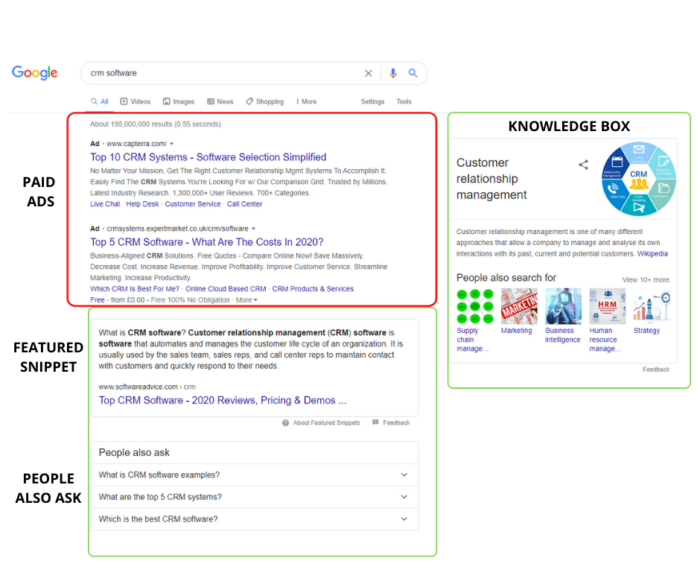
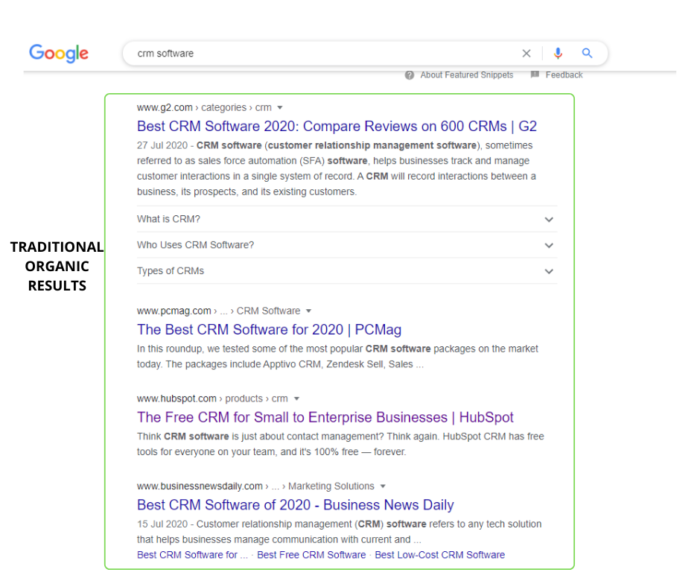
The results in the red box are paid listings, and all the green ones are organic listings. Each has its positives and negatives, and its influence on the SERPs.
Paid Search Results
Google AdWords allows websites to show up at the top of the SERPs for their chosen keywords, and they pay Google every time someone clicks their ad.
These results display at the top and bottom of the SERP and have “Ad” written in bold letters next to the URL.
Our example search term of “CRM software” shown above shows the variety of ways a site can earn organic traffic from the SERPs.
We’re all used to the traditional organic listing of a meta title and description, but Google has added more SERP features in recent years. These features, such as the Featured Snippet and Knowledge Pack that you see in the example, can significantly impact organic traffic.
Whereas paid ads are a quick way to the top of the results pages (the highest bidders will generally win), competition for organic results is fierce and more complicated.;
The SERP is where the vast majority of an SEO’s hard work plays out. SEO is responsible for ensuring that your website shows up in the SERPS, gets its fair share of clicks, and ensures users find what they are looking for once they click-through to your website.
The SERPs and SEO are intrinsically linked. The steps you take in this area are the keys to building organic traffic and achieving your traffic goals.
You can reach the top positions in the SERPs, and you can build a significant volume of organic traffic; you’ve just got to be consistent with your SEO and follow the right steps.
Small Changes in the SERP Results Make a Big Difference to Your Traffic
Google and the other search engines’ primary objective is to provide the user with the perfect search query results. To do this, Google uses algorithms that employ hundreds of different factors to determine each person’s best possible search results.
This level of personalization means the SERPs can vary greatly. Here are some of the key aspects of the SERPs that can largely impact your organic traffic.
Ranking on Page One
When you get to a results page, do you ever make it to page two? Or do you skim the top handful of results to see which will help you?
On a rare occasion, we might click to the second page to see what’s there, but most of us choose from the top results, which is why there’s a massive drop off in traffic between page one and page two of the SERPs.
On page one, listings earn 88.7% of all clicks, leaving all the other pages to fight it out for the remaining 11.3%. This difference just goes to show the importance of ranking on page one — most people never make it to page two.
Not All Positions are Created the Same
So you are thinking, “That’s great, if I make it to page one, then I’ve got everything sorted.”
Unfortunately, this isn’t the case.
Although getting to page one of the SERP is a great start, it’s only part of the challenge. There’s a massive variance between the click-through rate (CTR = number of clicks divided by the number of times your listing is shown) for the top three results and the CTR for ones lower down. These positions influence your organic traffic.
You may have reached page one, but there’s clearly a huge incentive to get to the top.
What Aspects of the SERP Can Hold Your Organic Traffic Back?
In the last section, we mentioned that 88.7% of clicks go to page one results, but this doesn’t mean that 88.7% of all searches go to organic listings.
What are the major obstacles to getting more organic traffic?
Paid Traffic
Paid ads feature prominently in the SERPs, so it’s no surprise that they attract plenty of clicks. This traffic is significant, but it only actually makes up around 3.58% of all clicks.
The reason for this is that paid ads don’t appear for every search term.
Generally, there are three types of searches: informational, navigational, and transactional. Advertisers pay for every click and want a good return on their investment, so they tend to focus on transactional search terms with the highest buyer intent.
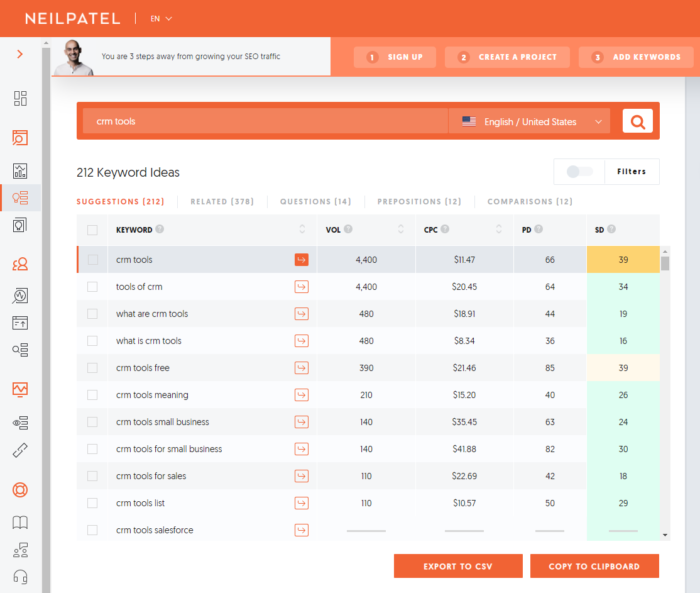
While it’s still possible to get organic clicks for these transactional search terms, it’s a good idea to use Ubersuggest to figure out which search terms are more likely to have a high share of paid clicks.
If you look at the cost per click (CPC) of your keyword, you can see which keywords are likely to be dominated by ads. As you can see in the results below, “CRM tools” has a high CPC, which means there are likely lots of people competing for it, and a higher likelihood you’re going to be competing with ads.
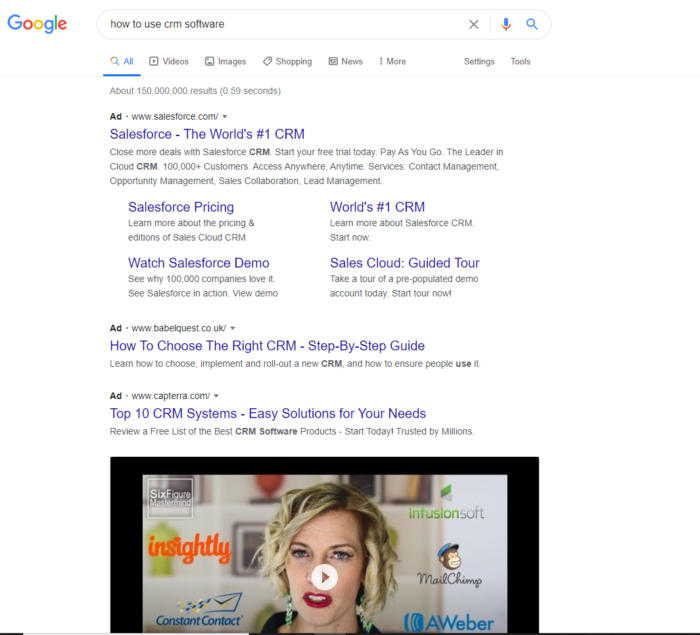
You can still gain organic clicks from these search terms, but you risk being pushed down the page by paid ads.
This search for “how to use CRM software” is a prime example. There are no organic results before the fold other than a video, meaning you have to scroll down before seeing even one traditional organic listing.
To do well in SERPs, you’ve got to be very focused on your keyword research to find the search terms with a realistic shot of gaining a prominent position in the SERP.
No-Click Searches
Google and the other search engines are always working to create a better search experience for their users. One way they have done this by introducing SERP features such as Featured Snippets and Knowledge Panels, giving people quick access to basic information.
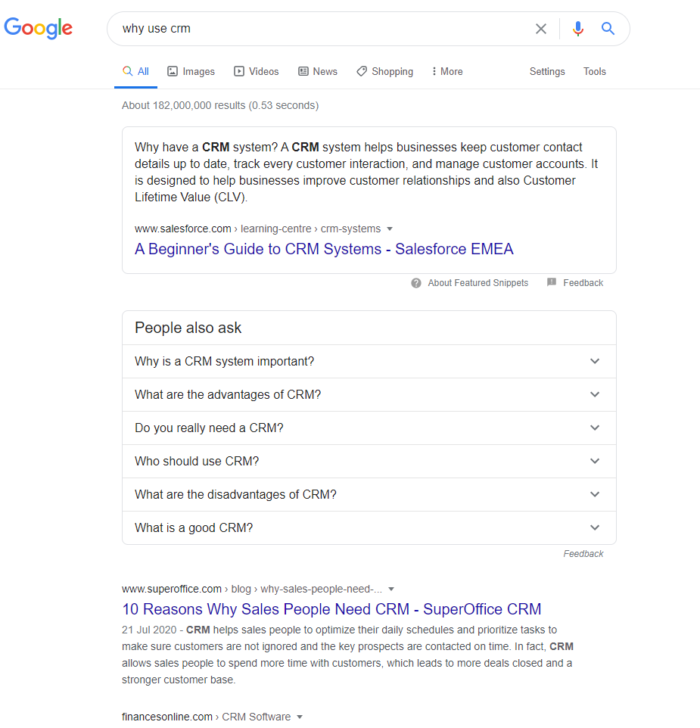
In this search for “why use CRM,” we can see the power of the featured snippet.
With the Featured Snippet, Google gave the user a cursory answer without having to click on a link. That means that even though Salesforce has won the snippet, and SuperOffice has the first traditional organic listing, neither got the click. It’s a no-click search because the user can read the Snippet.
Of course, lots of people are going to be curious enough to click to Salesforce or SuperOffice to find out more, but some users’ curiosity is going to be satisfied by the Featured Snippet. No-click searches account for 49% of all searches.
How Can You Use the SERP to Get More Organic Traffic?
Despite the competition with paid ads and the numbers of no-click searches, there’s still more than enough organic traffic to go around. However, you’ve got to know how to use the SERPs to your advantage.
Every SERP has its leader of the pack, and these folks put a lot of work into maintaining that position, so you’ve got to work hard to unseat them.
So, how do you do that?
The great thing about SEO is you’re in complete control of the content you put out and how you appear in the SERP. If you use this wisely, you can significantly boost your CTR and positively influence your organic traffic. Here’s how.
Produce High-Quality, Relevant Content
Google wants to provide users with the most relevant answers to their search query. To rank higher, your page has to accomplish two critical things. First, it has to be relevant for the search query, and second, it has to be high-quality content.
If you’re not achieving these two goals, then Google has no incentive to put you on page one because you’re not helping searchers achieve their goals.
This element is where your keyword research comes in handy to help you figure out precisely what your audience wants to see. When you know what your target audience is looking for, then you can provide the hyper-relevant content that attracts people to your website.
The more people who click to your site and engage with the content, the more the search engines will reward you for helping them do their job.
Make Your Listing Stand Out
You have complete control over what your listing looks like in the SERP. You can edit your title, meta description, and use other aspects like structured data, so use this opportunity to stand out from the crowd.
If you’re ranked number three for a search term, then the top listing has an advantage over you. But you can turn that around by crafting a more engaging, more relevant title and description. (Google usually uses the page’s chosen title and description but does occasionally modify it.) Your listing is out there competing for clicks, so treat it like an advert and work to entice users.
Get Those SERP Features
Google will keep using those “extra” SERP features, so you might as well embrace it and make sure your website is featuring in them.
The SERP features might lead to a higher percentage of no-click searches, but they can also lead to much higher CTRs when you win them. Hubspot found that sites that land featured snippets have a dramatically higher click-through rate.
Featured Snippets, Knowledge Panels, Local Packs, Shopping Results: they all stand out and draw in users. If you can snag those features, you’ve got an excellent opportunity to boost your organic traffic.
A SERP is simply the results page users see when they type a query into Google or any other search engine, but it has the power to help you unlock the full potential of your website.
While they might seem complicated, there are tangible steps you can take to rank well in the SERPs and bring in the organic traffic you crave. While the search engines are always changing the SERPs, SEO and high-quality, relevant content can help you stay on top.
Now that you’ve got a good understanding of what the SERP is, it’s time to start optimizing your SEO to help your website achieve its goals.
What goals will more organic traffic help you reach?
We are a Javascript development team of 5 developers. Each member in my team have more than 4 experience with Javascript. We build ecommerce, dashboard, search engine and webapp with ReactJS and NodeJS
How we work? After receive the mockup/design from you. We will discuss with you about the requirements of your project. Then we start breakdown the requirements into smaller milestones.
Location: San Francisco County, Marin County, Santa Clara County, San Mateo Country, Available to Relocate for right position Remote: Available Willing to relocate: Available Technologies: (SAMPLE OF SKILLS) DATA SCIENCE: Python, MATLAB, R, Julia IOS AND APPLE: Objective-C, Swift ANDROID: Kotlin, Java FULL STACK: Scala, Java, Play Framework, Ruby on Rails, Python, Django, Flask, JavaScript, … Continue reading New comment by JJBusiness in "Ask HN: Who wants to be hired? (September 2020)"
SEEKING WORK Location: Liverpool, England Remote: Yes (Remote only) Willing to relocate: No Technologies: C#, .NET Core, ASP.NET, SQL Server/MongoDB/EventStore, CQRS/Event Sourcing, Azure/AWS. Résumé/CV: http://cv.craigtp.co.uk Email: craig [at] craigtp.co.uk Hi. I’m Craig. I’m a senior analyst developer with over two decades of experience of a wide range of full life-cycle software projects. I’m a full-stack …
As the most-viewed site globally, YouTube is a must-visit destination for marketers and content creators looking to increase audience reach.
While it is possible to optimize YouTube SEO to score top results, without an understanding of the YouTube algorithm, SEO alone won’t manifest videos on a potential viewer’s suggested video list.
YouTube’s product chief underlined the reality of the impact of suggested-to-watch videos in an interview, noting 70% of a user’s time spent on the platform was dictated by the company’s suggested video algorithm.
70%. That number is huge.
To truly execute a successful YouTube marketing strategy, improve organic reach, and take advantage of that massive percentage, you need in-depth familiarity with the unique YouTube algorithm. Here are nine ways to increase your organic reach on YouTube.
The YouTube Algorithm’s Evolution
What began as a venture capital-funded technology startup in 2006 is now our go-to spot for all things video.
Although YouTube itself has undergone significant changes over the past fifteen years, its algorithm has, by far, been its most dynamic feature.
Before 2012, YouTube charted video success by the number of views alone, regardless of the length of viewing. This singular YouTube algorithm led to a profusion of clickbait videos that relied upon misrepresentative headlines and thumbnails to earn views, with most audience members jumping ship immediately.
Today, we still see the roots of the platform’s infancy in the current YouTube algorithm, which draws heavily on view duration as a component of a video’s ranking.
How Does the YouTube Algorithm Work?
While YouTube’s stated mission is to give everyone a voice and a window to explore the world, one of YouTube’s lower-ranking goals is to engage viewers for extended amounts of time, maximizing the number of advertisement interactions.
Why does this secondary goal matter? Because YouTube suggests videos that satisfy this goal of increased exposure to advertiser content.
YouTube uses an algorithm based on three main qualifiers: relevance, engagement, and quality.
To benchmark relevance, YouTube explores the pairing of title, description, tags, and content with an individualized search query.
Engagement aggregates the number of responses from users, including watch time, engagement, and frequency.
Quality rating is determined by a channel’s ability to demonstrate trustable authority.
In addition to these three qualifiers, YouTube’s algorithm also draws on a user’s historical views and a video-specific assigned score, one that weighs both novelty and frequency of channel uploads, among other attributes.
This combination of statistics allows YouTube to recommend videos that speak directly to a viewer’s interests, continuing a narratively static viewing material chain.
These videos will appear in six different locations on the YouTube platform:
Search results
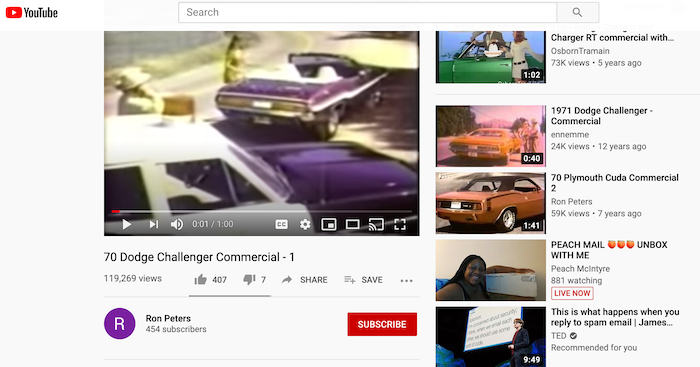
Recommended Streams (as shown in the screenshot on the right side in the below screenshot)
Notifications
Channel Subscriptions
Trending Streams
YouTube Home Page
Much like any search algorithm, YouTube’s ranking system is in constant flux, evolving and adapting in an ongoing attempt to better define and satisfy user engagement.
How do I Improve my Organic Reach on YouTube?
Armed with a concrete understanding of how the YouTube algorithm works, it’s time to break down how you can harness your newfound knowledge to increase your organic reach.
1. Keywords and Metadata
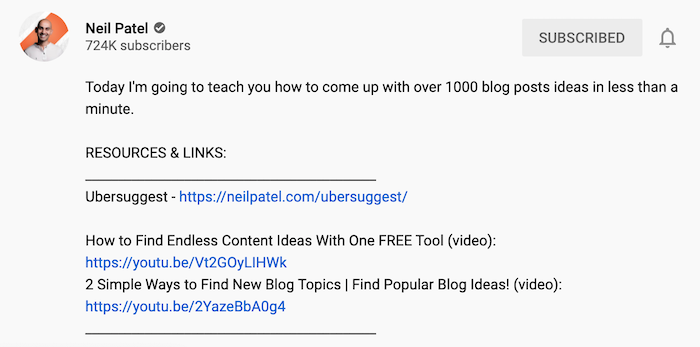
YouTube made it explicitly clear in their algorithm explanation that content-relevant keywords, descriptions, captions, and tags all matter when you’re optimizing videos for search. Make sure you do your keyword researching using a tool like Ubersuggest to make sure you’re mentioning terms users are looking for.
By writing compelling, keyword-rich titles and descriptions, you increase your chances of attracting audience members’ attention and increasing your video’s search visibility.
Check out this post if you need to brush up on SEO basics.
2. Optimized Description
The quote “you never get a second chance to make a first impression” is true of YouTube just as much as life.
Ensure audience engagement by crafting attention-getting copy that not only attracts your potential audience but also harnesses your keywords’ power.
YouTube slants toward the verbose, advocating long descriptions, so don’t be afraid to go the extra wordy mile with them.
Although your prospective viewer will only interact with the first few lines of the description unless they select the “show more” option, those few short lines are valuable real estate when it comes to attracting your audience.
3. Video Transcription
Closed captions not only help those with accessibility needs, but allows users to watch videos in silence.
To make the most of closed captions, upload self-created subtitles. By uploading these yourself, you ensure that, when these captions are indexed for search, they are more accurate than automatically-generated ones, in many cases.
4. Whole-Video Views
Because YouTube ranks videos by engagement, longer watch times mean more opportunities to earn the coveted suggested video inclusion.
If you’re struggling with viewer attrition rates, you’re going to want to tighten focus on your videos’ first few seconds and ensure you:
match the description with the first few seconds of video content, and
snag a viewer with an impossible-to-ignore hook.
Don’t forget to study your audience retention graphs and pay attention to what those metrics are telling you.
These quick fixes help you further engage your audience, extending watch time, and earning your video a higher score via the YouTube algorithm.
5. Conversational Conclusions
Rather than simply ending your video, use various tactics to influence your audience’s next view.
By directing viewers to another video on your channel, you increase interaction and likelihood that they’ll return to interact with future content, both of which satisfy the YouTube algorithm’s engagement portion.
To direct your audience, use watermarks, end screens, and cards, all of which can be clicked and linked to your next video, ensuring continued viewing of your channel and content.
6. Subscriptions
When viewers subscribe to your channel, you automatically increase your organic reach. To increase your number of subscribers, consistently create great content, videos viewers are dying to see.
While consistently creating great content may be easier said than done, it’s essential to building your channel. Create a channel trailer, reach out to influencers, and engage with all comments left on your videos.
If you’re looking for additional strategies to increase your subscribers, check out our YouTube Marketing Guide.
7. Serial Viewers
By crafting videos that continue a conversation, viewers are helpless to resist watching the next in the series.
To keep viewers on your channel, you can create playlists of videos with similar content: these are collections that will attract and sustain viewership.
8. Cross-Promote Content
Social channels are free advertising for your YouTube channel. Promote your videos on all your social accounts, website, and in your email marketing—anywhere you have an audience.
An example of a recent YouTube video shared on this blog.
You can also publish a blog post with the video and a summary or transcription.
9. Actionable Analytics
These numbers don’t just exist to make you feel good; they tell you what’s working well and when, and to identify who is watching what and when.
Conversely, these numbers also tell you what isn’t working, which is inarguably the more influential insight. By identifying what isn’t working, you can try new strategies and content, attempting to delight your audience and improve your reach through different approaches.
By digging deep into YouTube analytics, you can unearth realities about your videos and your audience, allowing you to tailor your creation process to suit the needs of the audience you’re trying to reach.
Conclusion
With over one billion hours of video watched per day on YouTube, it’s undeniable content creators and marketers need to take advantage of the platform to curate and grow their audiences.
By understanding how YouTube suggests videos, content creators and marketers can make their videos work harder and use its nuances to your benefit.
How you changed how you upload videos to satisfy the YouTube algorithm?
This website uses cookies to improve your experience. We'll assume you're ok with this, but you can opt-out if you wish.AcceptRejectRead More
Privacy & Cookies Policy
Privacy Overview
This website uses cookies to improve your experience while you navigate through the website. Out of these, the cookies that are categorized as necessary are stored on your browser as they are essential for the working of basic functionalities of the website. We also use third-party cookies that help us analyze and understand how you use this website. These cookies will be stored in your browser only with your consent. You also have the option to opt-out of these cookies. But opting out of some of these cookies may affect your browsing experience.
Necessary cookies are absolutely essential for the website to function properly. This category only includes cookies that ensures basic functionalities and security features of the website. These cookies do not store any personal information.
Any cookies that may not be particularly necessary for the website to function and is used specifically to collect user personal data via analytics, ads, other embedded contents are termed as non-necessary cookies. It is mandatory to procure user consent prior to running these cookies on your website.