
How to Market a Book: 7 Strategies

It might feel like you’ve already done the hard work. 

You’ve spent hours with a keyboard or notebook in your hands, writing away. You’ve edited, edited, and edited some more—and may have even struggled through the complicated process of self-publishing. 

Now you have to go to the next step: marketing your book.

This entails getting your book “out there,” earning an audience, and generating sales. You just need to understand how to market a book. 

With the right marketing tactics, there’s nothing stopping you from selling your book around the world and building the fanbase of your dreams—well, nothing but time and effort.  

How to Market a Book

No matter how good a book is, no one will read it if it doesn’t have the right marketing. 

International self-publishing websites like Amazon have brutal algorithms that punish the unaware. In order to get yourself that “best selling” tag, your best bet is to look away from the shops and start focusing on your audience. 

In many ways, having a book is like having a website. It can be absolutely brilliant, but if it’s not presented to the right people, it won’t take off. 

Luckily, with the help of modern technology, finding readers doesn’t have to be an impossible journey. 

Strategy #1: Research Your Niche

Any good marketing starts with research.

For this reason, marketing shouldn’t just be an afterthought. It needs to be a part of your process from the very conception of your book. 

If you fail in your market research, then you may find you’re writing a book that nobody wants to read. In some cases, this might not be a problem (such as you are writing for passion), but if you want to make sales and know how to market a book, then your writing has to be informed by your research. 

Fanbase

I always talk about the importance of targeted content. No matter what you’re writing, it’s impossible to accommodate everyone.

Instead, you have to focus on the people who are most likely to enjoy your book.

This is where it’s helpful to create a reader profile. Ask yourself questions about what your ideal reader looks like and build a picture of their character. Understand the following about them:

  • Demographics. 
  • How often do they read?
  • How many books do they read?
  • How fast do they read?
  • What information are they looking for?
  • How do they consume content?

Yes, your writing comes from you and is an expression of yourself, but it’s always important to keep your readers in mind. This will help you with the writing process, but it’s also going to help your marketing, and, eventually generating reviews. 

Genre 

If you tell someone you love reading, then what’s the next question they’re likely to ask?

“What genres do you read?”

Genres are one of the main ways we categorize books, so you should have a good picture of where your book fits into this. Each genre has unique characteristics that its readers look out for and your book is expected to follow certain tropes

Understanding what works and what doesn’t in your genre is important information for your market research. For example, the blurb on a non-fiction book is going to be very different from the blurb on a romance novel. 

The more information you have about your genre, the easier it is to understand how to market a book. 

Competitors

Consider this: who are you competing with?

Are you competing with that out-of-reach New York Times bestseller, or are you competing with something a little more niche?

In an ideal world, there would be no competition. Your book should stand proud, and alone. Only, in the real world… that’s not the case. 

Competition exists. 

For example, if you’ve written a children’s book, you need to look at similar authors.

After all, marketing is always much easier when you know what the competition is doing. When you can see what they do well and what they don’t do so well, then it can give you ideas for your own marketing. You can look at what they’ve written, what the blurb is, what social media pages they run, and even do a deep dive into their website. 

Take the aspects you like, and improve on them by adding your own touches (this is how we keep track of our competitors in online marketing.) 

Strategy #2: Develop an Online Presence and Following 

Sadly, books won’t just sell themselves. Wouldn’t it be nice if they could?

You can put them on Amazon, and in bookstores, but getting people to pick them up and buy them is a whole other thing. 

To market a book, you’ve got to establish an online presence and be able to create a buzz about your work. It takes time to build this authority, so the earlier you set up an author website and build out your social media profiles, the better.

A big part of marketing is reaching people where they are and in modern times, we’re virtually all online. 

We live in a world where we have instant access to information. When someone sees your book, they’re not just going to say “let’s give it a go,” they’re going to look online to learn more about it. 

If there’s no information online about you or your book, then it’s not going to fill them with confidence. 

There are lots of ways you can build your online presence:

  • Create an author website.
  • Engage with readers on social media.
  • Offer extra content.
  • Show “the person” behind the books through blogs or videos.

Your online presence is a fundamental part of marketing a book today. People want to feel a personal connection with authors, their books, and the characters in them, and your online presence is the way to give it to them. 

As Paperback Kingdom says, “when you’re a writer, you’re a writer. But when you’re an author, you become a whole lot more than just a writer—you become a brand.”

Take, for example, YA author C.G Drews:
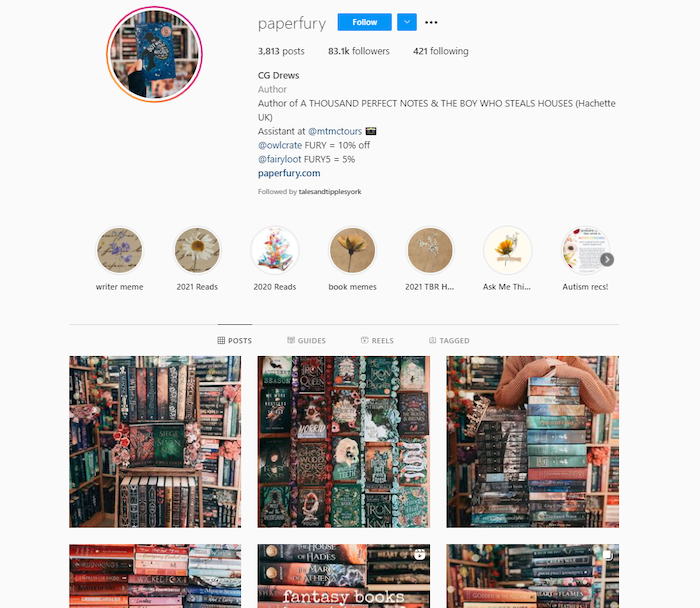
Strategies to Market a Book - Develop an Online Presence and Following

Drews runs a popular blog, Paperfury, and has an Instagram account with thousands of followers. When her first book, “A Thousand Perfect Notes” was released in June 2018, it became an instant hit, with support from her friends, followers, and blog readers.

This just goes to show how vital an established online presence can be in understanding how to market a book. 

Strategy #3: Create a Blurb and Press Kit

How much did a pirate pay for his hook? An arm and a leg.

That’s how much authors feel like they have to sacrifice when trying to become marketing experts. Sure, it’s difficult, but make no mistake: it’s not impossible.

Like with any great story, you need a hook for your marketing—something that will grab people’s attention and draw them into reading more.

In marketing, we use them all the time (just take a look at my first paragraph). 

The equivalent to a hook when you market a book is a blurb. Think about the steps someone takes when they’re considering your book:

  1. Look at the cover page and title.
  2. Read the blurb.
  3. Look at the index to see chapter titles.
  4. Research online.

All in all, with worldwide shortening attention spans, you don’t have a huge amount of time to grab someone’s attention before they click onto the next page.

You need to combine your great writing ability and newfound marketing skills to create the perfect blurb. You can even trial different versions and see which resonates with your audience the most (this would be called A/B testing.)

Blurbs should draw people in, inspire their imagination, and demand that they read on. 

Remember that a good buyer’s journey should finish with the delight stage. They should fall in love from the first sentence of your blurb, right to the end of your novel.  

Powerful synopses are how you convince people to take a chance on an unrecognized author and build your brand evangelists for future organic marketing. When someone loves your work, (whether that be a newspaper columnist, blog owner, or casual reader) you want to provide them with all the tools they need to help you market your book. 

This is when your press kit should come in (also known as a media kit). The more shareable images, videos, and other items you can put in your press kit, the easier it is for your fans to help market your book. 
Strategies to Market a Book - Create a Blurb and Press Kit

Writers Edit suggests that you should have the following on hand:

  1. Author bio, contact details, and a photo.
  2. Information about your book(s).
  3. Media release information.
  4. Ideas for interview questions or discussion topics.

Strategy #4: Design an Eye-Catching Book Cover

How many times have you been told not to judge a book by its cover?

The funny thing is, we all do it! 

We’re naturally drawn to certain elements (such as human faces or different color combinations).

In fact, the human brain processes visual information 60,000 times faster than any text

When it comes to marketing a book, this means your cover is going to be vitally important.

Strategies to Market a Book - Design an Eye-catching Book Cover

Take a look at the cover of Shatter Me by Tahereh Mafi, a bestselling YA dystopian novel. The color combinations, the typography, and the artwork are all cleverly designed to draw our attention. The light gradient as you move up the cover allows the main feature to stand out.

For the most part, book cover design is an area where market research can come in handy. 

What do some of the most successful books in your genre have in common when it comes to the cover? Are they like Shatter Me, with one main piece of artwork as the focus? Or, like in non-fiction, do bold-colored, imageless covers with large text dominate the leaderboard?

Consider how you can incorporate the details you are noticing on multiple bestsellers. Walk the thin line between going with what works, and finding a way to add your own, refreshing twist to the market. 

Remember that your book cover isn’t just for your physical book, it’s also going to play an important part in online stores like Amazon. 

Unless you’re a writer and a high-quality artist, this is probably something you will want to outsource, but your input will still drive the project. Knowledge and feedback will influence some important decisions that can help your book succeed.

Strategy #5: Run Targeted Ads on Social Media

There are nearly four billion active social media users across the world. When you think the population of the world is just under eight billion, this figure is staggering. 

When you run social media adverts, you have the ability to get your book in front of this massive audience.

The best part about it?

Social media ads allow you to be unbelievably targeted. Companies like Facebook, Twitter, Instagram, TikTok, and LinkedIn have so much information on their users, and you can use this to make sure you’re reaching the right people with your ads. 

Here’s how to market a book through social media ads:

  • use your market research to narrow in on your target audience
  • utilize video to boost engagement
  • build specific landing pages that reflect your ad copy
  • explore different platforms
  • keep an eye on your analytics and find ways to optimize

It’s much easier to advertise a book to people when you understand their interests, and, luckily that’s exactly what social media helps you to do.

Strategy #6: Create a Mailing List to Market Your Book

No matter what you’re selling, it often takes more than just one touchpoint for someone to make a purchase. People tend to research products, then go away, before coming back and making a purchase at a later date. 

Books are often considered “lower value items,” with prices running from $12-$24 on average. This means that customers are more likely to make impulse purchases when in the decision buying process, but, often, there will still be some back-and-forth before clicking the buy button. 

No matter how good your marketing approach or book cover, people are going to visit your website, look at your socials, view your book online, and, sometimes, simply leave without making a purchase (no matter how successful you are, this will still happen.) 

Once someone leaves, you have no way of reaching them. However, if you’re focusing your efforts on building a mailing list, then you’ve got a way of creating more touchpoints. 

Email marketing can be one of your best strategies for marketing your book. By engaging with your subscribers, offering valuable content, and building the relationship, you’re going to boost your sales. 

If you use email to market your book, make sure to:

  • respecting people’s privacy
  • using segmentation to personalize your outreach
  • offering value 
  • not just focusing on the sale
  • driving people to your website

A good mailing list is a valuable commodity and it’s a perfect way to build interest in your future releases.

Strategy #7: Network With Other Authors in Your Niche 

People often underestimate the power of networking. Modern technology allows us to reach our target audience so easily that we forget about building relationships. 

There are lots of other authors going through the exact same thing as you, and they have lots of insights to share. They’ve also spent time growing their websites, mailing lists, and social media profiles just as you’re doing. 

A great way to maximize your reach is by reaching out to other authors and seeing if they will help market your book. They can quickly shoot a message to their mailing list, and you could even pitch it as extra content they can use to share their own work. Perhaps you could organize a joint interview or review the other author’s book to share with your mailing list. 

You will find you can build reciprocal relationships, and friendships, where you support each other through the process of marketing your books. 

There is a strong writing community out there, and it can pay to get involved in it. 

Similarly, you can build up a reputation for your key insight into the industry. Reviewing other books in your genre allows you to tag authors and get your name on their feed. It’s a way to become more visible.

Always be constructive, though, and never tag author’s in negative reviews. You can still post your honest thoughts and feelings online, but it can be hurtful to share critiques directly with them.

Your goal is to make connections with authors, not ruin them. 

How to Market a Book: 3 Examples of Successful Book Marketing

Different authors will go about marketing their books in slightly different ways. You may find certain techniques work better than others, but it’s worth exploring every avenue. 

Here are some examples of authors who have done an amazing job with their marketing.

Author Website

Chloe Gong is an NYT bestselling author who has only recently published her first book. As part of her marketing efforts, she set herself up on TikTok, where she has millions of views and likes from talking about books. She also has an up-to-date website with great copy, and even a meme page to appeal to her YA audience. 
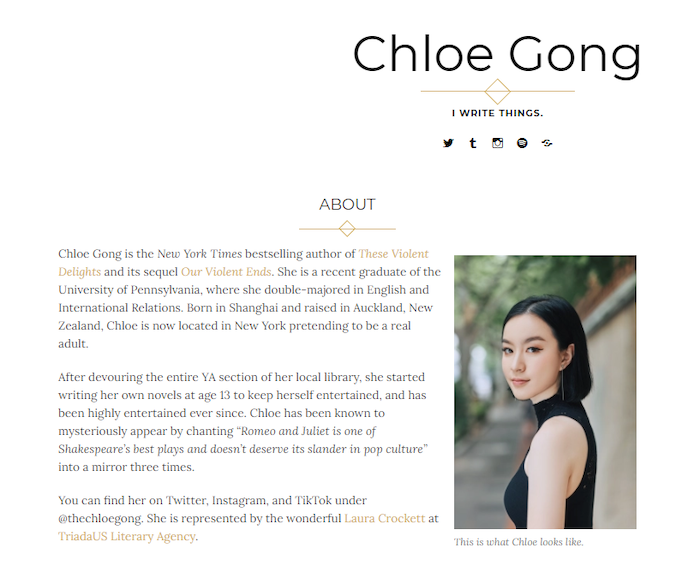
Examples of Successful Book Marketing - Author Website

The website helps keep Chloe’s fans updated, whilst also allowing people to get to know the person behind the books. With regular updates, she keeps people coming back and has built a brilliant platform to market her upcoming book, Foul Lady Fortune.  

Social Media 

Reddit isn’t a social media platform that gets talked about a whole lot, but it can be an amazing platform to start discussions about books. 

There are an endless number of Reddit threads on virtually every subject in the world, and often the people taking part are very passionate. This goes for the subject of books as well. 

Some authors have found that hosting question and answer sessions on Reddit have been a great way to market their book. People are generally interested in getting to know authors and understand the work they do, and Reddit provides a good platform for this. 

Mailing List

Don’t be afraid to do something a little bit different with your email communication. This email from Tansey Morgan is a great example of how you can create engagement with your subscribers. 
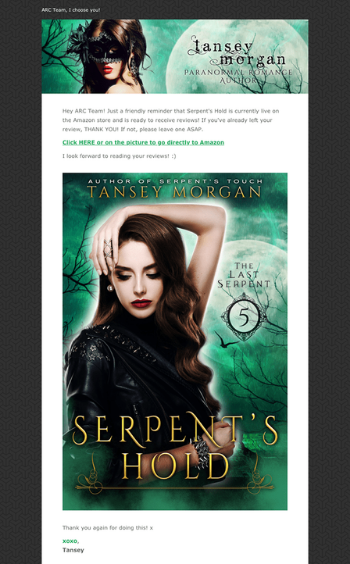
Examples of Successful Book Marketing - Mailing List

Not only are the Amazon reviews very helpful for Morgan’s marketing, but the email also makes the recipient feel involved in the process. 

There are lots of little ways you can do this, with sneak peeks at content, a behind-the-scenes view of the writing process, and other fun benefits for your subscribers. 

How to Market a Book: Frequently Asked Questions

How do I self-market my book?

To self-market a book it’s important to start with market research. From there, you can build your online presence and reach your target audience.

How do I get my book noticed?

Your book cover is one of the best ways to get your book noticed. Look at other books in your niche to find out what they do well, and incorporate this into your book cover.

Can a self-published book become a bestseller?

There’s nothing stopping your self-published book from taking off. Great marketing can create a viral effect, taking you all the way to a bestseller (think 50 Shades of Grey).

How do I market my book on social media?

Targeted social media ads are a great way to reach your target audience and market your book.

{
“@context”: “https://schema.org”,
“@type”: “FAQPage”,
“mainEntity”: [
{
“@type”: “Question”,
“name”: “How do I self-market my book? “,
“acceptedAnswer”: {
“@type”: “Answer”,
“text”: “To self-market a book it’s important to start with market research. From there, you can build your online presence and reach your target audience.”
}
}
, {
“@type”: “Question”,
“name”: “How do I get my book noticed? “,
“acceptedAnswer”: {
“@type”: “Answer”,
“text”: “Your book cover is one of the best ways to get your book noticed. Look at other books in your niche to find out what they do well, and incorporate this into your book cover.”
}
}
, {
“@type”: “Question”,
“name”: “Can a self-published book become a bestseller? “,
“acceptedAnswer”: {
“@type”: “Answer”,
“text”: “There’s nothing stopping your self-published book from taking off. Great marketing can create a viral effect, taking you all the way to a bestseller (think 50 Shades of Grey).”
}
}
, {
“@type”: “Question”,
“name”: “How do I market my book on social media? “,
“acceptedAnswer”: {
“@type”: “Answer”,
“text”: “Targeted social media ads are a great way to reach your target audience and market your book.”
}
}
]
}

How to Market a Book: Conclusion

There’s nothing stopping you from successfully marketing your book. 

The online world has made it much easier to reach your target audience, and there are lots of ways to take advantage of this. By creating an author website, building out your social profiles, and engaging with the community, you can soon build momentum behind your book. 

Lots of independently published books have had great success, but one of the key things is they’ve had good marketing behind them. If you can nail this part of the process, then it can make a huge difference to your book sales. 

How do you market your book?

Pop Meals (YC S17) Is Hiring a Chief Marketing and Growth Officer (CMO)

Article URL: https://www.ycombinator.com/companies/pop-meals/jobs/aLbeAmT-chief-marketing-growth-officer-cmo

Comments URL: https://news.ycombinator.com/item?id=28125861

Points: 1

# Comments: 0

The Top 3 Secured Business Credit Cards

Got Bad Personal Credit or No Business Credit? Secured Business Credit Cards Could be the Answer You’re Looking For

But be aware of what secured business credit cards really are – and what’s a much better alternative to kickstarting a business credit profile.

What Are Secured Business Credit Cards?

Secured business credit cards are for businesses with no credit or a less than perfect credit history. An initial security deposit is necessary. This deposit establishes your card’s credit limit. Often a minimum deposit of $500 is necessary. Once you start making purchases you get invoices like a regular credit card. But this begs the question: what does it mean when a business credit card is unsecured?

Unsecured Business Credit Cards

An unsecured business credit card works like an unsecured consumer credit card. Credit limits are calculated from many factors, this depends on the card issuer. Factors in deciding credit limit can include personal credit and/or your company’s business credit scores. They can also include time in business, annual revenues, etc. These credit cards can give your business the opportunity to earn incentives and rewards.

What Aren’t Secured Business Credit Cards?

There are a number of types of business credit cards. Some aren’t too different from secured cards. Or they may have some of the same results, where you can get credit when you normally couldn’t, and you may even have the opportunity to build business credit with such cards.

Prepaid Business Credit Cards

A prepaid business card works as a convenient alternative to carrying cash. In this way, it works a lot like a secured credit card. You add funds to your account. And then whatever amount you add is available for purchases. Sounds like a debit card, right?

Business Debit Cards

But, a business debit card is a card that works a lot like a business checkbook. The limit is the amount of funds you currently have in your business checking account. Every time you use it to make a purchase, the amount you charge comes from your account as a deduction

The Difference Between Prepaid and Debit Cards

Prepaid cards and debit cards are both widely accepted at merchants worldwide, but one is preloaded and the other is not. Debit cards are linked to a checking account, while prepaid cards aren’t and instead require you to load money onto the card

Prepaid Cards Versus Secured Credit Cards for Business

Not exactly. The salient difference between secured credit cards and prepaid debit cards has to do with whose money you’re spending when you use the card. With secured credit cards, you spend money borrowed from the credit card company. You pay that money back after the purchase. With prepaid debit cards, you’re spending your (or your business’s) own money. You load money onto the card before the purchase.

Because it involves borrowing and repaying money, a secured credit card can help someone (or a business) build their credit. It can also harm their credit if they don’t use the card responsibly. Prepaid debit cards have no effect on a credit score.

Business Charge Cards

Another, similar-sounding card is a business charge card. A business charge card has all the convenience of a credit card. But it’s without the high price of interest. When using this card you must pay your balance in full each billing cycle.

Since you can’t carry a balance, a charge card doesn’t have a periodic or annual percentage rate. Hence there is no rate for a charge card issuer to disclose. Let’s look at some secured cards for business.

FNBO Business Edition® Secured Visa® Card

With this card, you can, “take control of your credit history and help rebuild your credit”. Request your own credit limit between $2,000 and $100,000, in multiples of $50, when you apply. Your credit limit is subject to credit approval and a security deposit.

Your security deposit is 110% of the amount of your credit limit. And you will earn interest on your security deposit. But there is a $39 annual fee. Pay a variable 20.24% APR on purchases and balance transfers based on the Prime Rate.

Get it here: https://www.fnbo.com/small-business/credit-cards/ 

Union Bank® Business Secured Visa® Credit Card

With this card, you can, “start building credit for your business”. Get up to a $25,000 secured credit limit. You will pay a 13.99% variable APR on purchases and balance transfers. And pay a 5% balance transfer fee on each transfer, with a minimum of $10.

There is a 25.25% APR for cash advances. And there is a $30 annual fee. Also, Union Bank will demand immediate payment in full, if you use this business credit card for personal, family, or household purposes.

Get it here: https://www.unionbank.com/business/visa-credit-cards-all 

Score the best business credit cards for your business. Check out our professional research.

Wells Fargo Business Secured Credit Card

A Wells Fargo business checking or savings account must be open before applying. Upon approval, your funds will be transferred from the deposit account to fund the credit line

Get a $500 to $25,000 credit line, based on the amount of funds deposited by you as security in a collateral account. Pay no annual fee, and no foreign transaction fee.

You can get up to 10 employee cards. Pay prime + 11.90% APR on purchases. And pay prime + 20.74% APR on cash advances. Cash advance or balance transfer fees may apply.

Perks

Choose between Cash Back or Rewards Points. There is no annual rewards program fee. And there are no required spending categories or caps. Earn 1.5% cash back for every $1 spent on net purchases. You can receive cash back automatically as a credit to your account or to your eligible checking or savings account each quarter.

If you choose rewards points, you will earn 1 point for every $1 spent on net purchases. Get 1,000 bonus points when your company spends $1,000 or more in any monthly billing period. Redeem points for gift cards, merchandise, airline tickets and more. Get a 10% points credit when you redeem points online. And you can earn extra bonus points or discounts from Earn More Mall® retailers.

Business Credit Building with the Wells Fargo Business Secured Credit Card

Wells Fargo reports your payment and usage behavior to the Small Business Financial Exchange. Payment and usage activity of the Wells Fargo Business Secured card is not reported to the consumer credit bureaus, therefore it will not help build or rebuild personal credit history. 

Wells Fargo will periodically review your account and recent credit history for an opportunity to upgrade to an unsecured business credit card. You may become eligible with responsible use over time. Being able to upgrade to an unsecured business credit card also depends on your FICO score, payment history and ratio of credit card usage to credit limit.

Get it here: https://www.wellsfargo.com/biz/business-credit/credit-cards/secured-card/ 

Score the best business credit cards for your business. Check out our professional research.

Choosing the Best Secured Business Credit Cards for Your Circumstances

Wells Fargo is the best when it comes to annual fees (it’s hard to beat $0). For the highest possible credit limit, the FNBO Business Edition® Secured Visa® Card comes out on top,

 with a $100,000 maximum.

For the best balance transfer rate, it looks like Union Bank® Business Secured Visa® Credit Card is the best. But keep in mind, they do charge a 5% balance transfer fee on each transfer,

 with a minimum of $10.

Building Business Credit is a Viable Alternative to Getting Secured Credit Cards for Business

New businesses can get credit from starter vendors, and often there’s no need to pay money to secure a card. Consider CEO Creative and Grainger Industrial Supply. Neither of them require a deposit to secure a card.

Supply Works

Let’s focus on another starter vendor: Supply Works. They are a part of Home Depot, and offer integrated facility maintenance supplies. But they will not accept virtual addresses. They will report to Experian. Terms are Net 30. You can apply online or over the phone. 

Qualifying for Supply Works

You will need:

  • An entity in good standing with Secretary of State
  • EIN number with IRS
  • Business address (matching everywhere)
  • D-U-N-S number
  • Business License (if applicable)
  • Business Bank account
  • Trade/Bank references

But at least there is no minimal time in business requirement.

Score the best business credit cards for your business. Check out our professional research.

Secured Business Credit Cards: Takeaways

For entrepreneurs just starting out, getting secured business credit cards may seem to be one of the only ways they feel they can get credit. But you can build business credit with starter vendors. Even if you start with lower limits, you often don’t have to secure those cards with a deposit. As a result, starter vendor credit is nearly always a superior alternative to getting secured business credit cards.

The post The Top 3 Secured Business Credit Cards appeared first on Credit Suite.

The post The Top 3 Secured Business Credit Cards appeared first on Automation For Your Email Marketing Sales Funnel.

The post The Top 3 Secured Business Credit Cards appeared first on Buy It At A Bargain – Deals And Reviews.

The Top 7 Cash Back Business Credit Cards

Check Out the 7 Best Cash Back Business Credit Cards

Take advantage of our research and check out the seven best cash back business credit cards we could find.

Cash back usually comes in the form of a low percentage rebate, such as 1 – 5%. Some card issuers offer unlimited cash back. Others offer bonus amounts for chosen category spending or meeting a spending threshold within a certain amount of time after account opening, like $750 if you spend $7,500 in the first three months after account opening. Statement credits and signup bonuses are similar, the main difference is how you get the money – check, credit, points, or something else.

The Best Cash Back Business Credit Cards for You

There are differences among cash back business credit cards, and they go beyond the percentages. A high cash back credit card might require a very high spend in a short amount of time. Or a cashback credit card might not offer categories that work for you. Or cash back offers may come with too many strings attached. We sifted through over 100 business credit cards to find cashback credit cards to fit several different circumstances – including yours!

One Thing to Keep in Mind

Terms and rates for cash back business credit cards are subject to change. In particular, many annual percentage rates are tied directly to the Prime Rate. Banks and other credit providers sometimes add or drop features, or even credit cards. The best source for all credit card information is always directly on the provider’s website.

Let’s start with three honorable mention cash back business credit cards.

Honorable Mention: Get 3% Cash Back with High Credit Limits: Zions Bank Visa Amazing Cash® Business Credit Card

Get to know the Zions Bank Visa Amazing Cash® Business Credit Card. You get 3% cash back on select business purchases, including office supplies, cell services, internet, telecom, and cable TV. And get 2% cash back on select business travel purchases, including airlines and vehicle rentals. Get 1% cash back on everything else. Pay a 0% introductory APR on balance transfers for the 12 months after account opening, then pay a 14.24% variable APR afterwards. A 3% balance transfer fee for each transfer ($10 minimum) applies.

Get a credit limit up to $250,000. You will pay no annual fee. There are no rewards fees. 0% introductory APR for the first 6 months after account opening, then 14.24% variable APR afterwards. It is entirely possible that some of the other reviewed cards have better upper limits, you will need to check when you apply.

Honorable Mention: Get a Cash Back Bonus: PNC Bank Cash Rewards® Visa Signature® Business Credit Card

Check out the PNC Bank Cash Rewards® Visa Signature® Business Credit Card. Get a $200 bonus if you spend $3,000 in the first 3 billing cycles after account opening. Get 1.5% cash back on net purchases, with no cash back limits. Pay no annual fee. You will pay a 0% APR for the first 9 billing cycles after account opening, then 10.99-19.99% variable APR, based on creditworthiness. It boasts  mostly lower interest rates and a fairly easy to meet minimum spend. To get a bonus, this card is decent if you can’t or won’t spend too in such a short amount of time after getting the card.

Honorable Mention: Get Cash Back and Qualify Even with Fair Credit: Capital One Spark Classic Business Credit Card (Visa)

The Capital One Spark Classic Business Credit Card (Visa) can work if you have fair credit. You can earn 1% cash back with every purchase, with no minimums. Pay no annual fee. You will pay 26.99% variable APR for both purchases and cash advances. The minimum credit line is $300.

The cash back percentage is low, and the interest rate is higher than for the other cards reviewed. But if your credit is only fair, or you don’t have a very long credit history, this card could be right for you.

#7: Get 3% Cash Back with an Annual Bonus: US Bank Business Cash Rewards World Elite™ Mastercard®

Check out the US Bank Business Cash Rewards World Elite™ Mastercard®. Earn to 3% cash back on eligible gas station, office supply store and cell phone/service provider net purchases. All other purchases earn 1% cash back. Purchases of gasoline greater than $200 will not be deemed to be a purchase of automotive gasoline, and as such will earn a reward of 1%.

Get $500 cash back if you spend $3,000 in the first 90 days from account opening. Earn a 25% annual bonus based on your prior year’s cash rewards, to $250. Pay no annual fee. You will have a 0% introductory APR for the first 12 billing cycles. After that, 13.99-22.99% based on creditworthiness.

To hit the bonus limit, you would have to have spent over $33,000 in the previous year. Still, the initial spend requirement isn’t too bad. You can meet it with purchases of computers or the like. The APR after the introductory period is acceptable. If your credit is such that you qualify for the lower APR, this card could turn out to be a better deal than our #6.

Score the best business credit cards for your business. Check out our professional research.

#6: Get 3% Cash Back in Limited Categories: First Hawaiian Bank MasterCard Cash Rewards Business Credit Card

Check out the First Hawaiian Bank MasterCard Cash Rewards Business Credit Card. You get 3% unlimited cash back on gas and dining. Get 2% unlimited cash back on utilities, and 1% unlimited cash back on everything else. There is no annual fee.

Pay a 15.49% APR. Earn a $200 credit with a $2,000 spend in the first 3 months from account opening. With its fairly low spend requirement, no annual fee, and decent (but not exceptional) APR, this can be a good card. In particular, it can work well if your business requires you to travel by car and entertain clients on the road.

#5: Get 4% Cash Back for a Limited Time: Citi Bank Costco Anywhere Visa® Business Card

With the Citi Bank Costco Anywhere Visa® Business Card, get 4% cash back on eligible gasoline purchases, including buying gas at Costco. But this is only for the first $7,000 per year. After that, get 1% cash back. Get 3% cash back on restaurant and eligible travel purchases. Earn 2% cashback on all other purchases from Costco and Costco.com. Get 1% cash back on everything else.

There is no annual fee. There are no foreign transaction fees. But you must be a Costco member before applying. Pay a 15.24% variable APR.

While the 4% cash back offer is limited to just the first $7,000 per year, you will have to buy over 2,000 gallons of gasoline if they average $3.50 per gallon to hit the limit. If you think it’s unlikely you would meet that limit, and you’re a Costco member, this could be a good card. It’s got an APR that is decent but not as good as our #4’s rate.

Score the best business credit cards for your business. Check out our professional research.

#4: Get 4% Cash Back Until You Hit a Spend Limit: Huntington Bank MasterCard Voice Business Credit Card

With the Huntington Bank MasterCard Voice business credit card, earn 4% cash back on the first $7,000 spent per quarter in one category of your choice. There is a choice of 10 categories.. Hence the annual spend limit for 4% cash back is $28,000. Earn 1% cashback on all other purchases.

There is no annual fee, and no foreign transaction fee. Pay a 10.99-21.99% APR based on creditworthiness, tied to the Prime Rate. If you know you won’t meet the spend limit, and your credit is already good so the APR is on the lower side, this could be an outstanding card.

#3: Get 5% Cash Back on Amazon Purchases Only: Amazon Prime Store Card

Get 5% cashback on Amazon purchases with the Amazon Prime Store Card. Pay no annual fee. You get a $60 Amazon gift card upon application approval. However, limits seem to be low. There are reviews on the Amazon website and you should check them before applying.

If your business makes a lot of Amazon purchases, this could be one of the best cash back business credit cards for you. If not, it likely has too many limitations.

#2: Get 5% Cash Back in 2 Categories: Bremer Bank Visa Max Cash Preferred

The Bremer Bank Visa Max Cash Preferred card is particularly good if you can pay your credit bills on time and avoid paying interest. Earn a $150 bonus reward if you spend $500 in the first 90 days from account opening. The spending threshold required for a bonus is comfortably low. You will probably meet it if you charge a decent computer on this card. Also get 2% for one everyday category, otherwise get 1% unlimited cash back. There is no annual fee.

All annual percentage rates for interest will vary with the Prime Rate. Pay a 14.49-23.49% APR for purchases based on creditworthiness. Pay a 0% introductory APR for the first 12 billing cycles for balance transfers, and then 14.49-23.49% APR based on creditworthiness.

Get 5% Cash Back in 2 Categories: Alternatives to Bremer Bank

Note: Busey Bank offers the identical credit card, with the exact same rates and fees. The main difference is Bremer is headquartered in Minnesota, whereas Busey is based in Illinois.

First American Bank also offers the identical credit card – they are also based in Illinois.

Since there are no differences among these three offers, your best bet is to choose based on convenience or bank specialty or the like.

Score the best business credit cards for your business. Check out our professional research.

#1: Get 5% Cash Back on Flat Spending: Chase Bank Ink Business Cash®

For good interest rates, and a high percentage in cash back, check out this card. Pay 0% APR on purchases for the first 12 months, and then 13.24-19.24%. Pay no annual fee.

With the Chase Bank Ink Business Cash® card, you get 5% cash back on the first $25,000 you spend on certain business products, i.e. office supply stores, internet, cable, and phone services. This works out to 4% additional cash back rewards on top of 1% cash back rewards earned on each purchase. The $25,000 flat spending limit resets every year. You can get $750 bonus cash back if spend $7,500 in the first 3 months after account opening.

But unlike with some other cards, it can be harder to hit the minimum spend amount. The agreement does not prohibit using your card to buy pricier items such as plane tickets, vehicle repairs, or even heavy equipment. Still, you may find that using other means, such as equipment financing or fleet credit, would make for a better deal for your business.

While we do feel this is the best of the cash back business credit cards we reviewed, if you cannot meet the spend minimum, our #2 choices are a lot better.

Takeaways for the Top 7 Cash Back Business Credit Cards

The business credit cards we reviewed offer cash back deals running from 1% to 5%. Annual percentage rates run from 10.99% t0 26.99%, with many cards offering a 0% introductory APR for a limited time. Some cards offer monetary bonuses, often dependent upon spending a minimum amount during a short window of time. Limits and qualifications were not easy to find online – so ask! And always check a provider’s website for the latest and most accurate details on any business credit card that interests you.

The post The Top 7 Cash Back Business Credit Cards appeared first on Credit Suite.

In net: Rangers ink Shesterkin; Flyers, Caps re-sign goalies

The New York Rangers locked up their goaltender of the future Monday by agreeing to re-sign Igor Shesterkin to a four-year $22.6 million contract.

Internal Site Search is Killing Your Conversion Rate (Here’s How to Fix It)

How Site Search is Killing Your Conversion Rate (And How to Fix It)

An internal site search is a must-have. However, it’s often viewed as an afterthought rather than a true conversion optimization tool – and that could be killing your conversion rate.

So what should you know about improving your site search? Here are a few tips on making the most of site searches.

What is Internal Site Search and Why Does it Matter?

Internal site search is a search bar many site users add to their website which allows users to search for news, topics, or products. It’s crucial for eCommerce sites, but can be incredibly useful for content-based sites as well.

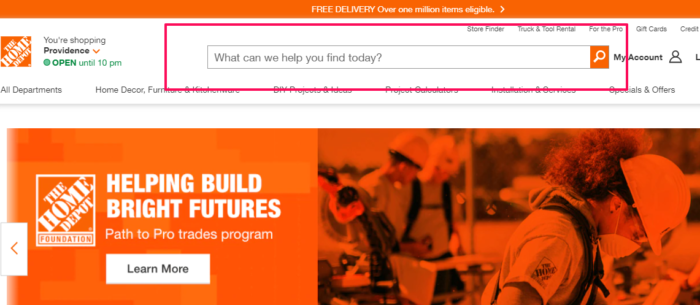
Many sites feature their site search front and center at the top of their homepage, as Home Depot does:

internal site search example from home depot

How Site Search Drives Conversions

Adding internal site search to your website helps users find what they are looking for. However, it can also impact your bottom line.

Site Searchers Much More Likely to Convert

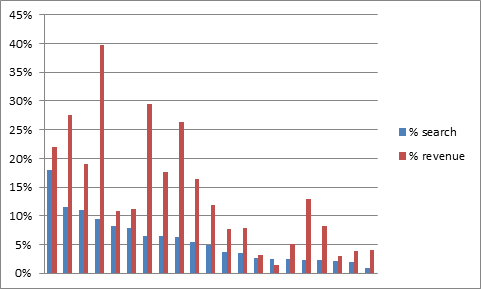
According to research by eConsultancy, on-site searchers are 1.8 percent more likely to convert than regular users.

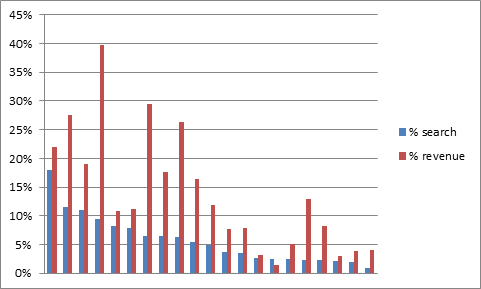
What’s more, Screen Pages found the average revenue from site search was significantly higher than regular users.

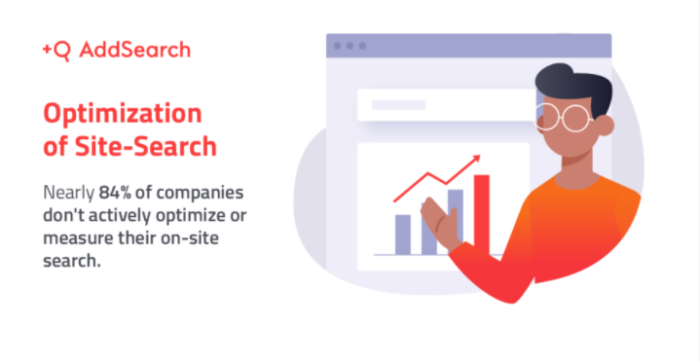
Despite the benefits of site search, a vast majority of sites don’t optimize their site search feature.

internal site search statics

If you don’t have a site search–or if you aren’t making the most of it–you could be missing out on revenue.

How to Drive Conversions With Internal Site Search

If customers aren’t getting the results they expect from your site search (or worse, getting links to your competitor’s sites), they’ll simply go elsewhere.

That’s why it’s vital to start paying attention to your internal search engine – and making changes that can improved results and drive conversions. Here’s how to do it.

Target the “Spearfishers”

According to Forrester Research, which did an in-depth report on the importance of site search for retail, businesses should focus on “spearfishers” – those users who come to a site searching for a specific product. They found 43 percent of visitors go immediately to a search box, and searchers are two to three times more likely to convert.

That means we need to make it push-button simple for users to do a search right away. You can thank sites like Amazon and Google for making a prominent search box the first thing users see.

Include Autocomplete

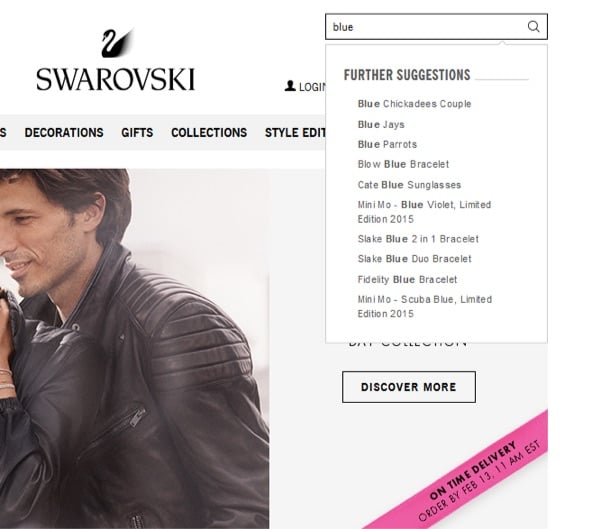
swarovski internal site search example with suggestions

Going to the Swarovski.com website without a specific product in mind will instantly lead the user to suggestions. I typed in “blue” and got 10 product suggestions right away.

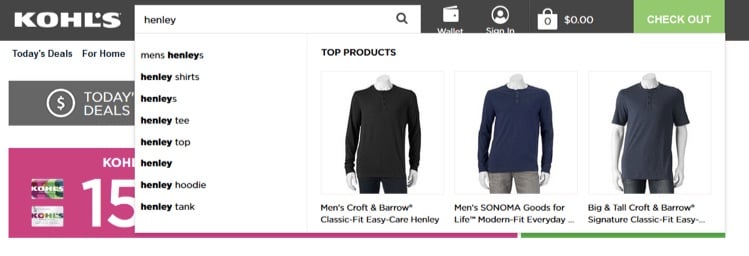
Kohl’s website goes even further to recommend (and show) specific products based on a basic search before the user ever hits enter:

kohls internal site search example with product recommendations

By suggesting specific products (or even showing top results), you’re guiding the user along the path you want them to take before they even make a conscious decision to continue. Essentially, you’re planting product suggestion seeds and allowing them to branch out from there – putting your user one step closer to a conversion.

Allow Users to Filter Internal Site Search Results

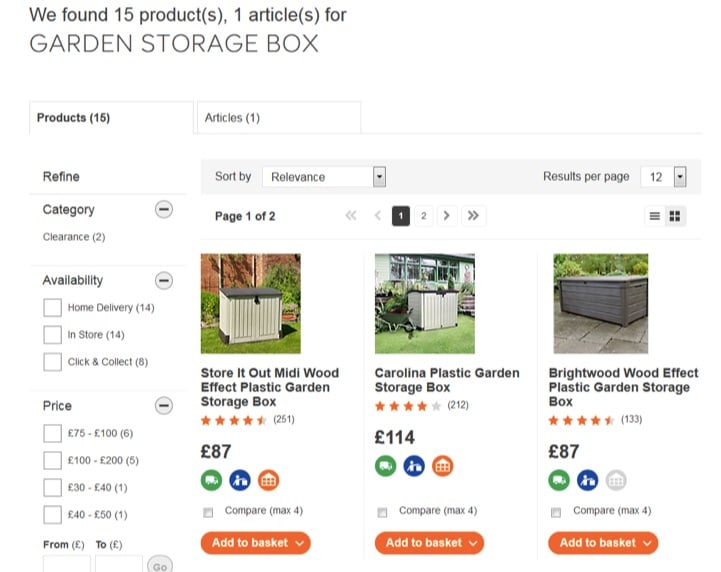
There’s nothing more frustrating than getting a million search results and having to sift through the clutter. U.K. site DIY.com helps users filter results search pages by offering a number of filters, including price, availability, and category. This lets users narrow down to precisely what they want and when they want it by.

diy internal site search page example

Create Dedicated Landing Pages

Based on the data you collect from your site search engine, you may want to elevate certain products to get more exposure or demote others that may not be as popular. For products getting the bulk of the hits, consider creating a dedicated landing page to help it stand out from among a sea of similar items.

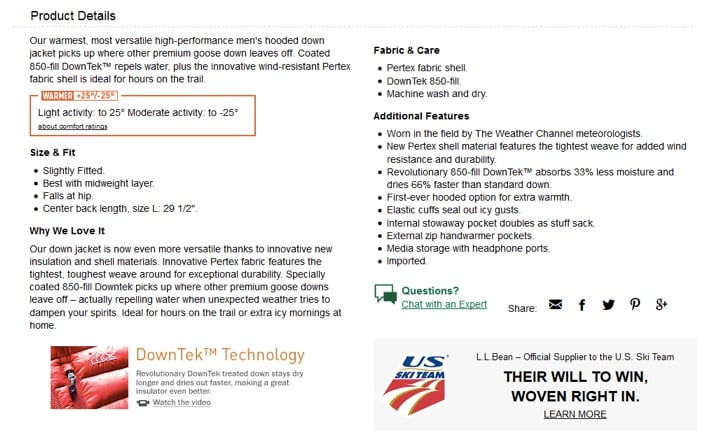
L.L. Bean has custom landing pages for many of its products which include not just the product details, but the best weather/activity levels, additional features, and even the technology behind the item:

ll-bean landing page for site search items

Offer Relevant Recommendations

Sometimes, despite your best efforts, products go out of stock or are discontinued. What happens when a user ends up on those pages? Sending them to a “product not available” page is a sure path to site abandonment. Instead, take a page out of Amazon’s book by offering users related suggestions and recommendations.

Bonus points if you can bundle products in a ‘Frequently Bought Together” option.

Improve Mobile Search

Don’t forget about mobile users. According to Statista, more than half of all internet traffic comes from mobile devices. Typing on a mobile device can be cumbersome at best, and misspellings often lead users to “Not Found” pages even if the product is available.

Test out your site search in a variety of devices for ease of use and fast loading. No mobile user is going to wait forever to see 1,000+ products load up on a results page. Consider limiting the number of suggestions and making sure your search bar is easy to use on mobile devices.

Internal Site Search Tools

Now you know what users expect from a high-performing site search and how to use it to drive conversion. So, how do you implement it? There are plenty of free site search engines available – but here is one area where you definitely don’t want to skimp on features.

Here are a few of the more promising site search platforms available.

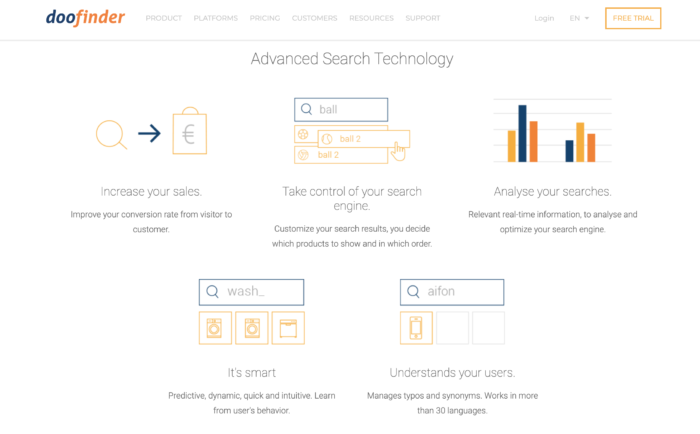
Doofinder

doofinder e-commerce site search

Doofinder created a cutting-edge site search tool that has been proven to increase conversions and boost sales on e-commerce sites. Combining artificial intelligence and machine learning, Doofinder is able to provide a fast, seamless, and effective search experience for users while helping sites sell more.

To make Doofinder even more exciting for users is that they offer both a free trial and a freemium version, making it easier for both small and large e-commerce sites to benefit from their impactful site search tool.

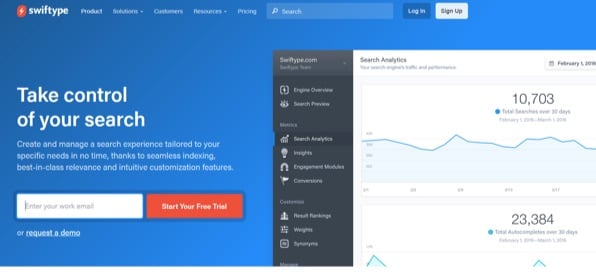
Swiftype

swiftype  internal site search tool

Swiftype integrates into many popular platforms including WordPress, Zendesk, Magento, and Shopify. With intelligent sorting, filters, spell check and autocomplete, it’s a solid search engine with fast indexing and fantastic relevance. Pricing starts at $79/month with a trial available if you’d like to test the waters.

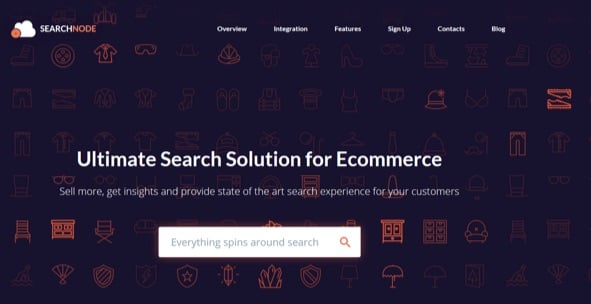
SearchNode

searchnode  internal site search tool

SearchNode is made for e-commerce sites and integrates with common shopping cart platforms such as OSCommerce, Woo Commerce, OpenCart, and many more. It can be up and running in as little as five minutes with a JS code snippet. One of the main benefits that set SearchNode apart is the ability to use their site search tool in multiple languages.

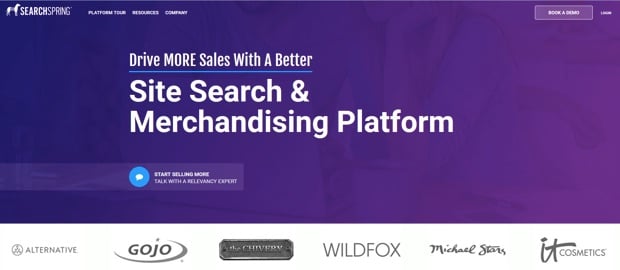
SearchSpring

searchspring home page internal site search tool

SearchSpring is an enterprise-grade site search platform that combines search and merchandising tools into one package. It offers common features like auto-complete, product recommendations, and even product quizzes/product finders to help users find the right product for their needs by answering a few simple questions.

They also offer a ton of other eCommerce tools, including navigation, personalization, and advanced reporting tools. Pricing starts at $499.

Internal Site Search Frequently Asked Questions

What is internal site search?

Internal site search, sometimes called site search, is a search engine function on a specific website that allows users to search for content or products on that specific page.

What are the benefits of adding site search to my website?

Site search makes it easier for users to find content or products on a specific site. It can help drive conversions and provide site owners with data about the types of products users are interested in.

Is adding a search bar to my site good for SEO?

Search bars don’t have a specific SEO benefit. However, they improve the user experience and keep users on your site, which is beneficial to SEO.

Is Google Site Search a good tool?

Google’s Site Search feature was sunset in 2018 and is no longer available. However, there are several other options, including SearchSpring and SearchWP.

{
“@context”: “https://schema.org”,
“@type”: “FAQPage”,
“mainEntity”: [
{
“@type”: “Question”,
“name”: “What is internal site search? “,
“acceptedAnswer”: {
“@type”: “Answer”,
“text”: “Internal site search, sometimes called site search, is a search engine function on a specific website that allows users to search for content or products on that specific page. ”
}
}
, {
“@type”: “Question”,
“name”: “What are the benefits of adding site search to my website? “,
“acceptedAnswer”: {
“@type”: “Answer”,
“text”: “Site search makes it easier for users to find content or products on a specific site. It can help drive conversions and provide site owners with data about the types of products users are interested in. ”
}
}
, {
“@type”: “Question”,
“name”: “Is adding a search bar to my site good for SEO? “,
“acceptedAnswer”: {
“@type”: “Answer”,
“text”: “Search bars don’t have a specific SEO benefit. However, they improve the user experience and keep users on your site, which is beneficial to SEO. ”
}
}
, {
“@type”: “Question”,
“name”: “Is Google Site Search a good tool? “,
“acceptedAnswer”: {
“@type”: “Answer”,
“text”: “Google’s Site Search feature was sunset in 2018 and is no longer available. However, there are several other options, including SearchSpring and SearchWP. ”
}
}
]
}

Internal Site Search Conclusion

Site search is definitely not something you’ll want to overlook when it comes to new ideas to improve your conversion rate. By implementing a few simple steps to give users more control over their results, you’ll likely start to see conversions and revenue soar as customers find precisely what they need quickly and easily.

Search site doesn’t have direct SEO benefits, but it does improve user experience, which can indirectly impact the effectiveness of all your marketing efforts.

Do you use site search extensively on your site? What do you believe makes a good site search engine? Share your thoughts with us in the comments below!

New comment by coolyd in "Ask HN: Who is hiring? (August 2021)"

Orbital Health | Web Developer + Sales Development Rep | Remote | Full-time

At Orbital Health, our mission is to improve the way patients find clinical care by building the most intelligent and proactive platform in healthcare. We are bringing new and powerful tools to providers and are looking for team members that are excited about making healthcare more intelligent and inclusive.

We are a growing startup who just raised our first pre-seed round and are fully remote, offer flexible hours, unlimited PTO, and stock options. Our stack is Vue, Dotnet, AWS, FHIR, and Firebase with plans to move into ML/NLP.

https://www.orbitalhealth.com/Careers

Cash Is Flooding Into Short-Term Markets Like Never Before

Money-market funds, banks and other investors are parking over $1 trillion in spare cash overnight in reverse and repo markets—a surge in short-term lending that is raising concerns about whether market unrest lies ahead. The post Cash Is Flooding Into Short-Term Markets Like Never Before appeared first on Get Funding For Your Business And Ventures. … Continue reading Cash Is Flooding Into Short-Term Markets Like Never Before

Cash Is Flooding Into Short-Term Markets Like Never Before

Money-market funds, banks and other investors are parking over $1 trillion in spare cash overnight in reverse and repo markets—a surge in short-term lending that is raising concerns about whether market unrest lies ahead.

The post Cash Is Flooding Into Short-Term Markets Like Never Before appeared first on Get Funding For Your Business And Ventures.

The post Cash Is Flooding Into Short-Term Markets Like Never Before appeared first on Buy It At A Bargain – Deals And Reviews.

11 Proven Hacks to Keep Your Customers Buying More

It costs 5X less to retain a customer than it does to acquire a new one.

That’s why customer retention is crucial to growing your Ecommerce business.

What is customer retention?

Customer retention is the ability to encourage customers to keep coming back to make purchases. Research shows that repeat customers spend more than once-off customers, making retention a priority for any Ecommerce business that wants to grow. With research showing that retail Ecommerce sales are set to be more than $548 billion by 2024, you’ll want your customer retention strategy to be solid enough to get you a piece of that pie.

This post will dive into the strategies you can use to boost your customer retention rates. We’ll also look at foundational principles like attracting and converting customers. So, let’s get to it, shall we?

5 Customer Retention Strategies and Corresponding Tools for Ecommerce Companies

Many businesses make the mistake of investing heavily in customer attraction. Sure, if you don’t attract new customers, there’s a possibility your business may fold. However, attracting custoTapymers is not the key to business growth.

The key to business growth is customer retention.

That’s why you must develop strategies that will help you retain the customers you attract. You also need to have the right tools for the job.

Why is customer retention so important?

I’ll give you a few good reasons:

  • boosts loyalty
  • helps drive referral marketing
  • increases ROI
  • increases average order value (AOV)

Speaking of ROI, research shows that a mere 5 percent increase in customer retention can boost your revenue by over 25 percent, depending on the industry, product, and other factors.

With that said, let’s dive into the five customer retention strategies you can use to grow your Ecommerce business.

1. Understand the Customer Journey and Optimize Your Customer Experience Accordingly

One of the first steps to designing a customer retention strategy that works is to understand the customer journey. The heart of customer retention lies in meeting or exceeding the expectations your customers have.

To do that, you must understand the customer journey and optimize it for positive customer experiences (CX) at every step.

If you can keep your customers happy, they’ll keep coming back for more.

How do you do that?

Understand Your Audience

Understanding your audience allows you to know how to craft personalized messaging and experiences at every stage of the journey. Personalized experiences are essential in driving return sales. To better understand your audience, use:

  • Audience research tools like surveys and quizzes to gather demographic and psychographic data on your target audience.
  • Social media platforms and tools like Facebook’s Audience Insights tools to better understand your audience demographics.
  • Tools like HubSpot to build buyer personas.

To build and optimize customer journeys that effectively retain your customers, you must first understand who your target audience is and what they want. This way, you can ensure each touchpoint is meaningful, resulting in a positive CX and, ultimately, higher customer retention rates.

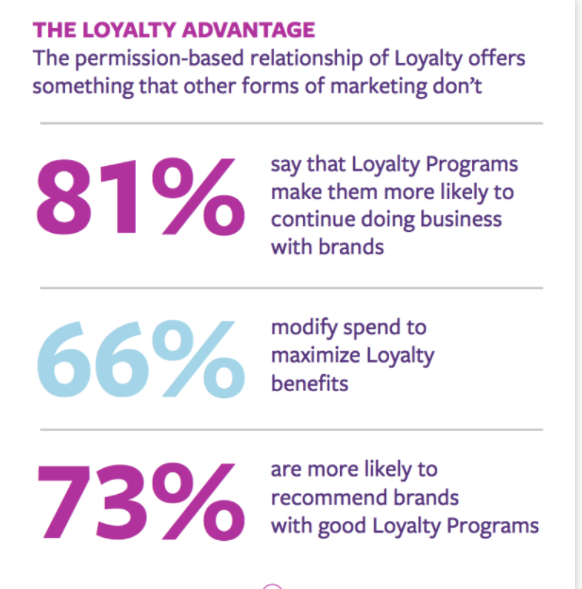
Design an Effective Customer Loyalty Program

Part of your customer journey must include creating a customer loyalty program.

Customer loyalty programs play a big role in increasing customer retention.

Customer loyalty is your customers’ willingness to keep buying from you. Loyalty programs encourage them to do just that and help increase their customer lifetime value (CLV). Designed and executed well, it increases sales and, most importantly, improves your customer retention rates. Here are a few tips and tools to help you design an effective customer loyalty program:

  • Know what rewards are meaningful to your customers.
  • Define the rules of your loyalty program. This includes which actions get rewarded and the kinds of rewards tied to each action.
  • Use tools like the Net Promoter Score to gauge your customers’ loyalty. This will help you know how effective your customer loyalty program is and how much work is needed to improve it.
  • Leverage customer loyalty programs like ReferralCandy to build and execute customer loyalty programs.

Designing a customer loyalty program must never be an afterthought; it must be an integral part of your customer retention strategy.

Running a hybrid B2B/B2C business?

My partner for this post, BigCommerce B2B Edition, makes it easy for you to offer different price lists and products to your different customer segments. You can also tailor your customer loyalty program to each customer category.

2. Follow Up After the First Transaction Is Completed

For most, a sale is the ultimate goal of running an Ecommerce business. However, to retain your customers, you must follow up after the first transaction is completed. Some follow up strategies you can implement include:

Use Email to Build Meaningful Relationships

Many Ecommerce businesses send a thank you email after a transaction. To retain your customers, though, you must do more than just thank them. You must build meaningful relationships with them.

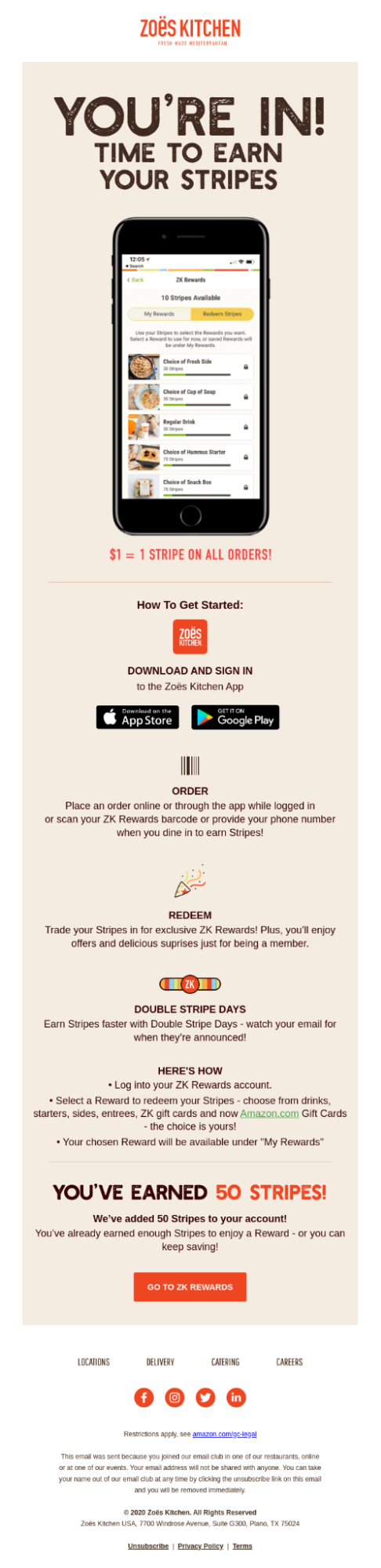
That’s why following up after a transaction is essential. Here’s an example from Zoe’s Kitchen:

Customer Retention Strategies for E-Commerce Companies - Follow Up After the First Transaction Is Completed

Following up after a transaction helps you build meaningful relationships with your customers. For your follow-up to be effective, you must show your customers that you can provide more value. You do that by sending post-sales emails like:

  • product updates
  • cross-selling and upselling emails
  • feedback surveys
  • promotional emails
  • informational emails

This is where Ecommerce platforms like BigCommerce come in handy. It has many features you’ll get to help you grow your business. One of them is the automated email tool and integrations that will help you run follow-up campaigns. Coupled with BigCommerce’s fully customizable email templates (using code or the text editor), creating follow-up campaigns couldn’t be easier. That’s especially since you can add discount codes and coupons to your email templates to encourage conversions.

Be Proactive With Customer Onboarding

Customer onboarding is one of the most crucial steps to ensuring that a first-time customer becomes a repeat buyer. Onboarding refers to all the steps you take to gain customers’ trust until they become loyal customers. A few tips to enhance your customer onboarding include:

  • Use email marketing to welcome and nurture new customers.
  • Invest in interactive content to engage customers and get more data to create hyperpersonalized experiences.
  • Where necessary, create a tutorial to educate your customers on how best to use your product.

Customer onboarding is an essential follow-up process that allows you to show your customers that you value their success. Once they see that, it becomes easier for you to retain them.

3. Segment and Target Existing Customers for Customer Loyalty Programs

By this time, your interactions with your customers have opened up a gold mine of data. Every interaction helps you paint a better picture of each customer.

This is precious data you can use to segment your customers.

Segmentation is crucial in helping you create targeted and personalized campaigns. When it comes to customer retention, segmentation plays an integral role in creating effective customer loyalty programs for your existing customers.

Segmentation is key to increasing your chances of creating a customer loyalty program that will help you retain your existing customers.

For your loyalty program to work, you must create tailored rewards and experiences for the different segments as their needs are different. Examples of segments you can consider creating among existing customers include:

  • high spenders
  • cart abandoners
  • coupon lovers
  • one-time buyers

This is another area in which platforms like BigCommerce shine. It has a built-in tool that allows you to create loyalty groups, making it easy to target particular segments of your customer base for your customer loyalty program.

4. Allow Changes to Orders

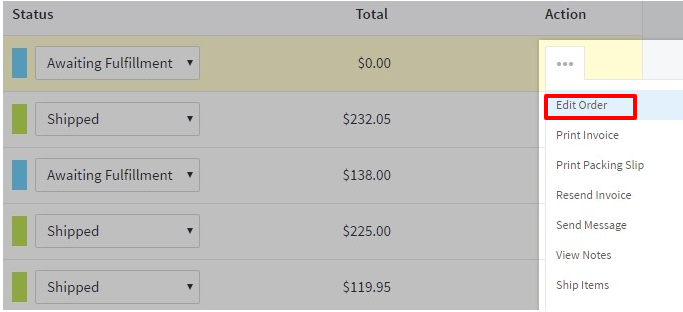
Customer retention hinges on creating memorable experiences for your customers. One way to do that is to allow your customers to change their orders once they’ve made a purchase. For example, a customer may change their mind and want a product that’s a different size, color, etc. For BigCommerce users, allowing customers to change their orders is a cinch. That’s thanks to the order editing functionality the platform provides.

Allowing customers to change their orders is an excellent way to encourage customer retention.

When that happens, allow your customer to swap their purchase for the one they really want.

One of the results of this is that your customers will trust you more. It shows that you have their back and are willing to bend over backward to make them happy. Of course, that kind of trust can only lead to one thing—higher customer retention rates.

5. Offer Outstanding Customer Service

Customer retention is a function of the experiences your customers have with your brand. Besides the shopping experience, customer service is one of the biggest elements of ensuring you serve your customers exceptionally well.

That’s why you must offer outstanding customer service.

When you solve your customers’ problems in a friendly and efficient manner, they’ll see you as a reliable partner. Although they had an issue with your product, you’ll have earned their trust and loyalty.

How do you ensure your customer service is good enough to bolster your customer retention strategy?

  • Offer omnichannel customer service: Make it easy for your customers to reach you by being available on multiple communication channels. MobileMonkey is one of the best customer service tools that will help you create a cohesive experience across multiple channels.
  • Assign the right agent to the right customer: Assess your customer’s needs and assign the agent most qualified to handle them.
  • Learn from your competitors: Research how your competitors handle customer service issues like returns, faulty products, faulty charges, etc. Also, read customer reviews and call their customer service line to see what the customer service experience is like.
  • Help your customers help themselves: Some people prefer to troubleshoot and solve their problems. Creating an easy-to-navigate knowledge base using tools like HelpJuice will help you do just that.

Creating an outstanding customer service experience will undoubtedly help you win your customers’ loyalty. People want to know that they can depend on you to help them fast and efficiently if anything goes wrong. On the other hand, poor customer service will cost you customers and, ultimately, your business.

Customer Retention Bonus Tips/Pro Hacks

Customer retention is all about creating memorable experiences for your customers. Here are a few more ways you can do that:

Ask Customers to Set Up Profiles

Creating profiles offers a platform where customers can input important dates like anniversaries and birthdays. Doing this allows you to send reminders and personalized product recommendations for the special occasion.

Create an Affiliate Program

Create an affiliate program where satisfied customers can begin promoting your products and earn a commission. Besides the potential to earn revenue, an affiliate program makes your customers feel like part of your brand. The result is heightened customer loyalty.

Create a Community

People love being part of a special group. That’s why creating a community around your brand is an excellent way of boosting customer retention. An example of this would be creating an exclusive Facebook group where you share content surrounding your brand.

Now that you know how to retain your customers let’s briefly take a step back and look at how you can attract and convert your customers.

How to Attract Customers to Your ECommerce Businesses: 3 Strategies

While customer retention is one of the main pillars of business growth, you can’t have retention without attraction. So, let’s briefly look at a few ways you can attract customers to your Ecommerce store.

1. Have Great SEO to Attract Organic Traffic

Paid ads are a great way to gain traction, especially for a new Ecommerce store. However, if you want to play the long game, you must invest in a robust SEO strategy. The main reason being SEO is one of the best ways to attract organic traffic. A few tips to help you with your Ecommerce SEO include:

Let the Pros Take Care of It

If you have the budget, one of the easiest ways to boost your SEO is to hire an agency to take care of it for you. Besides freeing up your time to run your business, hiring an SEO agency has the advantages of:

  • Access to the right tools, resources, and human resources.
  • Agility to change strategy to align with the ever-changing SEO landscape.

Learn SEO and Take a DIY Approach

No budget for an SEO agency?

Then you could DIY your SEO.

While this approach will require time and commitment, learning the ins and outs of e-commerce SEO will help you better understand what it takes to attract the right traffic to your store. So, invest in a couple of SEO courses or teach yourself the art and science of driving traffic to your Ecommerce store.

Leverage an Ecommerce Platform Designed With SEO in Mind

An essential aspect many entrepreneurs overlook when picking an Ecommerce platform is the SEO aspect. Always consider the SEO features of a platform before investing in one. This is one of the reasons BigCommerce is one of the best platforms on the market. Here are a few SEO-centric features you can expect:

  • Fully customizable URLs.
  • Access to editing robot.txt files.
  • 301 redirects and URL rewrites to reflect any changes in product names.
  • CDN to increase site speed.
  • Microdata and schema markup to enhance your search result listings.

BigCommerce also offers in-depth guides like this one and this one to help ensure your store’s SEO is on point.

2. Create Engaging and Targeted Paid Ad Campaigns

As said, SEO is about the long game—it takes time to see results. To drive traffic to your site quickly, you’ll need to leverage targeted paid ad campaigns. Research shows that 46 percent of the most visited Ecommerce stores spend up to $1,000/month on paid ads. The top 16 percent spend upward of $20,000 per month, so yes, if you want to drive traffic to your store, you must invest in paid ads. While paid ads may cost you, they have several advantages that include:

  • Drive hyper-targeted traffic.
  • Generate sales faster.
  • Boost brand awareness.

The main advantage of paid ads is the speed at which they produce results. So, if you’re running a promotion or simply want to boost your monthly sales, paid ads could help you drive the traffic you need.

For your ads to be effective, though, you must ensure they’re engaging and targeted. To do that:

  • Understand your target audience and develop an ideal customer profile (ICP).
  • Choose and understand the platform you’re advertising on and follow best practices.
  • Thoroughly research your keywords and negative keywords (Ubersuggest is an excellent tool for this).
  • Craft personalized ad copy.
  • Determine the ad format you’ll use (video, text, etc.)
  • Use a campaign management tool like AdEspresso to create, manage, and optimize your paid ads.
  • Optimize your landing pages for better conversions.

It can be quite scary to put money in paid ads. After all, the ROI is never guaranteed. Creating engaging and targeted ads helps make your ads more effective, ensuring that you drive relevant traffic to your products.

3. List Your Products On as Many Channels as Possible

Today’s buyer is spoilt for choice regarding the platforms and channels they consume content on.

That’s why, when creating your Ecommerce paid ad strategy, you must advertise your product on as many channels as possible.

You must adopt an omnichannel approach to advertising.

Omnichannel marketing will ensure that you meet your customers where they are. It makes it easier for you to create ads that will appeal to your customers—ads that convert.

What exactly is omnichannel marketing?

It is an approach to marketing where you anticipate that your customers may start their journey with your brand on one device or platform and continue on another. With omnichannel marketing, you create a cohesive and unified experience for your customers across all platforms and at every touchpoint.

The result is a positive CX that results in more conversions and, ultimately, higher customer retention rates.

This is important as research shows that over 73 percent of online shoppers use multiple channels when shopping. A few tips to help you create an effective omnichannel strategy for your Ecommerce store include:

Make Every Touchpoint a Shopping Experience

Thankfully, with Ecommerce platforms like BigCommerce, your customers can easily buy from other channels (like social media) other than your store. You can also leverage external social media payment processing solutions to sell products directly on social media.

Offer Omnichannel Customer Support

Being available for your customers on their preferred channels helps you create a positive experience that will get them hooked to your brand.

Create a Mobile App

It’s no secret that mobile has overtaken desktop in terms of usage. Creating a mobile app helps you create tailored experiences for your customers on multiple platforms. It also helps you put your store in your customers’ pockets.

Listing your products on multiple channels is a great way of getting them in front of a larger audience. As a result, you’ll drive more traffic to your store and generate more sales on the different platforms you leverage.

Customer Attraction Bonus Tips/Pro Hacks

Besides the three main customer attraction strategies mentioned above, you can use other more advanced ones. Here are a few of them:

  • Leverage AI: AI can help you create accurate buyer personas and serve users personalized product recommendations.
  • Create viral content: Understand your audience’s pain points and aspirations and create your content around these. Also, make sure to meet search intent.
  • Distribute your content: Effective content distribution results in your content being published on the right platforms and being seen by the right audience.
  • Partner with influencers: Partnering with influencers is a great way of tapping into a large demographic that’s a perfect fit for your ICP. The followers are more likely to be interested in your products, and thus the chance of them visiting your website (and converting into customers) is higher.

Developing a strategy to attract customers to your Ecommerce store is an essential step to customer retention. If you can attract an audience in the right way, it improves your chances of them converting and, ultimately, becoming loyal customers.

How to Convert Customers: 3 Strategies

There are three steps to growing a loyal customer base:

  • Attracting the right audience.
  • Converting traffic into paying customers.
  • Retaining your customers.

We’ve already dealt with attracting and retaining customers. Now let’s take a quick dive into how you can convert visitors into customers.

First—what is a conversion?

A conversion in Ecommerce is any visitor who purchases one of your products. Conversion rate, therefore, is the percentage of visitors to your store who turn into customers.

The higher your conversion rates, the more sales you make. Don’t take our word for it. Check out LARQ’s case study. After partnering with BigCommerce, their conversions lifted by 80 percent and they enjoyed a 400 percent average increase in YoY revenue.

How do you improve your conversions?

  1. Create Outstanding Landing Pages

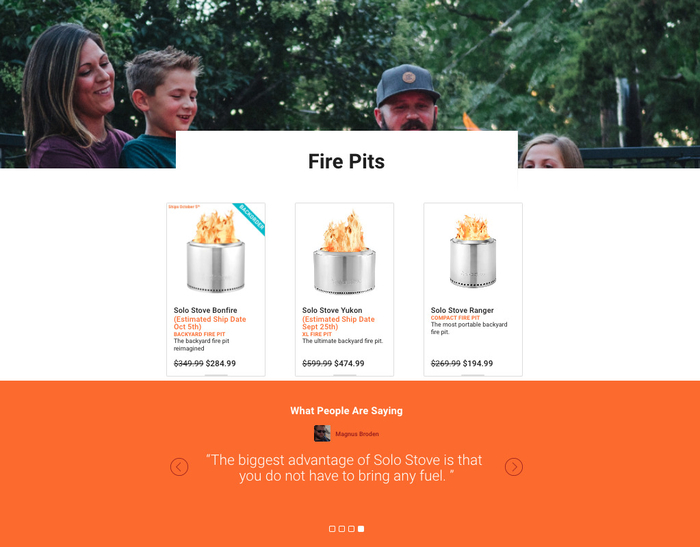
    Your landing page is an important element of your sales funnel as it’s usually the one that does the heavy selling. That’s why you must ensure you create outstanding ones that convert.Customer Retention Strategies for E-Commerce Companies - Create Outstanding Landing Pages
    Here are a few tips to help you do that:

    Keep it simple: Your landing page must be easy to read and understand at a glance. To do that, keep your design clear and uncluttered.

    Have only one objective: Your landing page must only have one goal—conversion. Keep it focused on that.

    Personalization is crucial: From meeting search intent to using language and visuals that appeal to the visitor, personalize your landing page as much as possible.

    Add detailed product descriptions: Your landing page is meant to sell, and one of the best ways is to give visitors a detailed description of what they’re buying. Include high-quality images.

    Use multiple CTAs: Include the same CTA at different places on your landing page. Doing so makes it easier for your visitor to click-through and purchase whenever they’re ready.

    Use a tried, tested, and proven landing page builder: If you’re a BigCommerce customer, you can use the built-in Page Builder tool to quickly and easily build landing pages.

    Your landing page is an essential part of your sales funnel. Besides helping you target specific customer segments, they also help you drive higher ROI for your paid traffic. That’s why you must invest in creating optimized ones for your Ecommerce store.

  2. Ensure Your Site Is Secure to Make Users Feel Safe Making Purchases From Your Shop

    Another crucial factor that helps boost your conversions is site security. Your customers want to feel safe when handing you their details during the checkout process, especially with the recent spike in data breaches. To ensure your site is secure, you must:

    Use a Secure Ecommerce Platform

    The first step to securing your Ecommerce store is to use a platform designed with security in mind. For example, platforms like BigCommerce offer sitewide HTTPS and other security features like firewalls, intrusion detection, and much more. A secure platform makes your customers feel safe to transact with you. It’s essential to boosting your conversions.

    Support Multiple Payment Methods

    Your customers will have different preferences when it comes to how they want to pay for your products. They feel more secure using a payment gateway they’re familiar with.

    Using multiple payment methods is a great way of giving your customers more options. Besides, it also enables you to offer multi-currency options—a crucial ingredient to improving your CX for global customers.

    While supporting multi-currency payment options may seem like a daunting task, with a platform like BigCommerce it isn’t. That’s because BigCommerce natively supports over 140 local currencies and over 65 payment gateways.

    Closely Review and Monitor All Plugins and Third-party Integrations

    When installing third-party solutions to enhance your store, you must make sure they’re from a trusted source. It’s also essential that you monitor them to ensure they’re regularly updated. Once you have no use for one, remove it from your store. You must keep third-party applications on your store to a bare minimum as they can create vulnerabilities in your store. 

    Stay on top of your Ecommerce store’s security by using tools like FreeScan to check for vulnerabilities and TrustWave for threat detection regularly. A secure store will not only protect you from cyberattacks, but also helps boost your conversions. Just make sure to invest in a secure Ecommerce platform and additional security tools if necessary. 

  3. Use an Abandoned Cart Saver

    Cart abandonment is an aspect of Ecommerce you can’t avoid. Research shows that, on average, close to 70 percent of carts are abandoned at checkout. That’s why, if you’re to improve your conversions, you must address this issue.

    One of the best ways to do that is to use an abandoned cart saver.
    An abandoned cart saver is a feature that allows you to send an email to customers who loaded their carts but didn’t complete the transaction.

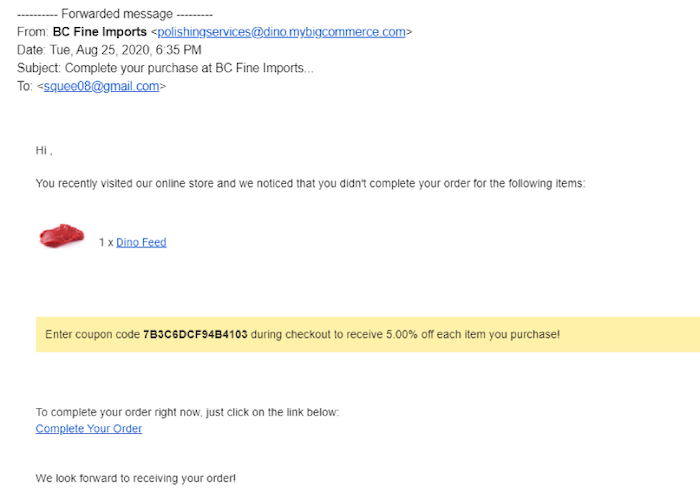
    With BigCommerce’s Abandoned Cart Saver, the emails are fully customizable, allowing you to create personalized invites (with discount codes or coupons) to encourage customers to complete their purchases.Customer Retention Strategies for E-Commerce Companies - Use an Abandoned Cart Saver

Other Customer Conversion Pro Hacks

Besides the three conversion strategies discussed above, here are other tips for increasing your customer conversion rates:

  • Run targeted ads: Targeted ads appeal emotionally to your target audience. They also make your product seem like the perfect solution to their needs.
  • Retargeting: Use social media ads, apps, banner ads on websites, or email to retarget customers who viewed products on your store.
  • Use easy-to-fill forms: A/B test different form designs on your landing page to find out which works best for your customers. Test the number of form fields, copy, placement, etc.
  • Offer free shipping: Free shipping is another great incentive to encourage visitors to your landing page to convert into customers. Make sure to display this benefit.
  • Optimize your checkout page: Optimize your checkout page by eliminating distractions, showing trust signals, offering multiple payment options, etc. These will encourage customers to go through with their purchases.

Attracting the right kind of traffic is always the first step to customer retention. The next critical step is converting that traffic into customers. Be deliberate about both.

Frequently Asked Questions About Ecommerce Customer Retention Strategies

Still have a few questions concerning customer retention strategies you can use to boost your Ecommerce business?

Let’s quickly clear the air on some of the most common ones:

What Is Customer Retention?

Customer retention is the ability for a business to generate repeat customers from visitors to their business. Therefore, customer retention rate refers to the percentage of your customers that continue to buy from you over a given period.

How Can I Improve My Customer Retention?

Improving your customer retention rate is dependent on many factors. However, at the heart of a good customer retention strategy lies creating positive customer experiences at each touchpoint.

What Are Some Examples of How You Retain Customers?

There are several activities you can undertake to retain customers. Here are a few examples: creating loyalty programs, using email to build relationships with your customers and designing outstanding customer service experiences.

What Is a Good Customer Retention Rate for ECommerce?

Customer retention rates are affected by many factors such as industry, product, and others. However, the average customer retention rate for Ecommerce is said to be around 30 percent.

{
“@context”: “https://schema.org”,
“@type”: “FAQPage”,
“mainEntity”: [
{
“@type”: “Question”,
“name”: “What Is Customer Retention?”,
“acceptedAnswer”: {
“@type”: “Answer”,
“text”: “Customer retention is the ability for a business to generate repeat customers from visitors to their business. Therefore, customer retention rate refers to the percentage of your customers that continue to buy from you over a given period.”
}
}
, {
“@type”: “Question”,
“name”: “How Can I Improve My Customer Retention?”,
“acceptedAnswer”: {
“@type”: “Answer”,
“text”: “Improving your customer retention rate is dependent on many factors. However, at the heart of a good customer retention strategy lies creating positive customer experiences at each touchpoint.”
}
}
, {
“@type”: “Question”,
“name”: “What Are Some Examples of How You Retain Customers?”,
“acceptedAnswer”: {
“@type”: “Answer”,
“text”: “There are several activities you can undertake to retain customers. Here are a few examples: creating loyalty programs, using email to build relationships with your customers and designing outstanding customer service experiences.”
}
}
, {
“@type”: “Question”,
“name”: “What Is a Good Customer Retention Rate for ECommerce?”,
“acceptedAnswer”: {
“@type”: “Answer”,
“text”: “Customer retention rates are affected by many factors such as industry, product, and others. However, the average customer retention rate for Ecommerce is said to be around 30 percent.”
}
}
]
}

Summary of Ecommerce Customer Retention Strategies

One-time sales are good, but they don’t grow your business.

For your Ecommerce business to be successful, you must encourage your customers to keep coming back.

That’s why designing a customer retention strategy is crucial.

Using the tips above, growing your business by attracting, converting, and retaining customers is no longer a lofty dream. Putting the tips into action will turn your dreams of growing your Ecommerce brand into reality.

And remember, your choice of Ecommerce platform also plays a huge role in your success in retaining customers. Platforms like BigCommerce that come with in-built customer retention features (like single-page checkout, coupon and discount codes, etc.) are your best bet.

Which customer retention strategies and tools have worked well for your business?