
Improve Your Chances of Getting a Loan with Small Business Lenders

Small Business Lenders Have the Money You Want

Can you improve your chances of getting a loan from small business lenders?

Small Business Lenders, Business Loans, and Funding

Of course you know your business needs money. But business lending doesn’t just come from banks. Still, working to make your business more attractive to lending institutions isn’t just an end unto itself. It will also help your company also become more attractive to nontraditional lenders. It may even help make your business more attractive to prospects. There are factors which are within your control and you can help your business right now.

Start Making it Easier to Get Money from Small Business Lenders

Once you understand what banks and lenders are looking for, you can address their concerns directly. Many of these are actions you only need to take one time, and many of them will also help you to convince prospects to buy from you, thereby helping you recoup any incurred costs.

Working to More Easily Get Money from Small Business Lenders: It All Starts with Fundability

Fundability is the ability of your business to get funding. When lenders consider funding your business, does it appear to them to be a good idea to make the loan? What do they look at to make that determination? Fundability means recognizing what’s important to lenders, and then giving them what they want.

How Does a Business Become Fundable?

You probably already know that a great business credit score is important. But many of the aspects necessary for a strong business credit score work for fundability as well. A potential creditor or lender needs to see your business is legitimate and profitable. Many loan applications get denials due to fraud concerns. Others, simply because something didn’t match up and threw up a red flag.

Your Business Setup

A business must be set up to appear to be a fundable entity separate from you, the owner. The first step is to ensure your business has its own phone number and address. That doesn’t mean you must get a separate phone line, or even a separate location. You can still run your business from your house or on your computer.

Business Phone Numbers

You can get a business phone number that will work over the internet instead of phone lines. This is called a VoIP (voice over internet protocol). The phone number will forward to any phone you want it too so you can use your personal cell phone or landline if you want. Whenever someone calls your business number it will ring straight to you.

Virtual Offices

Use a virtual office for a business address. A virtual office is a business that offers a physical address for a fee. They sometimes they even offer mail service and live receptionist services. There are some that offer meeting spaces for those times you may need to meet a client or customer in person.

But not every vendor will accept a virtual address.

Business Website and Email

A business website can affect your ability to get funding. But a poorly put together website that appears unprofessional will not help you with customers or potential lenders. Spend the time and money necessary to ensure your website is professionally designed and works well.

Along these same lines, your business needs a dedicated business email address. Make sure it has the same URL as your website. Don’t use a free service like Yahoo or Gmail.

Demolish your funding problems with 27 killer ways to get cash for your business.

Improve Your Chances of Getting Money from Small Business Lenders with Business Information and Consistency

All your business information should be the same everywhere you use it. But when you start changing things up like adding a business phone number and address or incorporating, you may find that some things slip through the cracks. This is a problem because many loan applications fail each year due to fraud concerns simply because things do not match up.

Consider all the places where this information could be.

Credit providers won’t stop to consider all the ways you could list your business. If you write Incorporated in one place, and Inc. in another, it can be enough to trigger a denial. Consistent and congruent information makes it fast and easy for credit providers and lenders to find your business and its payment history.

Fix Inconsistent Information by Getting Organized

Consider all the places where your business has a listing. It’s your website, credit applications, even places like Yelp and Google Reviews. Take the time to keep records of all of these places, so Google your business often. Claim your profile on review sites to better control how your business name, address, and other particulars are presented. Copy and paste your information. Don’t chance an error with typing it out. This also means updating info whenever it changes.

Get an EIN

An EIN is an identifying number for your business that works like how your SSN works for you personally. Many sole proprietorships and partnership use their SSN for their business. But it can cause your personal and business credit to get mixed up. When you are looking to increase fundability, you need to apply for and use an EIN. Get one for free from the IRS.

Demolish your funding problems with 27 killer ways to get cash for your business.

Incorporate Your Business

A lot of businesses start off as sole proprietorships. But there’s no separation between the owner and the business with this setup. Partnerships are another entity where the ownership and the business are more intimately connected. With either entity, any other efforts at separating business and personal credit could be all for naught.

Why Incorporate?

A corporate structure truly separates business and personal credit and finances. This is because a corporation is considered to be its own entity. Should you choose a C-corporation, an S-corporation, or a limited liability corporation? That’s up to you to decide. We highly recommend working with a corporate lawyer or an accountant to determine what’s best for your particular situation.

Why Should You Incorporate Quickly?

When you incorporate, you become a new entity. Hence if you haven’t incorporated ASAP, you lose the time in business that you have and must start over. You also lose any positive payment history you may have accumulated.

Hence you must incorporate as soon as possible. It’s not just necessary for fundability and for building business credit. Time in business is also vital. The longer you have been in business the more fundable you appear. That starts on the date of incorporation. This is regardless of when you actually started doing business.

Improve Your Chances of Getting Funding from Small Business Lenders with a Separate Business Bank Account

There are business owners who pay for business expenses with personal credit cards and checks. But a business’s credit file is only supposed to reflect the financial performance of the company itself. Using personal payment methods can muddy the waters. Resist the temptation to pay for any business expenses with personal credit or checks.

Separate Your Business and Personal Finances

Your business must stand or fall on its own financially. Once you get credit from starter vendors or any other business or lender, use it on your business, and stop floating what are essentially interest-free loans to your business.

Get a Merchant Account

Another way to assure your finances get and stay separate is separate bank accounts. Often, a starter vendor will want for your business to have its own bank account anyway. While you’re at it, open a merchant account so you can take credit cards from your customers. Customers will spend more if they can pay with plastic.

Improve Your Chances with Small Business Lenders and Get all Required Licenses

Fundability means being a legitimate business. For a business to be legitimate it must have all of the necessary licenses it needs to run. If it doesn’t, red flags will fly up all over the place. Do  research to ensure you have all the licenses necessary to legitimately run your business at the federal, state, and local levels. Being properly licensed can help assure skittish prospects that you and your business are legit.

Get a D-U-N-S Number

In addition to the EIN, there are identifying numbers that go along with your business credit reports. Some are assigned by the agency, like the Experian BIN. Dun & Bradstreet is the largest and most commonly used business credit reporting agency. Every credit file in their database has a D-U-N-S number. To get a D-U-N-S number, you must apply for one through the D&B website.

Demolish your funding problems with 27 killer ways to get cash for your business.

Business Credit Monitoring

The key to keeping records consistent is to monitor your reports frequently. Monitoring your credit means you know what’s going on with it. You can pounce on errors quickly. Yes, the business CRAs make them, but they are all committed to accuracy and want to correct those mistakes ASAP.

When it comes to business credit reports, you can monitor through the reporting agencies directly. But that’s expensive! Or you can save 90% and monitor through Credit Suite.

Improve Your Chances with Small Business Lenders with a Good Business Credit History

Your credit history has a lot to do with your credit score. It is a huge factor in the fundability of your business. The more accounts you have reporting on-time payments, the stronger your credit score will be.

Your credit history consists of a number of things including:

  • How many accounts are reporting payments?
  • How long have you had each account?
  • What type of accounts are they?
  • How much credit are you using on each account versus how much is available?
  • Are you making your payments on these accounts consistently on time?

Personal credit scores come from several metrics. But business credit mainly depends on one thing, how early or late you pay your credit bills. Paying late will damage your business credit scores at all three of the major CRAs.

Improving Your Business’s Payment History

Here are a few suggestions on how to improve your company’s payment history:

  • Set up reminders to pay – your phone or your business calendar are both fine
  • Set aside money for your credit bills as a part of your budget so you’re not caught short
  • Shop around for better deals and spend less if you can
  • Repurpose older equipment or the like to avoid spending in the first place

Improve Your Chances with Small Business Lenders by Building Business Credit

Business credit is credit in the name of the business, not its owner(s). It’s a measure of how well your business (not you) pays its bills. Properly created business credit separates personal and business credit completely. So if your business defaults on payments or goes bankrupt, it protects your personal assets.

Good business credit is the way to qualify for funding without good personal credit, collateral, cash, or a guarantor. Here are some tips on building business credit to improve your chances for financing from small business lenders.

Buy from Vendors and Other Credit Providers Which Report

While many vendors and credit providers don’t report all payment experiences, they have no problem reporting late and missing payments. So, seek out and mainly (if not 100%) work with vendors which report. These are called starter vendors. Their requirements change all the time. Fortunately, we know which vendors report, and we keep up with their ever-changing requirements.

Spread Out Your Credit Applications Over Time

Asking for too many lines of credit at once signals that you’re desperate and could be overextending yourself. Building a successful business takes time. In the same way, so does building a good business credit profile. As a result, spread your applications for additional lines of credit over time.

Applying for a lot of credit at once also means you’ll have a number of brand-new accounts, which will bring the average age down. Not using your credit can result in credit providers closing inactive accounts. This, too, brings the average age down.

Use Your Credit

Business credit isn’t going to be built if you get cards and then forget about them and never use them. The business credit reporting agencies are calculating your scores based on the credit you use. Using your credit, and paying on time, is positive fodder from business credit scores and reports. You can’t control the passage of time, but you can control card usage and not apply for every credit card you see all at once.

Finally, Apply for the Right Loan

Do you need a traditional loan or a line of credit? Would a working capital loan or expansion loan work best for your needs?  Choosing the right product to apply for can make all the difference. Don’t waste yours and the lender’s time by not considering the best loan product to apply for.

Improve Your Chances for Approvals from Small Business Lenders: Some Takeaways

There are steps you can take to make it more likely your business will get a loan. These steps may also help your business become more appealing to prospects. They also help with building business credit. And applying for the right loan product will also help improve your chances of getting a business loan from small business lenders.

The post Improve Your Chances of Getting a Loan with Small Business Lenders appeared first on Credit Suite.


Is it Possible to Get Flexible Financing for Your Business?

Can You Get Flexible Financing for Your Business?

Absolutely! Flexible financing exists for virtually any business – even startups! You just need to know your strengths.

The 3 Cs Capital Acquisition Formula

When you think like a lender, you realize they just want to be assured that you’ll pay them back. Lenders look at one of three things for loan approval: cashflow, collateral, and/or credit. The more of these “Cs” you have, the more funding options are available. For the many forms of funding we’re showcasing today, we show you exactly what you need to have for approval.

Flexible financing can absolutely be yours.

Fundability and Flexible Funding Options

Fundability is the ability of a business to get funding. It essentially covers all the points a lender or credit provider will be looking at when they’re trying to figure out if you’ll pay back a loan or credit extended to you. These include factors you probably haven’t thought about or might think aren’t so important. But they are!

The fundability of your business will affect your terms and how much you can get. For flexible financing, you want to be as fundable as possible.

Flexible Funding with Good Personal Credit

When it comes to flexible funding, let’s look at what you can get with good personal credit. Good personal credit is always an asset and will always help you out. If you don’t have good personal credit, you can often use a credit partner or guarantor who does.

Credit Line Hybrid

A credit line hybrid is a form of unsecured funding. Our credit line hybrid has an even better interest rate than a secured loan. Get some of the highest loan amounts and credit lines for businesses. Get 0% business credit cards with stated income. These report to business CRAs. You can build business credit at the same time. This will get you access to even more cash with no personal guarantee.

Credit Line Hybrid: Terms and Qualifying

You need a good credit score or a guarantor with good credit to get an approval (a FICO score of at least 680). No financials required. You can often get a loan of five times the amount of current highest revolving credit limit account. This is up to $150,000.

Traditional Term Loans

Traditional term loans are also looking for good personal credit.

Banks are often the first place we think of when we thinking of financing. But big banks only sign off on about 25% of the small business loan applications that come their way. Term loans often have lower interest rates than many other funding options. They also tend to be for higher loan amounts.

Term Loans: Terms and Qualifying

Generally speaking, the companies banks end up funding have very strong financials and near-perfect credit scores. You will most likely have to undergo a personal credit check. These kinds of loans may require collateral. Term loans tend to not be terribly flexible financing. 

Demolish your funding problems with 27 killer ways to get cash for your business

Flexible Funding with Business Credit

Building business credit will always be a good idea. In particular, it can make your funding options far more abundant and flexible.

It should be your goal to build business credit, even if you can get funding elsewhere. Business credit will help your company for years to come. It is credit linked to your EIN and not your SSN.

This credit is available without a personal guarantee. It is available regardless of personal credit. You can get business credit immediately. Business credit is the only way to get money for a business when you don’t have collateral, cash flow, good personal credit, or a guarantor.

Vendor Credit

Starter vendors are open to working with most businesses, even startups. Make sure vendors report to the CRAs – not all do. When they do report, it’s within 60 days. They help you build your business credit profile and score.

Terms vary depending on the vendor, but they tend to be Net 30. And you will not need collateral, good personal credit, or cash flow.

Retail Credit

Retail credit comes from major retailers. Buy everything from office supplies to power tools. Retailers will check if your business information is uniform everywhere. They will also check whether your business is properly licensed.

There can be a minimum time in business requirement. There may even be a minimum number of employees requirement, or a minimum annual sales requirement. Terms can be revolving. You will need at least 3 (5 is better) accounts reporting to the business CRAs.

Fleet Credit

Fleet credit is used to buy fuel, maintain vehicles of all sorts, and repair vehicles. Even businesses which don’t have big fleets can still benefit. These are usually gas credit cards.

There may be a minimal time in business requirement. If your business doesn’t make the time in business requirement, you may be able to, instead offer a personal guarantee or give a deposit to secure the credit.

Cash Credit

Cash credit comes from universal-type credit cards like MasterCard. So they can be used pretty much anywhere. These cards may even have rewards programs.

Terms can be revolving. Usually, you need at least 14 accounts reporting to the business CRAs. There can be longer time in business requirements. And there may also be minimum number of employee requirements.

Flexible Financing with Collateral

Having collateral can help you get many types of financing.

401(k) Financing

This is not a loan. You will not have to pay an early withdrawal fee or a tax penalty. You put the money back by contributing, just like with any 401(k) program. This means you won’t lose your retirement funds. This is a 401(k) Rollover for Working Capital program. The IRS calls it a Rollover for Business Startups (ROBS).

Per the IRS, a ROBS qualified plan is a separate entity with its own set of requirements. The plan, through its company stock investments, rather than the individual owns the trade or business. Therefore, some filing exceptions for individuals may not apply to such a plan. This type of financing isn’t a loan against, your 401(k), so there’s no interest to pay. It does not use the 401(k) or stocks as collateral. Instead, this is simply a movement or change of custodian.

401(k) Financing: Terms and Qualifying

Low rates, often less than 5%. Your 401(k) must have more than $35,000 in it . Can usually get up to 100% of what’s “rollable” within your 401(k).  The lender will want to see a copy of your two most recent 401(k) statements.

Get 401(k) financing even with severely challenged personal credit. The 401(k) cannot be from a business where you are currently employed. You cannot be currently contributing to it.

Equipment Financing

Equipment financing is when you use a loan or lease to purchase or borrow hard assets for your business. It is a business financing option you can use to buy any physical asset. Physical assets can include items like a restaurant oven or a company car. You pay predictable amounts every month. You can build business credit on a program such as this.

Equipment Financing: Terms and Qualifying

All terms are for equipment financing through Credit Suite. Companies must have at least one year in business. You can get approved even with challenged credit. You won’t need financials to secure equipment financing. Approvals take as little as 24 hours.

Equipment Sale-Leaseback

If you already own your equipment free and clear you can use that as collateral for financing. Sell equipment to a lender for cash. Then lease it back from them. You can unlock Section 179 tax savings, and depreciate your entire equipment purchase in the first year.

Equipment Sale-Leaseback: Terms and Qualifying

Term lengths and the amount you can finance will vary. You’ll need at least one larger piece of higher value equipment to qualify. Funding can be in as little as 3 weeks. In general, a lender wants to be sure your equipment does not have any liens against it.

Demolish your funding problems with 27 killer ways to get cash for your business.

Inventory Financing

Inventory financing is a revolving line of credit or a short-term loan acquired by a company so it can buy products for sale later. The products serve as the collateral for the loan. There may be restrictions on the type of inventory you can use. This can include not allowing cannabis, alcohol, firearms, etc., or perishable goods. There can be revenue requirements. And there may also be minimum FICO score requirements.

Inventory Financing: Terms and Qualifying

Get approved for a line of credit for 50% of inventory value, regardless of personal credit quality. Rates are usually 5 – 15% depending on type of inventory. Get funding within 3 weeks or less. It can’t be lumped together inventory, like office equipment.

Shopify Capital

With Shopify Capital, you can get inventory financing with 12-month terms. Pay back with a percentage of daily sales. Borrow between $200 and $1 million. The total owed and daily repayment rate depend on risk profile.

OnDeck

OnDeck offers inventory loans and business lines of credit. Term loans runs $5,000 to $250,000, with 12-month terms paid back daily or weekly. Lines of credit run from $6,000 to $100,000. Pay back over 12 months, with automatic weekly payments.

Demolish your funding problems with 27 killer ways to get cash for your business.

Flexible Financing with Cash Flow

If you can prove your business has good cash flow, several options open up to you.

Cash Flow Financing

A loan made to a company is backed by a company’s expected cash flows. A company’s cash flow is the amount of cash that flows in and out of a business, in a specific period. Cash flow financing (or a cash flow loan) uses generated cash flow as a means to pay back the loan.

Often you will need to have a few years in business. You may need to meet a certain minimum credit score requirement. You will need to prove historical cash flow. Present your accounts receivables and accounts payables. This way, the lender can determine how much to loan to your business.

Account Receivables Financing

Use outstanding account receivables as collateral for financing. Receivables should be with the government or another business. If you also have purchase orders,  you can get financing to have those filled. You won’t need to use your cash flow to do so. Get an accounts receivable credit line with rates of less than 1% with no consumer credit requirement. Receivables should be with the government or another business.

Use outstanding account receivables for financing. Get as much as 80% of receivables advanced ongoing in less than 24 hours. Remainder of the accounts receivable are released once the invoice is paid in full. Factor rates as low as 1.33%. you can get an accounts receivable credit line with rates of less than 1% with no consumer credit requirement.

Amazon Bank of America

Amazon Lending launched in 2011 and partners with Bank of America Merrill Lynch. This allows Amazon to reduce its risk and access capital specifically to provide credit to more merchants so they can get inventory. Amazon Lending is an invitation-only program. Participants get exclusive price and quantity discounts on over 5 million products. See amazon.com/b?ie=UTF8&node=17906292011.

Eligibility is (in part) tied to cash flow). The program makes loans of $1,000 to $750,000. Its terms are for up to a year. These loans are for companies that may have difficulty landing traditional business loans. Within 5 days of being approved, you can get 20% off your first $500.

Amazon Marcus

Currently, lines of credit are offered by Marcus by Goldman Sachs. Get access to loan funds within 5 days. Goldman Sachs will check your creditworthiness. No prepayment penalty. See sell.amazon.com/programs/amazon-lending.html.

If your business is eligible, you will see funding options when you log into Seller Central. Loans come from Amazon Lending – specific terms are tailored to the business. Amazon may review your business credit history with one or more credit bureaus. Get 3-, 6-, 9-, or 12-month term loans for working capital needs.

Amazon Corporate Card

Got an online business? Then you can get a revolving credit line. Enjoy 24/7 Customer Service. For customers with over $100,000 annual spend on their accounts, they can work with an account specialist assigned specifically to the account. Amazon will proactively help you maximize the value of your line of credit and adopt new product features.

Get 55-day payment terms. Pay 12.99% purchase APR (minimum interest charge is $1). There is an option to apply as a personal guarantor to build business credit. You can make minimum payments or pay in full monthly.

Fundbox

Fundbox will connect directly to your online accounting software. That’s all you need to do. You can get invoice financing or a line of credit. See fundbox.com.

Get a revolving line of credit for up to $150,000. Fundbox will auto debit your weekly payment from your bank account. You don’t need to show a minimum personal credit score, and you don’t need to show a minimum time in business.

Merchant Cash Advances

An MCA technically isn’t a loan. Rather, it is a cash advance based on company credit card sales. A small business can apply for an MCA and have an advance deposited into its account fairly quickly. So you can offer Net 30 terms, but not have to wait a month to get paid.

A merchant financing program is ideal for business owners who accept credit cards and want fast and easy business financing. An MCA program is designed to help you get funding, based strictly on your cash flow as verifiable per business bank statements. Hence lenders in general will not ask for any burdensome document requests.

Merchant Cash Advances: Terms and Qualifying

A lender will review 3 months of bank and merchant account statements. They are looking for consistent deposits. And they want to see deposits showing revenue is $50,000 or higher per year. They will also verify time in business of 6 months or more.

Lenders are also looking to see that you don’t have a lot of Non-Sufficient-Funds (NSFs) showing on your bank statements. They want to see you don’t have a lot of chargebacks on your merchant statements. And they want to see that you have more than 10 deposits in a month going into your bank account.

In essence, they want to see that you manage your bank and merchant accounts responsibly. And they want to see that have a decent number of consistent credit card transaction deposits each month.

PayPal

Get a loan from PayPal. Loan amounts and eligibility depend on your sales via PayPal. You will need to be in business for at least 9 months. See paypal.com/us/webapps/mpp/paypal-business-loan.

PayPal Terms and Qualifying

Get from $5,000 to $500,000. The highest loan you can get goes up to 35% of your annual PayPal sales. If you apply for a PayPal loan, credit checks and other public records checks will be performed which may impact your credit score.

Funding from the SBA

The Small Business Administration has several options which could work for you. You usually need to show good cash flow, good personal credit, and have collateral. Having good business credit will also help your cause. But it’s not terribly flexible financing.

SBA 7(a)

This the SBA’s most popular loan. The SBA guarantees 85% for loans up to $150,000, and 75% for loans greater than $150,000. The SBA makes the lending decision, but qualified lenders may be granted delegated authority to make credit decisions without SBA review.

The maximum amount on offer is $5 million. You will have to provide Articles of Organization, business licenses, documentation of lawsuits, judgments and bankruptcy or other pertinent documentation. Lenders are not required to take collateral for loans up to $25,000. For loans over $350,000, the SBA requires that the lender collateralize the loan to the maximum extent possible up to the loan amount.

SBA 504

This is an economic development loan program offering long-term, fixed-rate financing used to acquire fixed assets for expansion or modernization.

Use it to buy currently existing buildings, construct new buildings, and more. See sba.gov/offices/headquarters/ofa/resources/4049.

For corporations, anyone with a 20% ownership stake (or more) must fill out the application. In general, the SBA provides 40% of the total project costs, a participating lender covers up to 50% of the total project costs, and the borrower contributes 10% of the project costs. Under certain circumstances, borrower may have to contribute up to 20% of total project costs.

SBA CapLines

There are four kinds of CapLines: Contract, Working Capital, Builder’s, and Seasonal. For all of them, you can get a loan up to $5 million. Qualification requirements are same as with other SBA programs. Builder’s loans cannot exceed 5 year terms; the others can go up to 10 years. Holders of at least 20% ownership in the applicant business are required to guarantee these loans. Most loans can be revolving or non-revolving.

SBA Contract Line

This loan finances direct labor and material cost, associated with performing assignable contracts.

SBA Working Capital

Borrowers must use loan proceeds for short term working capital/operating needs.

SBA Builder’s Line

This one is for general contractors or builders who are constructing or renovating commercial or residential buildings. It finances direct labor-and material costs. The building project serves as the collateral.

SBA Seasonal Line

Advances against anticipated inventory and accounts receivables, or in some cases associated increased labor costs. It is meant to help seasonal businesses.

SBA Microloans

SBA microloan lenders are nonprofit community-based organizations with experience in lending as well as management and technical assistance. The SBA provides funds to specially designated intermediary lenders. These intermediaries administer the microloan program. It is to help small businesses and certain not-for-profit childcare centers start up and expand.

Get loans for up to $50,000. The average microloan is about $13,000. Generally, intermediaries require some type of collateral as well as the personal guarantee of the business owner. See sba.gov/loans-grants/see-what-sba-offers/sba-loan-programs/microloan-program%20

Grants

Grants are exceptionally competitive but there’s little wonder – you never have to pay them back! But they are also the antithesis of flexible financing – you will need to meet requirements and jump through a number of hoops.

Federal Grants

For urban projects, try HUD (Housing and Urban Development). For rural projects, try the USDA. But federal funding means paperwork. You often must show experience in what you are proposing. See grants.gov.

Grants have varying qualifications. Check information thoroughly, like due dates and any necessary paperwork. Some grants may offer preferences to businesses with minority, female, veteran, or disabled ownership.

Local, City, and State Grants

Your local government also provides grants. See grantwatch.com. Also try city and state websites. These are often less restrictive than federal grants. It helps if you can show you will help the community. Try to partner with a local business.

Just like with federal grants, check all requirements and other information carefully. You may need to be a resident of the state or city or county in question. Or your business may need to be headquartered there.

Funding from Giving Up Part of Your Business

Angel Investing

Angel investors invest in small startups or entrepreneurs. Often, angel investors are among an entrepreneur’s family and friends. The capital they provide may be a one-time investment to help the business get started, or an ongoing injection of money to support and carry the company through its early stages.

Angels are not covered by the Securities Exchange Commission’s (SEC) standards for accredited investors. Angels could be friends or colleagues sitting on home equity, or local professionals who are looking to invest. Consider people you know well and people you don’t know so well.

Angel Investing: Terms and Qualifying

Angels are informal investors so there really aren’t any terms. Technically, there is nothing done for qualifying, although investors may (probably should) insist on a valuation of your business. No matter what, it’s always a good practice to get everything in writing.

Angel investing can practically be the definition of flexible financing, seeing as it’s so informal.

Venture Capital

Venture capitalists give money to help build new startups, if the VCs believe a company has both high-growth and high-risk potential. These tend to be fast-growth companies with an exit strategy already in place. Venture capitalists often look to recover their investment within a 3-5 year time frame.

VCs will also, often, want to own a large piece of a company if not a controlling stake. They want game-changing businesses, so straightforward businesses won’t be on their radar unless it’s shifting the paradigm. VCs often want a larger share of your business than angel investors do.

Venture Capital: Terms and Qualifying

Since venture capitalists are more formal investors than angels, a valuation of your business is likely to be necessary. Specific terms will be spelled out in your agreement with them. The SEC will also have requirements. It is best practices to consult with a lawyer well-versed in business law before you sign anything.

Equity Crowdfunding

Equity crowdfunding is a stock offering from a company that is not listed on stock exchanges. It has been around for less than 10 years. It’s not the same as rewards-based (which comes from places like Kickstarter). Rather, potential investors visit a funding portal website. There, they can explore different equity crowdfunding investment opportunities. But note: there are limits on how much capital an individual can invest based on their income and net worth. Hence equity crowdfunding gives investors a stake in your business.

Equity Crowdfunding: Terms and Qualifying

Equity crowdfunding tends to be covered by numerous federal regulations. See: law.cornell.edu/cfr/text/17/227.100.

Federal law can be complex. It is best practices to consult with an attorney well-versed in federal law, specifically, securities and corporations, when it comes to interpreting terms and qualifications (and any changes that may be made to these aspects of the law in the future).

Flexible Financing: Takeaways

This is an enormous buffet of business funding choices! But how do you select the one(s) that’s best for your particular situation? This is where our Advisory Team comes in extremely handy. Or help yourself with our Business Credit Builder. It’s your choice.

There are all sorts of amazing ways to get business funding. You can find the one which fits your circumstances, including your strengths in areas like:

  • Personal credit
  • Collateral or
  • Cash flow

Or build business credit for even more choices. Now that’s flexible financing.

The post Is it Possible to Get Flexible Financing for Your Business? appeared first on Credit Suite.

McLaren gives Rosenqvist car new Indy 500 look

Arrow McLaren SP has collaborated with high-end streetwear brand Undefeated for a new design for the car that Felix Rosenqvist will be driving Tuesday when Indianapolis 500 preparations begin at Indianapolis Motor Speedway.

The post McLaren gives Rosenqvist car new Indy 500 look appeared first on Buy It At A Bargain – Deals And Reviews.

Ep. #535: John Bolton, Kara Swisher

Bill’s guests are John Bolton, Kara Swisher, Wes Moore and James Carville. (Originally aired 6/26/20)

See omnystudio.com/listener for privacy information.

The post Ep. #535: John Bolton, Kara Swisher appeared first on Buy It At A Bargain – Deals And Reviews.

New comment by timimsms in "Ask HN: Who is hiring? (May 2021)"

Hoot Medical | Phoenix, AZ | Full-time | https://www.hootmedical.com/

Hoot Medical is hiring a Medical Records Retrieval Specialist to join our team in multiple functions. This position will focus on records retrieval and follow-up; email communication with clients and physicians as well as daily administrative tasks.

There is significant room for growth in this position. Will be working closely with a high-growth tech and product team.

https://www.linkedin.com/jobs/view/2516591414/

Ep. #535: John Bolton, Kara Swisher

Bill’s guests are John Bolton, Kara Swisher, Wes Moore and James Carville. (Originally aired 6/26/20) See omnystudio.com/listener for privacy information. The post Ep. #535: John Bolton, Kara Swisher appeared first on Buy It At A Bargain – Deals And Reviews.

Etleap (YC W13) Is Hiring a Technical End User Documentation Writer

We are looking for a technical writer to create technical product documentation for our site/product, and help us maintain it on an ongoing basis.

The project is about 3 months half-time to start, and then a few hours a week following that.

What you are going to do:
– Create an intuitive, comprehensive, and readable documentation site
– Work closely with our engineering team to become an expert user of our product and extract insights
– Interview our engineers and users in order to create tutorials for appropriate topics

What we want to see in you:
– Experience writing documentation sites, at least one, ideally two or more.
– Experience writing and understanding for highly technical software products.
– High degree of user empathy – our docs will take hard technical concepts and translate to language that is a pleasure to read.

To apply, send your resume to jobs@etleap.com.


Comments URL: https://news.ycombinator.com/item?id=27190219

Points: 1

# Comments: 0

The post Etleap (YC W13) Is Hiring a Technical End User Documentation Writer appeared first on ROI Credit Builders.

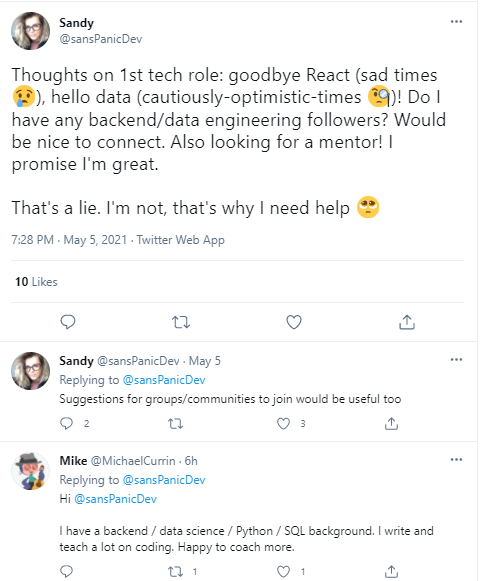
How to Find a Mentor Online

Success in many areas of life depends on personal and professional development, and finding a mentor can help.

You can’t successfully take the journey to personal and professional development alone.

Mentorship simply means a relationship between you (the mentee) and a more experienced person (mentor) that benefits your growth.

How to Find a Mentor

Finding the right mentor is never an easy task. However, if you know how to go about it, you could connect with the one who can transform your life. Here are a few tips on how to find a mentor:

Know What You’re Looking for in a Mentor

The first step in finding a mentor is having a clear picture of what you’re looking for. A few qualities to look for in a mentor include:

  • relevant knowledge, expertise, and experience
  • enthusiasm to impart their knowledge
  • ability to give honest feedback
  • empathy
  • passion for the field/skills you want to grow in

There may be many people who can mentor you. However, not all of them can do so successfully. As with any other relationship type, find someone who understands and is willing to invest in you.

Join a Mentorship Platform

There are several mentorship platforms created to help connect mentees to mentors.

Examples of such platforms include:

MentorCruise

MentorCruise is one of the best mentorship platforms for those in tech, design, and business

One of its advantages is it’s a two-sided marketplace. Mentees can look for mentors and vice versa. Mentors set prices, usually $150 to $250 per month with a seven-day trial.

GrowthMentor

As the name suggests, GrowthMentor is a mentorship platform targeted at growth hackers.

GrowthMentor’s most significant selling point is the unlimited calls with mentors. You can also post help requests and have mentors reply to you. You get all this and more starting at $50 per month paid yearly.

Pelion

Pelion connects developers to experienced mentors in their fields of expertise.

Featuring mentors from top tech companies worldwide, it’s one of the best mentorship platforms for those in tech. Mentors set prices, usually starting at $300 per month.

Clarity

Clarity operates on a simple model where you browse through their community of experts and request a call with your mentor of choice. Unlike other platforms, you usually only work with a mentor briefly to solve an immediate problem.

Mentors set per-minute rates, as this method is done via a call rather than an ongoing mentorship setup.

Reach Out to Your Existing Network

One of the best ways of finding a mentor is to look within your existing network. Find some people in your network who have already achieved what you want to achieve. Make a list of those people, looking closely at each one to help you narrow your list.

Once you’ve established who will make for a suitable mentor, reach out to them, asking if they’d be willing to take you on as a mentee.

With this method, you don’t have to start a relationship from scratch or hope you and your mentor get along.

If you can’t think of someone you already know, though, reach out to other members of your network. They could potentially recommend a perfect match for you.

Go to Professional Networking Events

Professional networking events connect you to people in your exact industry who have the knowledge, skills, experience, and connections you need.

The key to finding a mentor at professional networking events is to attend as many events as possible. Observe experienced participants and take note of those who fit your desired mentor profile.

Find an Industry Meetup

Industry meetups are similar to professional networking events because they’re full of people in your field looking to learn more, but they’re not strictly about networking. Examples of industry meetups include:

  • conferences
  • networking and speaking events
  • trade shows

You can also consider attending informal meetups organized by players in your industry or created through online platforms like Meetup.

Attend Volunteer Events or Social Clubs

Volunteer events and social clubs let you meet new people and learn what’s important to them. While these may not necessarily be industry-specific, you never know who you may encounter—perhaps the person cleaning the kennel next to you at the animal rescue is an established person in your field!

Consistently attending volunteer events and social clubs could help you get to know the regulars. Doing this will help you see who will make a suitable mentor for you in a situation outside of work.

While this takes a lot of time on your part and may not work all the time, you could find yourself doing good for your community and having fun, if nothing else.

Use Social Media

Social media helps people worldwide and from all walks of life connect on an equal level.

That’s what makes it an excellent tool for finding mentors.

How to Find a Mentor - Use Social Media

Most social media platforms allow you to search using keywords and hashtags. These features make it easier to filter according to the specific criteria you’ve set for the type of mentor you need. You can then monitor your potential mentors’ activities to check for authenticity and engagement.

So which social media platforms are best for finding mentors?

The answer depends on which social media platforms are most popular in your industry. However, the platforms that are likely to help you find a mentor online are:

  • LinkedIn
  • Facebook (especially Facebook Groups)
  • Instagram
  • Reddit
  • GitHub

A word of advice: Never pitch your prospective mentor outright. To increase the chances of accepting you as a mentee, engage and interact with their posts first. You want them to know who you are and what you value.

4 Tips for Getting the Most of Your Mentorship

Finding the right mentor is only half of the mentorship equation. You must also know how to get the most out of your mentor/mentee relationship. Here are a few tips to help you do that:

1. Have a Goal for Your Mentorship

Sit down with your mentor to discuss what the outcome of the mentorship should be. Doing so will help both of you focus on what matters the most in the mentorship relationship. Without clear-cut goals, you won’t know whether you’re making progress or not.

2. Prepare for Your Sessions

Never attend a mentoring session without first preparing for it. Remember, these sessions are for your benefit, so you must put in the work to ensure you maximize the time your mentor is giving you. Before your meeting, you should:

  • Review the notes from your last meeting.
  • List down questions you want to ask.
  • Set goals for the upcoming meeting.

While it’s your mentor’s responsibility to impart knowledge, you should also play a role in driving the conversations.

3. Know How to Give Feedback

An essential aspect of your relationship with your mentor is the feedback process. While most feedback will come from them, there are several times when you’ll also be expected to provide feedback. Here are a few tips to help you do that:

  • Avoid vague statements—be specific.
  • Only give feedback when it’s solicited.
  • Be descriptive rather than evaluative.

You must also be honest with your feedback. Trying to sugar-coat feedback will only slow down the process. Don’t be rude, but be clear.

4. Learn to Take Constructive Criticism

Part of the growth process involves receiving criticism. Not all feedback you’ll get from your mentor will be positive. You must learn to accept and handle negative feedback well. It’s only when you are open and receptive to constructive criticism that you’ll get the most out of your relationship with your mentor.

Remember, though: Constructive criticism isn’t the same as destructive criticism. The former helps find solutions, while the latter only finds problems. Assume positive intent—maybe you and your mentor communicate differently, or one of you is simply having a bad day.

But, if you’re only finding problems and not solutions, seek a new mentor and kindly exit this relationship. There are plenty of mentors out there!

Why Should You Find a Mentor?

No matter where you are in your business or career, you could benefit from having a mentor.

You can have many mentors as long as their knowledge and experience don’t overlap too much. Each member of your group of mentors should bring something unique to the table.

A few reasons why you must consider finding a mentor include:

Expedite Your Progress

One of the most significant advantages of mentorship is it could speed up your progress toward a goal. Mentors help you avoid common mistakes many in your niche/industry make. They may also show you the right steps to take to get where you want to go. As a result, your progress could be faster.

Extend Your Network

Another reason to consider finding a mentor is it can help expand your professional network. A mentor who has been in the industry for a long time has likely made some valuable connections. Access to a mentor may grant you access to those connections.

Improve Your Professional Skills

One of the best ways to learn and improve a skill is to get someone to teach you. That’s precisely what mentors do. If you want to enhance your professional skills, mentorship may be the best way to go about it.

Widen Your View of Your Field, Niche, or Industry

A common frustration many face in business and on their career paths is hitting a plateau. This usually happens because of not seeing other alternatives and ways to grow. Thankfully, because a mentor can often see the bigger picture, they could advise you on continuing to move on an upward trajectory.

As you can see, mentorship has several benefits for both your personal and professional development.

Conclusion

Mentorship is an essential part of the success equation. Whether you want to master digital marketing, programming, or any other career discipline, the best way to develop yourself is through mentorship. No matter your field, industry, or even level of expertise, mentorship is one of the most effective ways to help you level up.

For that to happen, however, you must know how to find a mentor. Using the advice outlined above, you can improve the chances of finding the right mentor.

Have you ever gone through mentorship or mentored someone? What was the experience like?

How to Decide on a Business Name: Tools, Tips, and Strategies

There are dozens of considerations entrepreneurs have to keep in mind when launching a new company, from the logo to the product to the packaging. The business name, however, may be the most important of all.

There are over 30 million small businesses in the U.S., according to the U.S Small Business Administration. That means you have to go above and beyond to stand out. The right name can help you do just that.

If you’re stuck on what to call your business or just want to make sure your chosen name ticks all the right boxes, I’m here to help.

In this article, I’ll cover my top tips for picking a winning business name, show some examples of what a great business name looks like, and even let you in on a sneaky way to get a load of business name ideas fast.

10 Tips to Pick a Business Name

Your business name can be almost anything you want it to be. As long as it’s legal and isn’t already in use, you’re good to go. However, there are several best practices most legal and marketing experts agree on.

I recommend the following tips to make sure your business gets off to the best start possible.

1. Ensure the Business Name Is Not Copyrighted or Trademarked

The first step in picking a business name is to make sure it doesn’t infringe any copyrights or trademarks. You can search copyright records and trademark records online.

I’d recommend going one step further and make sure it’s possible to trademark your brand name. You never know what the future will bring, after all. Even if you plan to keep your business small, I strongly recommend making sure it’s possible to copyright and trademark your brand.

Not doing so could land you in hot water years down the line. Just look at Apple. When Steve Jobs started the company, he chose Apple’s name because he was a fan of the Beatles (their recording label was called Apple Records).

There wasn’t any conflict initially because the two companies operated in completely separated industries. That was until Apple launched the iPod and the iTunes store, however. When they started operating in the same industry, Jobs quickly found himself saddled with a lawsuit.

2. Ensure the Business Name Isn’t Already Taken

This is a no-brainer, but it’s important to mention. Ideally, your business name will be unique and not used by any other business in existence. At the very least, it shouldn’t be used in any way by other companies operating in your industry.

A quick Google search can help you out here. If any results or domains come up that suggest another company is already using your name, either as a business name or as the name of one of their products, then it’s time to go back to the drawing board.

3. Ensure the Business Name Is Descriptive

You want customers to have an idea of what your business does just by hearing your name. You don’t have to know anything about TripAdvisor to know it is in the travel industry or that Burger King sells burgers.

Don’t be so descriptive that your name is downright boring, however. Seattle Plumber Inc. isn’t exactly inspiring and doesn’t separate your brand from any other plumbers in the city. First Call Plumbing is much catchier and easier to remember.

4. Make Sure the Matching Domain Name Is Available

Coming up with a brilliant business name is just the start. Before you can commit to it completely, make sure a matching domain name is available.

If it is, buy it.

If not, consider coming up with another business name. Having a domain name that is the exact match of your brand can be a real boost, particularly when it comes to SEO.

If your heart is set on a specific name, then all is not lost. There are several strategies you can use if your domain name is unavailable. Adding extra words or extending the name of your brand in your URL is becoming increasingly common.

5. Get Creative

This is your chance to embrace your inner copywriter and let your imagination and creativity run wild. Don’t be afraid to make something up. Almost three-quarters (72 percent) of the best brand names use made-up words or acronyms.

There are a couple of reasons for that. Firstly, existing words already mean something to many of your potential customers. You’ll need to decide whether this is a good or bad thing. Second, competitors may well be using the same or similar words.

6. Don’t Choose a Business Name That Is Hard to Pronounce or Spell

You’ll want your brand name to be accessible for everyone. That means no words that are impossible to pronounce when written down or easy to misspell.

While mixing up the letters or removing vowels from common words may look cool, it doesn’t help your customers find your business online. If customers can’t easily search for your business after hearing your name phonetically, there’s a good chance you’ll miss out on leads. You’ll also spend a lot of time spelling out your URL for customers.

7. Complete a Secretary of State Search

One way to make sure your business name is different from everyone else operating in your area is to complete a Secretary of State Search. Most states have a way to do this easily online, so it’s simply a matter of visiting your state’s website and typing in your proposed name.

If in doubt, ask your attorney for help. I’d also recommend searching in Delaware, even if you don’t live in that state. Delaware is a haven for company registrations, and so searching there helps ensure no businesses anywhere else in the country have similar names.

8. Get Feedback on the Business Name Before Making It Official

Test your business name out on your friends and family and get their feedback before committing to it. While you may think you’ve looked at your name from every angle, there’s a chance you’ve missed something.

If you’re not sure about a business name yet, give people a shortlist of your ideas and ask them to pick their favorite. If everyone agrees on the same one, you may just have found your new name.

9. Choose a Business Name That Isn’t Accidentally Offensive

Make sure your business name doesn’t mean something offensive in another language or as a slang term.

No self-respecting business owner would want to insult potential customers. Yet dozens of businesses do this without knowing it because of their business name.

Just because your business name isn’t offensive in your own country doesn’t mean it’s inoffensive everywhere. Any language or cultural issues can spell bad news for companies wanting to expand abroad.

Luckily, it’s never been easier to check whether your business name is offensive or not. Just head over to WordSafety.com and enter your proposed name. The site will quickly find whether there are any potential issues.

10. Keep It Simple and Easy to Remember

Long, complicated business names are bad news. The shorter, catchier, and more memorable your name is, the better. Try to keep it under 20 characters for the sake of your URL and avoid combining more than three different words.

Examples of Great Business Names

Tips and guidelines aren’t always enough to get the creative juices flowing. That’s why I’ve compiled five examples of great business names below, along with a description of what makes them so good.

Hopefully, these will give you a jumping-off point.

Google

Examples of Great Business Names - Google

In a parallel universe, someone is currently searching for something on BackRub. That’s the name Google was initially called because of the backlinks it used to rank websites. Eventually, they settled on Googol, a mathematical term for a number with a million zeros in it. The final brand name of Google was the result of a spelling error by an employee.

In the end, it worked out brilliantly. The name is catchy, creative, and random. “Google” is also easier to spell, remember and pronounce than Googol too.

Whole Foods Market

Examples of Great Business Names - Whole Foods

Whole Foods Market is the most descriptive name on this list, and that is part of the reason it’s so effective. It sends subtle signals that attract the brand’s target audience.

Choosing the word market rather than grocer or store was a stroke of genius in this regard. Market conjures up images of farmer’s markets and suggests the kind of well-off consumer Whole Foods’ targets.

Lego

Examples of Great Business Names - Lego

Lego is a simplified portmanteau of the Danish words leg godt meaning “play well.” Brilliantly, Lego also means “I put together,” so the name works on two levels.

Not only is the name descriptive for the native Danish market, but it also sounds great in other languages and doesn’t have any additional meanings.

Pepsi

Examples of Great Business Names - pepsi

Caleb Davis Bradham, the inventor of Pepsi, originally called his concoction Brad’s Drink. Thankfully, he rebranded three years later. Pepsi is derived from the word dyspepsia, which means indigestion as Bradham believed the drink aided digestion.

Pepsi is way more creative and memorable than Brad’s Drink. Perhaps most importantly, the new name in no way infringed on Coca-Cola, created just a handful of years earlier.

Verizon

Examples of Great Business Names - Verizon

Verizon was formed in 2000 by the merger of Bell Atlantic and GTE. The business name combines the Latin word for truth, veritas, and horizon to signify the new company’s honest and forward-thinking nature. It’s creative, it has meaning, and it’s definitely memorable!

Use a Business Name Generator to Find Your Perfect Name

If you’re still stuck, help is at hand in the form of business name generators. There are plenty of software tools to help entrepreneurs quickly brainstorm business names.

Here are some to try:

Shopify

Shopify is famous for helping small business owners thrive. Coming up with a brand name is no different. Enter a keyword into the search bar, and Shopify will instantly spit out 100 business names you can create a store from today.

Freshbooks

Bookkeeping software Freshbooks has a pretty comprehensive business name generator that tailors recommendations based on your industry.

Start your search by choosing whether you operate in creative and marketing, legal or business services, trade, and home services, or IT. Enter a keyword, and Freshbooks will serve up three suggestions. You can ask for more suggestions or change your keyword to get a different batch of names.

Namelix

Namelix is a free AI-powered business name generator. Enter one or several keywords to get started, then filter suggestions by name, length, and style. There are hundreds of names to scroll through and a mix of basic and premium names. Premium recommendations come with a logo and domain name attached to make building a brand easier.

Conclusion

The right name can impact your SEO, branding, and customer perception. Would Google be where it is now if it was called Backrub? I don’t think so.

The business landscape is becoming more competitive every day, and a great business name can help your brand stand out.

Take inspiration from some of the great business names already out there, and use a business name generator if necessary. Just make sure your business name sets you up for long-term growth.

What are you going to call your new business? Let me know in the comments!

Alisson's stoppage-time winner keeps Liverpool's top-four hopes alive

Liverpool’s quest for the top four looked to have run out of steam at West Brom, until goalkeeper Alisson headed home a 94th-minute winner.

The post Alisson's stoppage-time winner keeps Liverpool's top-four hopes alive appeared first on Buy It At A Bargain – Deals And Reviews.