Why would you want to take time and effort to attract organic Facebook leads when you could just pay for prospects?
Organic leads are free, and there are plenty of ways to get started, even if you’re not sure how. Social media sites like Facebook provide several free tools to start building a community, including:
Facebook groups
stories
posts
Facebook also provides an “insights” tool, allowing you to measure responsiveness, reach, and clicks.
Then there’s the overall effectiveness of your advertising. To get the best results from your campaigns, some say it’s better to combine paid and free social media leads.
Another advantage with organic leads is these prospects are already interested in your product or service. They may just need some nurturing to convince them to buy.
If you need a further reason, here it is: Your organic ads can allow you to build lasting results from people who already feel they know and trust you.
That’s the main benefits covered. However, how do you start getting a steady stream of organic leads?
This article will explain, but first, let’s go over the difference between organic and paid Facebook leads.
What Are Organic Facebook Leads?
As explained above, you don’t pay for organic Facebook leads. Instead, you build them by creating written and visual content and sharing it wherever you think your audience might be.
Organic leads are crucial to any inbound marketing campaign, and they can ensure you get interest from your ideal prospects.
While organic Facebook leads won’t cost you anything, gaining them may be time-consuming, and your results can depend on your creativity levels, where you place your content, and the way you promote it.
In contrast, paid ads are advertising services you pay for on a specific platform. Paid leads are usually known as PPC ads. Social media sites all provide PPC ads in varying forms. In Facebook’s case, you can create customized lead ads, for example.
5 Tips to Get Facebook Leads Organically
Getting Facebook leads organically doesn’t need to be complicated. With some proven methods, you can start getting free traffic from interested prospects.
In the following section, you’ll find five ways and some tips on how you can implement them yourself.
1. Join Facebook Groups for Your Industry and Post Links to Your Website
When Facebook announced a greater focus on “meaningful” discussion, it was met with positive results.
The move meant the social network’s users are now more engaged with groups, and Facebook says 400 million people are in groups that it considers meaningful.
Not only that, Facebook believes in groups so much it paid an estimated $10 million for a SuperBowl ad, writes CNBC.
That’s a huge audience and a lot of prospects.
Since these groups already have an active membership of interested followers, why not reach out to them?
Join some industry-related groups. Begin posting helpful content and answering questions where you can. Feel free to talk about your business and what it does to get people to message you on Facebook or your website. Just make sure you’re not overly promotional.
When looking for suitable groups to join, you’ll have to think of your typical audience and the day-to-day problems they may have. If your product or service can solve them, sign up, interact with group members, and get conversations rolling.
You can do this by:
posting informative content
asking and answering questions
offering free content to get group members to sign up for your newsletter or your other marketing materials
Although there are no golden rules for posting in groups as such, you may like to consider a few things:
When you use the group approach, ensure you’re consistent. You may not see results at first, but you should in time if you’re targeting the correct groups.
Get the balance right. You’ll need to be visible in groups, but you don’t want to reply so often it looks like spam.
Since their introduction, Facebook business pages have undergone considerable changes and continue to improve and evolve. Although business pages are getting increasingly sophisticated, just setting up a page isn’t enough: You’ll want your page to do some work by gaining organic Facebook leads.
You can do this by optimizing your page for increased clickthroughs and revenues. However, you’ll only need to optimize the parts relevant to gaining leads. Facebook suggests you concentrate on three main areas:
your business name and description
profile photos and cover photos
a call to action (CTA)
Let’s look at each of these areas.
Your Business Description
Information about your businesses’ purpose and how you can help should be readily available. Likewise, you’ll need to write a description that sells your product or service while explaining your concept.
Other ways to optimize your description for Facebook leads include:
using short, clear sentences and simple language
writing short paragraphs to make your content more scannable
highlighting the most important information at the start of your text
keeping your descriptions super-short
using keywords, but not overdoing them
Writing an About Page
Write your “About” page in the same way you would on your website. Add some background about yourself, the origins of your business, and anything you feel resonates with your target market.
Then, enhance confidence by adding a physical address and phone number so your prospects can contact you. You can also add different keywords. Use a free keyword tool like Ubersuggest to find suggestions, or try out the paid version to get extra features.
Personalize Where You Can and Add Images
Facebook has templates for a range of business categories allowing you to customize the page depending on your sector. However, templates can make every page look the same, so personalize where you can.
You can begin customizing your page by updating your business page tabs and adding customization for visitors to sign up for your newsletter.
For further branding and personalization, add a cover image and profile photo. People like to know who’s behind a business, and a strong cover image can get you noticed.
When choosing an image:
Keep it relevant and consistent with your other branding.
Finally, finish with a strong CTA. Facebook has a CTA button you can add to include contact details or to make a booking etc.
3. Post Content That Capitalizes on Current Events in Your Industry
Draw in organic Facebook leads by covering industry events and trends. You can track these through newspapers, industry press releases, trade publications, and Google Trends.
Piggybacking or “newsjacking” off current events within your industry trends works well for two reasons:
First, if a subject is at the forefront of people’s minds, they might want to find out more.
Secondly, it demonstrates your company is eager to keep up with developing events and trends.
There are a few methods you could use with this type of content.
For instance, you could write regular articles or blog posts around trending topics. However, why not get creative with video commentary and related images? The more imagination you show, the more shareable your content becomes.
Here are some creative ideas you can consider to get Facebook users sharing:
Use popular memes. Add a witty caption or include your contact info with them.
Promote specific products off the back of a trending story.
Present a video report. Or a Q&A-style video about a product or service.
Host a special offer or a deal.
4. Hold Facebook Live Events
Facebook provides a few video services, so why use Facebook Live? Well, viewership is the most pressing reason—Facebook Live has a much higher view rate.
Facebook Live lets users live stream video content in real-time, and you can choose the format. Some examples to consider are:
virtual conferences
Q&As
virtual tours
staff introductions
Above all, though, Facebook Live is a way to interact with prospects so they can get to know you better. This way, they can see the faces behind the brand and become more comfortable with your company and what you offer.
You can stream from your laptop or mobile, and you can choose who can attend your Facebook Live events. There’s also comment moderation, and you can schedule events and promote them before a live stream.
If you haven’t used Facebook Live before, don’t worry. You don’t need to be a tech whiz. However, if you’re looking for guidance, you’ll find tutorials readily available.
While there are many ways you could use Facebook Live, Sephora and Bloomberg are two brands you can mimic and adapt their approach to your strategy.
As a news channel, Bloomberg covers current events on Facebook Live. It also highlights upcoming Live events to stir interest and create anticipation.
Sephora’s past live events include beauty tips, window reveals, new products, and trends.
Consider doing the same. Offering product demos and reveals and responding to breaking news is something every brand can do to gain Facebook leads.
5. User-Generated Content
Are you looking for a free way to get content and to develop Facebook organic leads? Then consider user-generated content (USG).
UGC gives your brand authenticity and credibility in the eyes of potential prospects. After all, if happy users feel strongly enough about your brand to create content around it, that’s a good sign, right?
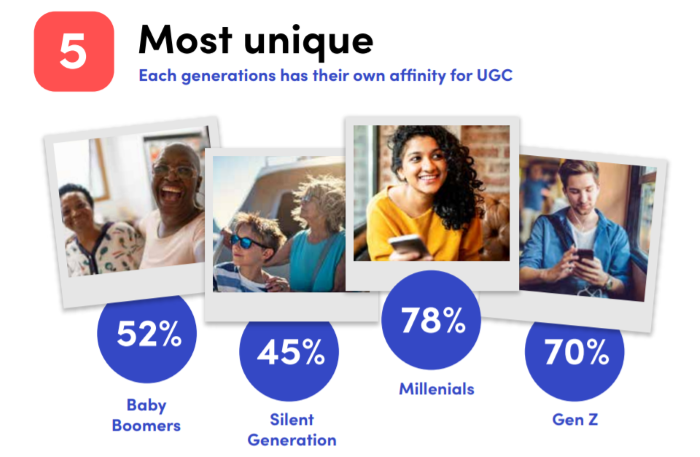
UGC is imperative to the purchasing decision, and most age groups are open to it. According to research from media experience platform Cloudinary, visual UGC content is popular among varying demographics:
Cloudinary’s survey showed:
Seventy percent of Gen X and Gen Z consumers surveyed found UGC either “extremely helpful” or “very helpful.”
Seventy-eight percent of millennials said the same.
Further, although visual UGC was less popular among other groups, 52 percent of baby boomers and 45 percent of the silent generation found it helpful too.
Sanjay Sarathy, the VP of Marketing at Cloudinary, says:
“The survey shows a clear trend of people increasingly wanting to hear from others through user-generated, visual content.”
Sarathy went on to add that brands need to analyze their content if they’re to deliver the correct mix of UGC, visual, and text content.
UGC can work incredibly well for video content on Facebook, and it’s also vital to inbound marketing by:
enabling consumers to discover your brand
attracting and closing prospects
increasing brand awareness
Many brands are already taking this approach, like Coca-Cola.
Some years ago, it launched a personalized “Share a Coke With” campaign in Australia. Coca-Cola’s digital promotion allowed consumers to send virtual Cokes on Facebook.
OK, you might not have the same advertising budget or reach as Coca-Cola, but the company shows how creativity and creating a buzz beyond the usual UGC can get you noticed.
Think about how your brand can do the same.
Easy Ways to Earn Facebook Leads Organically
Organic leads are free, and there are plenty of ways to get started, even if you’re not sure how. Here are five tips to earn more organic leads on Facebook.
Join Facebook Groups for Your Industry and Post Links to Your Website
Just make sure to add value to the group and engage in meaningful discussions.
Optimize Your Facebook Business Page
Make sure your business description and about page are complete and add images.
Post Content That Capitalizes on Current Events in Your Industry
Track events through Google Trends and use news jacking write about trending topics.
Hold Facebook Live Events
Conferences, Q&As, tours, and staff introductions can help you interact with fans.
Leverage User-Generated Content
Ask questions, share reviews, and host contests to engage followers and draw in leads.
Conclusion
With millions of users and thousands of communities, Facebook is a fantastic place to market your products and services and gain leads.
Although they may take longer to show results, organic Facebook leads can pay dividends by getting an already interested audience to visit your website, sign up for newsletters, and become customers.
By providing other group members with answers to questions, valuable insights, and industry updates, you can establish yourself as an expert while building confidence among prospects.
Using UGC, holding Facebook Live events, and piggybacking on trends are also effective ways of engaging an audience and building relationships in the long term.
Do you use organic Facebook ads? Share your tips for effective campaigns below.
Did you know that 73 percent of sellers prefer working with agencies that use real estate video marketing? Whether it’s a walkthrough of the property or a Q&A session, sellers expect their agents to use video marketing to reach the right buyers and sell their properties.
For real estate agents, this demand presents a few challenges. How do you make an engaging real estate video to impress both sellers and buyers alike, and how do you track a video’s performance for your marketing purposes?
Luckily it is not as hard as it might seem. Although real estate videos serve a unique purpose, they’re similar to regular marketing videos in many ways, so don’t be intimidated by them.
Let’s take a closer look at why real estate videos are worth the effort and how you fit them into your overall video marketing strategy.
Why Should You Create Real Estate Video Ads?
Real estate videos do two things: they attract buyers to your listing, and they encourage prospective sellers to choose your agency over your competitors.
Are they worth the effort, though, when you could create social media ads or optimize your listings? Maybe with the current market, you think it will be a waste of resources. Let’s look at what the numbers say.
46 percent of buyers think video tours are the most influential content on an agency’s website.
Listings with embedded videos are 53 times more likely to rank highly on Google than listings without embedded video.
You’ll earn around 60 percent more qualified leads through real estate videos.
A caring personality is one of the top reasons sellers choose a particular agent or agency, and that’s easier to share in a video than, say, a picture or article.
What’s more, 84 percent of video marketers feel they’ve generated more leads thanks to video marketing, and 94 percent of us use videos to learn more about the products we’re buying.
The takeaway? To draw traffic to your listings and impress your sellers, try out real estate video marketing.
Before we dig into strategies, let’s cover the basics.
What Equipment Do You Need to Create Real Estate Video Ads?
There’s no need to spend a fortune on top-of-the-range lighting, props, or cameras. However, you’ll still need some recording equipment before you shoot your first real estate video. How much you spend depends on your marketing budget, but let’s break down the basics.
First, you’ll need a camera capable of shooting in 4K or HD to make sure the videos are high quality and not blurry or pixelated. A smartphone works, too.
If you opt for a camera, make sure it’s capable of capturing both high-quality video and images. Practice shooting with the camera before filming day to ensure you get the most from the equipment.
Using a smartphone? Clip on a wide-angle camera lens. This allows you to shoot larger scenes while minimizing glare and improving image quality. Here’s what the lens looks like:
Lenses like this one shown above are cost-effective and widely available, so shop around.
Want to go all-out? You can always buy a drone for 360 aerial footage. However, you’ll probably need a permit to fly a drone in most areas, so keep that in mind.
Next, you’ll need lighting filters. Use a neutral density filter for shooting outside, and get a pocket-sized LED light you can attach to the camera (or smartphone) for filming in poorly-lit areas.
Got the lighting sorted? Now you’ll need a microphone. You can either buy a mic attachment for your smartphone, or a portable mic for attaching to any camera device.
You’ll also need editing software. Check out tools like Adobe Premiere Pro and Final Cut Pro X for professional editing support. You’ll likely pay for a subscription, but they’re easy enough to master, and you’ll produce the sharpest, most professional videos this way. Alternatively, you could outsource editing to a freelancer.
Finally, you’ll probably need a stabilizer like a selfie stick or a gimbal. These tools keep your camera steady and minimize shaking while you walk around a property.
10 Tips for Successful Real Estate Video Ads
A real estate video is all about setting a great first impression. You want to bring the property to life, connect with potential buyers, and ultimately set yourself apart from other realtors with your professional marketing skills.
To help ensure your content achieves these goals, here are ten tips to produce the highest-quality real estate video ads.
1. Know Your Real Estate Video Ad Budget
Be clear about what you can afford to spend on video marketing. Unsure how to allocate your budget? Let me give you a few pointers.
First, consider your target audience. It’s worth watching real estate videos in your listing’s price range to see how your efforts compare to your competitors’ video ads.
Next, think about how much you’ll spend on actually promoting your videos. From social media ads to targeted email marketing, the costs can eventually add up. To keep things more cost-effective, repurpose your real estate videos into digital ads so you can double your content output without spending more.
Also, take the time to research paid ad strategies, or hire a digital marketing consultant to take care of the budget, targeting, and testing.
2. Plan Your Angle in Advance
A great real estate video doesn’t just happen. It takes planning. Remember, you’re trying to tell a story, so you need to spend time thinking about what story you want to tell.
For example, determine what equipment you’ll need, whether you’ll hire actors to play any roles, and what time of day or night you plan on filming. Do you want to sell your own real estate skills or help a buyer fall in love with an unusual property?
Depending on the seller, you might also need their approval before you start filming or sending the video out to prospects, so factor in time for adjusting your angle and making changes as required.
3. Keep Your Real Estate Video Ad Short and Sweet
The length of your real estate video depends on where you’re marketing it. For example, according to HubSpot, popular Twitter videos average around 43 seconds, while popular YouTube videos run a little longer at two minutes.
A real estate video can be as long as six minutes, but it’s not always wise to fill this time. Why? People have short attention spans. Don’t risk losing a potential buyer’s attention just because you’ve added 30 or 40 seconds of filler to your video.
For example, here’s a video for a property listed by Douglas Elliman. It’s just over 90 seconds long, but it’s visually engaging and covers every angle a potential buyer needs to see without extra fluff:
4. Script the Video
Great real estate videos typically follow a three-act story structure, according to research by Vimeo.
Act one: Give a clear, frontal view of the property and a few clips of the neighborhood.
Act two: This part focuses on showcasing each room. Start with the main feature rooms before moving on to the smaller rooms.
Act three: End the video ad with an exterior view of the property. If you’re using drone footage, place it here.
Remember, you’re telling a story, so following a traditional story structure works!
5. Provide an Engaging House Tour
If you want to ensure a prospect watches your video the whole way through, keep it engaging. Be enthusiastic. Show people why you’re excited about the property, and inspire potential buyers to envision themselves living in the property.
Focus on the possibilities. What could make this property truly special for the right buyer? How might the property be flexible over time? For example, a first-floor bedroom can be an office now and a bedroom for an aging parent or partner later. A basement can be a game room, an in-law suite, or an at-home gym. Drive home how the property can meet their needs over time.
6. Focus on Special or Unique Features
No matter the price range, every property boasts a special, unique, or at least intriguing feature.
Maybe there’s cool history attached to the building, or there’s a custom marble countertop in the kitchen. Or, maybe it’s just the first house to come to market in the area for a long time.
To identify unique features, ask the buyer what changes they’ve made since they bought the house, and if it’s an older property, identify if they kept any key features like original wooden flooring.
Special features can be anything from dual sinks to fully-landscaped gardens, so look for those little quirks that make the property unique compared to similar properties.
For example, this property in Montecito has a wine rack:
Plus, it boasts a hot tub:
Capturing these features in the video highlights the unique aspects of this home.
7. Show Off the Neighborhood
It’s great to show off a property, but what’s going on around it? Include a few clips of the surrounding area, even if you just zoom out to capture the apartment block and a couple of nearby amenities. Make sure to include any famous landmarks, fun events, schools, and even sidewalks.
Is the neighborhood a little rundown or potentially off-putting? An aerial view might work best, so you don’t focus too much on the finer details.
8. Sell the Lifestyle
When you’re looking for a property, it’s not just about the unit. It’s about the life the buyer will lead when they live there. For example, if you’re near the beach or a park, talk up the family-friendly vibes. Are you close to the buzz of shops, restaurants, and cafes? Highlight the walkable, cosmopolitan lifestyle.
Use the property to sell the lifestyle, too. For example, going back to the Montecito property, the landscaping gives off seriously chilled, secluded vibes:
9. Interview Neighbors
People make neighborhoods. After all, who better to tell you what a neighborhood is really like than the residents? Try to get a testimonial or two to add some authenticity and personality to your real estate videos.
Unless it’s a new neighborhood, try to find residents who’ve lived there a few years. Otherwise, potential buyers might wonder why people don’t stay there very long!
10. Use Interactive Elements
From CTA buttons to clickable links, interactive elements help bring your videos to life. Use your editing software to add a CTA inviting people to book a showing, or include a link to a page where buyers can learn more about the listing and the services you offer.
Remember, real estate videos are a marketing tool. Use them effectively and treat them as you would, say, a YouTube video or digital ad.
Measuring the Success of Your Real Estate Video Ads
You’ve filmed your real estate video and launched some ads. How do you know if it’s working for you? The answer’s in your metrics. Here are five key metrics to track if you’re trying to measure your success rate.
View count: Your view count tells you, well, how many people watched your video!
Engagement: Video engagement levels tell whether people watch your video all the way through or stop watching.
Click-through rate: Want to know if people interact with your video and click those links and buttons? Check the click-through rate.
Conversions: Your conversions tell you if people are taking the desired actions, such as booking a showing or signing up for a newsletter.
Social media shares: Are people sharing your videos across social media? It’s a good sign if they are, so track your social media shares.
To get this data, either integrate your videos with your usual marketing platform to track metrics, or use a dedicated video analytics platform like Vidyard.
Conclusion
Video ads bring a whole new dimension to real estate marketing. With the right editing tools, a sharp eye for detail, and some enthusiasm, you can bring your property to life or show possible clients why you are the best choice.
There’s one final point to remember. You can shoot a clear, engaging, and professional real estate video with little more than a smartphone.
Don’t feel like you need to splurge to create successful video ads unless it’s within your budget to do so!
To determine creditworthiness, Brex checks a company’s cash balance, spending patterns, and investors.
You can get 7x points on rideshare. Get 4x on travel. Likewise, get triple points on restaurants. And get double points on recurring software payments. Get 1x points on everything else.
You can have bad credit (even a 300 FICO) to qualify.
Get a First Time Business Credit Card for Fair Credit
Capital One® Spark® Classic for Business
Have a look at the Capital One® Spark® Classic for Business. It has no annual fee. There is no introductory APR offer. The regular APR is a variable 26.99%. You can earn unlimited 1% cash back on every purchase for your company, without any minimum to redeem.
While this card is within reach if you have average credit scores, beware of the APR. However if you can pay on schedule, and completely, then it’s a bargain.
Get a First Time Business Credit Card with No Annual Fee
No Yearly Fee/Flat Rate Cash Back
Ink Business Unlimited℠ Credit Card
Have a look at the Ink Business Unlimited℠ Credit Card. There is no yearly fee for the first year. Then pay $250 per year. There is no introductory APR deal. If you pay your bill early, you get a 1.5% discount, with no cap on what you can earn back.
Earn 5% cash back at office supply stores and on cellular and landline phone service, internet, and cable TV; 2% cash back at gas stations and restaurants; and 1% cash back on everything else.. 5% and 2% cash-back bonus rewards apply only to the first $25,000 spent on the corresponding bonus categories each account anniversary year. You will need exceptional credit scores to get this card.
Business Credit Cards with a 0% Introductory APR – Pay Zero!
Blue Business® Plus Credit Card from American Express
Check out the Blue Business® Plus Credit Card from American Express. It has no yearly fee. There is a 0% introductory APR for the initial year. Afterwards, the APR is a variable 13.24 – 19.24%.
Get double Membership Rewards® points on day to day business purchases like office supplies or client suppers for the initial $50,000 spent per year. Get 1 point per dollar afterwards.
You will need good to excellent credit to qualify.
Also have a look at the American Express® Blue Business Cash Card. Note: the American Express® Blue Business Cash Card is identical to the Blue Business® Plus Credit Card from American Express. Yet its rewards are in cash as opposed to points.
Get 2% cash back on all qualified purchases on up to $50,000 per calendar year. After that get 1%.
It has no yearly fee. There is a 0% introductory APR for the initial 12 months. After that, the APR is a variable 13.24 – 19.24%.
You will need great to excellent credit to qualify.
Check out the Capital One® Spark® Cash for Business. It has an introductory $0 yearly fee for the first year. Afterwards, this card costs $95 per year. There is no introductory APR offer. The regular APR is a variable 20.99%.
You can get a $500 one-time cash bonus after spending $4,500 in the initial three months from account opening. Get unlimited 1.5% cash back with Cash Select.
You will need great to outstanding credit to qualify.
Check out the Discover it® Business Card. It has no yearly fee. There is an introductory APR of 0% on purchases for one year. After that the regular APR is a variable 14.49 – 22.49%.
Get unlimited 1.5% cash back on all purchases, with no category restrictions or bonuses. They double the 1.5% Cashback Match at the end of the first year. There is no minimal spend requirement.
You can download transactions quickly to Quicken, QuickBooks, and Excel. Note: you will need good to outstanding credit to qualify for this card. https://www.discover.com/credit-cards/business/
Check out the Ink Business Cash℠ Credit Card. It has no yearly fee. There is a 0% introductory APR for the initial year. After that, the APR is a variable 13.24 – 19.24%. You can get a $750 one-time cash bonus after spending $7,500 in the initial 3 months from account opening.
You can get 5% cash back on the first $25,000 spent in combined purchases at office supply stores and on web, cable, and phone services each account anniversary year.
Get 2% cash back on the first $25,000 spent in combined purchases at gasoline stations and restaurants each account anniversary year. Earn 1% cash back on all other purchases. There is no limitation to the amount you can earn.
Bank of America® Business Advantage Cash Rewards MasterCard® credit card
Have a look at the Bank of America® Business Advantage Cash Rewards MasterCard® credit card. Get an 0% introductory APR for the first 9 billing cycles of the account. Afterwards, the APR is 12.24% – 22.24% variable. There is no annual fee. You can get a $300 statement credit offer.
Get 3% cash back in the category of your choice. So these are gas stations (default), office supply stores, travel, TV/telecom & wireless, computer services or business consulting services. Earn 2% cash back on dining. So this is for the initial $50,000 in combined choice category/dining purchases each calendar year. After that earn 1% after, with no limits.
Get a First Time Business Credit Card with Flexible Financing
The Plum Card® from American Express
Check out the Plum Card® from American Express. It has an introductory yearly fee of $0 for the first year. Afterwards, pay $250 each year.
Get a 1.5% early pay discount cash back bonus when you pay within 10 days. You can take up to 60 days to pay without interest when you pay the minimum due by the payment due date.
Unbeatable Cards for Jackpot Rewards That Never Expire
Capital One® Spark® Cash Select for Business
Take a look at the Capital One® Spark® Cash Select for Business. It has no annual fee. You can get 1.5% cash back on every purchase. There is no limit on the cash back you can earn. Also earn a one-time $200 cash bonus as soon as you spend $3,000 on purchases in the first 3 months. Rewards never expire.
Pay a 0% introductory APR for 9 months. Then pay 13.99% – 23.99% variable APR after that.
You will need good to exceptional credit to qualify.
Fuel prices are already high, for reasons unrelated to gasoline supply. A prolonged shutdown of Colonial’s line could make for an expensive summer for drivers.
This website uses cookies to improve your experience. We'll assume you're ok with this, but you can opt-out if you wish.AcceptRejectRead More
Privacy & Cookies Policy
Privacy Overview
This website uses cookies to improve your experience while you navigate through the website. Out of these, the cookies that are categorized as necessary are stored on your browser as they are essential for the working of basic functionalities of the website. We also use third-party cookies that help us analyze and understand how you use this website. These cookies will be stored in your browser only with your consent. You also have the option to opt-out of these cookies. But opting out of some of these cookies may affect your browsing experience.
Necessary cookies are absolutely essential for the website to function properly. This category only includes cookies that ensures basic functionalities and security features of the website. These cookies do not store any personal information.
Any cookies that may not be particularly necessary for the website to function and is used specifically to collect user personal data via analytics, ads, other embedded contents are termed as non-necessary cookies. It is mandatory to procure user consent prior to running these cookies on your website.











 at the end of the first year. There is no minimal spend requirement.