
Fundability and Credibility Go Hand in Hand

Fundability is like a huge ball of yarn, full of layers and twists and turns that all touch each other. At its core, it is how a lender views a business in relation to whether or not it will repay debt.  If a lender views a business as one that is fundable, that means that they feel the business is willing and able to repay any debt that may be extended.  However, the fundability of your business can affect so much more than your ability to get a business loan. It can affect your credibility with virtually everyone you do business with. 

How Your Fundability Can Affect your Credibility with More than Just Lenders

It sounds unlikely on the surface because most people associate fundability with credit score.  However, when you consider that credit score is only one small slice part of what makes a business fundable, your perspective will change.  

There are literally hundreds of things that can affect fundability.  Before you can understand how fundability affects credibility with more than just lenders, you have to understand how all the pieces of that makes a business fundable fit together and affect each other. 

Keep your business protected with our professional business credit monitoring

A Fundable Foundation

Fundability starts with how your business is set up.  It has to appear to be a fundable entity separate from you, the owner.  This is necessary for a few reasons. First, it protects you personally.  Second, it allows you to build separate business credit, which is also a huge part of fundability. 

How do you accomplish this?  Well, like any foundation, it is best to start at the beginning.  It will be faster and easier if you do. However, if your business is already up and running, you may not have that option.  It’s never too late to start, but start now. The longer you wait the harder it will be. 

Contact Information

The first step in setting up your business to be fundable is to ensure your business has its own phone number, fax number, and address.   That’s not to say you have to get a separate phone line, or even a separate location. You can have a dedicated number forwarded to your current phone. You can even still run your business from your home or on your computer.  A fax machine is not even necessary. Find out more about how all of this works here

EIN

The next thing you need to do is get an EIN. This is an identifying number for your business that works similar to how your SSN works for you personally.  Some business owners use their SSN for their business transactions such as opening credit accounts. This is what a lot of sole proprietorships and partnerships do.  However, it really doesn’t look professional to lenders, and it can cause your personal and business credit to get all mixed up. To be fundable, you need to apply for and use an EIN.  You can get one for free from the IRS.

Incorporatefundability Credit Suite

Incorporating is absolutely necessary to set up your business to be fundable.  It lends credibility to your business as one that is legitimate. In addition, offers some protection from liability. 

Which option you choose does not matter as much for being fundable as it does for you budget and needs for liability protection.  The best thing to do is talk to your attorney or a tax professional. If you do not do this from the beginning, there will be some issues to work through. When you incorporate, you become a new entity.  This means you lose any time in business you already have. You basically have to start over. You’ll also lose any positive payment history. 

This is why you have to incorporate as soon as possible.  Not only is it necessary for fundability and for building business credit, but so is time in business.  The longer you have been in business the more fundable you appear to be. That starts on the date of incorporation, regardless of when you actually started doing business. 

Business Bank Account

A separate, dedicated business bank account is also a must.  There are a few reasons for this. First, it will help you keep business finances separate.  This is good for a lot of reasons, but the big one is tax purposes. 

However, there are also several types of funding you cannot get without a business bank account.  Many lenders and credit cards want to see one with a minimum average balance. In addition, you cannot get a merchant account without a business account at a bank. That means, you cannot take credit cards payments.  Studies show consumers spend more when they can pay by credit card.

Licenses

If anyone were to check to see if your business has all of the licenses is needs to operate and finds that you do not, it will cause a massive hit to your credibility with that person.  For a business to be legitimate, it has to have all of the necessary licenses it needs to run. If it doesn’t, warning flags are going to start waving. Research what licenses you need to ensure you have all of those necessary to legitimately run your business at the federal, state, and local levels. 

Website

I am sure you are wondering how a business website can affect your ability to get funding.  Here’s the thing. These days, you do not exist if you do not have a website. However, having a poorly put together website can be even worse.  It is the first impression you make on many, and if it appears to be unprofessional it will not bode well for you with consumers or potential lenders. 

Spend the time and money necessary to ensure your website is professionally designed and works well.  Pay for hosting too. Don’t use a free hosting service. Also, your business needs a business email address that is different from your personal one.  Make sure it has the same URL as your website. A free service such as Yahoo or Gmail will not work as well. 

Business Credit Reports

The next link is the fundability chain is business credit. Much like your consumer credit report details your personal credit history, this details the credit history of your business.  It is a tool to help lenders determine how credit worthy your business is.  

The main sources of business credit reports include Dun & Bradstreet, Experian, Equifax, and FICO SBSS.  Since you have no way of knowing which one your lender will use, you need to make sure all of these reports are up to date and accurate. 

Keep your business protected with our professional business credit monitoring

Other Business Data Agencies 

Other agencies can also impact how fundable your business is. Two examples include LexisNexus and The Small Business Finance Exchange. They gather data from a variety of sources, including public records.  This is where things can get a little sticky. These records include information on everything from arrest records to automobile accidents.   You cannot access their data or change the information they have on you or your business. What you can do is ensure that any new information they receive is positive.  Enough positive information can help negate any negative information from the past. 

Identification Numbers: Another Piece of the Fundability Puzzle

In addition to the EIN, there are identifying numbers that go along with your business credit reports.  You should be aware that these numbers exist. Some of them are simply assigned, but one of them you have to apply to get.  

Dun & Bradstreet is the largest and most commonly used business credit reporting agency.  To have a credit file in their database, you have to have a D-U-N-S number. Apply for one through the D&B website. 

Business Credit History Matters When It Comes to Fundability

Your credit history has everything to do with all that is related to your credit score.   

It consists of a number of things including: 

  • How many accounts are reporting payments?
  • How long have you had each account? 
  • What type of accounts are they?
  • How much credit are you using on each account versus how much is available?
  • Are you making your payments on these accounts consistently on-time?

The more accounts you have reporting on-time payments, the stronger your credit score will be. 

Consistency in Business Information Affects Fundability

Inconsistency in information across records can cause major problems with being fundable.  It makes your business look bad. It’s unprofessional. When you start changing things up like adding a business phone number and address and incorporating, you may find that some things slip through the cracks. 

Since a ton of loan applications are turned down each year due to fraud concerns simply because things do not match up, this is a problem.  Maybe your business licenses have your personal address but now you have a business address. You have to change it. Maybe some of your credit accounts have a slightly different name or a different phone number listed than what is on your loan application. Is all of your information up to date with your insurance agencies?  

The key to this piece of fundability is to stay on top you all of your reports, both business and personal.   Save money on business credit monitoring here

Fundability and Financial Statements

Both your personal and business tax returns need to be in order.  Not only that, but you have to pay your taxes, both business and personal.

Business Financials

It is best to have an accounting professional prepare regular financial statements. Having an accountant’s name on financial statements helps your business look more legitimate. If you cannot afford this monthly or quarterly, then at least have professional statements prepared once a year. 

Personal Financials

You need to be filing your personal taxes, and the information has to be consistent and legitimate.  Lenders will want to see it, of course, but it can affect your credibility in other ways if they are not available or correct. 

Bureaus

There are several other agencies that hold information related to your personal finances that you need to know about.  Everyone knows about FICO. Your personal FICO score needs to be as strong as possible. It really can affect how fundable your business appears, and almost all traditional lenders will look at personal credit in addition to business credit. 

Another bureau that many do not consider is ChexSystems.  They keep up with bad check activity, and it makes a difference when it comes to your bank score.  If you have too many bad checks, you will not be able to open a bank account. That will cause major fundability issues. 

For this point, everything comes into play.  Have you ever been convicted of a crime? Do you have a bankruptcy or short sell on your record?  How about UCC filings or liens? 

Personal Credit History

Your personal credit score from Experian, Equifax, and Transunion can also affect how fundable your business is.  If you need to increase your personal credit score, now is the time. The number one way to do this is to start making payments on-time, consistently.  

Also, make sure you monitor your personal credit regularly to ensure mistakes are corrected and that there are no fraudulent accounts being reported. 

Fundability: The Application Process

This piece of the puzzle affects credibility the least. It mostly affects your ability to get funding, but it is still important to understanding the entire concept of fundability.  So much plays into this that you may not even think about. First, consider the timing of the application. Is your business currently fundable? Are your business name, business address, and ownership status are all verifiable?  This also includes choosing the right loan product for your specific business and needs. 

How Fundability Affects Credibility

If a business is considered to not be credible, it will fail.  It must be credible not only to lenders, but also to customer, grantors if applying for grants, and potential investors.  If any of these sense that a business isn’t 100 percent on the up and up, it will not survive. 

Fundability Affects Credibility with Customers

I know.  You’re thinking that no customer checks a business credit score.  It’s true. I wouldn’t check on the credit score of a restaurant before going to eat there.  However, I might check online reviews. If I saw something negative, I might check to see if they have a business license.  I might also check for a report from the Better Business Bureau.  

If there is something off somewhere, it’s going to throw up a red flag to customers. While it may not deter them completely, it could certainly make them think before frequenting your business. 

Keep your business protected with our professional business credit monitoring

Credibility with Grantors

The same is true of those awarding business grants.  While they are likely not to check your credit score when you apply for a grant, there are other aspects of fundability that can make a difference.  For example, it they take a look at the grant application and it your personal address, phone number, and social security number are on there, it may cause them to pause.  If they compare with a business that, all other things equal, has an EIN and a separate business phone number, that business is going to appear more legitimate. 

Credibility with Potential Investors

This can get tricky. If you are looking for investors for a new business, you may not have any of the foundation laid yet because you are first looking for investors.  However, consider that investors can check on a number of the fundability pieces, though they may not yet be considering it as such, to determine whether or not they want to take a chance with your business. 

Fundability: How it Really Works

In truth, it isn’t so much that fundability affects all of these things, as it is that some of the same things affect your credibility with these groups and as well as how fundable your business appears to be.  It’s just further proof that the sooner you begin to make your business fundable, the better off you and your business will be.

The post Fundability and Credibility Go Hand in Hand appeared first on Credit Suite.

Land Minority Small Business Loans to Fund Your Business

If you are a person of color who runs a business, you could end up having some trouble finding traditional loans that will work with your unique needs.  Typically, there are not a lot of loans designed specifically for minority business owners. However, there are some loan options that work better than others. 

How to Find Minority Small Business Loans: What You Need to Know

What’s the trick to finding minority small business loans? Where is a minority business owner to go when the traditional options for loans do not work out?  There are a few options for minority small business loans that you may not realize are out there. Some involve the government through the Small Business Administration, while others involve going a more non-traditional route with private lenders. 

Find out why so many companies use our proven methods to get business loans

Where to Start with Minority Small Business Loans: The Small Business Administration

You cannot talk about minority small business loans without some discussion on the SBA.  While they do not lend funds themselves, they do handle the administration of a number of loan programs that help all small businesses get the funds they need through partner lenders.   

Minority Small Business Loans: 7(a) Loans 

This is the Small Business Administration’s most known program.  It provides federally funded term loans up to $5 million. The funds can be used for a number of purposes.  These include expansion, purchasing equipment, working capital and more. Banks, credit unions, and other specialized institutions in partnership with the SBA process these loans and disburse the funds. 

Minority Small Business Loans: 504 Loans 

504 loans are also available up to $5 million and can buy machinery, facilities, or land. Typically, they are used for expansion.  They work especially well for commercial real estate purchases. 

Minority Small Business Loans: Microloans 

These are $50,000 or less. They work well for starting a business, purchasing equipment, buying inventory, or general working capital. 

Minority Small Business Loans: SBA Express Loans 

These are fast turnaround loans, with the SBA taking up to only 36 hours to give a decision. There is less paper work as well, which is part of what makes express loans great if you qualify. 

Minority Small Business Loans: SBA Community Advantage Loans 

This is a pilot program running through 2020, with the potential for extension. Its purpose is to promote economic growth in underserved areas and markets. Decision makers look past such things as poor credit or low revenue if the business has the potential to create jobs or promote economic growth in underserved areas. 

These are some of their most popular programs. The Small Business Administration does so much more for small businesses in addition to these.  Get more details on the SBA, these loan programs, and additional resources offered by the Small Business Administration here.    

Other Options for Minority Small Business Loans: Private Lendersminority small business loans Credit Suite

Though not specific to minorities, some private lenders offer products that work better with the unique needs and challenges of minority business owners than others. 

OnDeck

OnDeck offers lines of credit and term loans with fixed interest rates.  You can get up to $500,000 with a term loan. Also, they have an A rating with the Better Business Bureau.  The minimum FICO they require is 600. In addition, you must have $100,000 minimum annual revenue and be in business for at least one year.  Find out more about OnDeck in our review

BlueVine

BlueVine offers a number of financing options including term loans, invoice financing, equipment financing, lines of credit, and merchant cash advances.  As a requirement, you have to be in business for at least 6 months. If you need a term loan or a line of credit, then they require a minimum annual revenue of $100,000.  For those looking for invoice factoring, the minimum credit score is just 530! If you want a line of credit or term loan, you will need a minimum credit score of 600. They have an A+ rating with the BBB.  Find out more about BlueVine in this review

Funding Circle

If you’re looking for a low APR, then Funding Circle is your go-to.  They have fixed rate term loans and require a credit score of 620 or above.  Unlike BlueVine, there is no minimum revenue requirement. However, they do require you to be in business for at least 2 years.  They have an A+ BBB rating. Find out more in our Funding Circle review

StreetShares

This company offers invoice financing, term loans, and lines of credit.  Similar to others, there is a number of years in business requirement. However, they require less minimum annual revenue than others at only $25,000.  Additionally, the minimum credit score is 600. They also have an A+ rating with the Better Business Bureau. Find out more about StreetShares in our review, here

SmartBiz

SBA loans typically take a lot of time and paperwork. Still, SmartBiz found a way to speed things up.  They make it easier than ever. Unfortunately, they do have stricter requirements. For example, your credit score has to be at least 650.  Also, you have to be in business for 2 years or more. Further, annual revenue has to be $50,000 at least. There can be no outstanding liens, bankruptcies, or foreclosures in the past 3 years either. 

Tips for Landing A Minority Small Business Loan

Once you know where to go to get minority small business loans, you need to know how to get them.  Meeting all the requirements is the first part, but these tips can help you out even more.

Appear Fundable

A business that appears fundable to a lender is an established business separate from its owner.  It is complete, organized, and either has solid revenue or a solid startup plan. 

Find out why so many companies use our proven methods to get business loans

To appear fundable, a business needs: 

  • To be formally incorporated as an S-corp, LLC, or a corporation.
  • An EIN from the IRS.  This is an identifying number for your business that functions similar to the way your SSN does for you personally.  
  • A dedicated business bank account.
  • Contact information that is different from the owner’s.  A separate telephone number on a toll-free exchange and a dedicated physical address are imperative. 
  • A professional website and an email address that has the same URL.  Free web hosting and email services won’t do the job in this case.  

Find out more about fundability here

You Must Have a  Business Plan

Lenders want to see a professional business plan.  Even if you are not a startup a plan is necessary. Startups need a plan so that lenders can see they know what they are doing.  Established businesses need to show how they plan to use the funds. Lenders want to see that they have research to show the market supports that plan. Find out more about business plans here

Be Prepared

It is almost impossible to over prepare when applying for a loan.  Consequently, you should try to anticipate any questions. Pull together forms and documentation they may ask for.  Items such as past tax returns, financials, and licenses are common. The more you have ready to go before you start, the faster and easier the process will be. 

Your Personal Credit Has to Be Strong

You need a solid personal credit score to land the best small business loans.  There is just no way around it. As you can see above, a score of 600 or above is required almost across the board with the exception of some invoice factoring options.  

Remember, it is possible to improve your personal credit score.  The first step is to get a copy of your credit report. You can get a free copy each year.  Look for what may be having a negative impact. If there are mistakes, contact the credit agency in writing to have them removed. If late payments are the issue, start paying on time.  You cannot fix a problem until you know what the problem is. 

Business Credit Is Important Too

Of course, when it comes to minority small business loans, you cannot ignore business credit.  While it isn’t listed as a primary requirement for most lenders, having a strong business credit score can only help you.

If a lender sees a personal score that isn’t exactly what they need, they may take business credit into consideration when making their decision.  In addition, if you qualify for the loan and have good business credit, you may be able to get a lower interest rate. 

Additional Options for Funding a Minority Owned Business

Grants are also an option for minority business owners. They can help bridge funding gaps and stretch funds from minority small business loans. However, they are highly competitive.  Many are only available to those that meet very specific criteria. Here is just a sample of some minority business grants that are out there.  

First Nations Development Institute Grants

The mission of this group is to offer grants that help Alaska Natives, Native Hawaiians, and Native Americans. Not only that, but there are a wide range of opportunities from the First Nations Development Institute.  There is a mailing list you can join to receive information about new opportunities as they become available.

National Black MBA Association Scale-Up Pitch Challenge

Also known as NBMBAA, the Scale-Up Pitch Challenge offers cash prizes ranging from $1,000 to $50,000.  The association says its purpose is to help newer businesses that have an African founder that maintains equal ownership.  

A business must be a member of the NBMBAA to compete.  There is a $10 monthly membership fee. After that, there is an online application.   If chosen, you must submit a pitch that lasts three minutes. After that, finalists go on to compete at the NBMBAA annual conference.

Other Grant Options: Non-Minority Specific 

There are grant options that can work well even though they are not exclusively for minorities. They are available to everyone, including minorities.  Some examples include the following.

FedEx Small Business Grant

This grant is how FedEx is working to strengthen small business innovation.  There are 10 grants the company awards each year. They range from $15,000 to $50,000, and if you’re a business with a cutting-edge product, this could be a great opportunity.

A business must use the FedEx website to submit entries. There are a few questions to answer about your business.  In addition, there is a requirement for an elevator pitch about what makes your business special.  Also, you have to explain how you would use the funds. A 90 second video submission is an option as well.

Find out why so many companies use our proven methods to get business loans

NASE Growth Grants

The National Association for the Self-Employed (NASE) has small business Growth Grants of up to $4,000. They are for micro-businesses, and proceeds can be used for a number of things.  They can be utilized for marketing, advertising, expansion, and even to hire employees. These grants are open to everyone. However, you do have to be an NASE member to apply. Membership fees vary based on the membership level chosen. 

USDA Value Added Producer Grant

The USDA’s Value-Added Producer Grant (VAPG) program offers grants for small businesses.  It includes minority owned business. Grants range up to $250,000. They are specifically to help agricultural producers with activities that add value to their products. As a result, grants are open to those in rural areas.  They must be operating as one of the following: 

  • Cooperative
  • Farmer
  • Rancher
  • an independent agricultural producer
  • or an agricultural producer group 

Know Your Options for Minority Small Business Loans and Other Resources

As a minority business owner, it is important that you know what options are available to you regarding funding and support.  The list above is a starting point, but here is so much more out there. Be sure to do your own research. In addition, get your personal and business credit in order, and be sure your business is fundable, so that you do not miss out on an opportunity.  

The post Land Minority Small Business Loans to Fund Your Business appeared first on Credit Suite.

Flexport is hosting an open house at our new Amsterdam engineering site

Article URL: https://amsflexportlaunch.splashthat.com/

Comments URL: https://news.ycombinator.com/item?id=22126236

Points: 1

# Comments: 0

Jerry (YC S17) Is Hiring Software Developers (Toronto) (SF Bay Area)

Article URL: https://apply.workable.com/jerry/j/630F7C6695/

Comments URL: https://news.ycombinator.com/item?id=22127554

Points: 1

# Comments: 0

Publications on Internet Banking

Publications on Internet Banking

There are lots of intellectual publications on electronic banking. There appear to be couple of that the typical individual can comprehend as well as review. With a little examination at your regional book shop and also online, you can locate some relatively current publications that have something to claim to the ordinary customer concerning electronic banking.

Swindles as well as rip-offs: Phishing, Spoofing, ID Theft, Nigerian Advance Schemes Investment Frauds: How to Recognize and also Avoid Rip-Offs in the Internet Age is a publication created in simple English as well as assembled by Silver Lake Editors. When you are being taken for a trip, it is a how-to publication of directions regarding recognizing.

If you review this publication, you will certainly obtain details from criminals that have actually scammed, individuals that have actually been scammed, and also polices that have actually examined frauds. You will certainly be provided worksheets as well as comprehensive records on acknowledging electronic banking scams. It is an essential publication for any person that wishes to comprehend exactly how fraudulences function.

Carrie Mauriello composed an intriguing publication labelled Net Worth, Using the Internet for Personal Financial Planning. In this publication, the writer goes over just how internet financial solutions can be utilized to develop riches.

The distinction in this publication is that it is all relevant to internet financial. This not just includes your web financial cost savings accounts.

The Wireless Internet Opportunity for Developing Countries is not a publication largely dedicated to electronic banking. It drops some light on exactly how internet financial might come to be a lot more preferred in creating nations. It describes that smart phones are much better to mounted tools in such nations.

This is because, for anything that includes setup, like a satellite or cable television solution for web, individuals need to wait fairly some time. The publication recommends, the very early individuals of web in creating nations will certainly be those that have cordless web. It stands to factor that these individuals will certainly utilize their computer systems for internet financial.

You may locate Modern Trends in Global Banking Development useful if you are up for one more severe read. This publication is an academic record on financial problems that influence the globe. It consists of a conversation of electronic banking.

One short article goes over the effects of net financial on home mortgage loaning. The post declares that web financial has permanently altered home loan financial.

It takes persistance to discover relevant details on net financial. There are some publications that are fascinating to check out concerning the topic of web financial.

With a little examination at your regional book shop and also online, you can discover some relatively current publications that have something to claim to the ordinary customer regarding internet financial.

The Wireless Internet Opportunity for Developing Countries is not a publication mainly committed to internet financial. The publication recommends, the very early customers of net in establishing nations will certainly be those that have cordless net. The short article declares that net financial has for life altered home loan financial.

There are some publications that are intriguing to review regarding the topic of web financial.

The post Publications on Internet Banking appeared first on ROI Credit Builders.

Rise to speed up on all this “fed funds” rate of interest th…

Rise to speed up on all this “fed funds” rate of interest things that is occurring now The supply market is caring President Trump as well as his profession offers. Authorities stated they would certainly increase their benchmark federal-funds price by a quarter portion factor to a variety in between 0.75% as well as 1%, …

New comment by mildweed in "Ask HN: Who is hiring? (January 2020)"

aware3.com | Kansas City, MO | REMOTE, Onsite | Full-time
We help non-profits (churches, schools, etc) connect with their communities via technology. Currently still a small team, but we must be doing something right, because we’re growing.

Seeking an iOS Developer – https://a3a.me/fB75f – Remote

Read about our great Engineering team’s values here:

https://medium.com/@aware3/tapas-teamwork-850b0b06f43d

New comment by camilogiraldo in "Ask HN: Who wants to be hired? (January 2020)"

Location: Medellín, Col
Remote: YES – Experienced

Willing to relocate: YES

Technologies: React/redux, Angular, NGRX, node.js, bootstrap/tailwindcss, HTML/CCSS, es6/typescript,GIT

Résumé/CV: camilogiraldo.co -linkedin.com/in/camilogiraldo91/

Email: camilogiraldo91@gmail.com

Real Corporate Credit Report Review

Have you ever wondered what exactly is on your corporate credit report?  For instance, what is it telling lenders about your business? How are lenders using the information in their decision-making process?  Are they simply taking the information at face value? Do they have their own formulas and algorithms that they apply? Your corporate credit … Continue reading Real Corporate Credit Report Review

Is SEO Dead? (A Data-Driven Answer)

SEO has been changing drastically over the years.

In 2010, Google made 516 algorithm changes. That number increased to 1,653 in 2016 and to 3,234 in 2018. We don’t have data for the last couple of years, but still, you can bet that the number is continually going up.

With over 9 algorithm changes a day, it’s safe to say that it is no longer easy to manipulate or game Google.

So, is SEO dead?

Well, let’s look at the data and from there I’ll show you
what you should do.

Is SEO dead?

Do you know how many searches take place on Google each day?

Roughly
5.6 billion searches per day
.

That’s roughly 2 trillion searches each year.

Although that’s a lot of searches, there is also a lot of
content being created.

There are roughly a billion blogs on the web.

There are so many blogs that you can find an excessive amount of content on most topics out there.

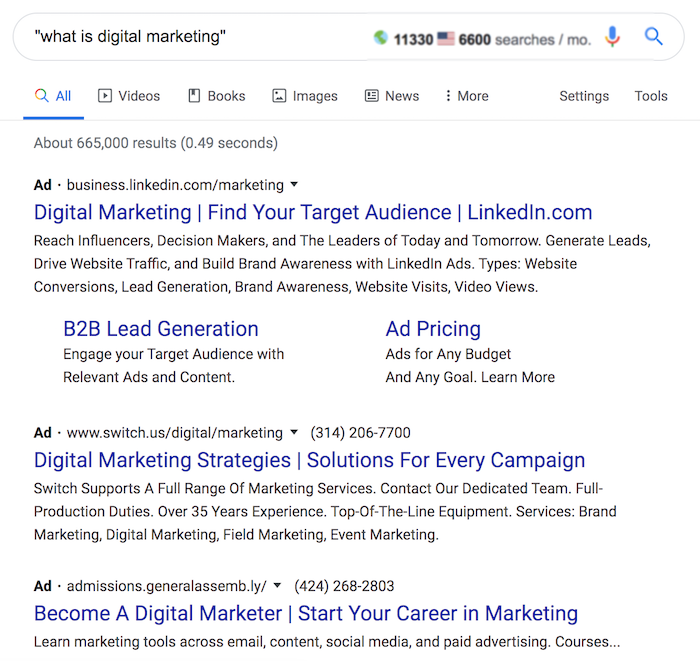
For example, if you look at the long-tail phrase, “what is digital marketing”, there are only 11,300 global searches a month but a whopping 665,000 pieces of content trying to answer that question.

In other words, the supply is much greater than the demand.

You’ll see even more of this for head terms. Just look at
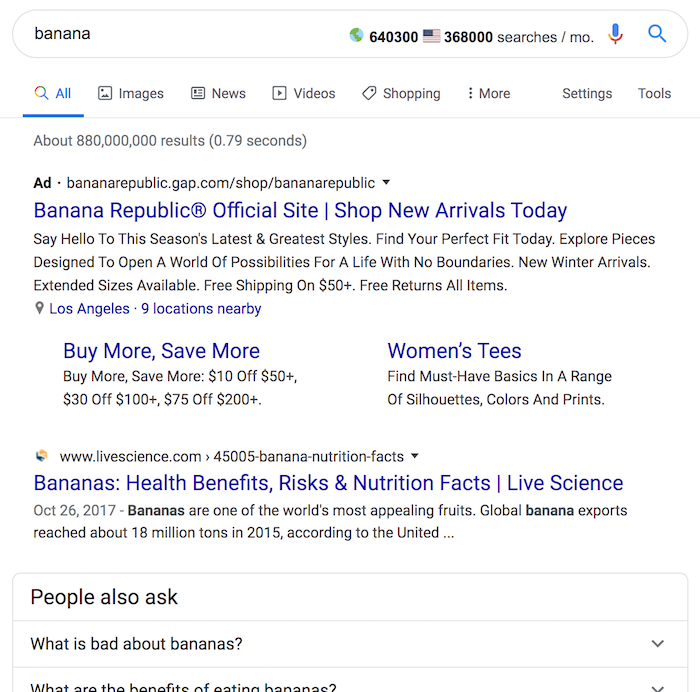
the phrase “banana”:

640,300 global searches seem like a high number but there are 880,000,000 million results. Sure, some of those results may not be on the food, banana, but still, that’s a lot of content compared to the search volume.

You can still find search phrases where there is more search volume than content but the trend is continually increasing in which content production is exceeding search demand.

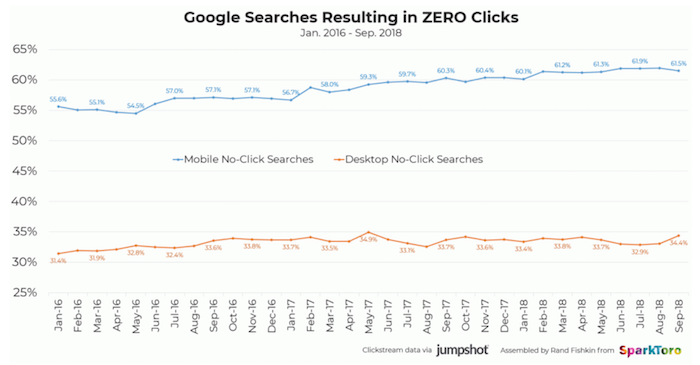
On top of that, Google is turning into an answer engine in which they are answering people’s questions without them having to go to a website.

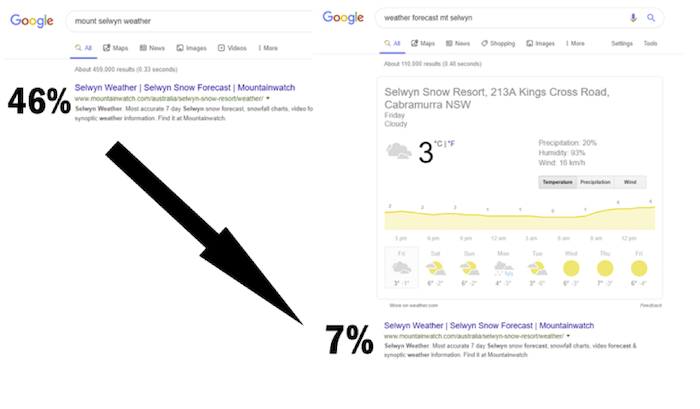
According to Dejan SEO,
they saw CTRs drastically decrease once Google started answering questions.
Just look at this weather search query:

Their clicks from weather-related queries went from 46% all the way down to 7%.

This trend has become so common that the percentage of traffic that Google drives to organic listings (SEO results) has been decreasing over time.

So, does this mean SEO is dead?

It’s actually the opposite.

SEO is not dead

With all of the data, how can that be the case?

First off, all marketing channels become statured over time. It’s just a question of when.

You can say the same thing about Facebook, Instagram,
Twitter, and even email marketing.

Heck, just look at the image below. It was the first banner ad on the Internet.

Can you guess what company created that banner ad? It was
ATT.

Of the people who saw it, 44% of them clicked on it. Now banner ads generate an average click-through rate of 0.5%.

That’s an enormous drop.

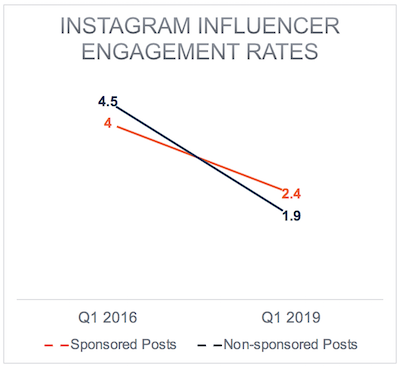
And, as I mentioned above, it’s with all channels. Just look at Instagram engagement rates:

It doesn’t matter if it is a sponsored post or an organic post, the trend on Instagram is that engagement is going down.

That’s why you are seeing people like Gary Vaynerchuk and Grant Cardone promoting their phone numbers all over Instagram.

That way they can communicate with their fans directly
without having to deal with algorithms or platforms decreasing their engagement.

But even with those decreasing numbers, you are seeing sponsored posts on Instagram surging by 150%.

In other words, people are still spending money because they
are seeing an ROI or generating enough value in their eyes.

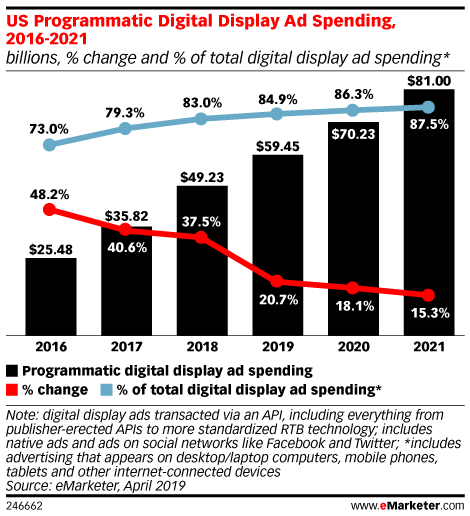
And the same is happening with digital
ad spending
.

The numbers are on the rise because companies are generating
an ROI.

So, how is SEO still not dead?

As I explained above, just because the metrics aren’t going in your favor doesn’t mean that a channel is dead.

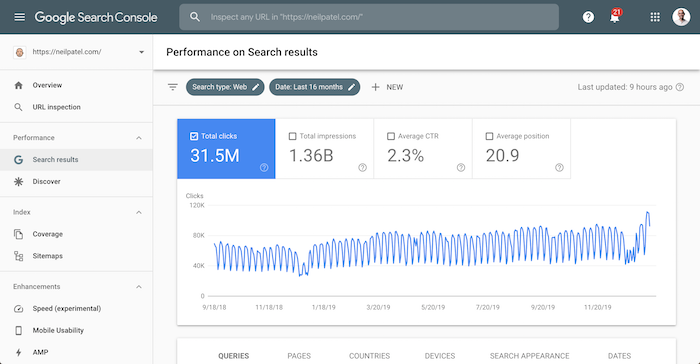
Just look at my search traffic on NeilPatel.com.

Not only do I have to deal with Google’s algorithm like you, but my competition includes other marketers who know what I know… yet I am still able to grow my search traffic even with Google’s decreasing CTRs.

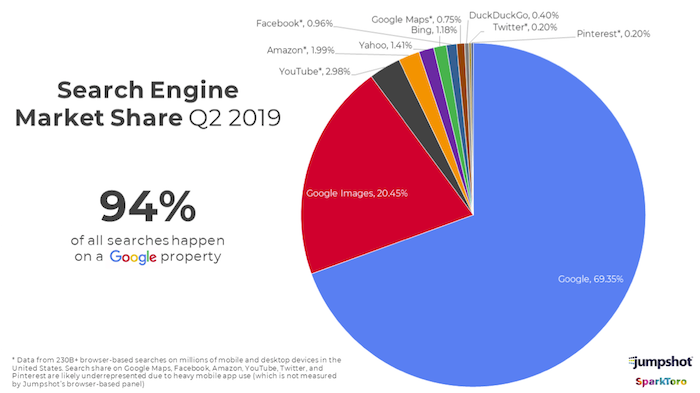
When you look at search as a whole (and I am not only talking about on Bing and Google as people also search on other sites and platforms as well) Google still dominates market share with a whopping 94%.

People still use Google and prefer them as their method of search. But what’s changed is how Google is being used.

It used to be where you would use platforms like Instagram
for discovery and Google for commerce (purchasing).

The trend has switched over the years in which Instagram is
being heavily used for commerce and Google is mainly used as a discovery engine.

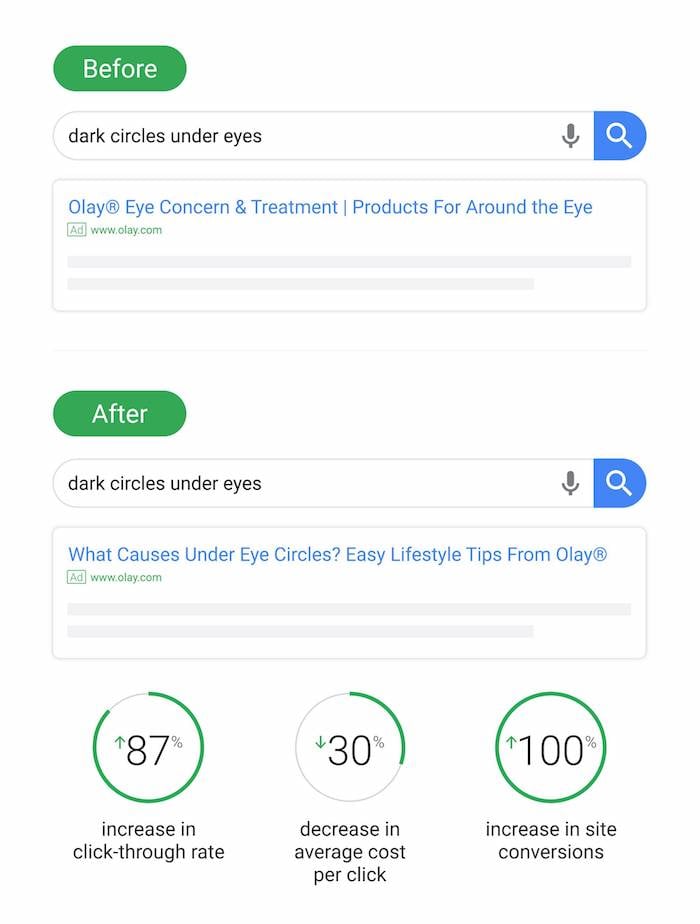
Just look at this case study by Olay.

Olay sells products related to skincare. One of their products happens to reduce darkness under your eyes.

So, they used to push heavily on ads that sold their
products directly.

But the moment they changed their ads to focus on education by teaching people how to reduce dark circles under their eyes instead of forcing people to buy their products, their ROI went through the roof.

By sending people to educational-based content first (and then selling through the content), they were able to increase click-throughs by 87%, decrease their cost per click by 30%, and increase conversions by 100%.

This is a prime example of how more people are using Google as a discovery engine first instead of a commerce engine.

SEO isn’t dying it is just changing

Now that you know that Google is shifting to a discovery
engine (for both paid and organic listings), there are a few other things you
need to know if you want to dominate the organic listings.

1: Google wants to rank sites you want to see

Their algorithm core focus isn’t backlinks or keyword density, or a specific SEO metric… the focus is on the user experience.

If a site has millions of backlinks but users hate it, the site won’t rank well in the long run.

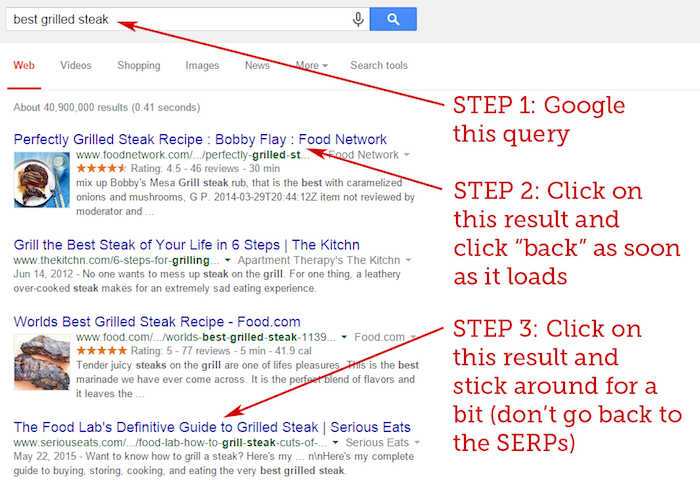
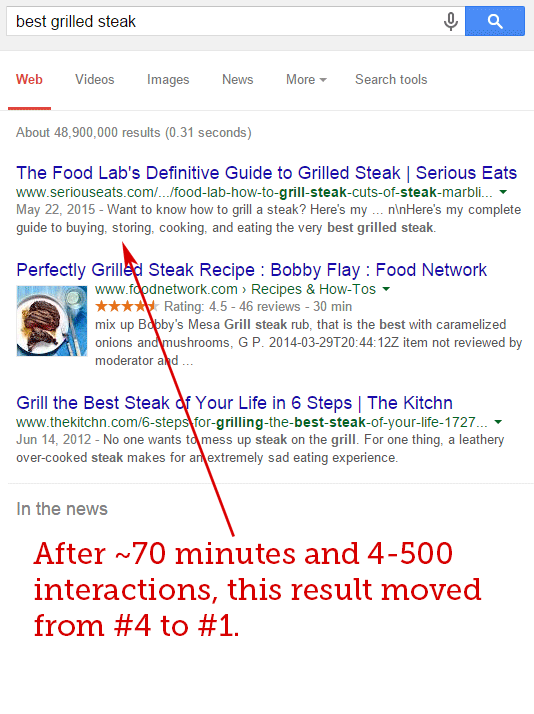
Look at this case study of the “best grilled steaks.”

Rand Fishkin had all of his social followers do the
following:

Within 70 minutes, the listing jumped to the top spot.

This is what I mean by user signals. You, the end-user, control how Google adjusts rankings.

2. People don’t just use Google. Google gathers data from everywhere.

Google knows you spend hours a day on your mobile device and hours on other sites and applications that aren’t controlled or owned by Google.

So, when they are figuring out what to rank and where to
rank it, they aren’t just looking at their own dataset.

They crawl things like social media and use social signals
to help them better improve their results.

For example, here is a case study on how Google is using social media for search discovery.

Even if you hate the social web, you need to use it more. Not only can it help with your site’s indexing but it can also help with brand building, which indirectly will help boost your rankings as well.

Here are some articles to follow to help boost your social
media presence:

3. Google loves brands

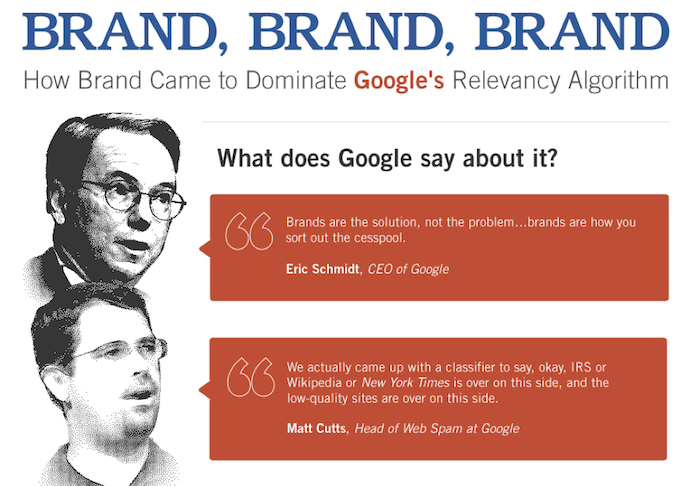
If you don’t believe me, just look at these quotes from Google’s ex-CEO and ex-head of webspam.

They both believe
in brands
.

As your brand grows, you’ll find that your rankings will climb as well.

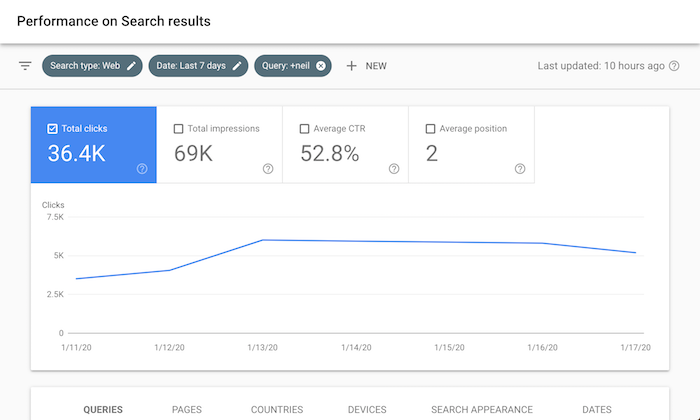
You saw my search traffic stats earlier in the post, but
here’s a breakdown of how many people found my site by searching for my name in
the last 7 days.

And that number doesn’t even include the misspellings. You would be shocked at how many people spell my name as “niel” instead of “neil.”

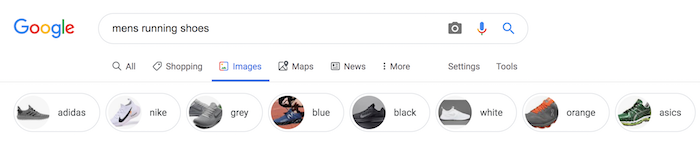
Google loves brands. Heck, when you type in “men’s running shoes,” they even have Nike, Adidas, and Asics there.

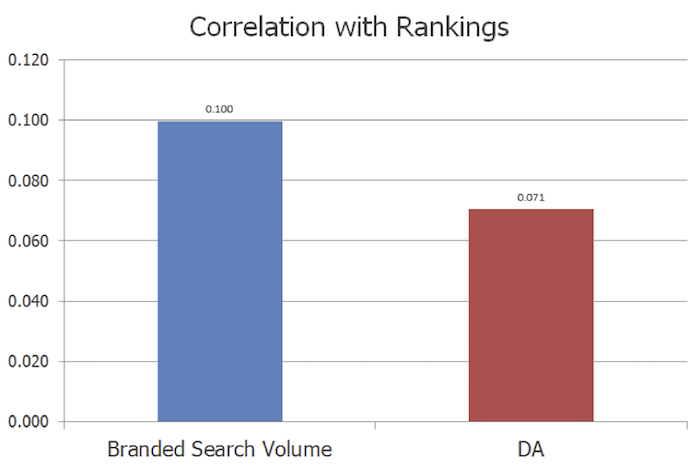
Branded search volume is more correlated with rankings than links or domain authority.

If you want to build a brand, focus on the social media
articles I linked to above and follow the brand building articles below:

If you are still struggling to build a brand, talk to one of my team members about our Digital PR.

4. Focus on a niche

Do you remember the old-school site About.com?

Over time, About.com tanked in terms of their Google rankings and the business was dying. There were a few reasons why:

  • The site didn’t focus on a single niche… it was about everything
  • The content was mediocre. They didn’t go in-depth but instead just kept things surface level.
  • They had too much content that no one cared to read.

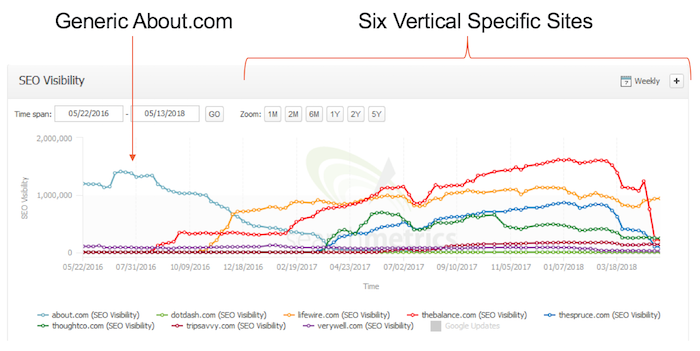
They decided to rebrand as Dotdash and start niching down. So they took the content on About.com and split it into six specific vertical sites.

When doing this they found that a lot of the content didn’t fit into those 6 verticals or wasn’t up to their new quality standard. This caused them them delete roughly 900,000 articles.

From the data, you can see that they got much more traffic by splitting up their content into niched-down sites.

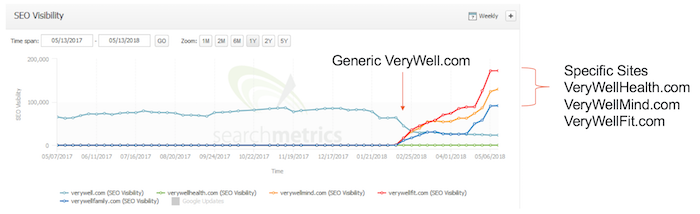
It was so successful that they took one of their new vertical sites and broke it down further into three niche sites. Here were the results:

This helped them grow their revenue by 140%.

If you want to do well in today’s world of SEO, focus on one niche. Google prefers topic-specific sites because that’s what you and everyone else loves.

Just think of it this way… would you rather read medical advice from About.com or WebMD?

WebMD of course.

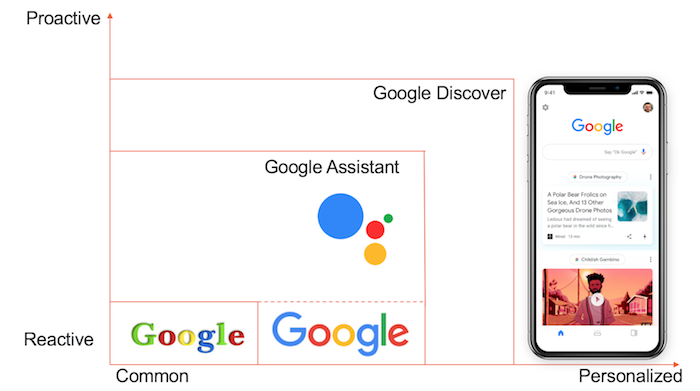
5. Future is personalization

Have you noticed that when you search on Google the results you see are different than the results of your friends?

It’s because Google is trying to personalize the results to
you.

Not just on Google search but anywhere you use a Google device… from a smartphone to Google Home to even their autonomous cars.

With all of the data they are gathering, they are better
suited to understand your preferences and then modify the results to that.

Just think of it this way: Every time you visit a place and you are carrying your mobile phone (especially if it is an Android device), Google may be able to potentially use that information to tailor results to you.

With your website, don’t try and show everyone the same message. If you personalize your experience to each and every user, you will be able to rank better in the long run as it will improve your user metrics.

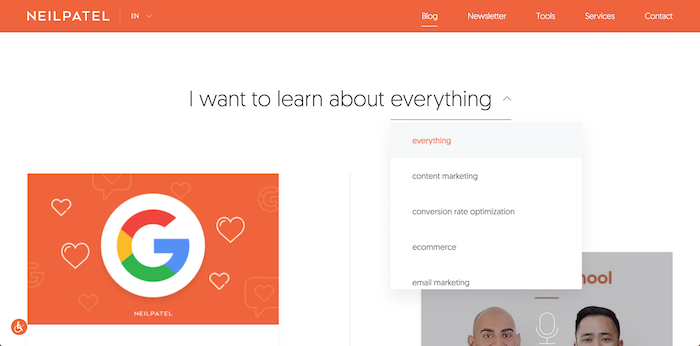
A good example of this is on my blog.

Right when you land there, I let you pick the type of content you want to see and then the page adapts to your interest.

It’s actually the most clicked area on the blog, believe it
or not.

Conclusion

SEO is not dead, it’s just changing.

Sure, click-through rates are going down and Google keeps adjusting its algorithm but that’s to be expected.

Google has made it so you can easily target your ideal customer through SEO or paid ads.

It used to be much more difficult before they came along. That’s why they are able to generate over 100 billion dollars a year in advertising revenue.

Don’t worry about things that aren’t in your control. Instead, start adapting or your traffic and business will be dead.

What do you think about the changing SEO landscape?

The post Is SEO Dead? (A Data-Driven Answer) appeared first on Neil Patel.