10 Kinds of Financing for a Small Business – Including Options You’ve Probably Never Heard Of

How Many Kinds of Financing for a Small Business Can YOU Name?

You may be surprised at the many kinds of financing for a small business there are.

Fundability

Any discussion of business financing has to start with fundability. Fundability is the ability of a business to get funding. It covers all the points a lender or credit provider will look at when they’re trying to figure out if you’ll pay back a loan or credit extended to you. These include factors you probably haven’t thought about or might think aren’t so important. Business details like address and entity all matter. But there’s more.

The 3 Cs Capital Acquisition Formula

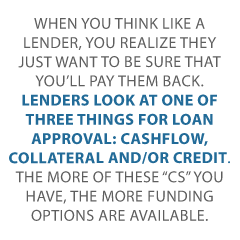
When you think like a lender, you realize they just want to be sure that you’ll pay them back. Lenders look at one of three things for loan approval: cashflow, collateral and/or credit. The more of these “Cs” you have, the more funding options are available. For the forms of funding we’re showcasing today, we show you exactly what you need to have for approval.

Two More General Ways to Get Funding

If you have absolutely none of the 3 Cs, there are still two other options: selling a part of your business or grants and crowdfunding. Let’s look at types of funding covering all of these options. We’ll start with financing via your business’s cash flow.

#10. Financing for a Small Business with Cash flow: Cash Flow Financing

A loan made to a company is backed by a company’s expected cash flow. A company’s cash flow is the amount of cash that flows in and out of a business, in a specific period. Cash flow financing (or a cash flow loan) uses generated cash flow as a means to pay back the loan.

Cash flow: Cash Flow Financing: Terms and Qualifying

Often you will need to have a few years in business. You may need to meet a certain minimum credit score requirement. You will need to prove historical cash flow and present your accounts receivables and accounts payables. This way, the lender can determine how much to loan to your business.

#9. Financing for a Small Business with Cash flow: Merchant Cash Advances

An MCA technically isn’t a loan. Rather, it is a cash advance based upon the credit card sales of a business. A small business can apply for an MCA and have an advance deposited into its account fairly quickly. So you can offer Net 30 terms but not have to wait a month to get paid.

Merchant Cash Advances

A merchant financing program is ideal for business owners who accept credit cards and are looking for fast and easy business financing. An MCA program is designed to help you get funding based strictly on your cash flow, as verifiable per your business banks statements. Hence lenders in general will not ask for any burdensome document requests.

Terms and Qualifying

A lender will review 3 months of bank and merchant account statements. They are looking for is consistent deposits. And they want to see deposits showing revenue is $50,000 or higher per year. They will also verify time in business of 6 months or more.

Lenders are also looking to see that you don’t have a lot of Non-Sufficient-Funds (NSFs) showing on your bank statements. They want to see you don’t have a lot of chargebacks on your merchant statements. And they want to see that you have more than 10 deposits in a month going into your bank account. They want to see that you manage your bank and merchant accounts responsibly. And they want to see that have a decent number of consistent credit card transaction deposits each month.

Let’s move onto funding based upon collateral – either yours, or a credit partner’s, or from the business itself.

Demolish your funding problems with 27 killer ways to get cash for your business.

#8. Financing for a Small Business with Collateral: Inventory Financing

Inventory financing is a revolving line of credit or a short-term loan acquired by a company so it can purchase products for sale later. The products serve as the collateral for the loan. There may be restrictions on the type of inventory you can use. This can include not allowing cannabis, alcohol, firearms, etc., or perishable goods. There can be revenue requirements. And there may also be minimum FICO score requirements.

Terms and Qualifying

Get approved for a line of credit for 50% of inventory value, regardless of personal credit quality. Rates are usually 5 – 15% depending on type of inventory. You can get funding within 3 weeks or less. But it can’t be lumped together inventory, like office equipment.

#7. Financing for a Small Business with Collateral: Account Receivables Financing

You can use outstanding account receivables as collateral for financing. If you also have purchase orders,  you can get financing to have those filled. You won’t need to use your cash flow to do so. Get an accounts receivable credit line with rates of less than 1% with no consumer credit requirement. Receivables should be with the government or another business.

Terms and Qualifying

Get as much as 80% of receivables advanced ongoing in less than 24 hours. Remainder of the accounts receivable are released once the invoice is paid in full. Factor rates are as low as 1.33%. You can get an accounts receivable credit line with rates of less than 1% with no consumer credit requirement.

Now it’s time to move onto funding with good personal credit (FICO) scores.

#6. Financing for a Small Business with Good Personal Credit: Credit Line Hybrid

A credit line hybrid is a form of unsecured funding. Our credit line hybrid has an even better interest rate than a secured loan. Get some of the highest loan amounts and credit lines for businesses. Get 0% business credit cards with stated income. These report to business CRAs. You can build business credit at the same time. This will get you access to even more cash with no personal guarantee.

Terms and Qualifying

You need a good credit score or a guarantor with good credit to get an approval (a FICO score of at least 680). There are no financials required. You can often get a loan of five times the amount of current highest revolving credit limit account. So this is up to $150,000.

#5. Financing for a Small Business with Good Personal Credit: Bridge Loans

A bridge loan is a short-term loan used until a person or company secures permanent financing or removes an existing obligation. It allows the user to meet current obligations by providing immediate cash flow. Bridge loans are short term, up to one year. They have relatively high interest rates. And they are often backed by some form of collateral, like real estate or inventory.

Bridge Loans via Our Credit Line Hybrid

The Credit Suite Credit Line Hybrid has a term loan program. This bridge loan works as either an add-on to, or in lieu of, the program, when the applicant meets eligibility and is agreeable to either a portion (or all) of their funding, supplied in the form of cash term loans. There is a fixed monthly repayment.

Terms and Qualifying

The Credit Suite program is an aggregate program requiring multiple accounts to meet our prequalification. Get $25,000 to $300,000 per applicant. The APR is 7 – 24% depending on creditworthiness and selected term. Terms are 3, 5, or 7 years. You must have a 680 FICO or better, and over $35,000 in adjusted gross income. Actual pre-qualification will depend on Debt-to-Income ratio.

#4. Financing for a Small Business with Good Business Credit: Start with Vendor Credit and Retail Credit

Starter vendors are open to working with most businesses, even startup ventures. Make sure vendors report to the CRAs – not all do. Vendors report to the business CRAs within 60 days. They help you build your business credit profile and score. Terms will vary depending on the vendor, but they tend to be Net 30. And you will not need collateral, good personal credit, or cash flow.

Move onto Retail Credit

Retail credit comes from major retailers. Buy everything from office supplies to power tools. Retailers will check whether your business information is uniform everywhere. They will also check whether your business is properly licensed

Terms and Qualifying

Qualifications will vary, and there can be a minimum time in business requirement. There may even be a minimum number of employees requirement, or a minimum annual sales requirement. Terms can be revolving. You will need at least 3 (5 is better) accounts reporting to the business CRAs.

#3. Financing for a Small Business with Good Business Credit: Fleet Credit and Bank Credit Cards

Fleet credit is used to buy fuel, maintain vehicles of all sorts, and repair vehicles. Even businesses which don’t have big fleets can still benefit. These are usually gas credit cards. Requirements will vary. There may be a minimal time in business requirement. If your business doesn’t make the time in business requirement, you may be able to instead offer a personal guarantee or give a deposit to secure the credit.

A Look at Bank Credit Cards

More bank credit cards are more universal, like MasterCard. So they can be used pretty much anywhere. These cards may even have rewards programs. Terms can be revolving. Usually, you will need to have at least 14 accounts reporting to the business CRAs. There can be longer time in business requirements. And there may also be minimum number of employee requirements.

Now let’s look at financing you can get if you’re all right with sharing the profits and ownership of your business.

Demolish your funding problems with 27 killer ways to get cash for your business.

#2. Financing for a Small Business via Selling Part of Your Business: Angel Investing

Angel investors invest in small startups or entrepreneurs. Often, angel investors are among an entrepreneur’s family and friends. The capital they provide may be a one-time investment to help the business get started, or an ongoing injection of money to support and carry the company through its early stages. Angels are not covered by the Securities Exchange Commission’s (SEC) standards for accredited investors.

Angels could be friends or colleagues sitting on home equity, or local professionals who are looking to invest. Consider people you know well and people you don’t know so well. But keep in mind, you’re giving up part of your ownership in your business.

Angel Investing: Terms and Qualifying

Angels are informal investors so there really aren’t any terms. Technically, there is nothing done for qualifying although investors may (probably should) insist on a valuation of your business. But no matter what, it’s always a good practice to get everything in writing.

#1. Financing for a Small Business via Selling Part of Your Business: Equity Crowdfunding

This is not the same as reward-based crowdfunding (like from Kickstarter). Equity crowdfunding is a stock offering from a company that is not listed on stock exchanges. Equity crowdfunding has been around for less than 10 years. Potential investors visit a funding portal website. There, they can explore different equity crowdfunding investment opportunities. Note: there are limits on how much capital an individual can invest based on their income and net worth. Equity crowdfunding gives investors a stake in your business.

Terms and Qualifying

Equity crowdfunding tends to be covered by complex federal law. It is best practices to consult with an attorney well-versed in federal law, specifically, securities and corporations when it comes to interpreting terms and qualifications. A lawyer will also be able to comprehend any changes that may be made to these aspects of the law in the future.

Let’s move onto kinds of funding you don’t need to pay back.

Bonus #1. Financing for a Small Business via Federal Grants

Federal grants generally do not have to be paid back. Try HUD (Housing and Urban Development) for urban projects. Try the USDA (Department of Agriculture) for rural projects. Federal funding means paperwork. You often must show experience in what you are proposing.

Terms and Qualifying

Grants have varying qualifications. They are very competitive. Be sure to check information thoroughly. This includes due dates and any necessary paperwork. Some grants may offer preferences to businesses with minority, female, veteran, or disabled ownership.

Bonus #2. Financing for a Small Business via Reward-Based Crowdfunding

You can get money from the crowd for your business. Start with a service like Kickstarter. But make sure you read the fine print (always a good idea!). Many crowdfunding platforms make you give all the funding back if you do not make your goal by the end of the campaign. But Indiegogo has a flexible funding option.

Reward-Based Crowdfunding

Crowdfunding platforms will take a percentage of the donations. That’s how they make their money. Crowdfunding platforms may push to have you deliver on your promises. So you’ll have to actually manufacture a product or do whatever else your business is supposed to be doing. Given how much social media we’re all bombarded with these days, it should come as no surprise that donors can become weary of crowdfunding pitches.

Details

Crowdfunding tends to work best when donors can personally connect with a product or service. Straightforward businesses may not do so well. The kinds of businesses which do the best often associate with products not quite on the shelves yet, or artistic endeavors. But standard widgets will most likely not attract brand ambassadors. They probably won’t get donors too fired up. Because crowdfunding campaigns are time-consuming, it doesn’t make sense to try this form of funding unless you realistically feel your chance of success is better than 50%.

Terms and Qualifying

Terms will differ depending on which platform you use. Check and make sure your platform of choice will allow your industry to work with them. For example, even though recreational cannabis use is legal in Massachusetts, Kickstarter (for example) doesn’t allow fundraising for drugs, nicotine, tobacco, vaporizers, and related paraphernalia. Any major crowdfunding platform has a section for rules, a FAQ, or ‘how it works’. Be sure to read such a section thoroughly so you know exactly what you’re getting yourself into.

And now let’s look at funding via creative and different means you may not have considered or heard of before.

Demolish your funding problems with 27 killer ways to get cash for your business.

Bonus #3: Financing for a Small Business via 401(k) Financing

This is not a loan. You will not have to pay an early withdrawal fee or a tax penalty. You put the money back by contributing, just like with any 401(k) program. This means you won’t lose your retirement funds. This is a 401(k) Rollover for Working Capital program. The IRS calls it a Rollover for Business Startups (ROBS).

401(k) Financing

Per the IRS, a ROBS qualified plan is a separate entity with its own set of requirements. The plan, through its company stock investments, rather than the individual owns the trade or business. Therefore, some filing exceptions for individuals may not apply to such a plan. This type of financing isn’t a loan against, your 401(k), so there’s no interest to pay. It does not use the 401(k) or stocks as collateral. Instead, this is simply a movement or change of custodian.

Terms and Qualifying

Pay low rates, often less than 5%. Your 401(k) will need to have more than $35,000 in it. You can usually get up to 100% of what’s “rollable” within your 401(k). The lender will want to see a copy of your two most recent 401(k) statements. You can get 401(k) financing even with severely challenged personal credit. The 401(k) you use cannot be from a business where you are currently employed. You cannot be currently contributing to it.

Bonus #4: Financing for a Small Business with Microloans

Microloans are business loans with relatively low interest rates. Generally, these loans are offered to small or developing businesses with modest capital requirements and little to no revenue history. Microloans — as the name suggests — are smaller loans than a traditional bank loan. They generally offer anywhere from $500 to $50,000 in business financing.

Terms and Qualifying

Terms and requirements vary among providers. Kiva, for example, charges 0% interest. The Opportunity Fund provides loans to low- and moderate-income immigrants, women, and other underserved small business owners. Accion requires a cosigner. Check the specific requirements of any microloan program that interests you

Bonus #5: Financing for a Small Business via SBA 7(a) Loans

This the SBA’s most popular loan. The SBA guarantees 85% for loans up to $150,000. They guarantee 75% for loans greater than $150,000. The SBA makes the lending decision, but qualified lenders may be granted delegated authority to make credit decisions without SBA review.

Terms and Qualifying

The maximum amount on offer is $5 million. You will have to provide Articles of Organization, business licenses, documentation of lawsuits, judgments and bankruptcy or other pertinent documentation. Lenders are not required to take collateral for loans up to $25,000. For loans in excess of $350,000, the SBA requires that the lender collateralize the loan to the maximum extent possible up to the loan amount.

10 Kinds of Financing for a Small Business: Takeaways

There are all sorts of amazing ways to get business funding. You can find the one which fits your circumstances. This includes your strengths in areas like personal credit, collateral, cash flow, selling a part of your business, and getting grants or crowdfunding. Let us help!

The post 10 Kinds of Financing for a Small Business – Including Options You’ve Probably Never Heard Of appeared first on Credit Suite.

Zendar (YC S17) is hiring a platform software engineer

Article URL: https://jobs.ashbyhq.com/zendar/ca3dde1b-ad32-43e2-bcde-7bb3c404017c

Comments URL: https://news.ycombinator.com/item?id=28019820

Points: 1

# Comments: 0

Compose.ai (YC W21) Is Hiring a Senior Front End Engineer

Article URL: https://www.ycombinator.com/companies/compose-ai/jobs/syPzbAB-senior-frontend-engineer

Comments URL: https://news.ycombinator.com/item?id=28021520

Points: 1

# Comments: 0

Red Bull's failed appeal and F1's war of words over Hamilton/Verstappen explained

Why was Red Bull’s appeal of Lewis Hamilton’s penalty unsuccessful? What was Red Bull hoping to achieve? And what happens now? Laurence Edmondson picks through the remarkable fallout from the British GP.

The post Red Bull's failed appeal and F1's war of words over Hamilton/Verstappen explained appeared first on Buy It At A Bargain – Deals And Reviews.

7 Link Shortener Alternatives to Goo.gl

When you’re trying to drive traffic to your website and generate new leads, the goal is to make your content as attractive as possible. After all, with so much competition out there, it’s important you stand out from the crowd and grab someone’s attention right away, right? 

The answer’s yes!

Just like you spend time and energy creating visually appealing content for users to enjoy, you shouldn’t forget the finer details: namely, your links.

Yes, really. URLs matter. Let me show you why link shortening is worth your time and what link shoortening alternatives to Goo.gl are worth trying.

What Is Link Shortening?

Link shortening takes longer links, with their confusing combination of numbers, letters, and special characters, and turns it into a short, readable link.

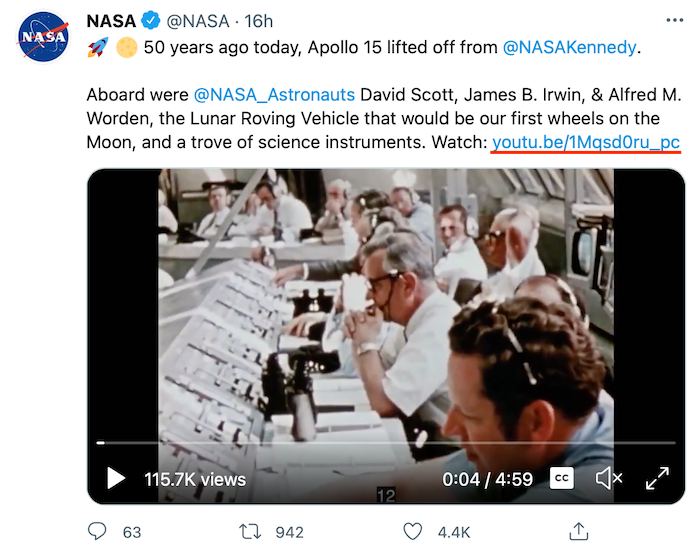
Here’s an example from NASA’s Twitter feed. The link is only a few characters long, it contains the NASA branding, and it’s clear where the link redirects to:

Link Shortener Alternatives to Goo.gl - Example from NASA Twitter Feed

Here’s another example. When you click the link, it takes you to a YouTube video. The destination is fairly clear from the short link (youtu.be) even though it’s unbranded, meaning there’s no mention of NASA’s name in the link:

Link Shortener Alternatives to Goo.gl - Example of NASA YouTube Video

The original “longer” link looks like this: https://www.youtube.com/watch?v=1Mqsd0ru_pc

Which one do you think looks more attractive on a website or social media post? Which one would you be more likely to click on?

Chances are, it’s the first option, and the reality is, your potential customers feel the same way.

Why Should You Use a Link Shortening Tool?

OK, so that’s how link shortening works, but is it worth your time? Here’s a bit more detail.

In most cases, URL shortener tools also track how many people click your links. You can track who clicked your link to calculate the success of ad campaigns or content marketing strategies you’re running. From a marketing perspective, link shorteners are invaluable.

It’s also ideal for social media posts, where you might have a limited number of characters to convey your message. Shortening URLs and focusing on content makes it easier to engage your followers.

Finally, short URLs are more attractive. They’re easier to read and make your content more user-friendly. You can also create branded links with URL shorteners to reinforce your brand message at the same time.

Since great marketing is all about creating a great experience for your customers and building awareness, short URLs are a crucial tool.

To be clear, it’s not always worth shortening URLs. For example, if you’re just linking from one page on your website to another, there’s no need to shorten the link.

If you need help figuring out which links to shorten and which ones to leave alone, check out my consulting services.

How Did Goo.gl Work?

Google’s own URL shortening tool, Goo.gl, launched back in 2009.

At first, it only worked with Google applications, meaning you could only shorten URLs for the Google toolbar. However, Google made the tool available to the public in 2010, which made it simpler for all website owners to access and use.

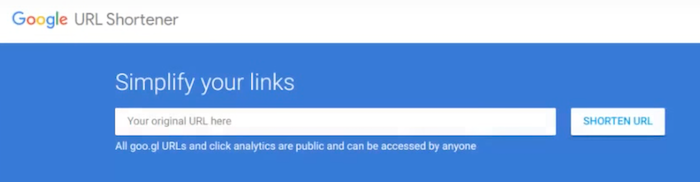
Goo.gl offered a simple means to create shorter, more readable URLs. All you had to do was input your long URL and Goo.gl generated a smaller URL without lines of extra characters:

Link Shortener Alternatives to Goo.gl - How Did Goo.gl Work

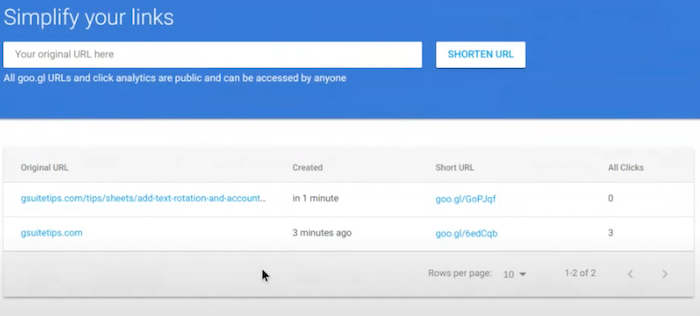
You didn’t need a Google or G Suite account to create a one-off URL, either. However, if you wanted to keep track of all your custom URLs, you could create an account and view all your shortened links at a glance:

Link Shortener Alternatives to Goo.gl - Screenshot of Simplifying Links with Goo.gl

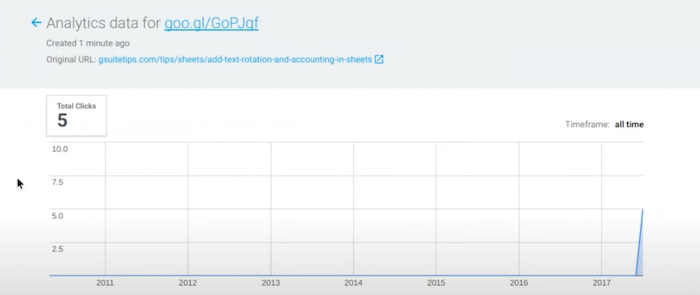
Website owners could also track how many people clicked the shortened URL, which helped with marketing strategy creation:

Link Shortener Alternatives to Goo.gl - Website owners could track how many people clicked the shortened URL

Why did Google shut down Goo.gl, though? Put simply, Goo.gl wasn’t designed for anything other than desktop browsing. As browsing habits changed and it became more common for people to access the web through mobile devices or apps, Google realized the tool just wasn’t flexible enough to stay competitive.

The answer? Firebase Dynamic Links, or FDL, which replaced Goo.gl back in 2019. As we’ll see in a moment, FDL improves upon Goo.gl in a few ways, although it’s not the only URL shortening tool worth considering.

7 Goo.gl Replacements

There are many other link shortening tools out there, so how do you choose the right one for your needs? To help you narrow your search, here are seven promising alternatives to Goo.gl you can try right now.

1. Firebase Dynamic Links

Since Firebase Dynamic Links (FDL) replaced Goo.gl, it’s a good tool to start with if you’re focusing on app creation and development.

Firebase works similarly to Goo.gl, since you’re still creating short URLs. However, these URLs are no ordinary links: they’re “smart” links, or Dynamic Links.

When a user clicks on a FDL link, they’re directed to exactly where you want them to go in your Android or iPhone app… even if they don’t already have the app installed. They simply download the app and the right page loads automatically.

Cool, right?

It doesn’t matter whether they click through from a desktop browser or mobile device, either. They will be directed to a compatible version of your website, so there’s no need for you to generate different URLs for each platform.

If you’re focusing on app-based marketing, definitely consider FDL. There’s a free plan available, although the paid plan has some nice features.

2. Rebrandly

Do you want to create unique branded links using custom domain names? Then Rebrandly could be for you.

Trusted by global brands like IBM and Shopify, Rebrandly is more than just a URL shortening tool. It’s a link management platform designed to help you build entire marketing campaigns around branded links in just a few clicks.

Without leaving your browser, you can create and share links across over 100 integrated apps including Twitter, LinkedIn, and Facebook. Plus, you can measure your campaign results from the dashboard.

Link Shortener Alternatives to Goo.gl - Rebrandly

It’s free to sign up, but paid packages start at just $29 per month, which gives you access to more detailed metrics and a larger number of branded links. If you’re looking for an enterprise-level solution for larger teams, reach out to Rebrandly for a custom quote.

3. Ow.ly

If you’re already using Hootsuite, Ow.ly is worth a look.

You can shorten any link posted to social media right from the Hootsuite dashboard. This lets you view everything from your campaign ROI to your link metrics at the same time. There’s no need to switch between different tools (unless you’re also using other platforms like Google Analytics.)

Ow.ly comes free with every Hootsuite account, too, so you don’t need a paid subscription to benefit from the tool. Sounds good, right?

All that said, Ow.ly’s only available to Hootsuite users, so it’s not the right tool for everyone, but it’s worth a try if you already use Hootsuite.

4. Bitly

For enterprise-grade link management, consider Bitly, one of the most comprehensive tools out there.

With Bitly, you’re not just creating short, branded links. You’re turning those links into valuable marketing tools. Bitly offers some of the most in-depth campaign management tools available to help you track everything from clicks to organic shares.

It’s a useful tool for tracking customer journeys without hopping between different CRMs, making it ideal for larger companies looking to track data and grow their campaigns efficiently. You can even generate QR codes to engage customers and drive sales.

What’s more, Bitly is trusted by the likes of Amazon, Disney, and Gartner, so you know it’s a platform that delivers on its promises! Packages start at $29 per month.

5. TinyURL

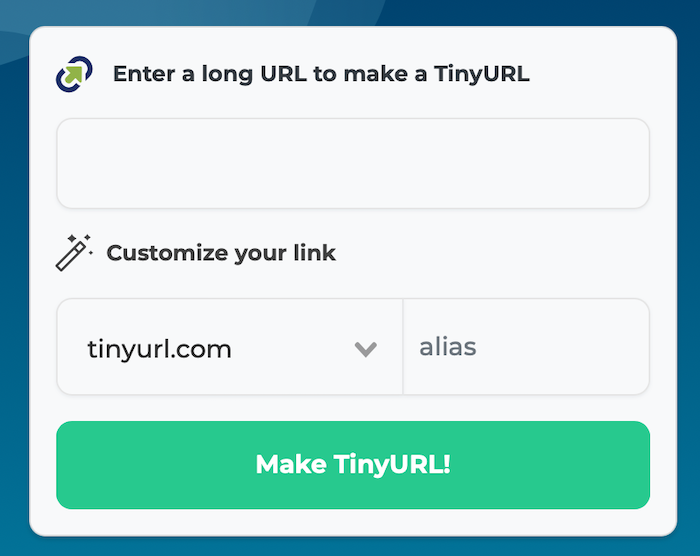
No roundup of link shortening tools is complete without TinyURL, the very first program of its kind:

Link Shortener Alternatives to Goo.gl - TinyURL

You don’t need an account to shorten one or two short URLs. To get the most of the platform, sign up for a free account which allows you to create an unlimited number of URLs and track clicks.

The Pro package starts at $9.99 per month and offers advanced tracking options. For businesses looking to run high-volume ad campaigns, the Bulk package may be a better option at $99.00 per month.

If you’re looking for a no-fuss way to shorten your URLs and track some metrics, TinyURL is worth a go.

6. BL.INK

Are you a small business owner looking to launch marketing campaigns but don’t need a large-scale solution? BL.INK was designed for you.

With BL.INK, you can quickly share shortened URLs across social media channels and even send actionable links by SMS or messaging platforms. BL.INK seamlessly integrates with existing worktools and CMS, so you can easily track link performance and view the data alongside other metrics.

Packages start at $48 per month, making it one of the more expensive tools on the list. However, you can try it free for 21 days, which is a bonus.

If you’re not looking for an enterprise-level solution but want more than just a basic shortening tool, consider BL.INK.

7. Sniply

Do you want to add a CTA to every shortened link you create? Now you can, thanks to Sniply.

On the surface, Sniply works like any other link shortener. However, it offers a unique level of customization: you can embed a colorful CTA button with every link you share across social media.

Not only do your links look more appealing because they’re shorter, but they’re more actionable than ever:

Link Shortener Alternatives to Goo.gl - Sniply

Pricing is reasonable, too, with packages starting at $29 per month. However, if you want to add more than one team member, you’ll need to opt for a more expensive tier.

Link Shortener Frequently Asked Questions

What is link shortening?

Link shortening, or URL shortening, lets you change how a link displays to users. You can make a URL appear shorter or even add branding and still send users to the correct page.

What’s the point of link shortening?

A link shortening tool turns a long, rambling link into something memorable to share with prospects, which is handy on social media. You can also track the number of real people visiting your website, which provides more accurate analytics information.

Why did Google stop supporting Goo.gl?

Google made the changes in response to how people use the internet. Its new tool, Firebase Dynamic Links, is more flexible than Goo.gl and lets site owners redirect users on mobile apps rather than just desktop websites.

When should you not use link shortening?

Since one of the main reasons we shorten links is for tracking purposes, you don’t need to shorten links if you’re just linking from one page on your website to another.

{
“@context”: “https://schema.org”,
“@type”: “FAQPage”,
“mainEntity”: [
{
“@type”: “Question”,
“name”: “What is link shortening?”,
“acceptedAnswer”: {
“@type”: “Answer”,
“text”: “Link shortening, or URL shortening, lets you change how a link displays to users. You can make a URL appear shorter or even add branding and still send users to the correct page.”
}
}
, {
“@type”: “Question”,
“name”: “What’s the point of link shortening?”,
“acceptedAnswer”: {
“@type”: “Answer”,
“text”: “A link shortening tool turns a long, rambling link into something memorable to share with prospects, which is handy on social media. You can also track the number of real people visiting your website, which provides more accurate analytics information.”
}
}
, {
“@type”: “Question”,
“name”: “Why did Google stop supporting Goo.gl?”,
“acceptedAnswer”: {
“@type”: “Answer”,
“text”: “Google made the changes in response to how people use the internet. Its new tool, Firebase Dynamic Links, is more flexible than Goo.gl and lets site owners redirect users on mobile apps rather than just desktop websites.”
}
}
, {
“@type”: “Question”,
“name”: “When should you not use link shortening?”,
“acceptedAnswer”: {
“@type”: “Answer”,
“text”: “Since one of the main reasons we shorten links is for tracking purposes, you don’t need to shorten links if you’re just linking from one page on your website to another.”
}
}
]
}

Link Shortener Conclusion

Are the alternatives to the Goo.gl link shortener worth your time? Absolutely. With the range of link management tools out there, you can quickly generate short, readable links to showcase your brand and drive traffic to your website.

What’s more, there’s a link shortening tool to suit every marketing strategy, whether you’re looking for a no-fuss, budget-friendly option or want to invest in an enterprise-level solution.

Have you tried a link shortening tool yet? How has it improved your conversions or made it easier to track your performance?

New comment by closetalent in "Ask HN: Who is hiring? (July 2021)"

Close | Multiple Positions | 100% Remote | Americas & Europe

At Close, we’re building the sales communication platform of the future. With our roots as the very first sales CRM to include built-in calling, we’re leading the industry toward eliminating manual processes and helping companies to close more deals (faster). Since our founding in 2013, we’ve grown to become a profitable, 100% globally distributed team of ~50 high-performing, happy people that are dedicated to building a product our customers love.

Product Manager (Americas): https://jobs.lever.co/close.io/21dca90f-06a3-4050-81a0-9659d…

Software Engineer – Backend/Python (Americas & Europe): https://jobs.lever.co/close.io/592193bf-8a9c-43cf-86a1-faeb7…

Senior Frontend Engineer – React (Americas & Europe): https://jobs.lever.co/close.io/10a1e32b-1a59-48dc-b8f4-e6f0d…

https://www.youtube.com/watch?v=ZbyGnLhtj0o

New comment by schallw in "Ask HN: Who is hiring? (July 2021)"

Amazon Print On Demand| Software Development Engineer | Senior Software Development Engineer | San Luis Obispo, California ONSITE

At Print-On-Demand, we enable authors around the world to publish their books on Amazon for free, in multiple formats, in just a few minutes. We make authors content available all around the world, and when a reader places an order we print and ship the book within 48 hours.

Print-On-Demand has changed the world of publishing, where previously authors needed a large contract to get their book printed, Amazon makes this available to anyone. Our technology is driving a change in the supply-chain economics of Amazon and other make-on-demand products are following suit. Spikes in demand for books never result in lost sales, since we can print any order we receive at any time.

We work with a wide range of tech, with partners all over the world. Interested in large throughput micro-services? High traffic react and angular websites? PDF processing including optical character recognition, image generation, automated quality assurance? Royalty processing, aggregation, reporting, and payments? Order planning, routing, and optimization? We do it all, so in this role you have the opportunity to go deep in areas you are interested in while getting wide technical experience.

We work out of a small office, where Print-On-Demand was originally built as a start up, in sunny central California.

Contact: William Schaller – schallw@amazon.com, hiring manager.

How to Craft Lead Magnets Your Customers Can’t Ignore

Getting traffic to your site is nice, but there’s not much of a point if those visitors don’t convert.

There’s one tactic I use above all others to generate new leads:

A lead magnet.

They aren’t some newfangled tech trend. They’ve been an essential marketing tool for decades.

With lead magnets, you give people something for free in exchange for an email address and permission to send them more offers—for example, a free ebook or an SEO checklist.

However, not all lead magnets are effective.

Let’s take about how lead magnets work and explore how to create one that drives leads.

How Lead Magnets Can Grow Your Business

The lure of ‘free’ is compelling, according to Predictably Irrational author Dan Ariely.

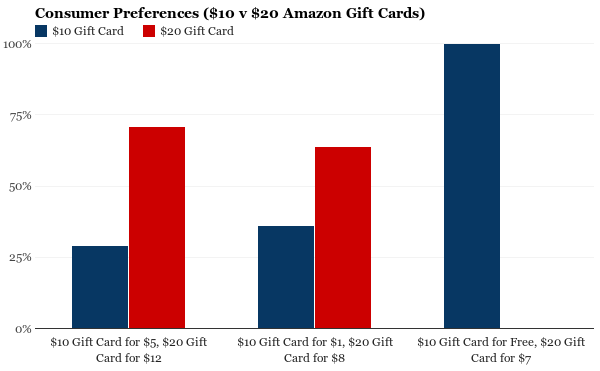
He proved this by giving groups of people the option to select from different Amazon gift cards. Respondents could choose from receiving either:

  1. A $10 Amazon gift card for free, or
  2. A $20 Amazon gift card for only $7

If you were to look at that objectively, based on cold hard math, you’d see that the second option was the better value ($13 vs. $10.)

Check out the third column on the far right to see which one won:

the power of free how to create lead magnets that work

It wasn’t even close! Everyone sampled chose the free $10 option instead.

Ariely calls this the Zero-Price Effect because humans don’t see the downside to something that’s free.

Ariely ran a related experiment. They staged a promotion for free tattoos and had people line up outside the store.

These people were waiting in line with full knowledge of what they were doing.

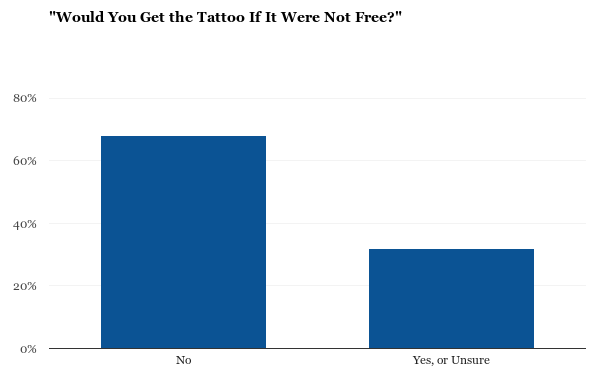
Yet when Ariely asked them if they’d be waiting to get the same tattoo if it wasn’t free, 68 percent of respondents said no!

would you get this tattoo if it wasnt free  guide to lead magents

In other words, people took time out of their busy schedule to commit permanent ink to their skin simply because it was free.

Good lead magnets, when done correctly, have the same effect (albeit without the same long-lasting effects).

They pass along a useful ebook, webinar, or email course, asking for very little (if anything) in return from visitors.

You leverage the power of free to kickstart the first step in your customer value optimization process.

Lead magnets are nothing new.

They get a lot of attention today because of how persuasive and powerful they can be.

One of the best ways to incorporate them today is with a content upgrade. People are already on your site, seeking something out.

Think about it:

They went to Google and typed in something specific to end up on your blog post.

A lead magnet sweetens the pot by providing additional insight on the same exact topic they were reading about.

Brian Dean used the content upgrade strategy to boost his conversions by 785 percent in one day.

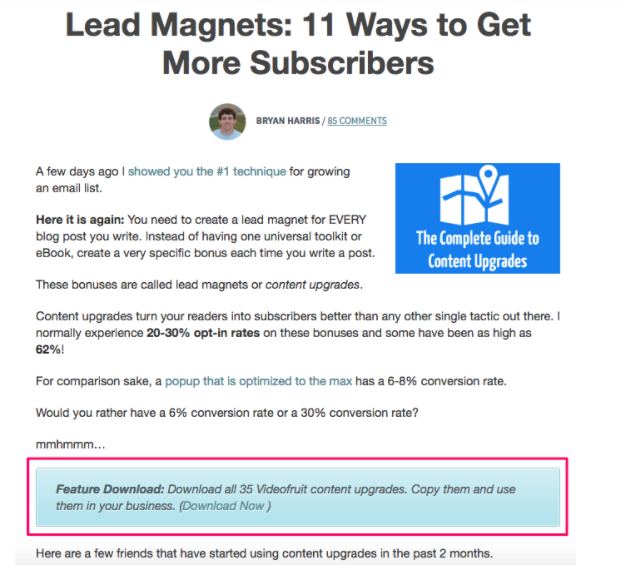
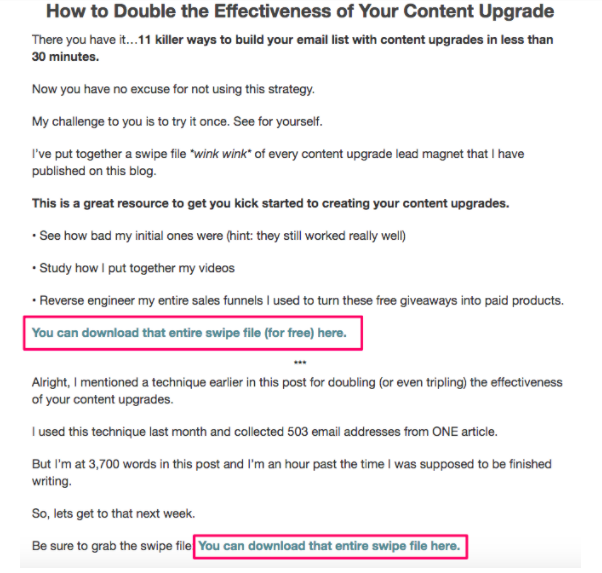
Brian Harris of Video Fruit is seeing a 20-30 percent opt-in rate from blog posts where he links not one, not two, but three times to his lead magnet.

For example, the first comes right in the introduction:

lead magnet example video fruit

Then he follows up that up with another two more for good measure down at the bottom:

lead magent example use content upgrages

The blog post goes through an in-depth analysis of how content upgrades can get you more leads. Then it distills those insights and actionable tips down so that you can easily start implementing the same tactics on your site (after downloading the lead magnet, of course).

If you want to see the same results, your lead magnet has to abide by a few rules.

The form or medium doesn’t matter necessarily. Instead, success typically comes down to a few >key ingredients:

  1. Does your audience care about it?
  2. Is there value to it?
  3. Does it solve a problem and/or give the audience something they need?

So how do you figure those things out?

Let’s dive into what the best lead magnets have in common to find out.

How to Create Lead Magnets That Drive Conversions

Now that you know why lead magnets are important (to get you more leads!) let’s talk about how to create one that drives conversions like mad.

Find Out What Your Customers Want

Saying you need to “know your audience” sounds obvious and trite. However, it’s one of those things that everyone talks about, but no one seems to know how to do.

The big clue is in the reception. If your digital copies aren’t flying off the shelf when it goes live, your issue typically comes back to a mismatch with your audience.

Thankfully, this can be an easy fix if you know where to look.

Start by looking for what people are already paying for.

That might sound counterintuitive because lead magnets are free.

However, if someone is willing to part with their hard-earned cash for something, it’s a sure sign that they’re committed.

For example, one of my favorite places to start is the Kindle Marketplace.

Let’s say I’m about to create a lead magnet in an industry I know nothing about: cooking. (Seriously, nothing.)

I could guess or make a few assumptions about which cooking lead magnet would work best. Or I could head on over to the Kindle Marketplace and see what’s already working well.

It’s not just the topic you’re looking for at this point, but also the ‘format’ that resonates with an audience.

Here’s what I mean.

Go to the Amazon Kindle Marketplace look at the sidebar on the left-hand side. There, you’ll find all the book categories and then subcategories upon subcategories upon subcategories. (In other words, drilling down to find your niche and your audience.)

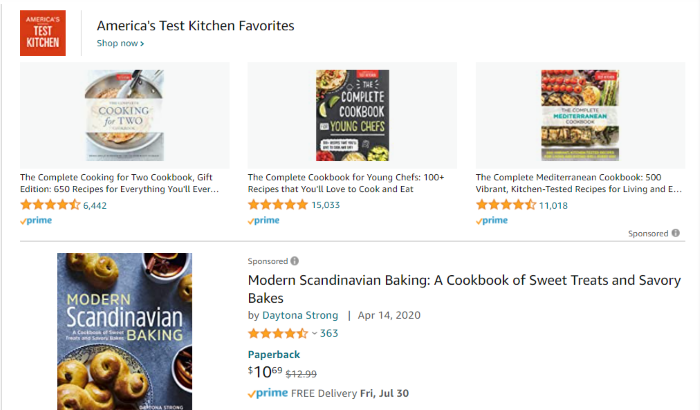
Here’s what the bestsellers look like in European cooking and food:

lead magnet example cook books

Ok, now we’re getting somewhere.

Most are unsurprisingly recipe books. However, that first one is especially interesting.

It’s a “cooking for two,” book which means the people buying it are looking for quick, no-fuss meals in smaller portions.

See?

That tells you a lot about the audience and what their preferences are. The Mediterranean one on the far right is another indication — those meals tend to be easy and healthy.

So these people might be looking for a new recipe cookbook, but that doesn’t mean they want some haute cuisine that requires working for hours in the kitchen.

Instead, these (presumably) busy people want something relatively quick and healthy.

Next, the trick is to put something together that’s like these examples but somehow different, better, or unique.

For example, let’s dive a little deeper into books reviews to see what they say.

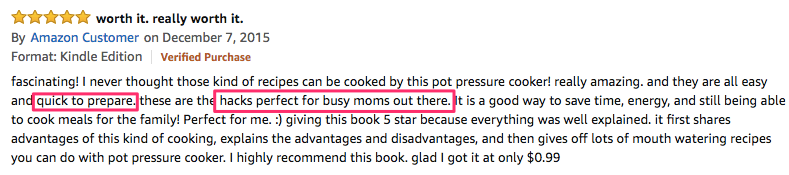
Here’s a positive review to kick things off:

book review example for lead magnet guide

Awesome! Two of our assumptions are already being proved correct.

People like this example because it provides recipes that are “quick to prepare. “

Busy moms might be foodies. However, foodies probably aren’t going to be buying this book.

That completely changes how you might create, package, design, and even promote this ebook already.

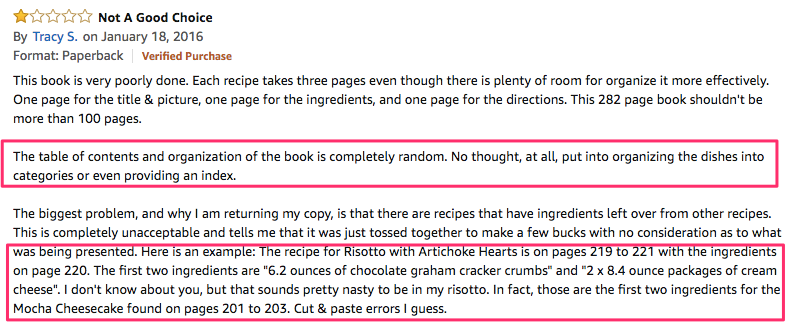
Positive reviews are helpful to start with, but many times you can learn more from negative reviews. Check this out:

lead magnet example

First, this book’s organization and table of contents aren’t up to snuff for this reviewer. They’re even giving you the answer here, too: “… organizing the dishes into categories or even providing an index.”

Good ideas! These are the little details that you or I wouldn’t have thought of because we might not be experts on cooking already.

However, a little bit of research has already revealed a few nuggets of wisdom.

Then, this reviewer goes on to complain about some of the editing and attention to detail towards the bottom.

Easy — let’s also have a subject-matter expert help edit this work to ensure accuracy (critical in cooking) is on point.

Use Audience Feedback to Refine Your Lead Magnet Idea

Now let’s take this one step further by simply asking the audience which versions of our idea they’d prefer.

For example, write up a simple blog post that explains what you’re thinking about creating and ask for ideas or improvements.

This does two things at the same time:

  1. It helps you get feedback to incorporate into the creation of your lead magnet.
  2. And it helps you ‘seed’ the market so that people are already primed to download it when you push the lead magnet live.

Soliciting feedback from people who aren’t yet on your email list can help you better understand how to get them on the list eventually. Here’s what I mean.

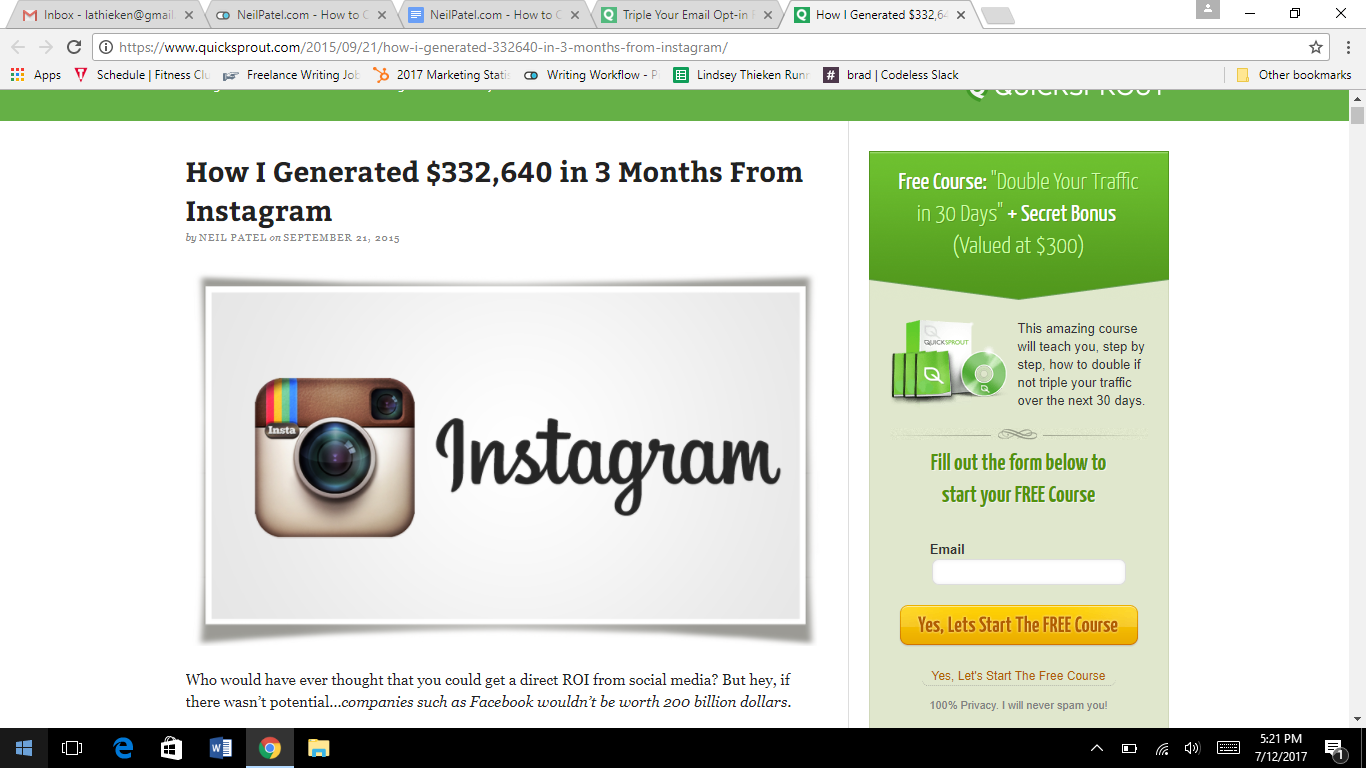
Take this post on how an Instagram user-generated more than $300,000.

how I generated money from instagram lead magnet example

If you take a close look at the comments section of the post, you’ll find a couple of readers asking about how the Instagram user made her lists.

lead magnet example ask questions to develop a magnet people want

Multiple people are now requesting the same information in the comments, which means there must be built-in demand for this information.

Lead magnets are ‘free,’ but users still have to part with their precious contact info. They won’t do that for just anything.

So you need to create content that interests the audience.

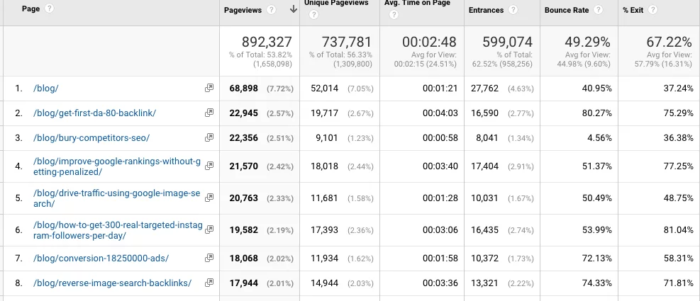
Let’s check out Google Analytics to see which pages (and topics) are performing best:

neil patel GA dashboard for lead magnet example

Start by segmenting all your posts into categories.

Sometimes your site already has this done if you included categories in your URL string. For example, Unbounce uses the category “PPC” in this blog post:

find a lead magnet idea screenshot of URL

So you can search for URLs in your most popular content that feature PPC.

You’ve now painstakingly compiled insight into what your customers want. Your next job should be insanely easy at this point: Give them what they’re asking for!

Being Specific About The Value

Picture someone on your site reading your perfectly crafted blog post about the latest trends in European cooking when a pop-up appears offering a printable “Be a Better Cook” guide.

Huh? That generic printed piece of paper is going to make them a better cook? How?

No, thank you.

What if it was a printable checklist on the “Ten Top-Rated Dinner Recipes from France and Italy?”

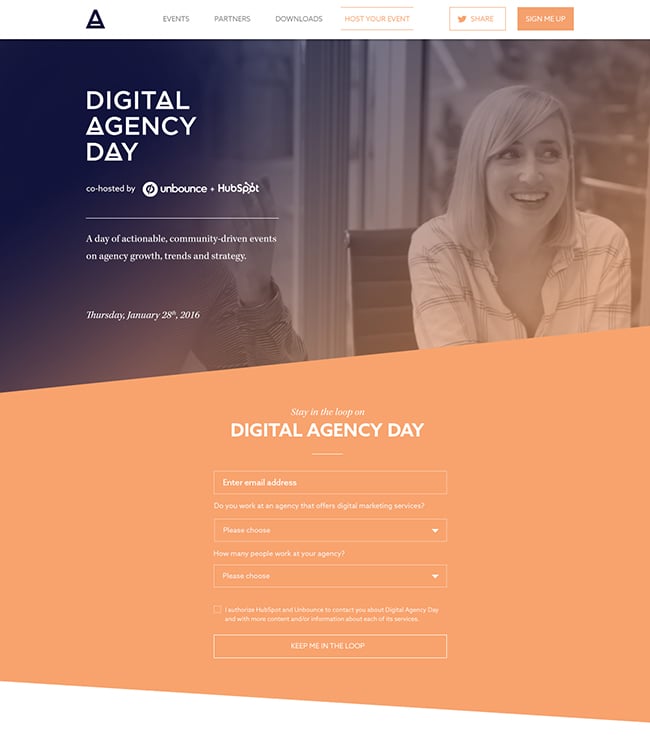
Now imagine you visit the landing page for Digital Agency Day because you want to see when the upcoming date is to make sure you don’t miss any of the great information.

DigitalAgencyDay microsite cropped lead magnet example

You’re hemming and hawing about signing up for the live event because you’re not sure if you’ll be able to make it.

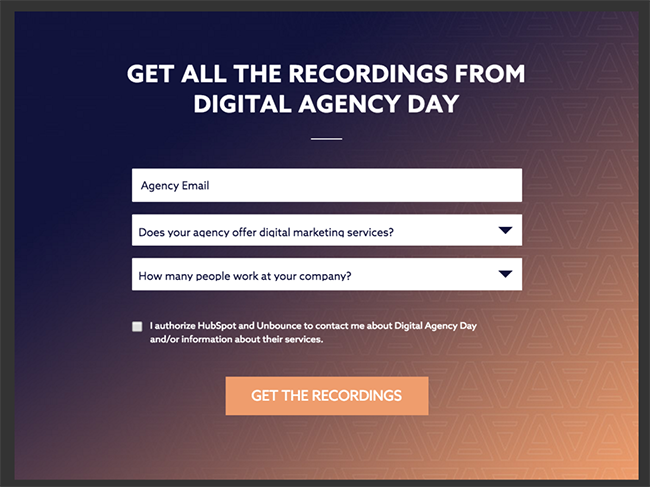
Then an exit overlay catches you before leaving, suggesting you sign up to receive the recordings when ready:

DAD overlay for lead magnets

Ok, that’s something you can get behind.

It’s specific and relevant, so it immediately makes sense.

So you’ll probably hand over your email.

It’s no surprise that this example resulted in a 19.03 percent conversion rate increase.

DAD Rooster results

People aren’t going to sign up for something they don’t think is useful.

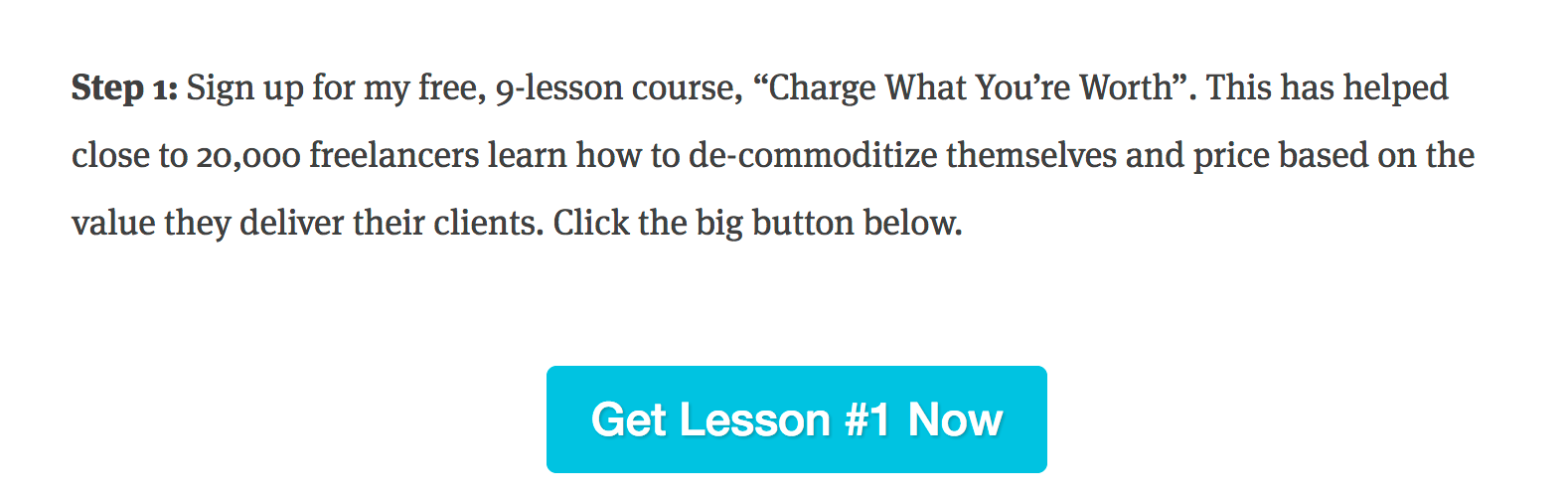
For example, check out this 9-part lesson from Brennan Dunn:

Charge what youre worth course 1

It targets a massive pain point for freelancers (“charging what you’re worth”).

It’s incredibly detailed and in-depth (“9-lesson course”).

There’s social proof that proves its value (“20,000 other freelancers”).

Brennan could easily charge for something like this, and people would still buy it.

It’s that good.

Checklists or cheat sheets can provide immediate value by giving people something they could put to use right now.

A longer multi-part course (like this example) or in-depth ebook can provide that long-term value people will reference for weeks (and months) to come.

Side-step these three issues, and you won’t just churn out another cookie-cutter lead magnet.

Instead, you’ll create a marketing asset that kicks off a long, profitable relationship with a new customer.

Design A High-Quality Lead Magnet

Remember the complaint on the first cookbook a few minutes ago? The poor organization and presentation detracted from the content and overall experience for that reviewer.

Now imagine what happens if you gave your email to get a downloadable guide filled with poor image quality and lots of typos. Same thing, right?

Unsubscribe.

The goal here is to get these users to move on from the freebie and eventually make a purchase. You can’t do that without attention to detail. You also need to show your value.

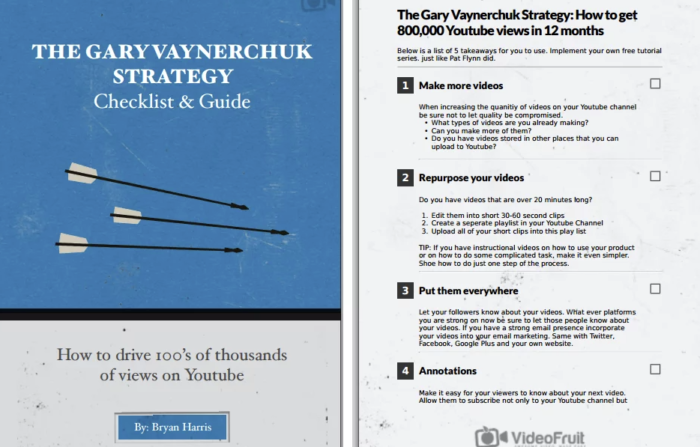
Check out this checklist from Bryan Harris of Video Fruit.

Looks pretty snazzy, right? Not just another boring rundown filled with typos.

video fruit lead magnet example

Don’t have the design skills or staffing to get this done? Hire a professional from Dribbble or Behance.

If you need a little extra help to enhance your own work, check out Beacon.

You can even hire a pro on Fiverr to do this for you, or you can do something similar by using a simple Google Doc.

Lead Magnet Frequently Asked Questions

What is a lead magnet?

A lead magnet is a free offer businesses offer in exchange for contact information from prospective leads. Examples include an ebook, discount code, free course, or checklist.

What makes a great lead magnet?

A great lead magnet must be valuable to your target audience. Aim to solve a problem or make their job or life easier in some way. For example, a business coach might offer “10 things to do before your next job interview.”

How much does a lead magnet cost?

They should be free to your leads. For businesses, the costs should be for research, creation, and distribution. These consts can vary widely based on the lead magnet and resources available. For example, if you have an in-house marketing team and graphic design person, the costs would be minimal.

What are the best types of lead magnets?

The best lead magnet is one your users find valuable, which can vary by industry, business model, and target audience. Common examples include ebooks, white papers, webinards, checklists, work sheets, coupon codes, and short courses.

{
“@context”: “https://schema.org”,
“@type”: “FAQPage”,
“mainEntity”: [
{
“@type”: “Question”,
“name”: “What is a lead magnet? “,
“acceptedAnswer”: {
“@type”: “Answer”,
“text”: “A lead magnet is a free offer businesses offer in exchange for contact information from prospective leads. Examples include an ebook, discount code, free course, or checklist. ”
}
}
, {
“@type”: “Question”,
“name”: “What makes a great lead magnet?”,
“acceptedAnswer”: {
“@type”: “Answer”,
“text”: “A great lead magnet must be valuable to your target audience. Aim to solve a problem or make their job or life easier in some way. For example, a business coach might offer \”10 things to do before your next job interview.\” ”
}
}
, {
“@type”: “Question”,
“name”: “How much does a lead magnet cost? “,
“acceptedAnswer”: {
“@type”: “Answer”,
“text”: “They should be free to your leads. For businesses, the costs should be for research, creation, and distribution. These consts can vary widely based on the lead magnet and resources available. For example, if you have an in-house marketing team and graphic design person, the costs would be minimal. ”
}
}
, {
“@type”: “Question”,
“name”: “What are the best types of lead magnets? “,
“acceptedAnswer”: {
“@type”: “Answer”,
“text”: “The best lead magnet is one your users find valuable, which can vary by industry, business model, and target audience. Common examples include ebooks, white papers, webinards, checklists, work sheets, coupon codes, and short courses. ”
}
}
]
}

Lead Magnets Conclusion

Lead magnets are one of the best ways to gather audience insight, generate leads, and even start the nurturing process to make the ultimate conversion (to revenue) easier.

Once they’ve signed up for the useful, relevant, and high-quality freebie, you establish yourself as a thought-leader on that topic and create a new customer relationship.

This means they’ll think of you when they need more information. They’ll come back for more. And they’ll come back to buy.

The good news is that these aren’t difficult to create, either. You need to take the time to dive deep into what your customers want and what they don’t want.

Then all you have to do is give them exactly what they’re already asking for.

What is your favorite lead magnet example?

A Complete Guide to Outbound Marketing

Is outbound marketing right for your business?

How do you decide which strategies are going to help you grow your brand?

If you’ve got questions about outbound, then you’ve come to the right place.

What Is Outbound Marketing?

Outbound marketing is where you (the business) initiate conversations with your customers to attract them to your brand. For example, TV commercials, cold calls, paid ads, and direct mail are all examples of outbound.

Inbound marketing, on the other hand, is when your customer initiates a conversation with you. For example, they visit your website, read an ebook, or download a white paper.

The goal for outbound marketing is to actively build authentic relationships through engagement, targeted communications, and putting your company in the right place at the right time. 

There’s no denying that inbound marketing has grown in popularity in recent years (and with good reason, as it produces tremendous results.) However, outbound still takes up 90 percent of marketing budgets due to the high cost per outreach.

To improve your ROI in outbound, you need to allocate your budget to the methods that work for your brand. Below, we’ll cover some strategies to try, but first, let’s talk about its relevancy.

Is Outbound Marketing Still Relevant Today? 

Every business owner loves to cut costs. When you, as a consumer, immediately delete a sales promotion email from your inbox without looking at it, you might wonder why that business would continually persist with an outbound strategy.

The likelihood is, they’ve built a huge mailing list and their promotions go to every single email address—paying no heed as to whether each customer is directly their target audience or not. 

Why? They’ve invested in building a mailing list, and outbound marketing is still an extremely useful tool. It’s amazingly good at driving brand awareness (as long as your emails aren’t repetitive enough that a customer ends up hating you), maintaining brand relevance, and introducing products to new audiences. It helps you be at the forefront of your customer’s mind, for recommendations, word of mouth marketing, and lead generation. 

Inbound marketing is great, and especially for smaller and low-budget businesses, but if customers don’t know your products exist in the first place, they can’t search for something they aren’t aware of. 

Outbound marketing guarantees you reach people. You won’t be shouting into the void. Blogs are great for SEO and hoping Google’s Algorithm will take pity on you, but when you pay for a TV ad in a half-time break of a popular show: you know it’s going to be seen.

It can be expensive, but, when done correctly, it still provides a good ROI and is still relevant today as a complement to inbound marketing. 

7 Outbound Marketing Strategies to Try

Most marketing success comes through a combination of different strategies. Whether it’s inbound or outbound, there are lots of different ways to reach your target audience, and often it will take lots of different strategies to achieve your goals. 

Here are seven outbound sales strategies you can use to boost your marketing. 

Outbound Marketing Strategy Number #1: Cold Email

Email seems to have been around a long time now, but it’s still bringing in an incredible ROI for marketers

We’re all accustomed to receiving newsletters from websites, but we tend to forget about an important part of outbound strategy: cold email.

Cold emails are unsolicited emails you send out to prospects. You’re initiating the interaction, so it firmly fits in with the principles of outbound marketing. 

“Everybody hates receiving unsolicited emails, spam is the worst.” 

Well, what if your cold emails didn’t feel like unsolicited emails? What if they were highly personalized, respected your customer’s time, and actually offered value to them beyond a product that can fix “all of life’s problems?”

Outbound marketing doesn’t have to be pushy, impersonal, sales-based spam. It can have all the creativity of inbound marketing. Using your understanding of your target audience, you can craft cold emails that get responses and create leads. 

Here are some things you will want to concentrate on with your cold emails:

  • cleaning your list: make sure you’re reaching live emails
  • engaging subject lines: earn the click
  • personalization: make people feel like they’re not the millionth person to receive this email
  • offering value: you want something from them, what can you offer in return?
  • A/B test everything: subject lines, signatures, CTA’s, interval between each email, the time you send each email, and, of course: the copy itself

Small details make a big difference, for example, 30 percent of people open an email based on the subject line, so make sure you’re optimizing every aspect of your outbound marketing.

Outbound Marketing Strategy Number #2: Direct Mail

First, I recommend “cutting edge technology” with emails, and now I’m telling you to send people letters through the mail?

Well, yes!

So much of our lives might have moved online, but we still exist away from the internet and we still receive mail. As it turns out, we still enjoy seeing something in the mailbox with our names on it, and this is an effective way of using outbound marketing. 

This scientific study found brand recall is 70 percent higher among participants exposed to direct mail than an online ad. It may not have the fancy analytics, and you may not be able to put a GIF on it, but it’s certainly a good way to gain traction for your brand, and can still be relevant to your ethos, voice, and how you want to present yourself.

Just take a look at KitKat’s amusing example

Estimates for the average ROI from direct mail vary a lot, and, like with most outbound marketing, it’s all about how good your campaign is. 

With direct mail, it’s important to:

  • Remain targeted with your approach and segment people based on past purchases, location, demographics, etc.
  • Be creative and make your ad stand out amongst the crowd.
  • Include a way to track the success of the campaign (unique discount codes are a great way to see which customers are responding).

It might not seem like it fits with the digital age, but direct mail is still a useful outbound strategy.

Outbound Marketing Strategy Number #3: Search Ads

Paid search ads can be seen as a cross between inbound and outbound marketing. While the targeted user has likely actively searched for information related to your products, you’re still artificially placing your brand in front of them in a way more reminiscent of outbound marketing.

Search ads are great for immediate success. 

With SEO, you write an article and watch as the search engines gradually start to rank it. When it does start to bring in traffic, it’s an amazing tool because you’re not paying for clicks, but it takes time and there’s no guarantee of success. 

When you invest in paid search ads, you give your brand an immediate presence in the SERPs, almost guaranteeing you traffic. Of course, you will be paying for each click which means the most important thing with search ads is optimization

Not only do your ads have to be on-point, but so do your landing pages (here’s how I make sure my landing pages are converting). 

Clearly set out what you’re trying to achieve with your paid ads and make sure everything is streamlined toward driving action from your customers. Small issues such as a clunky checkout page can hurt your conversion rate and make a big difference to your ROI on your search ads.

The average conversion rate for search ads on the Google network is 4.4 percent, but the hard work you put in might see you push well beyond this. 

Here’s my “Guide to Google Ads” to help you out.

Outbound Marketing Strategy Number #4: Social Media Ads

Billions of people are on social media every day. The average daily usage of social media is two hours and 25 minutes

In marketing, we talk a lot about reaching your customers where they’re hanging out, and the data shows this is overwhelmingly on social media. If you’re not running social media ads, then you’re missing out.

Social media is becoming more and more “pay to play,” increasingly making it an outbound tool. Paid social media is:

  • more cost-effective than organic social media
  • increases brand awareness
  • boosts reach

The average organic post reaches just five percent of your followers, so you need a huge following to make a difference with organic social media. Paid ads on the other hand allow you to immediately reach a highly targeted audience.

One of the most powerful aspects of advertising on platforms like Facebook, Instagram, TikTok, and LinkedIn is targeting. These companies have an incredible amount of data on their users and you can use this to be extremely targeted, serving your ads to the people they’re going to have the most impact on.

Outbound Marketing Strategy Number #5: Trade Shows/Events

Marketing may have shifted focus from the physical world to the digital one, but that certainly doesn’t mean getting out and meeting people is a dead art. One of the best ways to get your brand in front of a targeted audience is by attending a trade show. 

This can represent a large upfront cost (on average it costs $100-$150 per square foot of floor space), but the exposure and new connections you make can be well worth it. 

Maintaining brand relevance is something that takes constant commitment, and having a stand at a major trade show is one of the ways you can do this. Just think of any major trade show, and you’ll expect the biggest brands to be there. For example, what would an international farming show be without John Deere?

It may seem like these companies are so big it doesn’t matter whether they attend a trade show, but they recognize that to remain relevant you’ve got to be visible.

When planning for a tradeshow, make sure you’re setting goals and managing your budget appropriately. 

Outbound Marketing Strategy Number #6: Cold Calls 

Outbound doesn’t always have the best reputation and cold calls certainly fit this picture. Despite this, the inescapable reality is cold calling works for many businesses

Sales and marketing are still about reaching new audiences and starting conversations and that’s exactly what cold calling allows you to do. Of course, there are good and bad ways of doing this, and you need to consider your approach carefully.

Again, it’s easy to look at cold calling and think it’s all about numbers. Sure, outbound relies on volume, but the most important aspect is still quality, in this case, the quality of the conversations you can have. 

This is why there’s a push away from scripted sales pitches towards approaches like SPIN selling where the focus is on helping the customer to solve their problems (if you’ve read my inbound marketing articles then you know this is something I talk about all the time).

If you’re thinking about using cold calling as part of your outbound strategy then keep these important points in mind:

  • Invest in the right software: this will save you so much time and make you much more efficient.
  • Think about your brand image: don’t be pushy, work on growing relationships.
  • Research your prospect list: make sure you’re reaching a targeted audience.
  • Respect people’s privacy: take people off your contact list when requested.
  • Protect the vulnerable: look after your customers, especially the elderly, and put protections in place (such as a 30-day refund guarantee) to allow them to change their minds. 

Outbound Marketing Strategy Number #7: TV, Radio, and Print Ads

Online marketing has transformed the way businesses advertise, but traditional advertising is far from dead.

There are lots of online places you can advertise your business and continue to grow your brand. TV and radio ads may require a bigger investment than other forms. like PPC but they still bring in big results.

outbound marketing US tv consumption

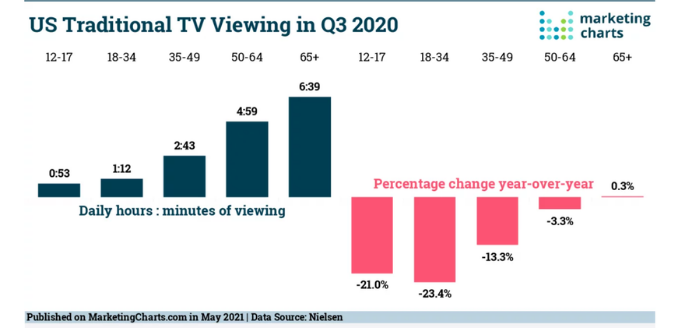
The average American might spend more than two hours a day on social media, but traditional TV consumption is even higher among the older generations:

  • 50-64-year-old Americans watch an average of four hours and 59 minutes of traditional TV each day.
  • Over 65s watch a massive six hours and 39 minutes.

Consumption of traditional media might be changing but it’s still there—and therefore it’s still a big opportunity for marketers. Make sure you understand your target demographics and are showcasing your brand with creative messaging and you can still see an excellent return on your investment.

Outbound Marketing Frequently Asked Questions

What is the difference between inbound and outbound marketing?

Outbound relies on the business initiating the interaction whereas inbound marketing relies on the customer searching for your brand.

Is social media inbound or outbound marketing?

Social media can be both inbound and outbound. Paid social media ads would be classed as outbound, whereas organic reach is inbound marketing.


Why is outbound marketing effective?

Outbound marketing is often effective because it’s immediate. You’re not waiting for people to find you, you’re putting your brand in front of people and initiating interactions.

Is outbound marketing dead?

No, it is very much alive. Many businesses still use outbound to achieve a good return on their investment. 

What are examples of outbound marketing?

Examples include paid search ads, social media ads, cold email, cold calls, trade shows, and tv/radio/print ads.

Outbound Marketing Conclusion

Outbound marketing is something that’s still relevant today. It’s a great complement for your inbound marketing and an excellent way to grow your brand. 

Marketing is a competitive field, and sometimes you can’t rely on people coming to you, instead, you’ve got to put your name out there and guarantee you’re getting exposure. In these cases, cold emails, search ads, social media ads, trade shows, cold calls, and traditional media ads can make a huge difference. 

The most important thing to remember is that many of the same principles of inbound marketing still apply to outbound. You still need to understand your target audience, and you’ve got to be able to provide value and help solve people’s pain points. 

If you can successfully do this, then outbound marketing can be an important part of your strategy. 

What’s your favorite outbound marketing strategy?

The post A Complete Guide to Outbound Marketing appeared first on #1 SEO FOR SMALL BUSINESSES.

The post A Complete Guide to Outbound Marketing appeared first on Buy It At A Bargain – Deals And Reviews.