But it’s not just YouTube—Instagram’s video content consumption has shot up by 80%, and Facebook users consume one million hours of video content every day.
All these platforms—along with most other social media sites—are ones consumers go to regularly. So as online sellers, these should become your go-to places for running promoted video content. In one study, US online shoppers said they expect to see at least three videos connected to each product when making an online purchase.
But how do you use promoted videos from paid campaigns that translate to tangible results for your e-commerce store?
Create Your Promoted Video E-Commerce Goals
Goals of promoted videos for e-commerce businesses mostly come down to these three:
Increasing brand awareness: -This essentially means if you make and sell, say, scarves, people looking to buy scarves know about you. Promoted videos are a great tool for building brand awareness as people are increasingly discovering new products through videos. In a YouTube survey, more than 90% of shoppers said they’d found new products and brands on the platform.
Boosting consideration: You want to know if people looking for scarves and checking you out are actually considering buying from you. When done right, promoted videos can push your “aware” audience base to the consideration stage. More than 50% of shoppers say online videos have “helped them decide which specific brand or product to buy.”
Generating more sales: YouTube’s “which product to buy” video watch time doubles each year. Promoted videos can give shoppers the push they need to choose your product.
Translate Your Promoted Video Goals Into KPIs
Take your goals for promoted videos and choose KPIs that reflect them.
Bigger e-commerce brands often use KPIs like ad recall, message association, and purchase intent, among others.
However, if you’re just starting out or are in your early stages of growth, these KPIs won’t make so much sense for you. Instead, you should map your goals to the more “real” KPIs, like upper funnel metrics like views and impressions, middle funnel metrics like watch time and view-throughs, and bottom-funnel metrics like click-throughs, signups, and sales. (Here’s a primer on e-commerce attribution modeling that can help you with this.)
Different video platforms have different ways of calculating these metrics. For instance, watch time of three-seconds counts as a view on Instagram (where video content maxes out at 60 seconds), whereas for YouTube, a view happens when someone watches the video content for at least 30 seconds.
Tap Into Your Users’ Moments of Need
Now that you’ve taken care of the “business side” of using promoted videos for your e-commerce business, it’s time to look into the “people side.”
One way to go about this is to tap into the idea of “moments of need” that drive video search and consumption. These are the things consumers want at this exact second.
The four key micro-moments of needs you must factor in when planning video content for paid promotions are:
I-want-to-watch
I-want-to-do
I-want-to-know
I-want-to-buy
These micro-moments represent opportunities for engagement, and videos fit seamlessly into them.
For example, if you sell skincare products, you could run a sponsored video on YouTube that targets users in your target market who also Googled “skincare products,” capitalizing on an I-want-to-buy moment. Google’s research has found advertisers who use YouTube video ads and Google search ads report 3% higher conversion rates and a 4% lower search cost/acquisition.
Or you could target broader audience segments and educate them about their top relevant concerns (ingredients, benefits, etc.). This is geared toward the I-want-to-know moments.
When you brainstorm ideas for videos using moments of need, don’t only think in terms of pitching your products. Some of these moments aren’t moments of buying but opportunities to connect with your users via meaningful video content.
The idea is to meet your users with relevant video content wherever they are in their buying journey with you—unaware, considering, or ready-to-buy.
Identify What Drives Your Users to Different Video Platforms
Each video platform has a unique video consumption pattern driven by the viewers’ intents.
For example, Pinterest users appear to have an appetite for “inspirational” video content, with searches for this content increasing 31 percent. “Inspirational,” in this context, means things like how-to guides and backstories of companies and products, making this platform great for “I-want-to-know” and “I-want-to-do” moments.
For YouTube, on the other hand, thetop four content categories are comedy, music, entertainment/pop culture, and “how to.” And, 68% of their users take this information and make purchase decisions—so, you can find all sorts of opportunities to use “moments” on this site to make your sales.
It’s also worth exploring how a user engages with the platform you’re using to promote your videos. Pinterest, for instance, serves as a wishlist for many users, as people save images and videos from all over to their personal pages. Meanwhile, a customer who uses YouTube may watch videos to learn how to use a product they want.
Instagrammers’ “moments” can fall into any category, but they want to use the information right now. When you create videos for Instagram, they need to be fast, informative, and provide easy purchasing information.
Before you pick a platform, dig into its demographics and research data. This information can help you set expectations for your promoted videos.
Optimize Your Video Content For Paid Campaigns
When it comes to creating video content you’ll pay to promote, the only rules are the ones mandated by the video platforms. These rules are about the formats supported and the approval policies, plus a few best practices.
Content-wise, there’s no one right way to do video. You need to know your company, your audience, and what works for similar brands.
For one brand, simply using stock photos, text, and music could do the trick.
Another brand might do better if they use video showing a product in action.
While there’s no one single way to create videos that work, some video types more consistently deliver results when promoted:
Product explainer videos: Sometimes simple product explainer videos—videos showing products in action—work as excellent content for promoting.
Storytelling/Sneak peeks/Behind-the-scenes videos: For some platforms, like Instagram, video content that tells a story, gives viewers a preview of new products, or shows them how things were created or who the workers are can generate great ROI.
How-tos: How-to videos directly address the “i-want-to-do” moments and often offer opportunities for showing products in action.
Unboxing and haul videos: Depending on your product(s), unboxing, or haul videos, too, can work well in paid campaigns. These are videos showing customers opening their new purchases and talking about their initial responses to the items.
Shop with me: In a two-year period, the watch time for “shop with me” videos increased tenfold on mobile alone, making this yet another video content type that can work well when promoted. These are videos where influencers literally share their shopping experiences with viewers.
Videos answering the “W” questions: Video consumers often have “W” questions— “what to buy?” “where to buy,” and “when to buy?” This may also include, “who should I buy this for?” Depending on your paid video campaigns’ goals, these questions can make good jumping-off points for promoted videos.
The above ideas for promoted video content may often overlap with the video content you’d produce for typical partnerships—but not always. It’s common for brands to create content specifically for partnerships and use it in addition to their other ads.
Alongside these promoted ads and partnerships, UGC (user-generated content) and testimonials can act as good ideas for promoted video content.
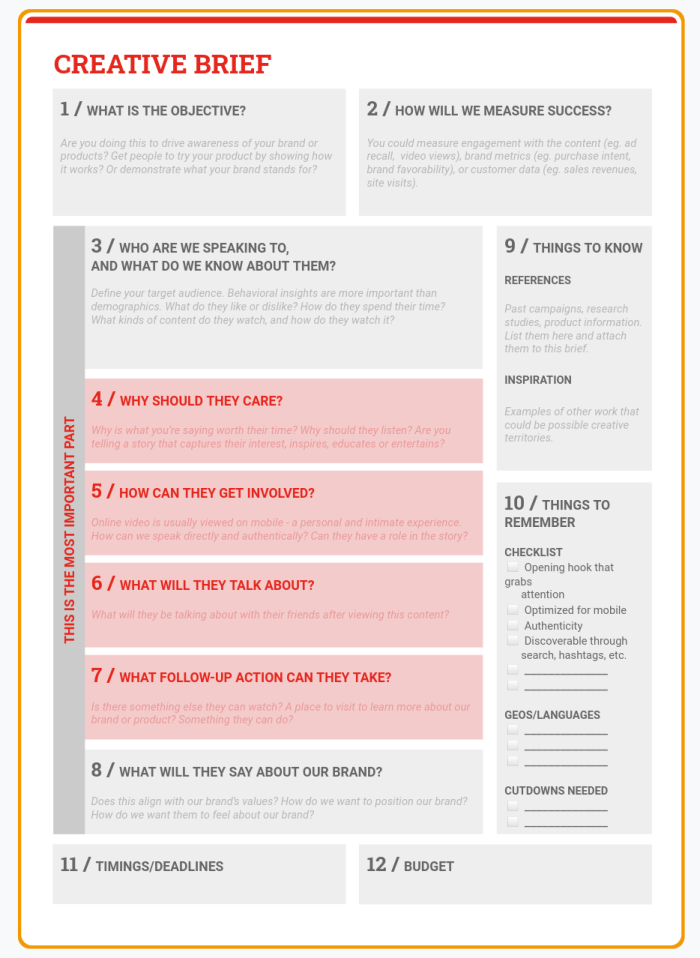
No matter what video type you choose, you need a video creative brief to prepare for your campaign. Below, Nic Burrows from Google shares a simple yet effective creative brief you can use to create compelling videos.
His template forces you to think about and research every aspect involved with creating useful, action-inspiring videos:
You can download your copy here (no opt-in needed).
To learn how to make your video content pop, Ben Jones and his team from Google review 1,000 video ad creatives each month and share how brands can improve. Check it out here:
Experiment With Your Promoted Videos
Like your other marketing assets, experiment with your promoted videos to know which ones drive the most revenue.
You can test pretty much everything, from your video’s length and opening sequence to the background music and interactive elements.
You’ll be surprised to realize significant savings with even simple experiments, so don’t shy away from trying all sorts of different things.
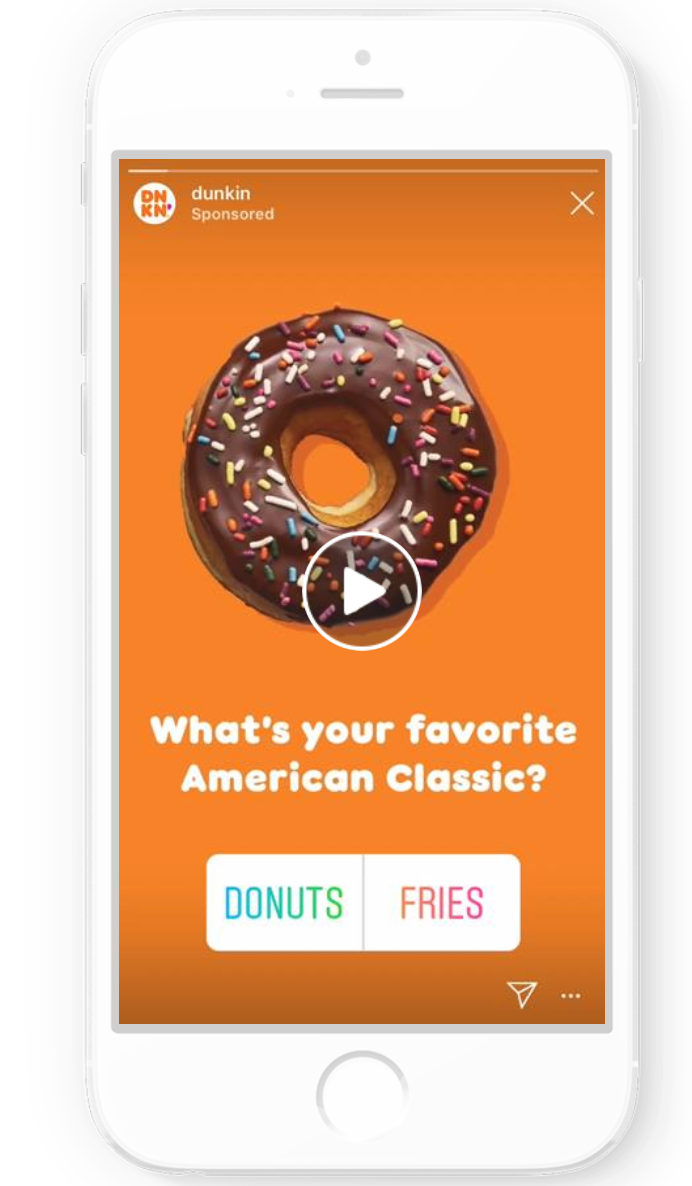
For example, when the coffee and bakery brand Dunkin’ experimented by creating an Instagram video ad with poll stickers and another version without them. By comparing these two concepts, they discovered a 20% lower cost per video view for those with stickers.
Avoid testing too many ideas in a single experiment because you likely won’t be able to tell why the winning version succeeded.
Document your findings to save on the next campaign. Additionally, your discoveries can fuel your follow-up experiments.
Analyze and Improve Your Promoted Videos
As with any other marketing channel, you may improve your ROI with your store’s promoted videos if you analyze their performance.
Just remember to look a little deeper than the top-of-the-funnel metrics like views and shares to uncover the “real” performance. No matter how impressive those numbers may be, they don’t necessarily translate to sales and profits.
So keep an eye on your sales volumes and value.
Also, when you use promoted videos on Facebook, Instagram, or YouTube, you can get instant feedback from your users via their comments, likes, dislikes, and shares.
Listen to the feedback they give and use any insights to optimize your videos.
Conclusion
When trying promoted videos for generating more sales, you should try a variety of platforms one by one.
That way, you’ll be able to identify which platforms produce the best ROI for your promoted video campaigns without needing to invest in complex attribution modeling.
Also, don’t think you need the most high-definition production equipment or the best creative agencies to produce the video content for promoting your products. Audiences crave for authentic content the most—so focus on that.
Remember, you’re competing against your own benchmarks, as there are no industry standards here.
Dive in, try different things, listen to your viewers, and—perhaps—have a little fun along the way.
Have you tried promoting videos on Facebook, Instagram, Pinterest, or any other platforms? Share your experience in the comments!
Introduction You won’t believe this, but, according to Impact Bound, up to 55.24% of all websites on the internet didn’t have a single backlink as of December 2019. That’s over 750 million sites, given that there are about 1.5 billion active websites at the moment. Hopefully, you’re not part of the 55.24%, because you’d be …
Is your company tapping into its local customers through B2B local SEO? Although business-to-consumer (B2C) brands often leverage local marketing, business-to-business (B2B) ones tend to take a broader approach. B2B brands without storefronts are even more likely to have their local marketing strategies slip through the cracks. That said, there are enormous opportunities for B2B …
4 years of experience in software development, last 1.5 mostly doing DevOps. Experienced in remote work. Experience leading small teams. Used to being the generalist in a small startup.
Looking for a (mostly) development role, maybe with some infra / DevOps sprinkled in. Happy to try out things outside my expertise.
Check out my CV and let me know if I’m a good fit. Thanks!
Article URL: https://bitmovin.com/careers-legacy/4904618002/?gh_jid=4904618002 Comments URL: https://news.ycombinator.com/item?id=24756561 Points: 1 # Comments: 0 The post Bitmovin (YC S15) Is Hiring a Solutions Director in Denver appeared first on ROI Credit Builders.
Is your company tapping into its local customers through B2B local SEO?
Although business-to-consumer (B2C) brands often leverage local marketing, business-to-business (B2B) ones tend to take a broader approach.
B2B brands without storefronts are even more likely to have their local marketing strategies slip through the cracks.
That said, there are enormous opportunities for B2B companies to tap into the local market’s power.
46% of all Google searches are local, so if you’re not targeting people in your area, you may be missing nearly half of your potential consumers.
Consumers regularly search online reviews and research businesses in which they’re interested. This trend continues to grow—a BrightLocal study showed 90% of consumers used the internet to find a local business in the last year, with 33% looking every day.
Are you wondering how to attract local customers? The answer is deceptively simple: optimize your local search engine optimization (SEO) strategy.
Let’s dive into critical areas and explore the best ways to enhance your B2B local SEO strategy.
What is B2B Local SEO?
B2B local SEO is about improving your online search visibility for nearby customers in your physical service area.
Some of these include a searcher’s location, your Google My Business listing, online reviews, your website’s mobile optimization, and more.
Begin the process with a B2B local SEO audit. This will help you define which areas need enhancement.
When done right, local search engine optimization will help your website rank higher for specific, relevant searches.
When you rank higher, you become more visible to searchers. Higher visibility in local searches often leads to more sales, leads, conversions, and revenue.
Create and Optimize Business Listings
Once your audit is complete, you can focus on tactics to take your B2B local SEO presence to the next level.
Start the process of optimizing your business for B2B local SEO by getting everything squared away with Google.
Most importantly, to get a Google My Business profile, your company must engage with customers—in person. This means you need a physical address, not a P.O. box or virtual office address. Businesses that travel to customers may also qualify.
Major categories include food establishments, attractions, professional services, personal services, entertainment, retailers, transportation, and more. If you provide any services to companies, your B2C is likely eligible for Google My Business.
The way you represent your business on Google should be consistent with how you showcase your business to the world.
Ensuring all the information on your Google My Business page is accurate is also critical to local SEO for B2B marketing.
When someone searches for your business, if your Google My Business is set up correctly, your listing appears in a box on the right side of Google’s search results.
It contains all the basics about your business, along with reviews. If you don’t fill out your address, phone number, website, and hours, local customers won’t find you as easily.
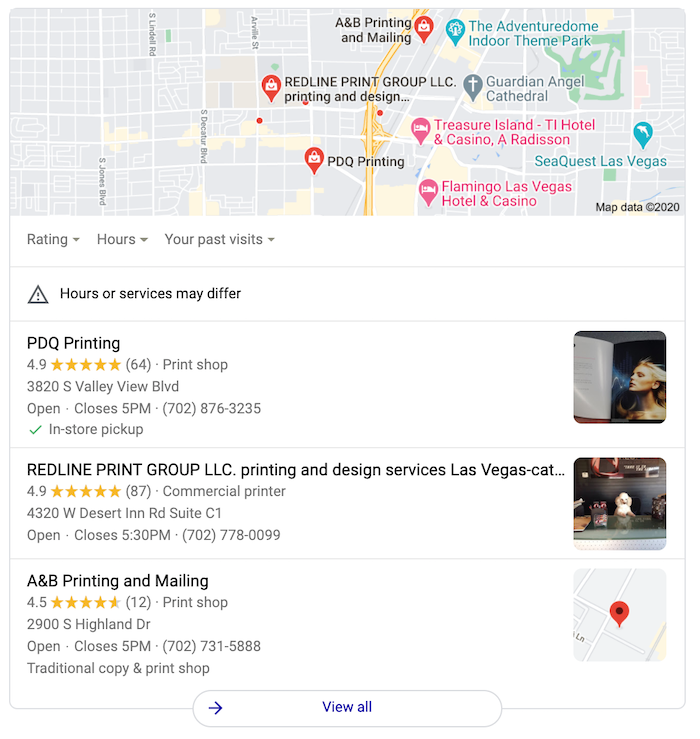
Then, there are the results that appear at the top of a Google search when someone searches for something more general, like “printing services in Las Vegas.”
The “snack pack” box displays the top local business listings most relevant to the search, along with a map showing where each is located.
Google’s customer reviews are also vital. They help increase transparency and establish trust in your brand. You can also gain a lot of insights into your customers’ perceptions through them.
Both positive and negative feedback can tell you a great deal about how your business is faring in the “real world.” Use these reviews to improve your business.
Perhaps most importantly, you need to use specific keywords related to your industry, products, and area of expertise.
When people search for those terms, your website is more likely to show up if you included them.
Your homepage should clearly illustrate your business. Your “About” and “Contact Us” pages should also feature details your customers may want to know.
This goes for both front- and back-end content. Your title tags, header tags, and meta descriptions should also contain vital information about the business.
Conduct keyword research and determine which ones make the most sense for your business.
The keywords should be contextually relevant and make sense for the audience you’re targeting. In other words, quality matters over quantity.
Ensuring your keywords fit from a regional perspective is also important for b2b local SEO.
While using broad keywords may drive traffic, those visiting may not be the most suitable leads based on location.
This is where strategizing for local customers comes into play.
By integrating region-specific keywords—like city or landmark names—into your content, you’ll be better able to connect with the relevant audience in your area.
Think about how you can give value to this audience in particular. What might they, specifically, be searching for? Create content answering the questions they commonly ask.
Create such content in either written or video form—or a mix of both. Video content is becoming more expected by audiences.
Research by Valasys Media suggests visual storytelling may benefit B2B marketers because:
It simplifies content for the users.
It conveys lots of information quickly.
It strikes a more emotional chord with prospects.
It improves personalization and invokes a perceived “personal value.”
It’s often timeless.
Take your region into consideration when creating your stories. How wide should you cast your net? Are you targeting a city or a whole state?
Additionally, research the most effective local base to target for the best ROI.
Link Building and B2B Local SEO
Link building is another pillar of local content marketing strategy. We touched upon link categories before, and they come into play with link building.
If possible, garner links back to your website and digital assets from a variety of local sources.
These may include local directories, industry-related sites, partner sites, chambers of commerce and other organizations, and newspapers’ sites.
A great way to have other sites link to you is to create and promote a useful resource. For example, say you’re a local medical clinic that provides flu shots to businesses, and flu season is approaching. You could create a guide about the best ways to avoid the flu at the office.
This type of guide is something from which anyone can learn, and it’d be beneficial for other sites to feature it.
Many chambers of commerce websites also have areas where local businesses can promote offers.
For example, the Newport Chamber of Commerce has aspecials page where various B2B brands like office space and printing services offer deals.
Since people have their phones with them all the time, they’re able to search more proactively than in the past.
Search Engine Journal compiled some fascinating stats on mobile search trends related to local SEO. Did you know 18% of local mobile searches lead to a sale within one day? Or that 78% of local-based searches on a mobile device end in purchases made offline?
Keep these mobile trends in mind when boosting your local online presence. Make sure your website and landing pages are optimized for mobile devices.
Your digital strategy for B2B local SEO should also include social media, which is primarily accessed through mobile devices. Facebook and Instagram have local components that let you include instructions and allow customers to geo-tag your business when they post about it.
There are many ways people search for businesses on their smartphones. This is why having your Google My Business listing up to date is imperative.
Whether your customer is planning in advance or already on the way, you want to make sure to reach them wherever they are.
The Benefits of B2B Local SEO
Why is b2b local SEO important? Because you have a greater potential of driving in-person traffic to your business when you target your local audience.
For a relatively low-cost, you can draw in people who are searching for your type of business.
Diversifying your online presence across various channels has further benefits as well. Many third-party websites and platforms like Yelp, TripAdvisor, and other similar directory-like sites are becoming more advanced.
They also have their own audiences, who wouldn’t find you as easily if those directories are their go-to search options.
In addition to maximizing your presence on Google and other websites, optimize your website for local search.
For example, if you’re a dog groomer in San Diego, integrate keywords like “dog groomer in San Diego” so you have specifically mentioned your location.
When people in your region are conducting local searches for “dog groomers near me,” you’ll rank for those, too—but only if Google knows where you’re located.
The key to ranking for “[your term] near me” is to start by Googling that specific phrase or your local-specific phrase that you want to rank for.
When you do that, you’ll be able to see all the localized sites from which Google is pulling. Make sure you’re listed there—if you’re not, you need to figure out why. Have you made your location clear?
If you live in Boston, for instance, there are many suburbs, landmarks, etc. On your website, list different nearby features like these. It could also be beneficial to include directions to your business from those specific places.
Ensure you also have a localized number and not just an 800 number, so people know you’re really there.
Furthermore, when people look for a specific service, they’ll often visit various touchpoints.
For instance, they may land on your website and then go to Yelp to read reviews. This is why having a listing there is essential.
After providing services, ask customers to leave reviews.
Are you looking for recession business credit cards for average credit? It may seem harder with the novel coronavirus changing our society. But it can still be done! Average personal credit does not have to be an obstacle to getting credit. Yes, you can get funding even now, and it does not have to come from the Small Business Administration.
Check out how – we can show you how.
Get the Recession Best Business Credit Cards for Average Credit
Are you searching for the best recession business credit cards for average credit? Then look no further, for we have done the research on cards and a number of different perks, too!
Per the SBA, business credit card limits are a whopping 10 – 100 times that of consumer cards!
This demonstrates you can get a lot more money with small business credit. And it also means you can have personal credit cards at retailers. So you would now have an extra card at the same stores for your company.
And you will not need collateral, cash flow, or financial data in order to get business credit.
Business Credit Card Benefits
Benefits can differ. So, make certain to pick the perk you like from this selection of options.
Secure Recession Business Credit Cards for Fair to Poor Credit, Not Requiring a Personal Guarantee
Brex Card for Startups
Have a look at the Brex Card for Startups. It has no annual fee.
You will not need to provide your Social Security number to apply. And you will not need to supply a personal guarantee. They will take your EIN.
Nevertheless, they do not accept every industry.
Likewise, there are some industries they will not work with, as well as others where they want more paperwork. For a list, go here: https://brex.com/legal/prohibited_activities/.
To determine creditworthiness, Brex checks a business’s cash balance, spending patterns, and investors.
You can get 7x points on rideshare. Get 4x on Brex Travel. Likewise, get triple points on restaurants. And get double points on recurring software payments. Get 1x points on everything else.
You can have bad credit (even a 300 FICO) to qualify.
Establish business credit fast and beat the recession with our research-backed guide to 12 business credit cards and lines. Improve your average credit!
Recession Business Credit Cards with a 0% Introductory APR – Pay Zero!
Blue Business® Plus Credit Card from American Express
Check out the Blue Business® Plus Credit Card from American Express. It has no yearly fee. There is a 0% introductory APR for the first 12 months. Afterwards, the APR is a variable 14.74 – 20.74%.
Get double Membership Rewards® points on day to day business purchases like office supplies or client dinners for the initial $50,000 spent per year. Get 1 point per dollar afterwards.
You will need great to superb credit scores to qualify.
Also take a look at the American Express® Blue Business Cash Card. Note: the American Express® Blue Business Cash Card is identical to the Blue Business® Plus Credit Card from American Express. Yet its rewards are in cash rather than points.
Get 2% cash back on all qualified purchases on up to $50,000 per calendar year. After that get 1%.
It has no yearly fee. There is a 0% introductory APR for the initial one year. Afterwards, the APR is a variable 14.74 – 20.74%.
You will need great to exceptional credit to qualify.
Establish business credit fast and beat the recession with our research-backed guide to 12 business credit cards and lines. Improve your average credit!
Recession Business Credit Cards for Average Credit for Low APR/Balance Transfers
+Discover it® Cash Back
Take a look at the Discover it® Cash Back card. There is a 10.99% introductory APR for six months from date of first transfer. So, this is for transfers under this offer which post to your account by January 10, 2019.
After the introductory APR expires, your APR will be 14.99% to 23.99%. So, this is based on your creditworthiness. Your APR will vary with the market, which is based upon the Prime Rate.
Details
You can earn 5% cash back at different places every quarter. So, these are establishments like gas stations, grocery stores, restaurants, Amazon.com, or wholesale clubs. But this is up to the quarterly maximum each time you activate. Plus, automatically earn unlimited 1% cash back on all other purchases.
You will get an unlimited dollar-for-dollar match of all the cash back you have gotten at the end of your first year, automatically.
Terrific Recession Business Credit Cards for Cash Back
Flat-Rate Rewards
Capital One ® Spark® Cash for Business
Take a look at the Capital One® Spark® Cash for Business. It has an introductory $0 annual fee for the first year. After that, this card costs $95 annually. There is no introductory APR deal. The regular APR is a variable 18.49%.
You can get a $500 one-time cash bonus after spending $4,000 in the first three months from account opening. Get unlimited 2% cash back. Redeem any time without any minimums.
You will need good to exceptional credit scores to qualify.
Check out the Discover it® Business Card. It has no annual fee. There is an introductory APR of 0% on purchases for year. After that the regular APR is a variable 14.49 – 22.49%.
Get unlimited 1.5% cash back on all purchases, with no category restrictions or bonuses. They double the 1.5% Cashback Match™ at the end of the first year. There is no minimum spend requirement.
You can download transactions| quickly to Quicken, QuickBooks, and Excel. Note: you will need good to superb credit scores to get approval for this card.
Bank of America® Business Advantage Cash Rewards MasterCard® credit card
Check out the Bank of America® Business Advantage Cash Rewards MasterCard® credit card. Get an 0% introductory APR for the first 9 billing cycles of the account. Afterwards, the APR is 13.74% – 23.74% variable. There is no annual fee. You can get a $300 statement credit offer.
Get 3% cash back in the category of your choice. So these are filling stations (default), office supply stores, travel, TV/telecom & wireless, computer services or business consulting services. Get 2% cash back on dining. So this is for the initial $50,000 in combined choice category/dining purchases each calendar year. Then earn 1% after, with no limits.
Recession Business Credit Cards for Fair Credit Scores
Capital One® Spark® Classic for Business
Have a look at the Capital One® Spark® Classic for Business. It has no annual fee. There is no introductory APR offer. The regular APR is a variable 24.49%. You can get unlimited 1% cash back on every purchase for your company, without any minimum to redeem.
While this card is within reach if you have fair credit scores, beware of the APR. But if you can pay on schedule, and in full, then it’s a bargain.
Recession Business Credit Cards for Average Credit for Jackpot Rewards That Never Expire
Capital One® Spark® Cash Select for Business
Have a look at the Capital One® Spark® Cash Select for Business. It has no yearly fee. You can get 1.5% cash back on every purchase. There is no limit on the cash back you can get. And earn a one-time $200 cash bonus as soon as you spend $3,000 on purchases in the first 3 months. Rewards never expire.
Pay a 0% introductory APR for 9 months. Then pay 14.49% – 22.49% variable APR after that.
You will need good to excellent credit scores to qualify.
Recession Business Credit Cards for Average Credit with No Annual Fee
No Annual Fee/Flat Rate Cash Back
Ink Business Unlimited℠ Credit Card
Have a look at the Ink Business Unlimited℠ Credit Card. Beyond no yearly fee, get an introductory 0% APR for the first 12 months. After that, the APR is a variable 14.74 – 20.74%.
You can earn unlimited 1.5% Cash Back rewards on every purchase made for your business. And get $500 bonus cash back after spending $3,000 in the first three months from account opening. You can redeem your rewards for cash back, gift cards, travel and more using Chase Ultimate Rewards®. You will need superb credit scores to qualify for this card.
Establish business credit fast and beat the recession with our research-backed guide to 12 business credit cards and lines. Improve your average credit!
Flexible Recession Business Credit Cards – Check Out Your Options!
The Plum Card® from American Express
Have a look at the Plum Card® from American Express. It has an initial annual fee of $0 for the first year. Afterwards, pay $250 per year.
Get a 1.5% early pay discount cash back bonus when you pay within 10 days. You can take up to 60 days to pay without interest when you pay the minimum due by the payment due date.
You will need great to exceptional credit scores to qualify.
Your Best Recession Business Credit Cards for Average Credit
Your outright best recession business credit cards for average credit will hinge on your credit history and scores.
Only you can select which features you want and need. So make sure to do your homework. What is outstanding for you could be disastrous for another person.
And, as always, be sure to develop credit in the recommended order for the best, quickest benefits. The COVID-19 situation will not last forever.
This website uses cookies to improve your experience. We'll assume you're ok with this, but you can opt-out if you wish.AcceptRejectRead More
Privacy & Cookies Policy
Privacy Overview
This website uses cookies to improve your experience while you navigate through the website. Out of these, the cookies that are categorized as necessary are stored on your browser as they are essential for the working of basic functionalities of the website. We also use third-party cookies that help us analyze and understand how you use this website. These cookies will be stored in your browser only with your consent. You also have the option to opt-out of these cookies. But opting out of some of these cookies may affect your browsing experience.
Necessary cookies are absolutely essential for the website to function properly. This category only includes cookies that ensures basic functionalities and security features of the website. These cookies do not store any personal information.
Any cookies that may not be particularly necessary for the website to function and is used specifically to collect user personal data via analytics, ads, other embedded contents are termed as non-necessary cookies. It is mandatory to procure user consent prior to running these cookies on your website.