I’m going to go ahead and say it: programmatic advertising is the future. Although it’s a relatively new concept compared with other forms of marketing, spending on programmatic advertising is growing yearly.
Omnichannel marketing, audio and in-game advertising, voice-activated advertising, and 5G are just some of the factors fueling its growth, and they’re going to take programmatic advertising into 2023 and beyond.
Now, enough about the future. What if you’re not so familiar with this type of marketing? How does programmatic advertising work? How are others using it? More importantly, is it right for your business?
In this article, I discuss all of that and more, starting with the basics.
What Is Programmatic Advertising?
Programmatic advertising is the automated buying and selling of digital advertising space over the internet.
Here’s how it works.
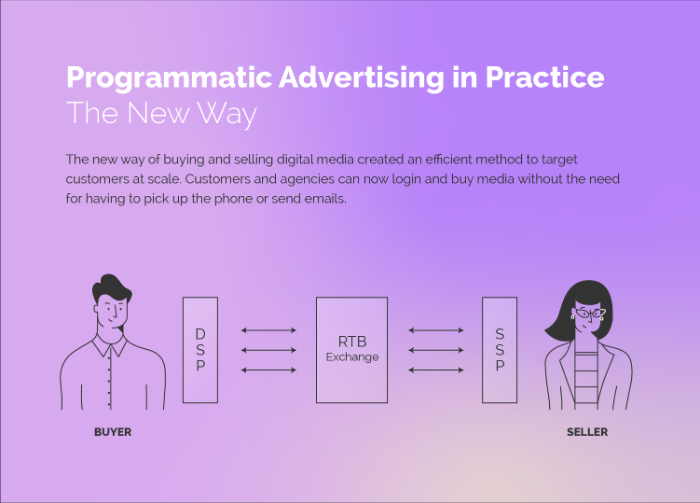
Two main platforms are involved: a supply-side platform and a demand-side platform.
By using programmatic technology, ad space gets bought and sold in real-time through automated auctions on a demand-side platform (DSP). This process happens instantaneously, with the winning ad displayed on the publisher’s website or app. This means that ads can be bought and sold more efficiently and at a lower cost.
When targeting ads, marketers first identify their target audience and then set parameters, such as geographic location, age, gender, interests, etc. They also specify how much they want to pay for each ad view or click.
Aside from the ease of automation, programmatic advertising allows for better targeting of specific audiences. The golden rule with this type of marketing is it only does well if you target the right prospects with your ads.
Programmatic advertising relies on data, meaning marketers can direct their ads to people based on their interests, location, internet searches, or even what they’ve bought before. All this makes the ads more relevant to the individual, and likely results in more clicks and conversions.
For instance, if you’re selling health foods in California, you’d want to target fitness enthusiasts in the area.
Publishers also benefit from programmatic advertising because it allows them to sell ad space more efficiently. They can target specific buyers interested in their content and sell ad space on an impression-by-impression basis.
Second, programmatic advertising is efficient and effective. For many marketers, programmatic advertising is an ideal hands-off approach to buying ads; it allows advertisers to buy ad space in real-time, which means they can get their ads in front of the right people quickly and at a lower cost than traditional methods.
Third, programmatic advertising is constantly evolving. Marketers can use it to target not only consumers, but also businesses. As new technologies emerge, programmatic advertising is likely to grow and adapt, becoming even more effective.
However, perhaps the main reason behind programmatic advertising’s success is simple: it gets results.
For example, when Grapeseedmedia.com worked with Lights.com, the campaign created a Return on Advertising Spend (ROAS) of 316 percent, a Cost Per Acquisition (CPA) of $26, 179 newsletter signups, and a 25 cents cost per page visit. This is four times the industry benchmark.
Another case study shows how a campaign for Grand-Hyatt achieved revenues of $1, 647,787 during the nine months it worked with the agency. In addition, by using display advertising, Facebook, and Google, the agency gained:
A 1,017 percent ROAS.
Over 3,000 Facebook page likes
A $275 average daily rate, which is $12 higher than the overall average
Along with 2.5 times more room nights from the Hyatt.com website.
The strategy behind the campaign included:
Showing messages to people actively searching and engaging with Google’s search results.
Focusing on users depending on their travel patterns to New York by analyzing data from Hertz and American Airlines, among others.
Targeting audiences in the trip planning phase of the customer journey
Now, let’s look at the different types of programmatic advertising available.
What Are the Different Types of Programmatic Advertising?
There are three types of programmatic advertising and four main formats available:
Open Auctions: Otherwise known as real-time bidding (RTB). This process is where ad inventory is bought and sold via a DSP or SSP.
Private Auctions: These are sometimes called ‘closed deals’ and are only open to invited bidders.
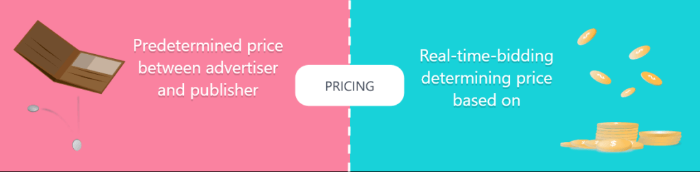
Preferred deals: Rather than auctioning ads, these provide programmatic advertising at a fixed price to a buyer.
Typically, programmatic advertising comes in four formats: display, video, banner, and in-app ads.
Video advertising is ideal for grabbing people’s attention through imagery, narratives, and sound.
Banner ads consist of a graphical image or animation placed on a web page, along with a URL to direct visitors to a website.
Native advertising is a form of online advertising that matches the form and function of the platform on which it appears. Native ads are less intrusive than banner ads and other online advertising, and can appear in various formats, including in-feed content, search results, and recommendations.
In-app ads are a type of advertising shown within an app. This can include banner ads, interstitial ads (full-screen ads), video ads, and native ads. In-app ads can be a great way to monetize an app and generate revenue.
Is Programmatic Advertising the Right Fit for Your Business?
You’ve read all about the benefits, but how do you know if programmatic advertising is the right fit for your business? That depends on a few factors, such as your target audience and marketing goals.
Below are some reasons why you might want to consider using programmatic advertising:
Volume targeting: if you’re looking to reach a large audience quickly and easily, programmatic advertising may be a good fit for you. Through automation, programmatic platforms allow you to focus on specific audiences according to interests and behaviors to reach more people in less time.
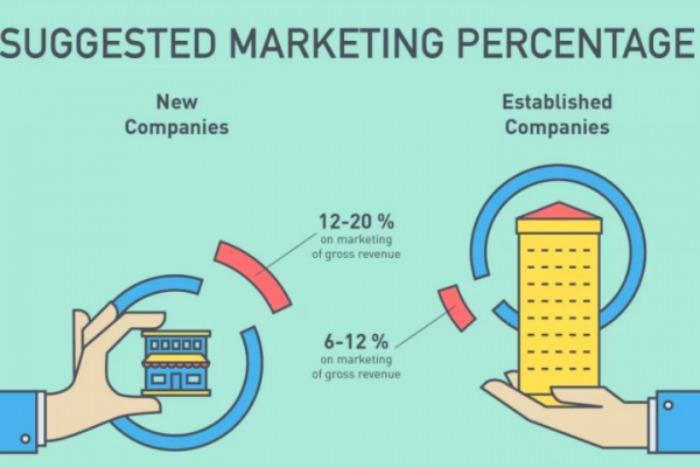
Managing your budget: As programmatic advertising lets you target specific groups, it can be budget-friendly. However, depending on the size of your business, the advice is to spend no more than 6-20 percent of your overall marketing.
What are your goals? Programmatic advertising can help you achieve various marketing goals, such as increasing brand awareness, generating leads, or driving sales.
What type of media do you want to use? Programmatic advertising offers you a variety of media types, including digital and in-app ads.
You need to be comfortable with the idea of automation and trusting algorithms to make decisions about where your ads should run.
Additionally, there are occasions when programmatic advertising may not be for you. If view-through-conversions aren’t of value to you and you haven’t tried display advertising before, then programmatic advertising may not be the ideal match.
How Much Does It Cost?
Programmatic advertising uses cost per mile (CPM), meaning you’re charged per 1,000 impressions.
However, other factors impact the cost of programmatic advertising. These depend on several factors, such as the type of system used (real-time bidding or private exchange), the amount of competition for ad space, and the quality of the ad space.
How Do You Integrate Programmatic Into Your Existing Ad Plans?
Suppose you’re looking to introduce programmatic advertising into your marketing mix. In that case, you can do a few things to help get your campaigns off to a flying start, like:
Defining your objectives: What do you want to achieve with your programmatic advertising? Do you want to increase brand awareness, drive increased website traffic, generate more leads, or improve your ROI? Once you know your objectives, you can start setting specific goals and determine how to measure them.
Set realistic goals: It’s important to set achievable goals; otherwise, you’ll only be setting yourself up for disappointment. Be sure to consider factors like budget and available resources when setting your goals.
Decide on your Key Performance Indicators (KPIs): KPIs measure if you’re on target regarding your business goals. For example, if you were working on SEO, featured snippets might be a desired KPI. Everyone wants something different from their programmatic advertising campaigns. Therefore, the KPIs you choose stem from what you’re hoping to achieve and what success means to you. Some key performance indicators to keep an eye on include:
click-through rate (CTR), which is a metric that measures how often people who see your ad click on it. A high CTR means that your ad is relevant and interesting to your audience.
cost per click (CPC): CPC is an important metric for measuring the success of online advertising campaigns. By understanding how much each click costs, advertisers can better assess the ROI of their campaigns and make necessary adjustments to ensure they are getting the most bang for their buck.
conversion rate, or the percentage of people that make a purchase when they visit your website.
cost per acquisition, which is the cost of acquiring a new customer through an ad campaign.
Decide on the type of ads to use: You can select from In-app ads for getting more downloads, banner ads for brand awareness and retargeting, video advertising for engagement, and native advertising for brand awareness and engagement in a user-friendly format.
Sign up for a DSP: Examples include Amazon DSP, MediaMath, or RocketFuel. However, there are plenty more, and it’s best to do your own comprehensive research before you decide which platform is right for you.
Create your budget: Some networks have pre-determined budgets, while with others, you work to your budget. There are a lot of different resources out there on how to optimize your budget.
Decide who to target: This is when it gets personal. Ideal customers are identified by many factors, including interests, buying behaviors, location, languages, operating systems, and plenty of other factors.
Choose your SSP: Turn to options like Google Ads Platform, AdSuite, or OpenX to get you started in your search.
Next, upload your creatives and set up your ad markups.
Use the above only as a guide, and follow the step-by-step instructions for your chosen platforms.
Once you’ve launched, analyze your data and keep tweaking until you get the results you’re looking for.
Finally, I’ve got another article for you if you’re looking for more ways to implement programmatic advertising.
Programmatic Advertising Success Stories
Now you see the potential of programmatic advertising, here’s a look at some success stories.
Agency Pubmatic worked with a Chinese mobile app games developer with an audience of 40 million. The developers sought a suitable in-app monetization solution to improve the overall customer experience and scale demand.
Pubmatic’s solution was an Openwrap SDK, which allows advertisers to optimize their in-apps earnings. The result was:
A 10.6 percent daily average fill rate lift
A 16.4 percent daily ARPU lift
A 14 percent eCPM lift
For another example, World of Warcraft is one of the most popular online video games with a turnover of $6.9 billion. However, that doesn’t mean its makers, Blizzard, didn’t want to reach out to new audiences. It wanted an advertising campaign that would:
Improve brand awareness and drive qualified traffic.
Enhance awareness for upgrades and game launches.
Develop a healthy return on ad spend.
Increase traffic away from usual sources like Google, YouTube, and Facebook.
To achieve this, Advent Technology used in-app advertising in the form of rewarded video advertising. It also:
Created a full-funnel retargeting solution.
Allowed Blizzard to own the data.
Used retargeted strategies to enhance re-engagement.
The campaign led to an 8.6 percent click-through rate, compared to YouTube’s average of 0.33 percent for audible and viewable on complete (AVOC).
FAQs
What is Next for Programmatic Advertising?
In the fast-approaching cookieless society, we’re likely to see more focus on customer engagement through impactful and engaging creative media based on quality over quantity, with more emphasis on engagement-driven metrics. Artificial intelligence is also likely to play a role in programmatic advertising in the future.
How Does Programmatic Advertising Work?
Programmatic advertising is a type of online advertising that uses computerized systems to purchase ad space in real-time. Advertisers bid on ad space through an auction system, with the highest bidder winning the ad spot.
What is Programmatic Display Advertising?
Programmatic display advertising is a type of online advertising that uses programmatic technology to purchase ad space and target audiences.
When Did Programmatic Advertising Start?
It may sound like a new development, but programmatic advertising has been with us since 1994. The first banner ad was for AT&T’s ‘You Will’ advertising campaign.
Conclusion
If you’re looking for an effective and efficient way to reach potential customers, then programmatic advertising could be your answer.
Not only is programmatic advertising affordable and it can deliver you a high ROI, it automates buying digital ad space, saving you much-needed time.
Programmatic advertising also lets you target your ideal customers with precision, while delivering ads in real-time, potentially saving you money.
However, this type of advertising may not be suitable for everyone, especially if you haven’t started with regular digital marketing and don’t have a lot of data to go with.
Do you use programmatic advertising? How does it compare with other methods?
Helios (https://www.gethelios.dev) | United States | Full-time | Remote | Sales and Marketing Leadership
hey folks we’re looking for sales and marketing leadership at Helios. We’re a fast growing startup in the world of Distributed Tracing successfully selling in Israel but looking to expand to the US.
Remote (so anywhere in the US), not interested in agencies, but good people. If you or someone you love might be a fit hit me up: Kendall at gethelios.dev
However, let’s not get too carried away, because I’m here to explain all the basics today. I’m also going to discuss the best practices, give you tips for creating Twitter carousel ads, and show examples, all to improve your chances of success with the format.
Ready? Let’s get started with the fundamentals.
A Quick Explanation of Carousel Advertising
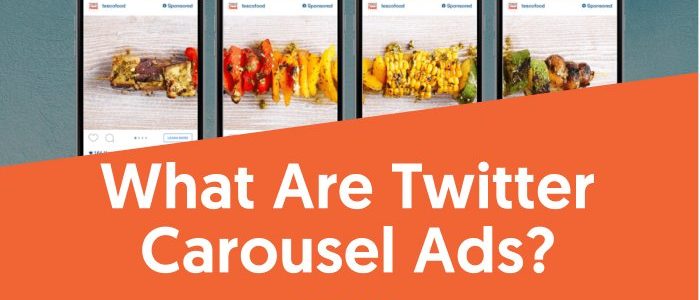
Twitter carousel ads are a newer form of advertising that allows businesses to showcase multiple images and videos in a single ad.
Marketers can use these ads to tell a story or highlight a product or service, while users can swipe through the edge-to-edge images. Advertisers can also use carousels to direct visitors to landing pages and apps and combine images and videos for greater versatility.
You create Twitter carousel ads like regular PPC ads on the platform, and you can target them to specific users based on interests, demographics, and behaviors.
Carousel ads offer businesses an easy tool to increase engagement and connect with more customers on Twitter, helping increase brand awareness, drive website clicks and conversions, and generate leads.
Why Use Carousel Ads on Twitter?
The possibilities are endless when it comes to using carousel ads on Twitter. You can also use Twitter carousel ads for:
Sharing short stories, customer testimonials, or even behind-the-scenes footage.
Promoting a sale or new product or simply introducing your company to potential customers.
Highlighting multiple features/products/services and promoting multiple offers.
Showing off multiple products or images in one ad.
Additionally, suppose you’re looking for a new way to grab attention. In that case, this is another reason why you should use Twitter carousel ads. This model offers many advantages, including:
More precise marketing: Everyone who uses Twitter knows that the character limit is 280 characters, which doesn’t always give advertisers enough space to sell their products adequately. However, adding multiple images and videos means advertisers can convey more information in a single Tweet and provide a unique URL/headline to encourage the type of customer you’re looking for.
More installs and click-throughs: When Twitter tested its carousel ads, it found it boosted average click-through rate by 15 percent and installs per impressions an average of 24 percent compared with its regular single asset ads. With Twitter’s multi-destination website carousel ads, beta testing showed a 20 percent increase in click-through rates compared with single-asset ads and a 25 percent increase in click-through rates for ‘campaigns that optimize for site visit conversions relative to single-asset ads.’
Access to analytics: Twitter offers analytics and metrics, so you have a clear illustration of how your carousels are performing, and then you can adjust your campaigns according to the data.
Ease of use: You can create Twitter carousel ads by following step-by-step instructions and adding your media.
Engagement: The carousel’s design allows users to swipe seamlessly across images for added engagement.
Achieve your objectives: Do you want more app downloads and video views or to create awareness? Well, you can set your campaigns to achieve all of these things and more.
How To Set Up a Twitter Carousel Ad
Even if you’re new to the world of marketing and you don’t know how to advertise on Twitter, it’s simple to get going with this ad format. Just follow these steps:
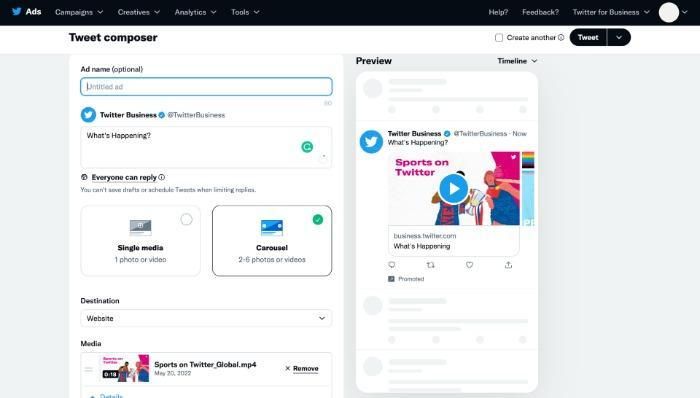
To set up Twitter carousel ads, begin by navigating to ‘Ads Manager.’ From there, select ‘creatives,’ and ‘Tweet composer.’ Then:
Add your text using the Tweet composer.
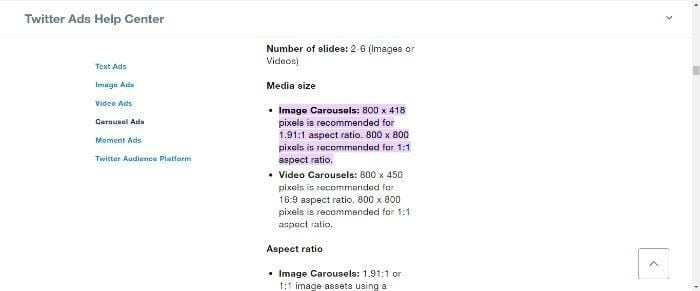
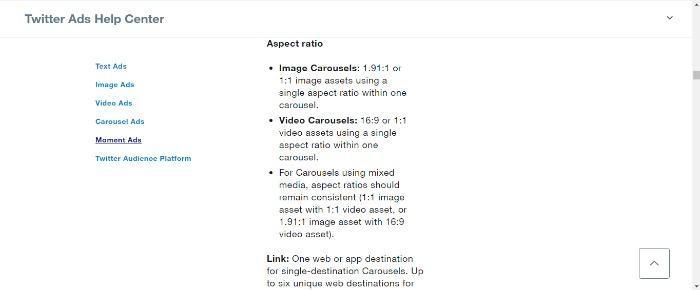
Next, go to ‘add media.’ You can upload any creatives (images and video) with a maximum of six of your images, or choose from the Twitter stock library. For this step, ensure you follow Twitter’s media guidelines:
If you want to tweet your carousel organically, uncheck the ‘promoted only’ box.
Now, customize the ad destination. For the same headlines/URL on a carousel, choose the ‘Apply this headline and URL to the entire carousel.’ Alternatively, select the ‘Customize a destination’ and select a unique headline/URL for your individual media assets.
Publish your Tweet by pressing the black button on the right side of the page. Alternatively, you can go to the drop-down menu and choose ‘Schedule’
Finally, there’s Twitter carousel ads printable templates available if you want to brainstorm and practice before hitting ‘Tweet.’ You can download this from the ‘Twitter media guidelines’ page above.
Twitter Carousel Ad Examples
Comic book app Comico specializes in content like comics and manga; one of its main forms of income is in-app purchases. The Japan-based company uses Twitter carousel ads to share teasers of its most popular content.
By posting teasers on Twitter, Comico engages social media users and encourages them to click through and read the rest of the story.
Twitter’s carousel ads are also perfect for showcasing items. Hyundai is just one company using this format to highlight its latest vehicles with design reveals to intrigue prospects, display videos, and news.
Hyundai combines its ads with engaging, enticing text and a URL to get people to click through to its website.
Skincare brand CeraVe is no stranger to Twitter advertising, using takeovers, which offer a mass reach, allowing your brand to build brand awareness and promote tweets.
However, CeraVe used Twitter carousel ads to detail the stories of four nursing staff. When CeraVe used these ads in combination with its other advertising, it achieved a 59 percent increased engagement and +19 percent higher impressions than Twitter’s usual internal benchmarks.
Best Practices for Twitter Carousel Ads
When creating a carousel ad, there are a few best practices to follow to ensure that it’s effective.
First, check that all your carousel’s images are high quality and relevant to your product or message. Also, use a strong headline and call to action for each image. For instance, to spur people into action, you can offer a discount, use the word ‘free’, or create a sense of urgency with time-limited deadlines.
You can also do the same with headlines. Don’t forget to stress the uniqueness, use power words, and include ‘you’ to personalize your tweets.
Second, make sure that your carousel is well-designed. The images should be easy to navigate, and the text should be easy to read.
Third, make sure that your targeting is accurate. Only target likely users of your product or service.
Finally, test and optimize your carousel ad campaign regularly. Try different images and copy, and see which combinations work best for you.
Include visual storytelling. Like every good story, each carousel should incorporate a narrative with a beginning, middle, and end. The difference here is that you are doing this purely with visuals.
Target your audience according to the funnel stage. For example, if consumers click through to product pages, add product images, or appeal to prospects with general top-of-the-funnel images to build product/service awareness.
Highlight the benefits and ensure your product is clear and visible.
Customize your headlines and URLs to different landing pages and headlines using Twitter’s multi-destination carousels.
Don’t just rely on images. Include solid and captivating headlines, detailed descriptions, and compelling CTAs to spur leads into action.
FAQs
Can You Do Carousel Ads on Twitter?
Yes, Twitter started carousel ads in 2020 and introduced multi-destination Twitter carousel ads in 2021.
What is Carousel Advertising?
A carousel ad contains several images or videos that rotate (or “carousel”) as you scroll through them.
Can You do Organic Carousel Ads on Twitter?
Organic carousel ads are possible on Twitter. Just deselect the ‘promoted only’ box in the Tweet composer.
What Makes a Good Carousel Ad?
Relevance and A/B testing should be at the top of your list. However, you also want attention-grabbing imagery with a clear call to action, and detailed descriptions that detail the features and benefits.
Conclusion
Twitter carousel ads are a great way to showcase various products or images in a single ad. This type of ad is especially effective for e-commerce businesses or companies with multiple products. You can use carousel ads to tell a story, highlight different features of a product, or show off different products in a collection.
They are eye-catching and allow a lot of information to be conveyed in a small amount of space. In addition, Twitter carousel ads are interactive, which makes them more engaging for users.
A bill to avert a government shutdown cleared a key procedural hurdle in the Senate Tuesday after lawmakers stripped a proposal from Sen. Joe Manchin on energy permitting reform from the legislation.
By a vote of 72-23 the Senate agreed to proceed to debate on the temporary funding bill, which will keep government services operating until Dec. 16. This sets Congress on track to likely clear the bill through both chambers and send it to President Biden’s desk before government funding runs out midnight Friday.
Senate Appropriations Committee Chairman Patrick Leahy, D-Vt., said that the Manchin, D-W.Va., proposal was the only sticking point in their chamber. And House Majority Whip Steny Hoyer, D-Md., has been adamant his chamber won’t allow a government shutdown.
“It is unfortunate that members of the United States Senate are allowing politics to put the energy security of our nation at risk,” Manchin, said in a statement announcing he would ask Senate Majority Leader Chuck Schumer, D-N.Y., to remove the permitting reform from the funding bill.
Tom Brady and Gisele Bündchen’s marital troubles are reportedly not due to infidelity.
According to a new report, while rumors of adultery are unfounded, the 45-year-old NFL star and the 42-year-old Brazil-born supermodel have recently “grown apart.”
“There is absolutely no accusation of cheating on either side,” an insider told Page Six.
“Tom and Gisele have recently struggled to make their marriage work and have grown apart,” the source claimed.
The source added that the embattled couple spent most of the summer living apart after taking a family vacation to the Bahamas with their son Benjamin, 12, and daughter Vivian, 9, in July.
Following their trip, Bündchen and the children spent three weeks at their home on the Nicoya Peninsula in Costa Rica, but Brady did not join them.
In addition, Page Six reported that the seven-time Super Bowl champion vacationed alone in the Bahamas with Benjamin and Vivian during his 11-day break from the Tampa Bay Buccaneers training camp in August.
“Gisele wasn’t there in August. It was Tom’s time alone with the kids,” the source noted.
The two, who have been married 13 years, reportedly have been trying to work through their issues but have been living separately with Bündchen living in New York while Brady has been staying in Florida to be close to his team.
Upon returning to camp, Brady had hinted at the pair’s marital woes during a press conference ahead of the Buccaneers’ first home game Sunday.
“It’s all personal, you know. Everyone’s got different situations that they’re dealing with,” the California native said.
“We all have really unique challenges to our life. I’m 45 years old, man. There’s a lot of s— going on, so just gotta figure out life the best you can. It’s a continuous process.”
Meanwhile, the source dispelled a previous report that the couple had an “epic row” over Brady’s decision to “unretire” from professional football in March.
“There wasn’t an epic fight,” the insider said.
“Gisele has no problem with Tom returning to football. She wants him to be happy and wants him to play if that is what he wants.
“There was never an ultimatum set down for Tom to choose between football or her. Their problems are more about the distance that has been created between them over a longer period of time.”
Previous reports had indicated that the couple’s rift stemmed from Bündchen’s disappointment over Brady’s decision to return to the NFL as she had hoped that he would spend more time with his family in retirement.
The Vogue cover star was also conspicuously absent from Brady’s game Sunday at Raymond James Stadium in Tampa, Florida.
The game was attended by Benjamin and Vivian as well as Brady’s 15-year-old, whom he shares with ex-girlfriend Bridget Moynahan, 51.
The quarterback was seen sharing a sweet moment with his children in a video shared by the Buccaneers’ Twitter account. He stopped to hug Vivian and kiss her on the forehead and embraced his sons before taking the field.
“Gisele continues to be dedicated to her kids and is working on personal projects,” a source told People magazine.
The Buccaneers lost their home opener to the Green Bay Packers, 14-12.
Representatives for Brady and Bündchen did not immediately respond to Fox News Digital’s request for comment.
GDPR Cookie Consent Agreement
This website uses cookies to improve your experience. We'll assume you're ok with this, but you can opt-out if you wish.AcceptRejectRead More
Privacy & Cookies Policy
Privacy Overview
This website uses cookies to improve your experience while you navigate through the website. Out of these, the cookies that are categorized as necessary are stored on your browser as they are essential for the working of basic functionalities of the website. We also use third-party cookies that help us analyze and understand how you use this website. These cookies will be stored in your browser only with your consent. You also have the option to opt-out of these cookies. But opting out of some of these cookies may affect your browsing experience.
Necessary cookies are absolutely essential for the website to function properly. This category only includes cookies that ensures basic functionalities and security features of the website. These cookies do not store any personal information.
Any cookies that may not be particularly necessary for the website to function and is used specifically to collect user personal data via analytics, ads, other embedded contents are termed as non-necessary cookies. It is mandatory to procure user consent prior to running these cookies on your website.