Our mission is to make the world’s code safe, performant and reliable. We’re starting with a tool to catch JavaScript regressions in web applications with zero-effort from developers.
How it works: Insert a single line of JavaScript onto your site, and we record thousands of real user sessions. We then replay these sessions on new code to automatically catch bugs before they hit production. You can watch a 60-second demo at meticulous.ai.
We are a London-based YC company. Our engineering team previously worked at Dropbox, Opendoor and Google. We just raised $4m, and are backed by some of the best founders and technical leaders in Silicon Valley, including Guillermo Rauch (founder Vercel, author next.js), Jason Warner (CTO GitHub), Scott Belsky (CPO Adobe), Calvin French-Owen (founder Segment), Jared Friedman (YC partner and former CTO of Scribd) and a bunch of other incredible folks.
Catching JavaScript regressions is just the start. There is an entire category of products to build on top of replay. This ranges from automatic UI previews to revealing the performance impact of frontend code.
We want to change the way the world develops software, and influence software approaches for decades to come.
We are seeding a London office and hiring an onsite (few days per week) founding engineer to join our team of four.
You will have autonomy in building out this technology, but here are a few problems you might work on:
– Build a distributed system to concurrently replay thousands of sessions, such that a developer gets a result in seconds.
– Speed up the replay of sessions in a way that retains determinism.
– Derive algorithms to detect sessions that cover differing code paths and edge cases, and ignore sessions that are too similar.
– Help build out a team of world-class, highly collaborative, software engineers.
As founding engineer, you get to shape the company, and build the culture and technology from the ground up.
What we look for:
In a sentence: Technically brilliant, delightful to work with, combined with a self-awareness and strong desire to improve. We also want to make sure everyone is highly supportive of each other; we win as a team.
We’re currently only looking to bring on folks with senior level skill sets and 5+ years of industry experience. You should have strong web fundamentals and a deep love for software engineering. Maybe you enjoy programming books like Clean Code, Designing Data Intensive Applications, Pragmatic Programmer etc. or enjoy hacking on interesting side projects. You value transparency and candid feedback, and are motivated by a strong desire to become the best engineer you can be.
You will be given the space and time to up-level yourself as an engineer in terms of conferences, reading, or whatever you think will be most valuable. We will also set you up with mentorship, if you desire it, from top engineering leaders (folks running 100-engineer organizations at the world’s leading tech companies).
If this sounds interesting, please reach out to me at gabe [at] meticulous [dot] ai with “HN” in the subject line and 2-3 sentences about what you find interesting about Meticulous and your resume/LinkedIn/GitHub.
After not being traded from the Houston Texans on NFL trade deadline day, wide receiver Brandin Cooks posted a cryptic tweet that appeared to show some frustration.
The Texans are reeling through seven games this season with a 1-5–1 record and no playoff hopes in sight. It’s for that reason many believed Cooks would be moved to a playoff contender.
“Don’t take a man’s kindness for granted,” Cooks tweeted. “Covered for the lies for too long those days are done. Crossed the line with playing with my career.”
The 29-year-old signed a two-year extension worth $39.8 million with the Texans that runs through the 2024 season, after which he will become an unrestricted free agent. And $36 million of the deal is guaranteed.
The one caveat to a Cooks trade for any team was the $18 million he is owed for the 2023 season, which seemed to be a deal breaker in a potential trade with the Dallas Cowboys.
The Cowboys and Texans were reportedly discussing a deal that would have moved Cooks to Dallas, but they couldn’t see eye to eye on compensation, so the deal fell through, per Sports Illustrated.
Cooks’ first year in Houston was tremendous with quarterback Deshaun Watson favoring him during a 2020 season in which Watson led the league in passing yards. Cooks totaled 1,150 yards on 81 receptions with six touchdowns.
Cooks did well despite quarterback troubles in 2021 with 90 catches for over 1,000 yards. But, this year with Davis Mills at the helm, the Texans have struggled offensively, and Cooks’ production has dipped as a result.
Cooks has 354 yards on 32 catches with just one score this season, and he hasn’t broken 100 yards in a single game.
With the trade deadline past, Cooks will now have to finish out the regular season with Houston before he can be traded again, assuming that’s what he wants.
It’s a short week for the Texans, who face the undefeated Philadelphia Eagles Thursday night.
Nonetheless, no matter what platform you look at, it’s safe to say that the advertising industry is seeing a slowdown.
Now let’s dive into the obvious bad news, and then we will get into the silver lining and how you should adapt. Because there is hope and you can still do well in this market.
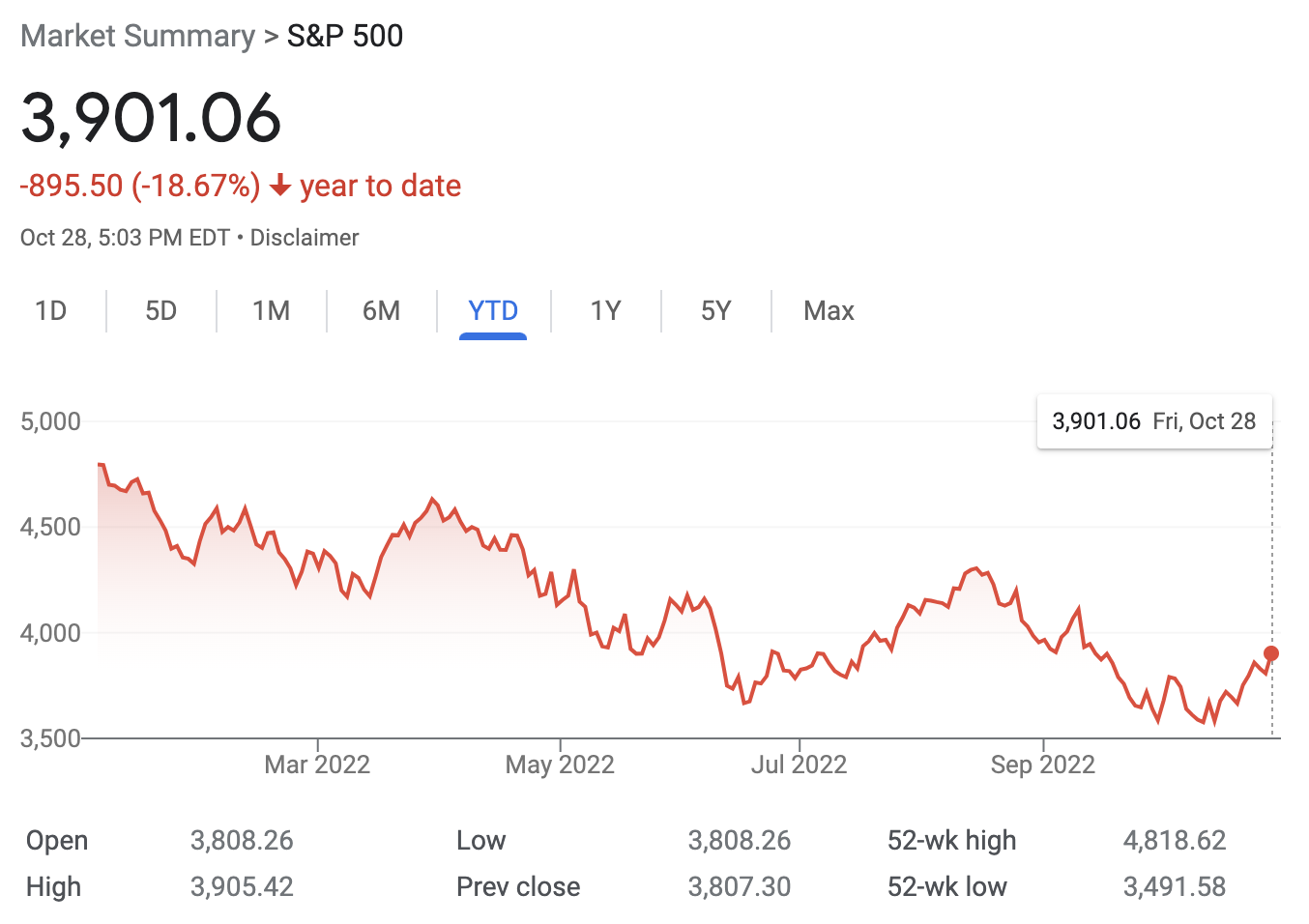
And when you have the S&P 500 down 18.67% it means companies have lost a lot of money… and I mean a lot.
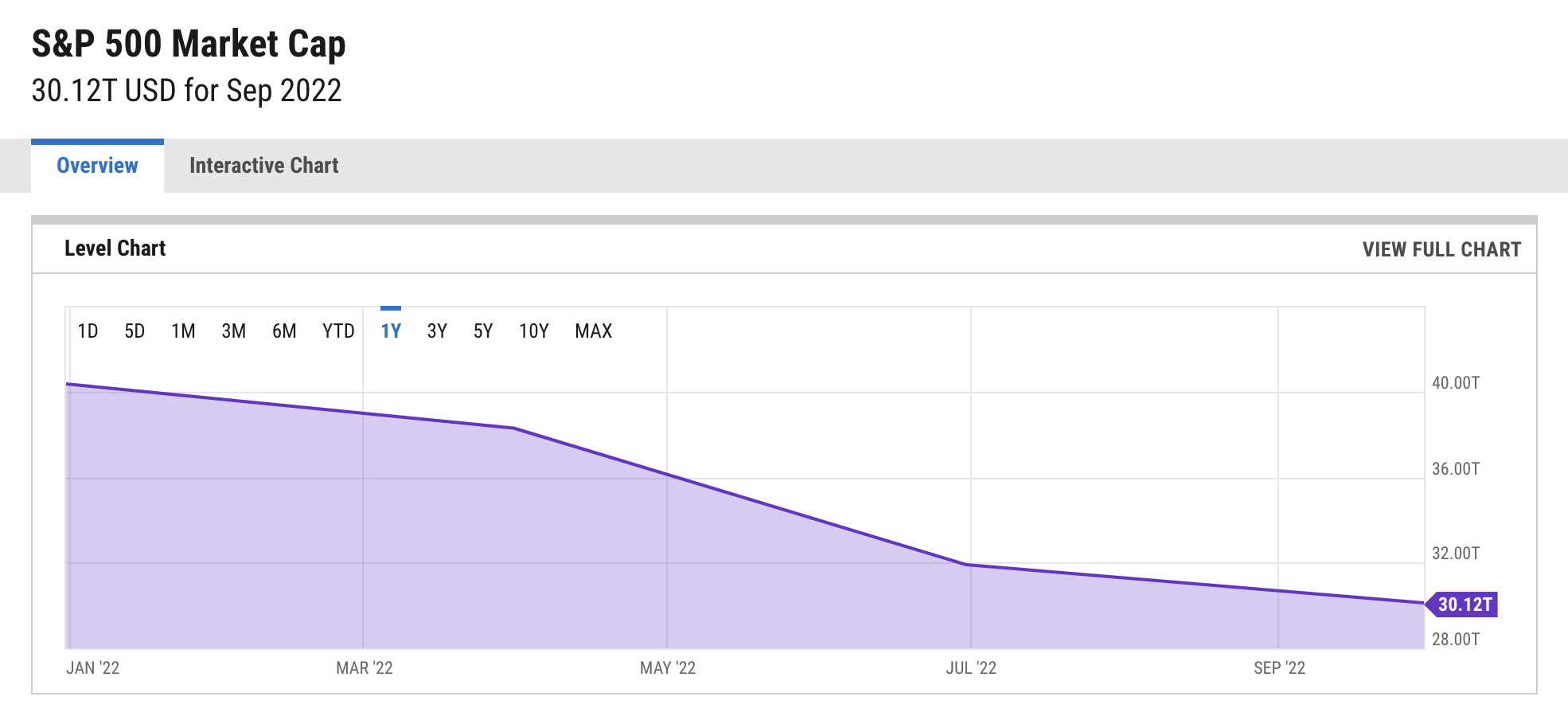
Just think of it this way, the companies in the S&P 500 have a market capitalization of 30.12 trillion dollars.
In December of 2021, the S&P 500 had a market capitalization of 40.36 trillion dollars. That’s roughly a 10 trillion dollar loss.
To put it in perspective, if Apple, Amazon, Google, Facebook, and Microsoft didn’t exist that would only be 6.8 trillion dollars (based on today’s stock price).
When the market goes down, the value of which companies are worth goes down, which means companies cut back on spending. Marketing happens to be the first thing that gets cut in a bad economy.
And when the value of companies goes down, a lot of people’s net worth goes down. Just in America alone, 43% of the population owns stocks.
So, when people’s net worth goes down, eventually they start spending less. It’s already started to slow too… when you look at data from the first half of this year (inflation-adjusted) spending increased by 1.5% compared to 12% last year.
But what about marketing?
Here’s what’s interesting…
Because our agency, NP Digital, works with companies of all sizes we see data from both small and medium businesses as well as enterprises.
Plus we have offices and employees throughout the world such as in Canada, Brazil, Germany, India, Australia, etc… because we work with companies in multiple regions and help them with their global and local marketing campaigns.
That in combination with working closely with some of the big advertising platforms and having tools like Ubersuggest that tracks millions of domains we really see a lot of data and trends.
Here are the 3 main trends we are seeing (keep in mind the data below is from what we can see and track, as we don’t have data on the whole web or even a large fraction of it):
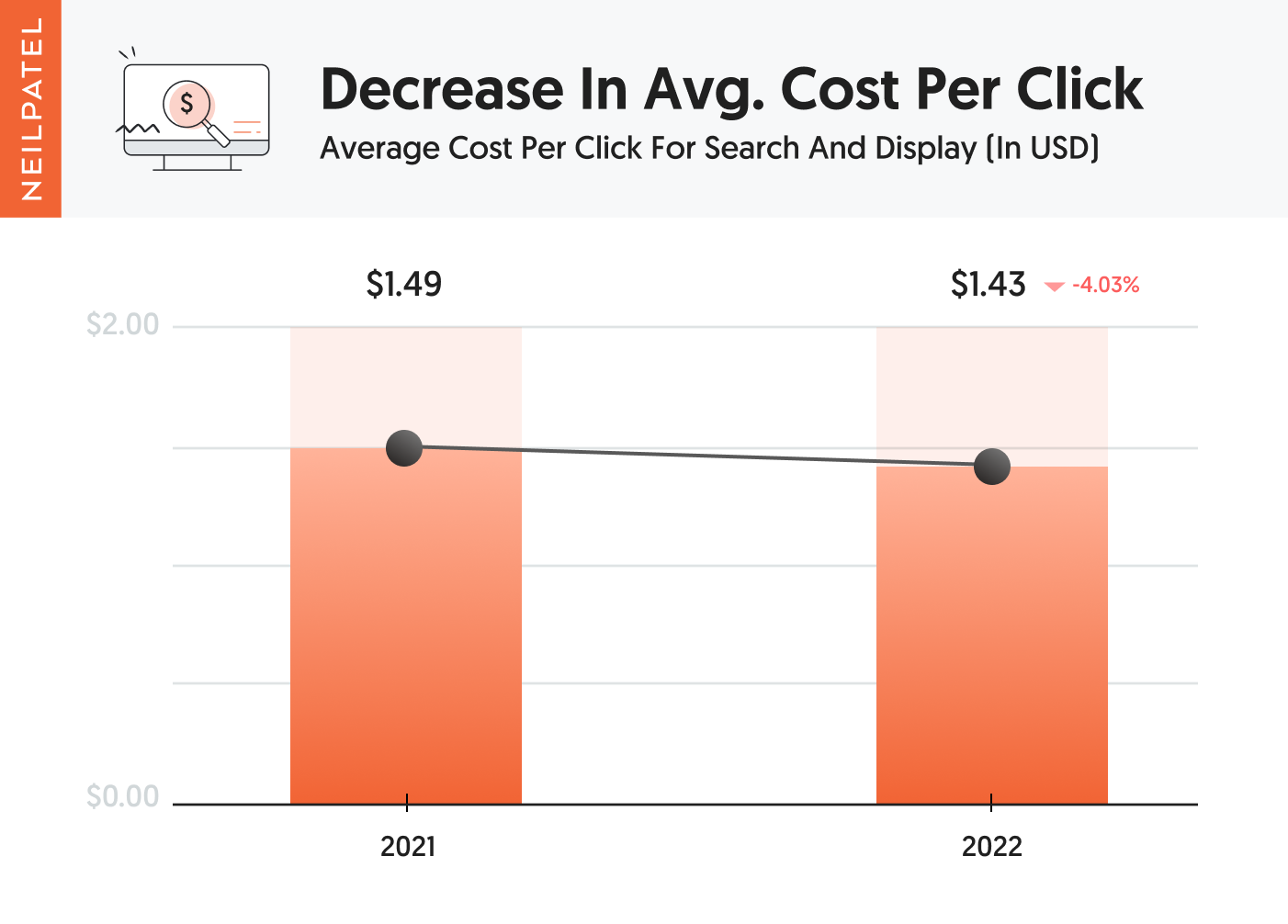
Trend #1: Ad costs are decreasing
Overall, the global costs for ads have been going down by 4%. Some industries like real estate have gone down much more, but with other industries like B2B SaaS, we haven’t seen much of a change with our clients as they optimize for lifetime value.
A lot of this is because businesses are cutting back on their spending in addition to many sectors such as real estate not having the same demand that they had a year ago.
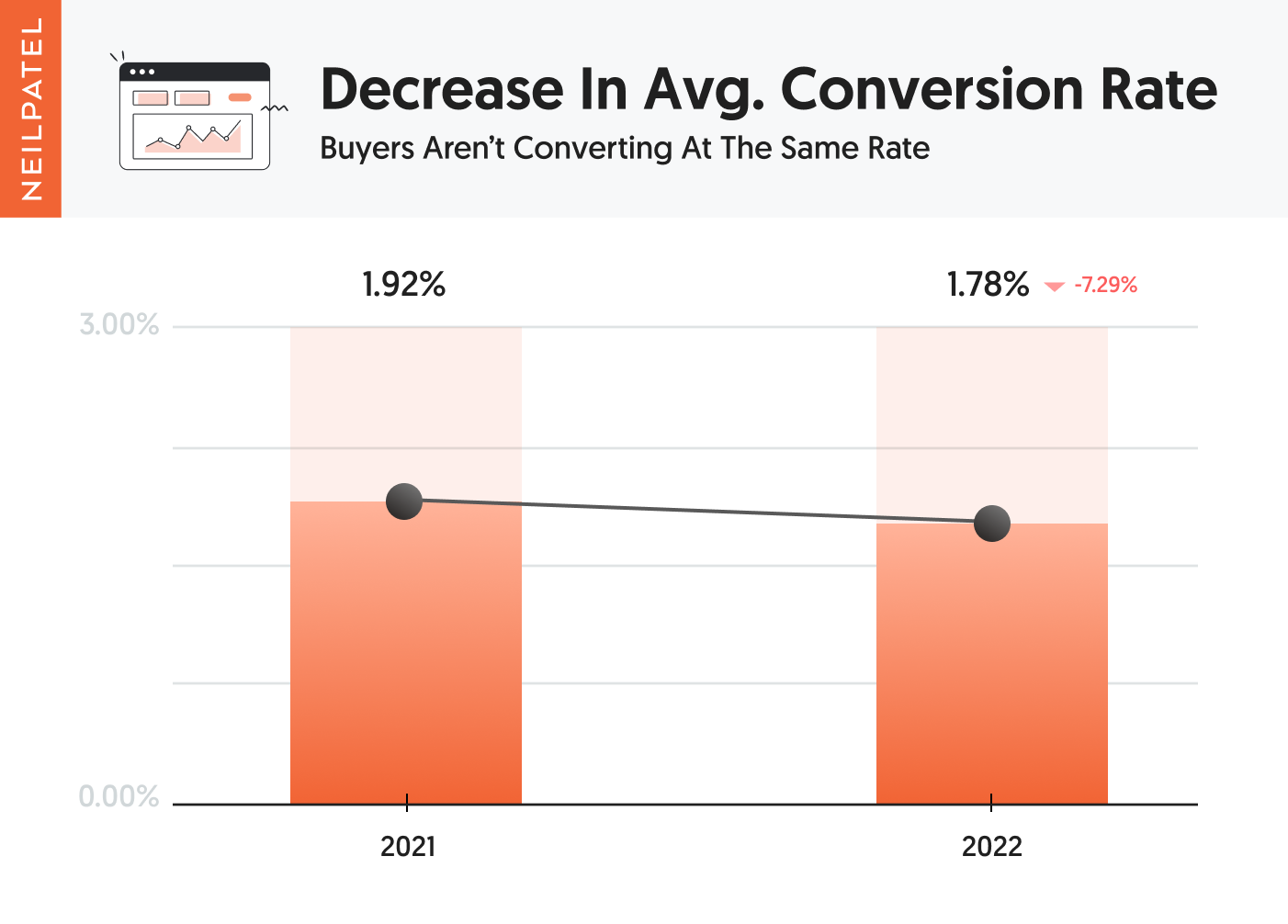
Trend #2: Buyers aren’t converting at the same rate
We aren’t seeing conversion rates as high as they used to be. We’ve seen a drop of 7.13%.
Keep in mind that different websites have different conversion goals. Such as one website may focus on leads while another may focus on a signup or another may focus on a purchase.
Conversion rates are also affected by many other factors such as companies increasing prices due to inflation costs, shipping costs, and supply chain delays.
Or conversion rates being lower because some people aren’t spending as much because they may have lost their job.
Trend #3: Companies are fearful of the unknown
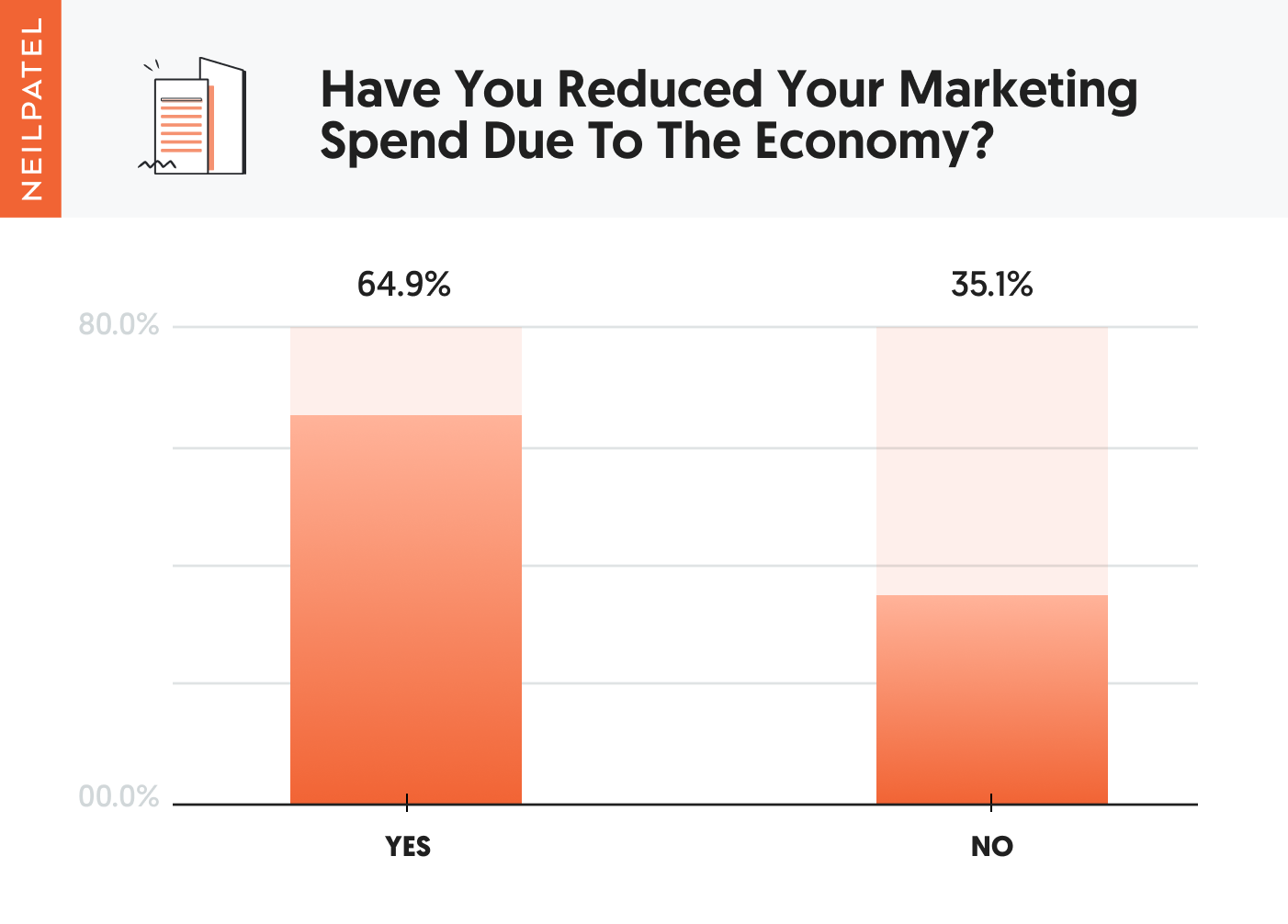
We are seeing some companies pulling back on their total marketing budget because they are afraid of what lies ahead.
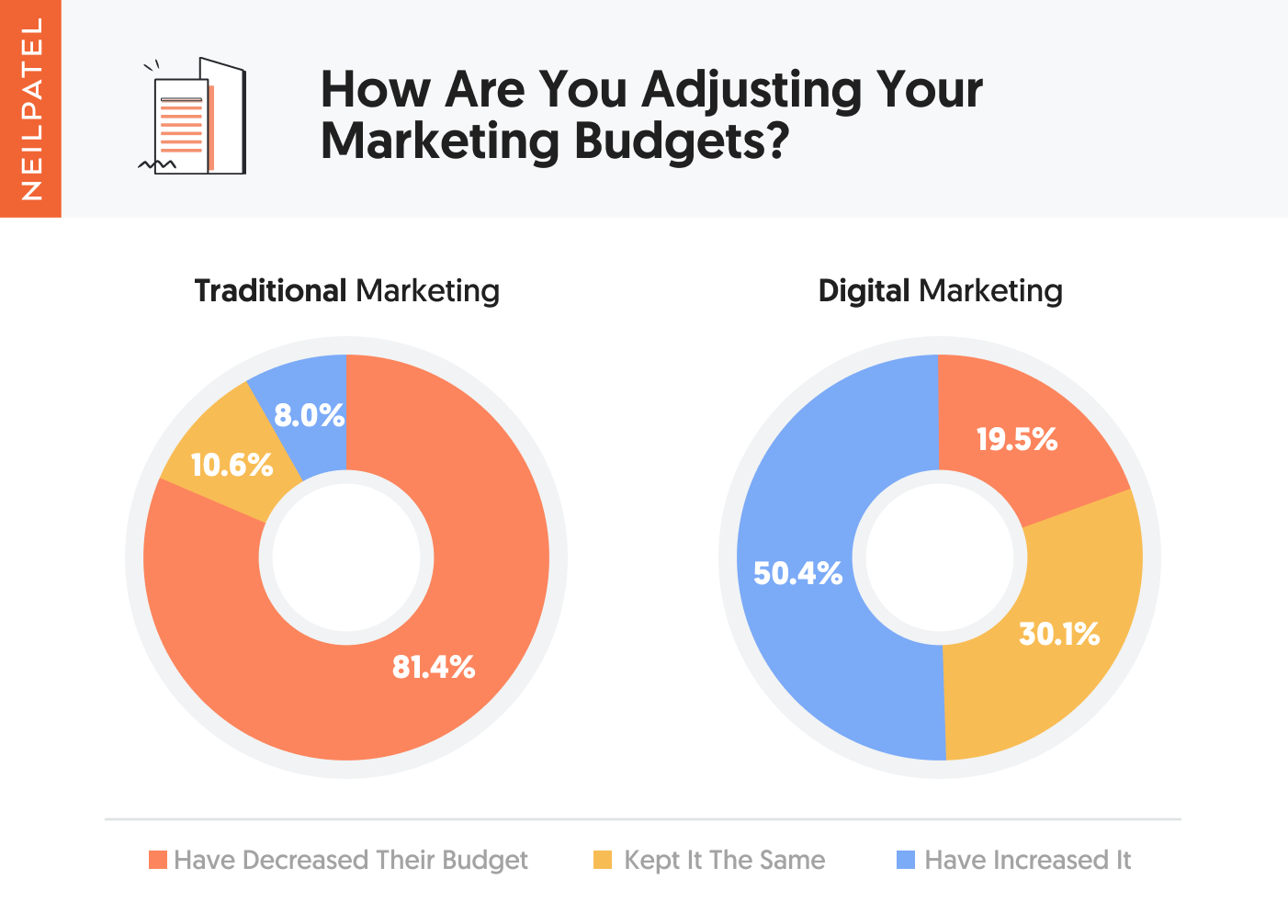
But we are also seeing companies shift their budget to digital marketing because it is easier to track than let’s say traditional TV or radio advertising.
Now we don’t manage traditional budgets for our clients, but we handle the digital side. In a good or a bad economy, companies tend to spend on digital marketing (things like SEO, paid ads, email marketing, social media, etc) as long as it is profitable.
The silver lining in marketing
As I mentioned earlier, we see a lot of data.
There’s a pattern that we have seen with the companies that have been growing this year (the ones we work with at least).
And to be clear, when I say growing, I mean companies that are generating more revenue and profit.
These companies are also taking advantage of the current economic climate to double down on their whole business, not just marketing, to gain more market share.
So, what are these growing companies doing in this economy?
Conversion optimization – 83% of them have doubled down on conversion rate optimization. If you can get more of your visitors to convert into customers through copy, images, or products you can generate more sales. A great example of this is Legion which will grow around 40% this year mainly due to conversion rate optimization, while a lot of their D2C competitors are flat or declining.
Influencer marketing – 49% have either doubled down on their influencer marketing budgets or started influencer marketing. Rates for influencer marketing have gone down. They can convert well too if you focus on micro-influencers that have your target audience. They tend to be both cheaper and generate more revenue. You just need thousands of them to really build scale (not hundreds).
SEO – SEO is a long-term play, but it provides a massive ROI. Only 2% of the companies we work with that have grown this year have slowed down on their SEO efforts. 98% of them continued their current budgets or increased them when it comes to SEO.
Global expansion – an easy way to generate more revenue is to add new regions to sell your products and services in. 19% of the winning companies we work with have expanded into new regions. This creates more revenue generation opportunities, and you’ll find that marketing is much cheaper in most regions compared to the U.S. or U.K. Sure you won’t generate as much revenue, but the ROI tends to be higher from what we are seeing.
Email marketing – it’s rare that we work with a company that isn’t collecting emails or already doing email marketing. But what’s funny is companies assume that if you just send out promotional emails every once in a while, or a few educational ones… that’s considered email marketing. Sadly there is much more to it. For example, segmenting your lists and sending different campaigns to different people. Or optimizing your open and click rates. 77% of the companies we work with that grew this year doubled down on email marketing and fine-tuned their campaigns.
Omnichannel marketing – there is multi-channel marketing and there is omnichannel marketing. 100% of the companies we worked with that grew focused on omnichannel marketing and continually expanded. What I mean by this is when a company uses omnichannel marketing, the channels work together and they are also using learnings from each channel to maximize others. Versus multi-channel marketing where each channel just sits in a silo. TikTok has been massive for ecommerce… and channels like Snap, Pinterest, Reddit, Bing or even Quora that people don’t really talk about have been effective too.
Conclusion
Just because the economy isn’t where you want it to be, it doesn’t mean you can’t grow.
And if you really have headwinds ahead of you such as the mortgage industry, you can still make a lot of changes that will put the company in a much better place when the economy starts to recover.
In other words, start thinking outside the box. Don’t focus all of your energy on the news… sure it’s smart for you to stay up to date with what is happening, but the majority of your time should be spent on solutions and new ways to grow.
Do you find yourself often pondering blog-related questions, such as how many blogs per month for SEO? You’re not alone. There is no golden rule, but there are set practices to find the best fit for you, and we can illustrate how.
Blogging frequency is a common struggle for new bloggers and experienced bloggers alike. With so many factors to consider, including search engine optimization and brand awareness, it’s certainly an important thing to have planned out.
In this post, we’ll uncover the blogging frequency we found that works for one specific industry. We’ll show you how we drew this conclusion and how you can do the same for yours.
Why Is Blogging Frequency Important?
Blogging frequency is how often you publish blog posts on a weekly or monthly basis.
There are a number of benefits to finding your ideal blogging frequency.
First and foremost, blog posts allow you to rank for organic keywords. These are needed for driving organic traffic to your site.
A frequently updated blog also increases brand awareness. The more you post about your industry, the more aware of your web presence, your products, and your services your target audience becomes.
Blogging can help your business build trust in the community. Posting relevant content about your industry and regularly updating it will help convey trust and authority to your audience. They will be more likely to convert on your site versus a competitor that rarely updates their content or posts blogs.
For more practical reasons, a blog post frequency helps you to set a standard for yourself or your content writing team. Without a frequency in mind, you may constantly focus on writing blog posts at the expense of other activities. This extends to adjacent teams too, like social media and design, who would greatly benefit from a known frequency so they can prioritize their tasks.
So a blog post frequency gives you both an upper and lower limit, which means you can spend more time and money focusing on other aspects of your business.
Are You Blogging Too Often?
In addition to asking how often do you need to blog, it’s not uncommon to ask what happens when you blog too frequently? Or, is that even possible?
Perhaps you’re thinking the more, the better. As you’ll see in the analysis below, it’s not quite that simple.
You could post daily on your blog. Hourly, even. Will it be your best content, though? Remember that quality is better than quantity in almost all cases. By posting too frequently, you may be sacrificing the quality of your content which itself will have a negative impact on your brand.
What We Learned From Our Data about Blogging Frequency
For this analysis, we’re evaluating eight companies in the CBD industry. To find out how many blog posts they publish per month, we looked at their post sitemaps and calculated the average number of posts per month since January 2022.
We looked at a few metrics when measuring their success.
First, we looked at the overall keyword universe, meaning we analyzed the total number of keywords the blog ranks for on Search Engine Results Pages (SERPs). To drill down further, we also looked at the number of those keywords which ranked within the top 10 results, or on the first page. Finally, we compared the number of organic keywords each business ranked for in the top three results. These are the most coveted positions.
The greater your number of organic keywords, the farther your reach. While it’s not the only metric to consider when measuring success, it is a good indicator of such.
RoyalCBD.com: A High Post Frequency Example
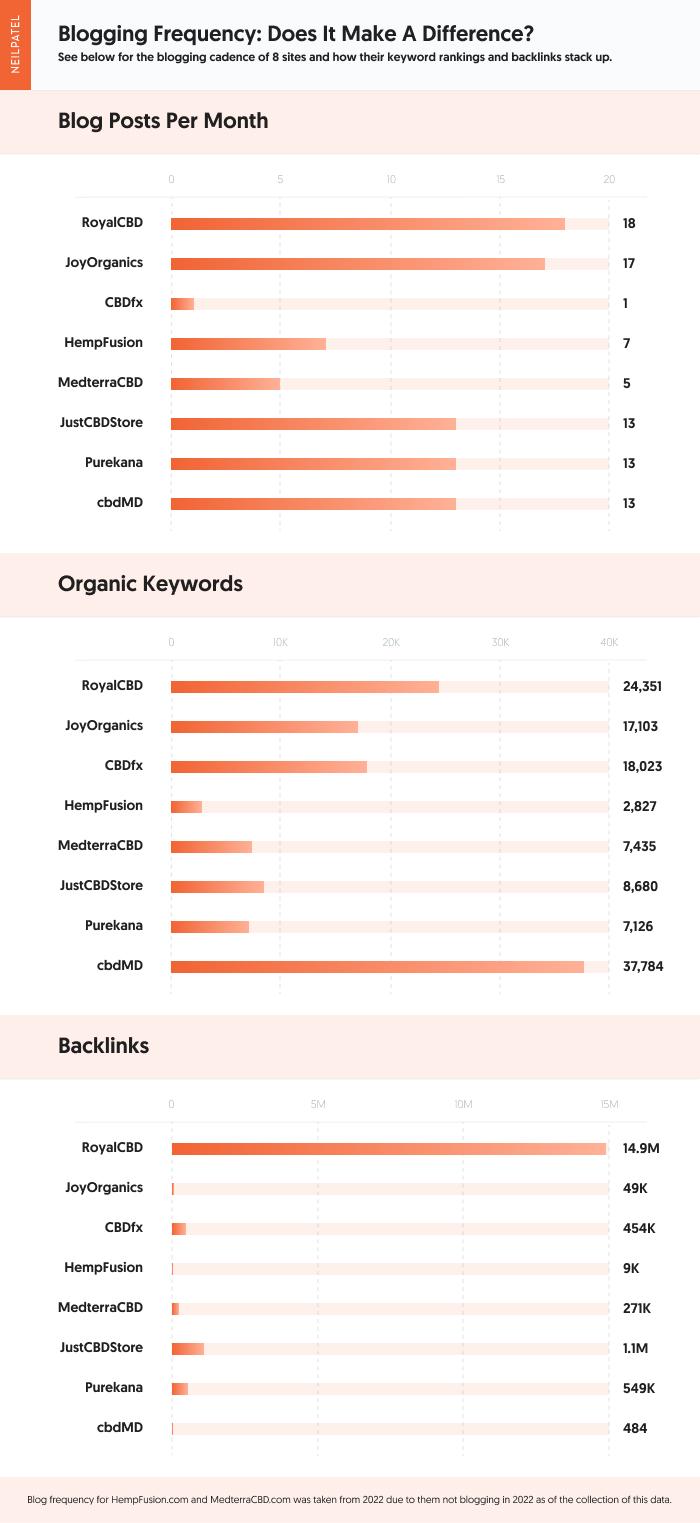
With the highest post frequency on our list, RoyalCBD.com boasts an average of 18 blog posts per month. This seems to have paid off, with 24,351 organic keywords driving traffic to the website.
More important than organic traffic, however, is the quality of that traffic. RoyalCBD seems to boast high numbers there, too. The website has 5,603 keywords ranking in the top 10 and 2,920 keywords ranking in the top one through three positions on SERPs.
JoyOrganics.com
The next on our list, JoyOrganics.com, also happens to be the site with the second-highest posting frequency that we analyzed. That is, 17 posts per month on average from January 2022 through June 2022.
This is likely a contributing factor for the rather high number of organic keywords – 17,103 to be exact – driving traffic to the site. Of those keywords, 1,679 rank in the top 10 and 511 rank within positions one through three on SERPs.
CBDfx.com: Is One Post Per Month Enough?
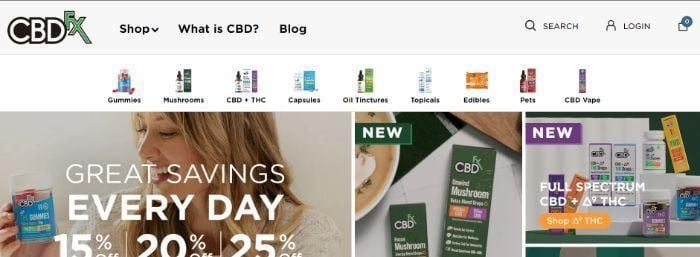
On the opposite end of the spectrum, there is CBDfx.com, with a blogging frequency of about one post per month.
Before you think CBDfx.com is an anomaly, you should know they have refreshed 155 blog posts on their site in June 2022 alone. This means they optimized existing posts to meet current SEO standards. So while their posting frequency is low, the refreshed content is likely playing a large role in their organic keyword rankings.
CBDfx.com has 18,023 organic keywords with 2,576 ranking in the top 10 and 984 ranking within the top three positions on SERPs.
While we initially looked at post frequency from January 2022 through June 2022, there are some websites that have yet to post in 2022. This includes HempFusion.com. In those cases, we looked back at July 2021 through December 2021.
From July through December 2021, there was an average of seven blog posts per month. Despite not posting in 2022, this prior frequency seems to have provided some protection for HempFusion.com on SERPs. It currently has 2,827 organic keywords, with 391 ranking on the first page and 201 ranking in positions one through three.
MedterraCBD.com
Here’s another site with no blog posts in 2022. From July through December 2021, though, MedterraCBD posted an average of five blog posts per month.
You might be thinking that surely MedterraCBD.com will have fewer organic keyword rankings than HempFusion.com. MedterraCBD.com actually has considerably more. To be specific, 7,435 organic keywords with 840 ranking in the top 10 and 486 ranking in the top three.
There are a few reasons for this. Foremost, MedterraCBD.com has ranked since the middle of 2017 while HempFusion.com only started ranking around January 2020. MedterraCBD.com has also seen higher average rankings overall, so it’s likely to see the effects of not posting less drastically.
JustCBDStore.com
With 14 posts per month, surely JustCBDStore.com has a significant number of organic keywords.
Surprisingly, this site has only 8,680 organic keywords. Of those, 1,615 rank in the top 10, and 776 rank within the top three on SERPs. That’s close to the sites like HempFusion.com and MedterraCBD.com that didn’t post at all in 2022!
We know it’s not the posts per month responsible for that low of organic keywords. So the answer is likely in a factor we have not considered, such as the age of the website or social media presence.
Purekana.com: Moderate Number of Posts Per Month
Another on our list with a moderate number of posts per month, Purekana.com has a monthly blogging frequency of approximately 13.
Similar to JustCBDStore.com, Purekana.com has a small organic keyword profile with 7,126 organic keywords. Of these, 983 rank on the first page of SERPs, and 414 rank within the top three.
cbdMD.com
Here’s another anomaly, though occurring in the opposite direction of what we saw above.
cbdMD.com posts an average of 13 blog posts per month. Despite this middle-of-the-road number of blog posts, it has the most organic keywords on our list with 37,784. This includes 5,924 keywords ranking in the top 10 and 2,154 keywords ranking within the top three.
But How Often Should I Blog?
To recap our findings, we analyzed eight CBD websites with the intention of pinpointing the optimal number of blog posts per month for the industry. Here is what we found:
cbdMD.com has the largest number of organic keywords. When you take into account its modest domain authority and medium-sized backlink profile, it becomes clear that the number of blog posts is the driving factor for its success.
Why is this not the case for JustCBDStore.com and Purekana.com, both of which also post approximately 13 blog posts per month? There are a lot of other variables at play, such as target keywords, length of the average blog post, and social media presence.
What does this mean for you?
Our research shows that for this industry, 13 blog posts per month is a good balance between quantity and quality. These should be focused on well-researched topics with at least one or two target keywords. This should further be accompanied by ample support from your cross-functional teams. This means social media promotion of the posts and digital assets from your design team at the very least. 13 a month was a number that allowed the sites we mention above to strike that balance.
In addition, blog post refreshes should also have a place in your content writing strategy. There’s no magic number of refreshes to implement here. It’s more so about updating older posts that may not fit in with the most recent SEO recommendations. This also gives you an opportunity to improve your internal linking.
Finding the Ideal Blog Post Frequency for You
The blogging frequency we found to be ideal for the CBD industry may or may not be ideal for your industry. So how can you find the ideal blog post frequency for your industry and, even more important, your blog?
The best way to do so is with an analysis of a sample of blogs within your industry like we performed above. You can easily do this with access to XML sitemaps and an SEO analysis tool like Ahrefs or, of course, Ubersuggest.
What does this look like?
Find ten to 15 competitors with blogs in your industry to evaluate.
Take note of how often each site posts within a designated time period. We recommend looking at the last six months if possible.
With the average number of posts per month for each site, you can now use an SEO analysis tool for a fuller understanding of that site’s SEO profile. Look specifically at the number of organic keywords and the number of keywords ranking within the top ten.
With this information combined, you can determine which post frequency correlates to the highest number of organic keywords in your industry.
While organic keyword profile isn’t the only indicator of a solid posting frequency, it’s one that seems to correlate highly. So do take other factors into consideration if something stands out, but don’t overcomplicate it.
FAQs
Here are the answers to frequently asked questions on the subject of blogging frequency.
How many blogs should you post a week?
The answer is not so cut and dry as we’ve highlighted above. Once you have found your ideal blog post frequency for the month, it’s best to break it down into weekly goals.
How often do most bloggers post?
In our data, we saw post frequencies anywhere from once a month to almost 20. The answer is going to vary based on the client’s industry as well as the capacity of their content team, though it’s important not to compromise quality for cadence.
Does it hurt my content marketing to blog more or less than my competitors?
While competitor research can provide a good idea for the number of blog posts to write each month, it’s not the be-all-end-all. You should also consider how many quality posts you can write and whether you actually have something useful to say.
This could be an article topic all its own, as there is a lot that goes into quality blog writing. A few elements of a quality blog post include a compelling headline, a narrow focus, and a unique brand voice.
{
“@context”: “https://schema.org”,
“@type”: “FAQPage”,
“mainEntity”: [
{
“@type”: “Question”,
“name”: “How many blogs should you post a week?”,
“acceptedAnswer”: {
“@type”: “Answer”,
“text”: ”
The answer is not so cut and dry as we’ve highlighted above. Once you have found your ideal blog post frequency for the month, it’s best to break it down into weekly goals.
”
}
}
, {
“@type”: “Question”,
“name”: “How often do most bloggers post?”,
“acceptedAnswer”: {
“@type”: “Answer”,
“text”: ”
In our data, we saw post frequencies anywhere from once a month to almost 20. The answer is going to vary based on the client’s industry as well as the capacity of their content team, though it’s important not to compromise quality for cadence.
”
}
}
, {
“@type”: “Question”,
“name”: “Does it hurt my content marketing to blog more or less than my competitors?”,
“acceptedAnswer”: {
“@type”: “Answer”,
“text”: ”
While competitor research can provide a good idea for the number of blog posts to write each month, it’s not the be-all-end-all. You should also consider how many quality posts you can write and whether you actually have something useful to say.
”
}
}
, {
“@type”: “Question”,
“name”: “How can I find creative blog ideas?”,
“acceptedAnswer”: {
“@type”: “Answer”,
“text”: ”
”
}
}
, {
“@type”: “Question”,
“name”: “What makes a quality blog post?”,
“acceptedAnswer”: {
“@type”: “Answer”,
“text”: ”
This could be an article topic all its own, as there is a lot that goes into quality blog writing. A few elements of a quality blog post include a compelling headline, a narrow focus, and a unique brand voice.
”
}
}
]
}
Conclusion
When it comes to determining the ideal blogging frequency for your website, there is no magic number. There are many factors that play into that decision.
So how can you determine the best frequency for your blog?
The key is to look at other blogs in your industry and compare their posting frequency to their organic keyword profile. You’re looking for a strong organic keyword profile – the highest number of relevant page one keywords within the industry – for a clue as to how many posts per month are ideal for your blog. Remember, though, that quality is just as important (if not more so) as quantity. So maintain a frequency that nears the ideal frequency for your industry but that still allows you to maintain a high content quality.
Content marketing can certainly help your business online when used creatively and purposefully, along with SEO and Social Media. Sure, content marketing has been around since the dark ages, but since the digital age, it …
Wondering why perception is so important in marketing? This quote sums it up nicely: “Facts matter not at all. Perception is everything. It’s certainty.” – Stephen Colbert.
You see, it doesn’t matter how good your product/service is, the value it offers, or the quality you provide. If consumers don’t perceive your brand the way you want them to, your business will struggle with loyalty and getting new customers.
Today, I’m covering brand perception in detail. What is it, and why does it matter? How do you measure it? Keep reading to find out more.
What Is Brand Perception?
In marketing, brand perception is how consumers see and feel about a company or product. It’s how customers interpret and react to messages, experiences, and interactions with a brand.
Obvious things like marketing, word-of-mouth, and customer service contribute to your brand perception, and less obvious areas like colors can also influence how customers perceive you. (I’ve written an article if you want to know the best colors for online conversions).
Brand Perception vs. Brand Equity
While both concepts are essential to businesses, they serve different purposes. As you know, brand perception helps you understand how customers see your company; in contrast, brand equity allows you to quantify the value of your business. It consists of multiple factors, like:
Brand loyalty
Name recognition
Visibility
Essentially, brand equity is the difference between what a customer would pay for a generic product and what they would pay for the same product from a specific brand.
There are several ways to build equity in a brand. One is by offering high-quality products or services that customers can rely on. Another is positive customer experiences that leave people feeling good about the brand.
Creating an emotional connection with consumers can also help build equity, as people with a positive association with a brand are more likely to be loyal.
Why Do You Need Strong Brand Perception?
A brand isn’t merely a name or logo. It’s also the perception that consumers have of a company or product, and that idea can make or break a business.
Think about it – would you buy a product from a company you don’t trust? Or one whose values don’t align with your own?
Probably not.
That’s why brand perception is so important. It’s the difference between customers choosing your company over your competitors.
In addition, a strong brand perception:
Helps build trust with your audience. We mentioned earlier how important trust is, and how it makes people more likely to do business with you.
Lets you stand out from the competition. In a crowded marketplace, it’s important to have a unique and recognizable brand that people can easily identify and remember.
Can lead to higher profits. Customers pay more for products and services from brands they know and trust; when you have a loyal customer base, they keep coming back, leading to even higher long-term profits.
If consumers perceive your business positively, it can put it on the map, and if you’re already established, a good impression can grow your brand exponentially.
offers amazing products that millions of us want to own.
provides exceptional customer service by offering full support so you can get the best out of your products.
All these factors give buyers confidence and, you’ve guessed it, give Apple a great brand perception.
On the other hand, what about Meta (formerly Facebook)? According to branding expert Rebecca Biestman, Facebook can’t repair its brand perception simply by changing its name.
Scandals like Cambridge Analytica significantly wounded the company’s reputation, and its user base is set to decline for the first time ever; although there are multiple factors behind Facebook’s falling user numbers, brand perception is among them.
Now that you see how consumers’ brand perception can influence your business’s fortunes, let’s discuss how you measure it.
How Do You Measure Brand Perception?
Fortunately, measuring brand perception is not as complicated as you may think. Below are some of the easiest ways to understand how buyers and prospects view you.
Customer Outreach
Email lists, online review platforms, and social media make reaching out to your customers easier than ever. Want to know what your buyers think of your product or service? Or how to make them better? Send them a survey and ask them what you could do to improve.
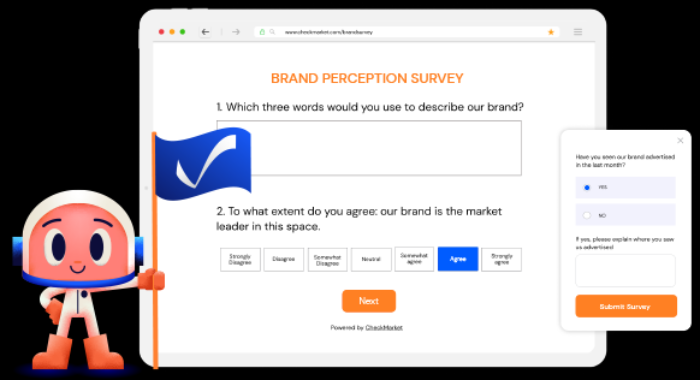
Brand Perception Surveys
If you’re a larger company with a decent budget, consider brand perception surveys or focus groups.
For more general answers on what your buyers value, you could ask them things like:
How important is it for you that a brand aligns with your personal values?
How much does a brand’s reputation affect your decision to purchase its products or services?
How much does customer service influence your perception of our brand?
These questions can give you a better idea of what customers look for in a business and provide valuable and actionable feedback. For instance, if you believe you provide great customer service but your customers believe you could be more responsive, you can introduce measures to improve response times.
Does our brand make you feel more confident or stylish? Explain why.
To what extent do you feel like you are a part of the brand’s community or “tribe”?
Would you recommend our brand to your friends or family?
Have you ever been disappointed by your experience with our brand? Why?
What emotions do you associate with our brand?
Describe our brand in three words.
What are your favorite products/services and why?
Of course, the type of questions you ask depends on what you want to achieve. Here are some tips for creating a brand perception survey:
1. Decide what you want to measure. Do you want to know how customers feel about your brand overall? Or are you looking for feedback on specific products or services? Determine what you want to learn from the survey to create suitable questions.
2. Keep the questions focused. Too many questions can overwhelm respondents and make it difficult to get useful data. Stick to around 10-15 questions that are relevant to your goals for the survey.
3. Make sure the questions are clear and easy to understand. Use simple language and avoid jargon.
4. Ask open-ended questions to get detailed answers rather than ‘yes’ or ‘no’ responses.
Use Social Media
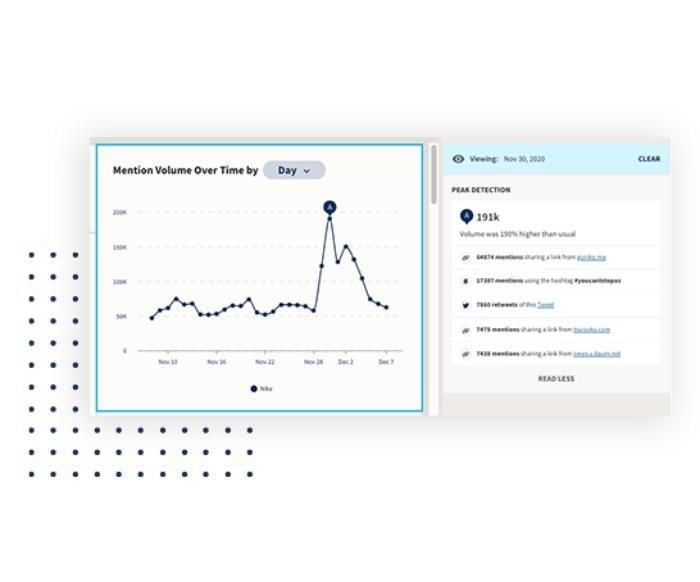
Yes, you can spend your time looking through your Twitter feeds and relevant tags, but you may find automating the task with social listening tools more efficient.
Social listening tools can track and measure brand perception across social media channels. By analyzing online conversations, businesses can get insights into how customers perceive your brand, what customers are saying, and what areas need improvement.
Many different social listening tools are available, each with unique features and benefits. Some of the most popular include Hootsuite Insights, Brandwatch, and Talkwalker.
Brand Audits
A brand audit is a detailed analysis of how customers and other stakeholders perceive a company’s brand, allowing businesses to identify areas where the brand is strong and where it needs improvement.
An audit usually involves:
Conducting surveys and focus groups with customers and other stakeholders.
Analyzing media coverage, social media activity, and other data sources.
You can then use this information to create a detailed report to help you understand your brand’s strengths and weaknesses.
Brand audits can be important for businesses looking to improve their brand perception. By understanding how customers and others perceive the company, businesses can make changes to improve their image.
Consumer ratings of your brand and why your buyers/prospects view you that way.
How you compare with your top competitors.
How your customers would describe your brand; this helps you understand if your messaging is right.
Your brand trajectory or where your customers see your business going.
Finally, check online review sites to see what your buyers are saying about their experience and address any shortcomings you discover.
Best Practices For Improving Brand Perception
There are some best practices every business can introduce to enhance its brand reputation. Here are some of them.
First, start with the basics. Ensure you deliver high-quality products and services and always exceed/manage customer expectations.
Next, use effective marketing to improve brand perception by communicating the right message/image about your company to the right audience. You can do this by using customer avatars or buyer personas to understand your ideal customers and the type of content that most likely resonates with them.
Then, focus on the customer journey. Complete customer journey mapping to see the purchasing process from your customer’s perspective. Doing this helps ensure each interaction along the customer journey leaves a positive impression.
Use Social Media to Your Advantage
I’ve already discussed social listening, but responding to what your consumers say is every bit as vital. It doesn’t matter if a buyer’s experience is positive or negative; they’re only too happy to share their views on social media. While you can’t do much about this, you can at least ensure you’re fast to respond and offer your customer a positive outcome.
Giving swift responses and addressing issues is more likely to improve your brand perception and get you noticed by potential buyers.
Don’t Underdeliver
Does your product do what it says on the label? Making bold claims in your advertising that you can’t deliver is guaranteed to underwhelm and frustrate your customers.
However, don’t just focus on your product descriptions, features, and benefits. Check your images, too. For instance, does your imaging suggest your product comes with accessories when it doesn’t?
Take Feedback On Board
You’ll never perceive your product or service the same way as your customers. Your buyers and prospects can often give you insights and suggestions you’ve never even dreamed of.
Whether it comes from social media, surveys, reviews, or niche-related forums, understanding your customer’s pain points helps you develop and refine products/services to meet their needs.
Train Your Staff
Training your staff ensures they feel empowered to answer consumer/leads questions accurately. When your staff are knowledgeable, it inspires confidence among buyers and enhances your brand perception.
Examples of Brand Perception Success
Changing times and consumer demand often mean companies must reposition themselves if they want to influence customers’ views.
Let’s look at two examples of brand perception.
Zoom
At first glance, Zoom might look like an overnight success, but that’s not the case. Eric Yuan founded Zoom in 2011. It had a public launch in 2013, with a mission of ‘making video communications frictionless and secure’.
However, it wasn’t until 2020 that it became more mainstream. As its popularity soared, the brand perception changed. ‘Zoom fatigue’ became a thing. Some employees spending lengthy periods on the app complained of exhaustion from the extra cognitive demands of video conferencing, irritability, and muscle tension.
Zoom’s answer to this problem? It repositioned itself to change users’ brand perception.
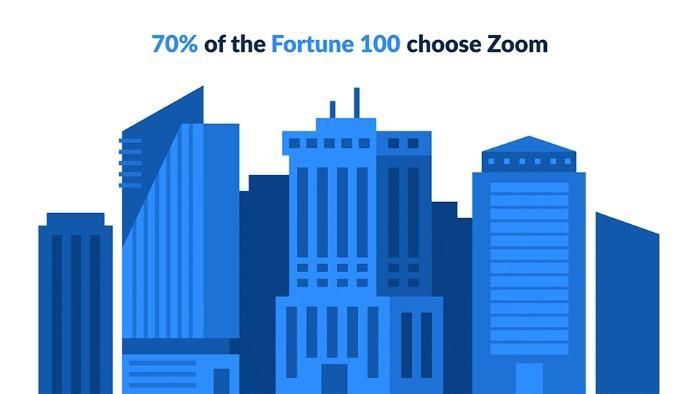
It launched a ‘How the World Connects’ campaign and expanded away from video with the Zoom phone. Online, the company stressed its highly successful track record, highlighting how half a million businesses use Zoom, including:
70 percent of the Fortune 100
Over half of the Fortune 500
85 percent of the Forbes Cloud 100, the world’s top private cloud companies
That’s before you get to the ton of top finance, healthcare, and educational facilities that use Zoom and how the app helps them. For example, Zoom provides secure communications for hybrid working and allows better collaboration between teams. It sounds like a real success story, doesn’t it? And perhaps one you want to be part of.
Chipotle
Here’s a great example of how marketing can change brand perception.
Think of Chipotle, and the first thing that comes to mind is fast food. However, the company wanted to win new customers for its ‘Lifestyle Bowls Range’ for those following vegetarian, vegan, and keto diets.
To achieve this, Chipotle needed to change its brand perception and reposition itself as a healthier alternative. By working with a marketing agency, Chipotle highlighted the use of its natural, fresh ingredients in its made-to-order takeaway meals.
The agency:
Divided potential consumers into different tribes like ‘Fitness Fanatics’ and ‘US Health & Nutrition’.
Used the insights gathered from the different tribes to reach these audiences with targeted traffic and awareness campaigns.
Applied geo-targeting to attract customers to new restaurants.
The results were impressive by anyone’s standards, leading to 10.7 million impressions and potentially 2.5 million new customers. In addition, click-through rates (CTRs) exceed standard benchmarks, averaging 1.24 percent.
Using bespoke segmentation analysis to create hyper-relevant and audience-centered campaigns instead of relying on generic advertising.
Analyzing your audience to discover new target markets and ensure your new brand voice stands out.
If you want to change your brand perception or move into new market sectors, taking these measures can supercharge the impact of your advertising campaigns.
FAQs
What is an Example of Brand Perception?
Apple has an excellent brand perception, built on having high-quality products that are easy to use. Its positive brand perception has helped Apple become one of the most successful companies in the world.
How Do You Create a Brand Perception?
Brand perception starts with knowing your audience and understanding what they want and need. From there, you can create messaging and visuals that resonate with them.
How Do You Measure Brand Perception?
You can measure brand perception through audits, surveys, social listening, and reading reviews.
What Factors Influence Brand Perception?
Numerous factors influence brand perception, like your marketing, word of mouth, customer service, and color scheme.
What Is The Importance of Brand Perception?
Brand perception is essential to your business. The better consumers perceive your products/service, the more loyal your customers are likely to be, and you can charge a premium for your products.
Why Is Perception Important in Marketing?
Perception is important in marketing because it helps you understand how customers see your brand. This understanding is valuable when deciding how to position your brand and what messages to communicate to your target audience.
What Is the Difference Between Brand Perception and Brand Equity?
Brand equity is the value of a brand based on customer perceptions and associations. Brand perception is how customers perceive a brand in the present moment.
{
“@context”: “https://schema.org”,
“@type”: “FAQPage”,
“mainEntity”: [
{
“@type”: “Question”,
“name”: “What is an Example of Brand Perception?”,
“acceptedAnswer”: {
“@type”: “Answer”,
“text”: ”
Apple has an excellent brand perception, built on having high-quality products that are easy to use. Its positive brand perception has helped Apple become one of the most successful companies in the world.
”
}
}
, {
“@type”: “Question”,
“name”: “How Do You Create a Brand Perception?”,
“acceptedAnswer”: {
“@type”: “Answer”,
“text”: ”
Brand perception starts with knowing your audience and understanding what they want and need. From there, you can create messaging and visuals that resonate with them.
”
}
}
, {
“@type”: “Question”,
“name”: “How Do You Measure Brand Perception?”,
“acceptedAnswer”: {
“@type”: “Answer”,
“text”: ”
You can measure brand perception through audits, surveys, social listening, and reading reviews.
Numerous factors influence brand perception, like your marketing, word of mouth, customer service, and color scheme.
”
}
}
, {
“@type”: “Question”,
“name”: “What Is The Importance of Brand Perception?”,
“acceptedAnswer”: {
“@type”: “Answer”,
“text”: ”
Brand perception is essential to your business. The better consumers perceive your products/service, the more loyal your customers are likely to be, and you can charge a premium for your products.
”
}
}
, {
“@type”: “Question”,
“name”: “Why Is Perception Important in Marketing?”,
“acceptedAnswer”: {
“@type”: “Answer”,
“text”: ”
Perception is important in marketing because it helps you understand how customers see your brand. This understanding is valuable when deciding how to position your brand and what messages to communicate to your target audience.
”
}
}
, {
“@type”: “Question”,
“name”: “What Is the Difference Between Brand Perception and Brand Equity?”,
“acceptedAnswer”: {
“@type”: “Answer”,
“text”: ”
Brand equity is the value of a brand based on customer perceptions and associations. Brand perception is how customers perceive a brand in the present moment.
”
}
}
]
}
Conclusion
Let’s return to my original point: perception is everything. It doesn’t matter if the image customers have of your business is accurate or not; it only matters what their perceptions are.
The truth is that companies sometimes perceive themselves differently than their customers or prospects, which can make it difficult to attract new buyers.
Poor brand perception can hamper growth, limit customer loyalty, and ultimately means you don’t reach your core audience.
However, businesses can make better decisions about their marketing efforts by understanding brand perception and how to measure it. Additionally, companies can identify trends and adjust accordingly by tracking brand perception over time.
What brand perception are you trying to craft for your business?
Striveworks | Remote in USA | Sr. DevOps Engineer | Full Time | www.striveworks.com
As a Senior DevOps Engineer at Striveworks, you will be leading the charge on ensuring the robustness, reliability, efficiency, and automation of our development and operational environments as well as the design, engineering, and development operations for our products. You will be responsible for refining our software development/delivery process. You will have the opportunity to work with new, cloud-native technologies, and have the autonomy to select or engineer solutions to address the unique challenges posed by artificial intelligence data systems at both large and small scale. In addition to standard site reliability engineering tasks—such as building software for monitoring and alerting, DevOps, and infrastructure automation—you will have the opportunity to contribute to the design and deployment of our MLOps platform.
The anticipated base pay range for this position is $175,000-240,000/year. In addition to base pay Striveworks offers annual performance-based equity paired with a lucrative cash bonus, a full benefits suite, and two compensation reviews per year.
This is a high impact, high visibility, high priority role for our team. Need someone with 2+ years of professional experience with Kubernetes.
Forward is looking for a Python dev to help out an electrical and mechanical engineering firm that builds hardware devices. Their software needs revolve around aggregating and displaying data produced by their devices and, in the immediate term, they’re looking for someone to build out a tool that lets them proxy TCP/IP packets to multiple clients. Over the long term most of the work would involve encoding or decoding data, displaying, and occasionally analyzing data.
Details:
* Keywords: Python
* Term: 6-12 months
* Hours per week: 10-20
* Rate: $50-100/hr
* Timeline: Immediate
* Timezone Constraints: 5 hours overlap with ET
* Geographic Constraints: Must be a U.S. citizen living in the U.S.
The Broncos have received multiple trade inquiries on Bradley Chubb and could eventually deal away the star pass rusher, but they don’t plan to trade receivers Jerry Jeudy or KJ Hamler, according to sources. The post Broncos field Chubb calls; no plans to trade WRs appeared first on Buy It At A Bargain – Deals … Continue reading Broncos field Chubb calls; no plans to trade WRs
GDPR Cookie Consent Agreement
This website uses cookies to improve your experience. We'll assume you're ok with this, but you can opt-out if you wish.AcceptRejectRead More
Privacy & Cookies Policy
Privacy Overview
This website uses cookies to improve your experience while you navigate through the website. Out of these, the cookies that are categorized as necessary are stored on your browser as they are essential for the working of basic functionalities of the website. We also use third-party cookies that help us analyze and understand how you use this website. These cookies will be stored in your browser only with your consent. You also have the option to opt-out of these cookies. But opting out of some of these cookies may affect your browsing experience.
Necessary cookies are absolutely essential for the website to function properly. This category only includes cookies that ensures basic functionalities and security features of the website. These cookies do not store any personal information.
Any cookies that may not be particularly necessary for the website to function and is used specifically to collect user personal data via analytics, ads, other embedded contents are termed as non-necessary cookies. It is mandatory to procure user consent prior to running these cookies on your website.