The Disadvantages of Working from Home: 5 Things to Consider When Using Your Home Address for Your Business

Working from home has many advantages. One of the easiest ways to start a business is to start it from your own home.  It’s the most natural way to start for many.  Whether you are baking, woodworking, offering a service, or anything else, doing so out of your house has many advantages. What isn’t discussed as often are the disadvantages of working from home. 

5 Surprising Disadvantages of Working from Home

Most business owners just assume that if they are running their business from home, their home address and their business address will be one and the same.  That’s fine, but what if you decide to move out of your home?  Changing business address can cause issues. This is just one of many surprising disadvantages of working from home.

Disadvantages of Working from Home #1:  Your Home May Not Be Conducive to Productive Work

A home may not necessarily be well equipped to handle working. You need a workspace that will help you be productive.  This will be different for everyone.  But, consider that you at least need a room with a door you can close.  Drawing boundaries between home life and work life can be hard.

Learn more here and get started with building business credit with your company’s EIN and not your SSN.

Managing time can be harder when working from home as well. It can be easy to work all day when you are at home, or not work enough due to “home” distractions. It’s hard to get people to respect your time and boundaries. Also, isolation and depression are not uncommon. 

Disadvantages of Working from Home #2: You May Not Be Allowed to Run Your Business From Your Home

In some situations, you may not be allowed to run your business from your home. If you rent, you will need to check your lease to make sure there are no issues. Whether you rent or own, you need to check zoning requirements. Also, agencies like the Health Department and the FDA have guidelines related to running certain types of businesses from your home. 

Disadvantages of Working from Home #3: Home Address on Public Record

Many people worry about their home address as their business address.  They feel it is unsafe, so they turn to a PO Box or an UPS Box. However, that can make it difficult to get funding.  Lenders require a physical address.  

This is a unique disadvantage of home-based businesses.  Even home based businesses need funding for a number of things: 

  • Supplies
  • Inventory
  • Equipment (for jewelry making, woodworking, computer/ office equipment, etc.)
  • Even working capital

One option is to use a virtual address.  Be aware however, that some lenders will not accept those either.  The truth is, if someone wants to find your home address, it’s easy enough regardless of whether you use it as your business address or not.  In the end, to get funding for your business you are going to need to use a physical business address where you an receive mail.

Learn more here and get started with building business credit with your company’s EIN and not your SSN.

Disadvantages of Working from Home #4: Changing Your Business Address Later Can Cause Problems

You may think you can get by with using your personal address now, and just change it later. That’s not a good idea. If you think about it, your business address goes everywhere.  For example: 

  • All legal documents
  • Licences
  • Marketing materials
  • Your website
  • Insurance papers
  • Everywhere!

The longer you wait, the more places you will have to remember to change it. It is a bigger deal than you may think if you miss one. If lenders start looking into your business and see your business address is listed differently in different places, it can cause unnecessary issues. It brings up fraud concerns. 

A bank will not take the time to try to figure out all the different ways a business may be listed. Even something as simple as using Street vs St, or using an ampersand in one spot and the word “and” in another can cause issues. So you can imagine using your home address in one spot and a separate business address in another will definitely cause problems. 

That doesn’t mean that if you move your business out of your home you have to keep your home address.  Just be aware that you will need to make sure the address is changed everywhere.  

Disadvantages of Working from Home #5: Legal Issues

There are a number of legal considerations that you have to think about when it comes to running a home based business. For example, even if zoning laws allow you to run your business from your home. You need to check out what requirements those laws lay out. Some cities have regulations regarding foot traffic. Some even regulate yard sign use for advertising. And if you have an Homeowners Association (HOA) you may need their permission as well.

Learn more here and get started with building business credit with your company’s EIN and not your SSN.

Some cities limit the number of employees a home based business can have. Some even regulate the number of customers that can come to your door. You’ll need to check with your local city officials to determine what if any regulations apply to you. And figure out what licences and permits you need to operate.

Consider the tax issues as well. While you can deduct some expenses when it comes to home-based businesses, it can get complicated. You need to make sure you thoroughly understand the home business deduction on the front end and plan accordingly. 

Insurance needs to be considered as well. If you have employees or customers coming in and out, you need to think about what would happen if they were injured. Will homeowners’ insurance cover it? Often you will need to purchase a separate policy or a rider. All insurance needs to be in place on the front end.  Be sure it has the proper business address on it!

Avoid Many Disadvantages of Working From Home 

Nothing is perfect. Running a business from your home is no different. However, you can avoid many of the disadvantages of working from home by building fundability from the beginning.  Not only will it help with legal issues, but it makes a bigger difference than you may think when it comes to funding.  

The best way to start building fundability, whether you own a home-based business or run a business from a different location, is to work with a business credit expert. Contact us today for a free consultation.

The post The Disadvantages of Working from Home: 5 Things to Consider When Using Your Home Address for Your Business appeared first on Credit Suite.

New comment by mrTeale in "Ask HN: Who wants to be hired? (July 2021)"

  Location: Brisbane, Australia
  Remote: Yes, please
  Willing to relocate: Depends on circumstances
  Technologies: Python (Advanced) | Tensorflow/Keras/Pandas/Numpy (Intermediate)| HTML/CSS/JS/React (Intermediate) | GCP/AWS/Azure/Serverless (Intermediate) | Business Processes (Intermediate)
  Résumé/CV: https://bit.ly/3xG5a8V
  LinkedIn: https://www.linkedin.com/in/mrteale/
  Email: lachlan.teale@gmail.com

Coming up on 5 years experience in Data Science and Machine Learning, I currently lead a team at one of Australia’s largest hospital providing automation and AI/ML solutions for scientific and financial problems. Previously worked with Multi-national mining companies remotely and founded multiple startups (one was acquired by one of these companies). Looking to work on creating solutions to cool problems with awesome, talented people.

Gordian Software (YC W19) is hiring back end engineers

Article URL: https://jobs.ashbyhq.com/GordianSoftware/0ea0a67e-3621-4b28-ab56-3f27a956af22 Comments URL: https://news.ycombinator.com/item?id=27935581 Points: 1 # Comments: 0

Path is hiring Engineers to automate Gen Z finance

Article URL: https://www.notion.so/pathfinance/Fullstack-Engineer-Path-YC-S19-ff0fd31fa5d4410dafce77f83403ce0d Comments URL: https://news.ycombinator.com/item?id=27932945 Points: 1 # Comments: 0

New comment by closetalent in "Ask HN: Who is hiring? (July 2021)"

Close | Multiple Positions | 100% Remote | Americas & Europe

At Close, we’re building the sales communication platform of the future. With our roots as the very first sales CRM to include built-in calling, we’re leading the industry toward eliminating manual processes and helping companies to close more deals (faster). Since our founding in 2013, we’ve grown to become a profitable, 100% globally distributed team of ~50 high-performing, happy people that are dedicated to building a product our customers love.

Product Manager (Americas): https://jobs.lever.co/close.io/21dca90f-06a3-4050-81a0-9659d…

Software Engineer – Backend/Python (Americas & Europe): https://jobs.lever.co/close.io/592193bf-8a9c-43cf-86a1-faeb7…

Senior Frontend Engineer – React (Americas & Europe): https://jobs.lever.co/close.io/10a1e32b-1a59-48dc-b8f4-e6f0d…

https://www.youtube.com/watch?v=ZbyGnLhtj0o

The post New comment by closetalent in "Ask HN: Who is hiring? (July 2021)" appeared first on ROI Credit Builders.

Rescale (YC W12) Is Hiring Software Engineers

Article URL: https://jobs.lever.co/rescale/57b5bc81-ee75-4a30-a763-3eb8dd595165?lever-origin=applied&lever-source%5B%5D=Hacker%20News

Comments URL: https://news.ycombinator.com/item?id=27929715

Points: 1

# Comments: 0

Gordian Software (YC W19) is hiring back end engineers

Article URL: https://jobs.ashbyhq.com/GordianSoftware/0ea0a67e-3621-4b28-ab56-3f27a956af22

Comments URL: https://news.ycombinator.com/item?id=27935581

Points: 1

# Comments: 0

8 Powerful Negotiation Tactics

What comes to mind when you think of negotiation tactics? 

People in suits closing business deals? 

Bargaining with a seller in a market?

Convincing your landlord to lower the rent?

How about all of these?


Negotiation Tactics Play a Key Role in Life

It’s tempting to think of negotiation only in terms of price, but the term represents many possibilities beyond money. 

For example, if you’re struggling to negotiate your desired salary, you can negotiate the job benefits, the scope of work required, hours, or remote-work options.

In other areas of life, you can negotiate a better package with your regular service providers, you can negotiate better deals when shopping and you can even improve your relationships and expectations through effective negotiation. 

What about business? Can negotiation tactics help you grow your business

Research over the past few years says yes. 

Whether you are an established CEO conducting high-profile meetings or a small independent seller collaborating with other business owners in your community, negotiation can significantly impact the rate of your growth.

Why Are Negotiation Tactics Important in Business?

Most business decisions can be improved by learning powerful negotiation tactics. Here’s a few reasons why learning to negotiate is important for growing your business.

  • Improve Operations: Negotiation can help you find the right compensation package for your employees, get discounts from your manufacturers, have a successful fundraising round, and help you scale your business faster. 
  • Succession/Exit Plan: If you plan on selling your company eventually, negotiation can also help you find the right buyer at a great price.
  • Improve Revenue: Done right, negotiation can help reduce business costs and increase profits. For example, negotiating better deals with suppliers or lower costs for rent.  
  • Business Relations: Negotiation can help you strike mutually beneficial deals that are not only profitable but also build positive long-term relationships. 
  • Life Satisfaction: You can also use negotiation in other areas of life like building healthy relationships or getting good deals on products and services. This will promote life satisfaction, creating an optimal mindset for success in your working life.

8 Negotiation Tactics to Become a Better Negotiator

Negotiation can offer great benefits, but it can also be challenging to enter a negotiation without effective negotiation tactics. 

If you’re new to negotiations, worry not! 

I have something for you. 

Research over the years has found dozens of powerful negotiation tactics that can help you make better business decisions, land better opportunities, and successfully close important deals. 

1. Listen More Than You Talk

I used to think a powerful negotiator knew all the right things to say. I believed negotiation was about who could outsmart the person in front. 

I was wrong. 

Successful negotiation is less about talking and more about listening. 

When you listen without waiting for your turn to talk, you begin to truly understand what the other party wants. This can help you strike a “win-win” deal so you get what you want and they get what they want. Everyone goes home happy. 

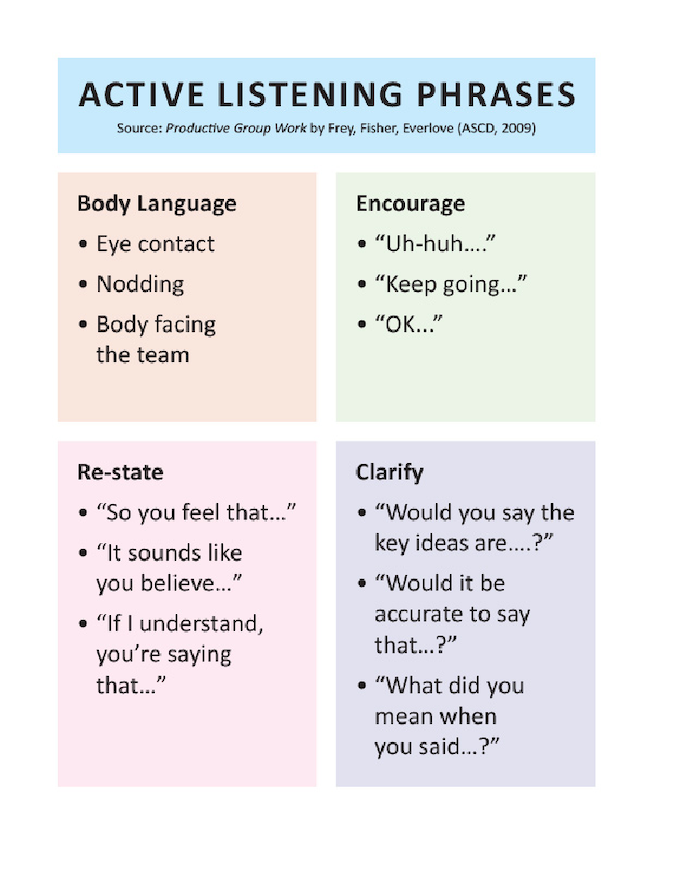
This practice of being present in a conversation and listening carefully is called active listening. It helps people feel heard and understood. This can help build a good rapport, which can turn into a good deal. 

Here’s a helpful graphic that dives deeper into how you can practice active listening. 

Active listening as a negotiation tactic can help you land better deals.

2. Use the Framing Method

Perception can have an interesting effect on how we see the world. Take, for example, the following image. It is often used to highlight how perceptions differ.

Do you see an old woman? Or a young one?

Perception framing can be used as a negotiation tactic.

We interpret information differently depending on how it is presented to us. It’s a cognitive bias called the framing effect. You can use this knowledge to improve your negotiations. 

For instance, consider this graphic from The Decision Lab:

Framing effect can help you re-frame your negotiation tactics for effective presentation.

You can see that “80% fat-free” sounds more appealing than “contains 20% fat,” even though it’s the same quantity. 

This principle can easily be used as a negotiation tactic. To do this, frame your negotiations as a win-win opportunity. 

For example, let’s say you want to make a deal for $30,000 but your client is set on $25,000. Now, instead of going back and forth over the price, try reframing what you have to offer. 

Can you highlight the potential savings your client can enjoy by using your product? Can you address the risk of not using your services?

Ask yourself “How can I frame this solution so we both win?”

Keep in mind that you are not necessarily changing the end result. You are simply changing the way you frame the conversation.

3. Prepare for Compromise

Sometimes you can have the best negotiation tactics in your toolkit and still have to compromise. Many times, you will have to give something up to reach a mutual agreement.

This isn’t always a bad thing. 

All relationships require some level of compromise.

You can’t entirely prevent it but you can prepare for it. 

Negotiators who enter the room with a plan are often more successful than those who choose to “wing it.” 

If you know you may have to compromise, why not be prepared for it?

In fact, having a plan B can actually put you in a stronger position

To plan for what you can and can’t compromise, ask yourself, “What am I willing to give up for this opportunity/deal/product/relationship?” 

Focus on what really matters, and don’t let minor details derail an otherwise good deal.

4. Rank Your Priorities

Another important part of planning your negotiation tactics is ranking your priorities. 

There are things you absolutely need to have in order to enter a profitable agreement. Then, some things may be “good-to-have,” but aren’t a necessity. 

Rank these so your priorities are clear to you. 

If you must compromise on something, you need to decide what you can give up. This is where priority lists can help. 

For example, building a good relationship with a client may be more important for you right now than making a big sale. In this situation, you can compromise on the price and earn the trust and goodwill of the other party. 

5. Make the First Offer

You might have heard the adage “never show your cards.”

Many people believe you shouldn’t make the first offer and let the person in front “reveal” their number first. 

This doesn’t work so well in real-life negotiations. 

In fact, I’ve found, when it comes to negotiations, you should always be the first to say a number.

Why?

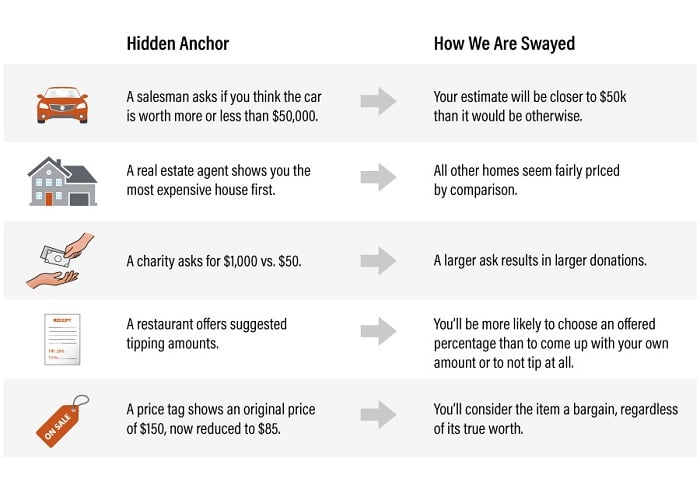
Remember, the starting number sets the tone for the rest of the negotiation. Being the first to state a number puts you in control of the negotiation process.

This practice is called anchoring.

Even if your number is extremely high or extremely low, now you can steer the negotiation conversation in the direction of your choice. 

If your first number is very high, you have biased the negotiations to skew higher.

In most cases, this absurdly high number will be disregarded, but you are already angling for a higher price than if you came in much lower at a “reasonable” price.

Here are some examples of anchoring presented in a graphic by AMGfunds:

Anchoring a price can be a helpful negotiation tactic.

6. Identify the Real Issue

In some negotiations, the problem and the solution might be obvious. For example, when you negotiate a salary, both parties know you’re asking for more money in exchange for continuing to offer your services to the company. 

Sometimes the real issues aren’t as obvious. 

Let’s say you’ve lost interest in your current job, and need some free time to invest in a side hustle. You go to your boss and try negotiating more PTO or similar benefits. 

You haven’t communicated your true needs, so your boss may not understand what you’re looking for. Maybe they’ll offer you a raise.
They think they’re doing the right thing, but both of you are stuck in an awkward situation because you couldn’t communicate your actual issue. 

This often happens in negotiations. People negotiate for money when they really want more time, freedom, consistency, flexibility, or even another employee for support with the expected workload. 

If the goal of a good negotiation process is to solve the problem, then communicating the real problem becomes a key aspect of negotiation tactics. 

To succeed at negotiating, you need to understand what solution or outcome you’re seeking. This means you need to communicate the real problem—not just the most apparent one.

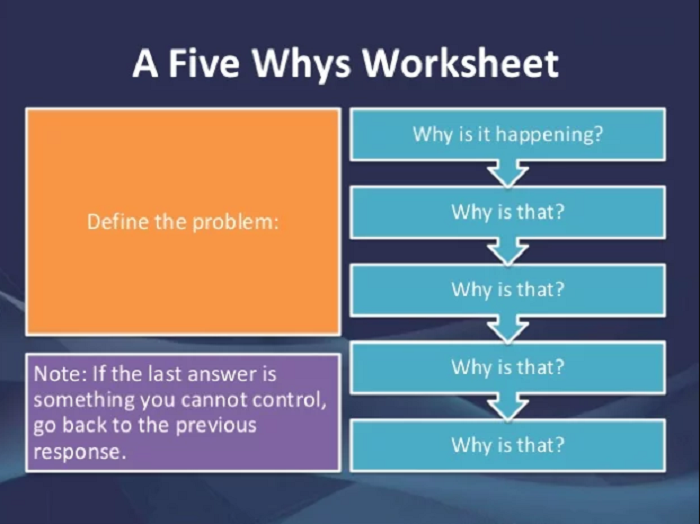
The Five Whys is a simple technique that will ensure you are addressing the root cause.

This graphic from Olivier Serrat will help you understand how to use it:

Five whys dig deeper into your motivation for using negotiation tactics

7. Offer a Win-Win Situation

As we discussed earlier, framing your negotiation as a win-win situation can help you become a powerful negotiator. 

Here’s why a win-win situation matters. 

  • It helps both parties feel comfortable about the deal.
  • It establishes mutual trust, respect, and a good rapport
  • It focuses on problem-solving, getting to the heart of the problem. 
  • It eliminates the winner-loser power dynamic.
  • It opens up the possibility for working together again. 

When we frame negotiations as a win-or-lose proposition, we automatically start with the assumption that someone has to lose.

(Hint: No one likes to lose.)

When you enter negotiations with a win-or-lose mindset, your goal is to convince the other party to accept defeat.

Instead, a powerful negotiator frames the negotiations as a win-win opportunity, so everyone is satisfied with the deal.

8. Be Willing to Walk Away

If you’ve framed the negotiation as a win-win opportunity, tried your best to compromise, discussed the underlying problems, and still failed to reach a mutually beneficial agreement, it may be time to walk away. 

Many people are scared of having to walk away from a negotiation. This makes them more likely to take a bad deal rather than have no deal at all. 

This is a counterproductive approach.

Being prepared to walk away will give you an advantage. It may not be what you hoped for when you entered the negotiation, but sometimes it’s better to say no than sign a bad contract. 

If you’re comfortable walking away from the deal, you can use it as leverage. By having other options, you’re already in a stronger position—and now you’ve got a new level of experience to bring to your next round of negotiations with someone else. 

Frequently Asked Questions About Negotiation Tactics

What should you not say in a negotiation?

Don’t say things like “let’s make this quick,” or “what about my profit?” This can make the person in front feel like you care more about your personal gains than the relationship you share. 

What’s the most important negotiation skill?

Active listening can be an important negotiation skill as it helps you truly understand what the other person has to say. This helps you make better, more empathetic offers that are more likely to be accepted. 

Is negotiation manipulative?

Many people believe negotiation tactics are manipulative and unethical, but that’s not true. As long as you’re respectful of the other person’s needs and committed to offering a fair deal, negotiation is perfectly ethical. 

Can I negotiate as a beginner?

Negotiation is a skill anyone can practice. Even if you’ve never negotiated in your life, working with a simple negotiation technique can help you increase your confidence and improve your ability over time. 


Negotiation Tactics Conclusion

Negotiation tactics sound intimidating. Like they’re reserved for high-profile business people in suits.

That’s not true.

Anyone can negotiate almost any area of their life for better outcomes. From yearly raises to monthly rent, there’s scope for using these negotiation strategies everywhere. 

Each of the negotiating tactics we discussed today is powerful alone, but together, their impact can be incredibly effective. 

Try them, and you’ll see.

Which negotiation tactic will you try first?