
How Does Your Garden Grow? Best Business Line of Credit in a Recession

The COVID-19 pandemic caught the world by surprise and turned the economy upside down.  If you are a business trying to make it during this time, we can help.  The Federal government has approved funding through  The CARES Act, including the Paycheck Protection Plan.  In addition, many states and local organizations are offering their own COVID-19 relief options.  Beyond that, we can help you find the best business line of credit in a recession.

A Business Line of Credit is Like Miracle Grow for Your Business

A business line of credit can be an incredible tool for your business, even in a recession. You don’t want just any line of credit however. You want the best one for your business needs.

Not all businesses are the same, and not all lines of credit are best for all businesses. Different limits, rates, and terms work better for some than others. How do you ensure you are getting the best business line of credit in a recession?

What’s a Line of Credit?

It can help to get a quick rundown of exactly what a line of credit is. The most basic definition is that it is a revolving line of credit, similar to a credit card. You have a limit and continuous access to that limit while making payments only on the portion you use each month.

For example, if you have a $10,000 line of credit, you can use however much of those funds you need each month for whatever you want, unless your lender issues some sort of restriction. If you use $2,000, then when you get your statement your payment will be based on $2,000 plus the interest, rather than a payment plus interest on the entire credit line.

If you were to pay $1,000, then spend another $500, you would pay on the $1,500 balance the next month. Your payments change as your balance changes. Just like with a credit card.

Access is most typically granted through checks or a card connected to the line of credit account.  Electronic draws and transfers are also popular.

Learn bank rating secrets with our free, sure-fire guide which can even help during a recession.

Line of Credit vs. Credit Cards

The question is always asked what the difference is between a line of credit and a credit card, and why is one better than the other? The truth is that in some cases, a credit card may be the better option. There is a choice to make based on several different factors.

The main difference between the two that most borrowers need to know is that a line of credit typically has a consistently lower interest rate.  Also, there are no perks like 0% interest or cash back that you sometimes see with credit cards.

What Signifies the Best Business Line of Credit in a Recession?

The best business line of credit in a recession is going to be the one with the best rates and terms that your business can qualify for.  That makes finding it a little more involved. You have to know where you stand and what various lenders offer and require.

It will take some leg work on your part to pull together the information needed for application.  You will also need to understand that the best business line of credit in a recession may not come from the same place you would have gotten a business line of credit pre-recession.  You might have better luck with online lenders or smaller banks over larger traditional banks during an economic downturn.

A Word of Warning

Before you apply for the best business line of credit in a recession, remember that balance is important.  Recession times are by default, hard.  A line of credit can ease some of the burden, but be careful not to let the credit line itself become a burden.  Know your limits as far as what you can pay.

If you do not make payments on-time, you could end up with more trouble than you already had.

How to Find the Best Business Line of Credit in a Recession?

There are several steps to this process.

1. Why do you need a business line of credit in a recession?

Figuring this out could be the most vital step in finding the best business line of credit for your needs. You have to understand why you need a credit line in the first place. Here are some examples of how a business may use a line of credit.

  • Take advantage of a sale on inventory, raw materials, or supplies. This can reduce the cost of goods sold and consequently, increase the bottom line.
  • Purchase or repair minor equipment when needed. This would be like a new printer or laptop. It would not include items like an industrial oven or delivery truck. Larger equipment would best be purchased with an equipment loan.
  • Bridge temporary cash gaps or continuous, known cash gaps due to timing issues. An example of this would be several bills that are due at the beginning of the month when you know your largest contracts pay at the end of the month. The money is coming, but the bills come due before the money gets there. You can pay the bills with the line of credit, then pay off the line of credit when the contracts pay.

Another example of this is a seasonal line of credit for a business that does the majority of its sales during a certain time of the year.  A florist does a large percentage of sales during Valentines day, so a seasonal line of credit can come in handy to bridge the cash gap during other times of the year.

2. Determine your options.

Shop around with various financial institutions to determine which ones offer the best business lines of credit in a recession. You will want to look at factors such as interest rate and credit limit in relation to what you need and can afford.

Check with various types of lenders to get a feel for which ones offer what you need.  Check with larger commercial banks, small local institutions and credit unions, and alternative lenders such as those that operate exclusively online.

Pay specific attention to eligibility requirements to avoid wasting your time with those you do not qualify for.

Learn bank rating secrets with our free, sure-fire guide which can even help during a recession.

3. Know where you stand.

Your ability to get approval for the best business line of credit in a recession will be directly related to your business credit. Traditional banks pay more attention to personal credit, but they crack down a lot on lending when there is a recession.  Non-traditional lenders may also consider income and cash flow. They may, in addition, rely heavily on your business credit score when making an approval decision about a line of credit.

A lower business credit score does not necessarily mean you can’t get approval.  It could greatly affect your interest rate and credit limit however.

Consider signing up for a credit monitoring service that lets you keep tabs on your business credit and what is affecting it each month. The one offered by CreditSuite.com is easy to use and cost effective.

Once you have a handle on why you need a business line of credit, what is available, and what you may actually be eligible for, you can make a decision as to where you are going to apply and which product you are going to apply for.

Determining which of these lenders has the best business line of credit in a recession for you goes back to knowing what you need, who has it, and who will approve you for it.

When Is a Line of Credit Better than a Credit Card?

If you are going to need to make payments, a line of credit is a better option. The reason is pretty simple. The credit rate is almost always lower. The few exceptions are those cards that offer 0% APR for a short period of time.

If you are going to use a credit card to make regular purchases you intend to pay off immediately, that’s another story.  Especially if you qualify for a card with perks such as cash back.  In that case, you may find that you can benefit from using a credit card over a line of credit.

An example would be if you wanted to use your business credit card to make your monthly supplies purchase each month and then pay it off in the following month. You could take advantage of the cash back and reduce your overall cost.

To float a cash flow gap or make significant purchases that you will need to pay out over a short amount of time, a line of credit is almost always the best choice.

Where to Find the Best Business Line of Credit in a Recession

Some small businesses will have a hard time getting approval from a traditional lender due to poor credit or a lack of sufficient credit history.  We found examples of what alternative lenders are offering currently. Keep in mind these offerings can change, so make sure to visit the lender and verify.

Kabbage

Kabbage offers a credit line of up to $150,000 with no credit score required. The catch is that the interest rate is between 32% and 108%. The business must have been in existence for at least one year and have revenue of at least $50,000.

The interest rate is very high. This is really only an option for those businesses that cannot get financing due to a low or nonexistent credit score and need funding immediately.
Best Business Line of Credit in a Recession Credit Suite2

StreetShares

There is a credit line available here of up to $100,000.  A business must have what they consider to have “reasonable credit.”  It also must be in business for at least one year and have more than $25,000 in revenue. Repayment is weekly.

Due to the lower revenue requirement, this is a good option for smaller businesses with okay credit scores but lower annual revenue. Also, the interest rate minimum is lower, with the low end at 9%.

OnDeck

If you have a credit score of at least 600 you can get a credit line of up to $100,000 with OnDeck. There is a $20 per month maintenance fee and weekly repayment. The interest rate is a little higher here than with those that require a higher credit score minimum. It ranges from 13.99% to 39.99%.

Again, due to the higher interest rate, this should only be an option if you cannot meet the higher credit score requirement.

Lending Club

The credit line offered by lending club goes up to a limit of $300,000. It requires a credit score of 600.  In addition, at least one year in business and at least $50,000 in revenue are necessary. The repayment term is 25 months, and they require collateral for limits over $100,000.

This is a good option for those that meet the requirement as there is a higher limit available with collateral, and the interest rate can go as low as 6.25%. The repayment terms are much friendlier as well.

Credit Line Hybrid: Another Option

A credit line hybrid is revolving, unsecured financing.  It allows you to fund your business without putting up collateral, and you only pay back what you use.  It even works for startups.

What are the Qualifications?

How hard is it to qualify?  It’s probably easier than you think.  You do need good personal credit.  That is, your personal credit score should be at least 685.  In addition, you can’t have any liens, judgments, bankruptcies or late payments.  Also, in the past 6 months, you should have less than 5 credit inquiries, and you should have less than a 45% balance on all business and personal credit cards.  It’s also preferred that you have established business credit as well as personal credit.

If you do not meet all of the requirements, all is not lost. You can take on a credit partner that meets each of these requirements.  Many business owners work with a friend or relative to fund their business. If a relative or a friend meets all of these requirements, they can partner with you to allow you to tap into their credit to access funding.

Business Credit in a Recession

When you apply for the best business line of credit in a recession, consider using your business credit rather than personal credit.  Some lenders will require you to use both.  If you can get a credit line on your business credit only, that is best. If not, strong business credit can help negotiate better terms and rates.

Learn bank rating secrets with our free, sure-fire guide which can even help during a recession.

Not sure what business credit is, if you have it, or how to get it?  Here’s a quick rundown.  Business credit is similar to your personal FICO, but it is for your business only.  It is not attached to your name or social security number, but rather to your business name and EIN.

The most commonly used business credit reporting agency is Dun & Bradstreet, but there are others.  With Dun & Bradstreet however, you must have a DUNS number to have a record with them.  If you do not have one, you don’t have a D&B business credit report.

You can get a free DUNS number on the D&B website.  Before you do, your business must be incorporated.  It also must have dedicated, separate contact information that is not your personal contact information.  You can find out more about incorporation options and how to get a free EIN on the IRS website.

It is Possible to Find the Best Business Line of Credit in a Recession

A business line of credit is a great financing option. It offers flexibility that isn’t always available with a term loan. Interest rates are often better than those offered by business credit cards.  With alternative lenders in the mix, a line of credit is an option for most small businesses even during a recession.

The post How Does Your Garden Grow? Best Business Line of Credit in a Recession appeared first on Credit Suite.


How Hard is it to Establish Business Credit in a Recession?

Do you know? How hard is it to Establish Business Credit in a Recession?

It’s a brilliant question. How hard is it to establish business credit in a recession? Is business credit building impossible? Or is it just some nightmare? And what happens in an economic downturn?

I assure you it is not only possible, it is downright sure-fire. And business credit is all but recession-proof!

Business credit is credit in a business’s name. It doesn’t link to an owner’s personal credit, not even if the owner is a sole proprietor and the solitary employee of the corporation. Because of this, an entrepreneur’s business and consumer credit scores can be very different.

The Advantages

Because business credit is distinct from individual, it helps to safeguard a business owner’s personal assets, in the event of court action or business insolvency. Also, with two separate credit scores, an entrepreneur can get two separate cards from the same merchant.

This effectively doubles buying power.

Another benefit is that even startups can do this. Visiting a bank for a business loan can be a formula for frustration. But building small business credit, when done right, is a plan for success.

Individual credit scores are dependent on payments but also additional considerations like credit usage percentages. But for small business credit, the scores actually merely depend on whether a corporation pays its invoices timely.

How Hard is it to Establish Business Credit in a Recession: The Process

Establishing business credit is a process, and it does not occur automatically. A corporation will need to proactively work to build business credit. Nonetheless, it can be done readily and quickly, and it is much swifter than developing individual credit scores.

Merchants are a big component of this process.

Doing the steps out of sequence will cause repetitive rejections. No one can start at the top with company credit. For instance, you can’t start with store or cash credit from your bank. If you do you’ll get a rejection 100% of the time.

Learn more here and get started toward building business credit attached to your company’s EIN and not your SSN. Get money even in a recession!

How Hard is it to Establish Business Credit in a Recession: Company Fundability

A business has to be authentic to lenders and vendors. As a result, a company will need a professional-looking website and email address, with website hosting from a company like GoDaddy. Additionally business phone and fax numbers need to have a listing on ListYourself.net.

At the same time the company telephone number should be toll-free (800 exchange or the like).

A company will also need a bank account dedicated strictly to it, and it must have every one of the licenses essential for running. These licenses all must be in the accurate, accurate name of the company, with the same business address and phone numbers.

Keep in mind that this means not just state licenses, but potentially also city licenses.

How Hard is it to Establish Business Credit in a Recession: Dealing with the Internal Revenue Service

Visit the IRS web site and obtain an EIN for the small business. They’re free of charge. Select a business entity like corporation, LLC, etc.

A small business can start off as a sole proprietor. But will most likely wish to switch to a form of corporation or partnership to decrease risk and maximize tax benefits.

A business entity will matter when it concerns tax obligations and liability in the event of litigation. A sole proprietorship means the owner is it when it comes to liability and tax obligations. No one else is responsible.

If you run a company as a sole proprietor, then at least be sure to file for a DBA (‘doing business as’) status.

If you do not, then your personal name is the same as the small business name. Therefore, you can find yourself being directly responsible for all company debts.

And also, per the IRS, with this structure there is a 1 in 7 probability of an IRS audit. There is a 1 in 50 chance for corporations! Prevent confusion and drastically lower the odds of an Internal Revenue Service audit as well.

Learn more here and get started toward building business credit attached to your company’s EIN and not your SSN. Get money even in a recession!

How Hard is it to Establish Business Credit in a Recession: Starting off the Business Credit Reporting Process

Begin at the D&B website and obtain a cost-free DUNS number. A DUNS number is how D&B gets a corporation into their system, to produce a PAYDEX score. If there is no DUNS number, then there is no record and no PAYDEX score.

Once in D&B’s system, search Equifax and Experian’s websites for the company. You can do this at https://www.creditsuite.com/reports/. If there is a record with them, check it for accuracy and completeness.

If there are no records with them, go to the next step in the process. By doing this, Experian and Equifax will have something to report on.

Trade Lines

First you must build trade lines that report. This is also known as vendor accounts. Then you’ll have an established credit profile, and you’ll get a business credit score.

And with an established business credit profile and score you can start obtaining revolving store and cash credit.

These kinds of accounts have the tendency to be for the things bought all the time, like shipping boxes, outdoor work wear, ink and toner, and office furniture.

But first of all, what is trade credit? These trade lines are credit issuers who will give you initial credit when you have none now. Terms are oftentimes Net 30, instead of revolving.

Hence if you get approval for $1,000 in vendor credit and use all of it, you will need to pay that money back in a set term, like within 30 days on a Net 30 account.

Details

Net 30 accounts must be paid in full within 30 days. 60 accounts need to be paid in full within 60 days. Compared to with revolving accounts, you have a set time when you must pay back what you borrowed or the credit you made use of.

To begin your business credit profile the right way, you should get approval for vendor accounts that report to the business credit reporting agencies. As soon as that’s done, you can then make use of the credit.

Then repay what you used, and the account is on report to Dun & Bradstreet, Experian, or Equifax.

Not every vendor can help like true starter credit can. These are vendors that will grant an approval with very little effort. You also want them to be reporting to one or more of the big three CRAs: Dun & Bradstreet, Equifax, and Experian.

And Continue…

So get 3 of these to move onto the next step, which is revolving store credit.

1. Uline Shipping Supplies

Uline Shipping Supplies is a true starter vendor. Find them online at https://www.uline.com/. They offer shipping, packing, and industrial supplies, and they report to D&B and Experian.

You need to have a DUNS number. They will ask for 2 references and a bank reference. The initial few orders may need to be paid in advance to initially get approval for Net 30 terms. Also, you may need to buy some things you do not need.

2. Crown Office Supplies

Crown Office Supplies is another true starter vendor. Find them online at https://crownofficesupplies.com.

They sell a variety of office supplies and take helping clients seriously. They say, “just starting your business, or maybe have an existing business, but you have a question regarding office supplies… we are here to help!” And they report to Dun and Bradstreet, Experian, and Equifax.

There is a $99.00 yearly fee, though they do report that fee to the business credit reporting agencies. For other purchases to report, the purchase must be at least $30.00. Terms are Net 30.

3. Grainger Industrial Supply

Grainger Industrial Supply is also a true starter vendor. Find them online at https://www.grainger.com/. They sell safety equipment, plumbing supplies, and more, and they report to D&B. You will need a business license, EIN, and a DUNS number.

For less than $1000 credit limit they will approve virtually anybody with a business license.

Accounts That Don’t Report

Non-Reporting Trade Accounts can also be helpful. While you do want trade accounts to report to at the very least one of the CRAs, a trade account which does not report can yet be of some worth. You can always ask non-reporting accounts for trade references.

Also credit accounts of any sort will help you to better even out business expenditures, consequently making financial planning simpler. These are companies like PayPal Credit, T-Mobile, and Best Buy.

Revolving Store Credit

Once there are 3 or more vendor trade accounts reporting to at least one of the CRAs move to revolving store credit.

Use the corporation’s EIN on these credit applications.

Fleet Credit

Are there more accounts reporting? Then progress to fleet credit. These are companies like BP and Conoco. Use this credit to buy, repair, and take care of vehicles. Make certain to apply using the business’s EIN.

Cash Credit

Have you been sensibly managing the credit you’ve gotten up to this point? Then move onto more universal cash credit. These are service providers such as Visa and MasterCard. Keep your SSN off these applications; use your EIN instead.

These are typically MasterCard credit cards. If you have more trade accounts reporting, then these are doable.

Learn more here and get started toward building business credit attached to your company’s EIN and not your SSN. Get money even in a recession!

How Hard is it to Establish Business Credit in a Recession: Monitor Your Business Credit

Know what is happening with your credit. Make sure it is being reported and fix any inaccuracies ASAP. Get in the practice of checking credit reports. Dig into the specifics, not just the scores.

We can help you monitor business credit at Experian and D&B for $90 less. Update the relevant information if there are errors or the details is incomplete.

Disputing Mistakes

So, what’s all this monitoring for? It’s to challenge any mistakes in your records. Errors in your credit report(s) can be taken care of. But the CRAs typically want you to dispute in a particular way.

Disputing credit report inaccuracies usually means you send a paper letter with copies of any proof of payment with it. These are documents like receipts and cancelled checks. Never mail the originals. Always send copies and retain the originals.

Disputing credit report inaccuracies also means you specifically detail any charges you challenge. Make your dispute letter as clear as possible. Be specific about the issues with your report. Use certified mail so that you will have proof that you mailed in your dispute.

How Hard is it to Establish Business Credit in a Recession: A Word about Business Credit Building

So always use credit sensibly! Don’t borrow beyond what you can pay off. Monitor balances and deadlines for payments. Paying on time and fully will do more to boost business credit scores than virtually anything else.

Establishing corporate credit pays. Good business credit scores help a company get loans. Your credit issuer knows the corporation can pay its financial obligations.

They know the corporation is authentic. And the business’s EIN connects to high scores, and credit issuers won’t feel the need to require a personal guarantee.

How Hard is it to Establish Business Credit in a Recession: Takeaway

Business credit is an asset which can help your small business for years to come.

Obtaining merchant accounts for business credit means that you are on your way to getting good business credit.

These three should conveniently get you going. How hard is it to establish business credit in a recession? Pretty easy! So go out there and clobber it! Learn more here and get started toward establishing business credit.

The post How Hard is it to Establish Business Credit in a Recession? appeared first on Credit Suite.

The post How Hard is it to Establish Business Credit in a Recession? appeared first on Business Marketplace Product Reviews.

The post How Hard is it to Establish Business Credit in a Recession? appeared first on Buy It At A Bargain – Deals And Reviews.

How Marketing Siloing May Be Ruining Your Business

According to Investopedia, a silo mentality is “a reluctance to share information with employees of different divisions in the same company… reducing the organization’s efficiency.”

In other words, if different people or teams in your company aren’t on the same page about everything that’s going on, they might end up doing a worse job.

Silos can make your company seem less innovative and damage your employee engagement, resulting in lowered productivity.

They could also make your marketing less effective

What is Marketing Siloing?

When it comes to marketing, “working in silos” usually means that everyone in the marketing department keeps to themselves.

The SEO people only think about SEO, designers about design, developers about development…you get the picture. Like actual silos, they’re separated and don’t interact. Why does this matter? Because it’s bad for business.

Why Are Marketing Silos Detrimental to Your Bottom Line?

There are many reasons why marketing silos can cause a ripple effect in your business that goes beyond ineffective communication.

Silos Waste Time

When your marketing is siloed, your team can end up accidentally wasting a lot of time by not coordinating with each other.

Picture this…

You own a company that makes dog food, and your content marketing strategist is trying to generate a few content ideas about pet care for your blog. They go to my keyword research tool, Ubersuggest, to get some inspiration:

keyword research example when describing marketing siloing

But what they don’t realize is that the SEO team already did a bunch of research about this topic last week, and could easily have shared it with them. No one on the SEO team thought to tell the marketing team about their research, and no one on the marketing team thought to ask.

Because of marketing siloing, your content marketer has now spent their entire day doing something that’s already been done.

Here’s another example:

You have a freelance copywriter writing for your new website and a UX specialist working on the design. They’re working separately.

marketing siloing wireframes example

When they present you with the final deliverables, none of the copy fits into the wireframes. At all.
Your copywriter now has to redo all their work, annoying them and costing you more money.

The whole thing could have been avoided if you had just asked the copywriter and UX specialist to work together.

Silos Prevent You From Getting the Best Marketing Results

In addition to wasting time and money, marketing siloing prevents you from getting killer results.

Your customers expect your marketing to be consistent across channels—it’s how they know they’re on a legitimate site for your company. That’s why it’s so important to have an integrated marketing strategy. If your marketing department is siloed, your campaigns—and even basic things like font choices and colors—will look inconsistent. Silos can also create confusing situations and missed opportunities. 

For example, let’s say you’re launching a new content marketing campaign. Your content team pours a bunch of money into hiring freelance writers, graphic designers, and videographers to create lots of awesome content for your website.

And then…

No one knows what happened. The content is really high-quality and perfectly optimized for SEO. You’re getting tons of additional traffic, but no conversions. What gives?

Turns out, the tone of the content is all wrong. It’s written in a way none of your ideal clients can understand or relate to. 

Know who could have told you that? The sales and customer service teams. After all, they know your clients pretty well.

Once again, siloing leads to a marketing fail.

(By the way, if you’re trying to get more conversions for your website, there’s more to it than just creating content. In the video below, I share seven cool hacks that can help improve your conversion rate.)

Silos Demotivate Your Employees

Another terrible thing about marketing siloing is that it demotivates your employees.

Here’s how:

It’s easy to get excited about something when you see the bigger picture. But the larger your business gets, the more removed every individual becomes from your company’s overall mission—because they may not even know who is making decisions, let alone why.

Think about the way freelancers and consultants see their business. They’re responsible for doing everything themselves, so it seems like a real win when they get results.

The same goes for small teams—when something goes well, everybody celebrates. People feel like their job is making a difference.

When you’re running a larger company, it’s harder to keep this dynamic going.

Suppose your SEO person sits around all day copying and pasting keywords into a spreadsheet without seeing how this impacts the company’s marketing strategy. They’re likely to start thinking their job is pointless. After a while, they’ll probably start to look for another one.Losing talent is expensive. You don’t want your best people to leave because of an easily-solved problem like marketing siloing.

For employees at mid-size or larger companies, getting together with co-workers to bounce around ideas can be motivating, especially when those co-workers aren’t the same ones they see every day.

It makes everyone feel like they’re working towards the same goals.

How to Tell If Your Marketing is Siloed

By now, you should be pretty convinced that marketing siloing is not a good thing: it’s something that can hurt your business.

But how can you know if you have a silo problem?

When you’re “in the trenches” day in and day out, it can be hard to take a step back and think about what’s going on at the macro level in your company. And if you’re making the higher-level decisions, you may not know what your employees are experiencing.

If you’re worried about marketing siloing, take a look to see if you notice any of these things:

Your Marketing Employees Don’t Talk to Each Other

Have you noticed that your employees only talk to a few of their co-workers?

Maybe they don’t leave their desks and just chat with the people next to them. Or perhaps they have one or two friends in their department and don’t talk to anyone else.

If this is something you’ve seen at your company, marketing siloing might be an issue for you.

Your Marketers Don’t Understand What Their Colleagues Are Doing

Another way to see if your marketing department is siloed is to ask your marketers what their co-workers are doing.

Ask your designers what the dev team is up to in relation to their projects. See if your SEO team knows anything about paid ads. Check if your content marketers are working with your social media people on writing consistent content across verticals.

If the answer people keep on giving you is “I have no idea,” they’re working in silos.  

Your Marketing Team Doesn’t Work with Other Teams

Even if your marketers are pretty good at working with other marketing team members, that doesn’t mean they’re good at working with other teams.

Marketers need to know what other teams are doing—even when their jobs seem unrelated.

If your marketing team doesn’t understand your business from a big-picture perspective, they could be making major mistakes that cause your marketing campaigns to fail.

How to Get Rid of Marketing Siloing Right Now

Let’s say you’ve decided that your business has an issue with marketing siloing. What are you supposed to do about it?

You have to take action to deal with the siloing.

When creating a plan to tackle marketing siloing, the first thing you’ll want to do is talk to your managers.

Siloing often starts at the higher levels of a business. If your marketing department is divided into several teams, meet with your team leads separately to see what their goals are.

If the team leads aren’t working together and their goals seem unrelated to one another, that’s a problem. You should call a meeting with them to come up with a way to do things better.

Here are some of the things you can include in your de-siloing plan:

Have a Marketing Master Plan

Having one central marketing plan that everyone has to follow is essential for your company. If you don’t already have one, that’s the first place to start.
If you’ve been running your marketing in a “throw things at the wall and see what sticks” type of way, it’s time to nip that in the bud and get serious about your strategy.

What does this mean? Well, first, you should have one or more buyer personas that show who your customers are and what they care about.

Next, you need to know what your competition is doing. Do some competitor analysis and try to understand what they’re doing that works and how you can use that information to get ahead of them.

Don’t copy their strategies, though. You’re not the same as your competitors; instead, you’ll want to show you’re better. More on that in my video below:

Once you’ve covered these things, you can create a multichannel marketing plan to help you get the results you need.

You’ll want to define your main goals and KPIs and make sure you’re hitting them. Make it clear that everyone needs to be involved in that process. 

Meet, Talk, and Train Together

If you already have a marketing plan in place, but you still feel like you’re dealing with marketing silos, how can you get everyone in your company to get on board as a cohesive team?

If folks in your company don’t see the big picture, maybe it’s because they’re not talking to each other enough.

Make sure to plan regular meetings for your marketing department where your marketers can present what they’re working on and tell others about their wins and roadblocks. Even a 15 or 30-minute weekly meeting does wonders for team connection and communication.

Another thing to look at is the collaboration software you’re using.

If people are divided into different groups in your internal chat software or project management tools, make sure some company-wide channels are open, too. These will let everyone talk with each other.

Ensure that all your marketers have access to training, even in fields that are different from theirs. Maybe your SEOs want to learn more about web development, or perhaps your developers want to know more about copywriting. Let them learn!

Training your employees not only helps them get better at their job, but it also shows you care about helping them advance in their career—in turn, making them more engaged at work

Identify and Deal with Culture Problems

If you still can’t figure out why your marketers aren’t working together, maybe your company has a culture problem.

Maybe one of your managers has trouble controlling their temper and has a history of blowing up at people. Everyone tries to avoid them, so communication breaks down.

Or maybe you’re paying your lead SEO twice as much as your head of content marketing, and the content marketer isn’t happy about it. Since the content marketer resents the SEO, they’ve stopped talking to them and just do things on their own.

Once you root out these problems, you can deal with them.

Restructure Your Marketing Team(s)

If you’ve already tried fixing culture problems and giving your marketers more opportunities to communicate, but you’re still having problems, it’s time to consider taking more significant steps to deal with your marketing siloing.

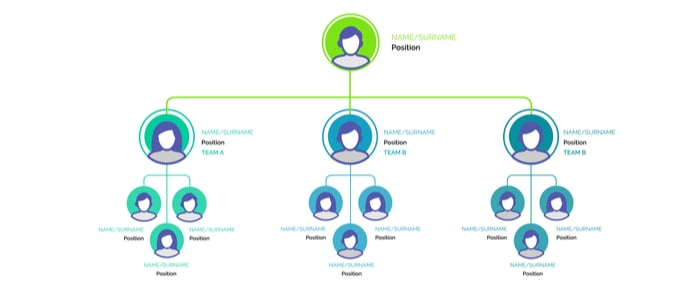
Maybe what you need is a full overhaul of your org chart.

organizational chart to fix marketing siloing

If you have several small, siloed teams, consider merging them into one larger unit with a few different “sub-units.”

Put these bigger teams together in the office to talk to each other about their current projects.

Or you could keep the hierarchy you have now, but move people around in a way that makes them feel less isolated.

Follow Through Over Time

No matter what you choose to do to deal with marketing siloing, the most important thing is that you follow through with it.

Don’t just go on an “anti-silo crusade” for a few months and then forget about it, letting things go back to the way they were before. Make sure your commitment is permanent.

Conclusion

Marketing siloing is one of the main things that can sabotage your marketing campaigns. Luckily, once you realize your company has a silo problem, you can often deal with it pretty quickly—as long as you have an organized plan.

Your employees will feel relieved that you’re taking the initiative. They will benefit from better communication between departments and individual employees.

Did I miss any ways to deal with marketing siloing? Let me know in the comments. 

The post How Marketing Siloing May Be Ruining Your Business appeared first on Neil Patel.

How to Establish Business Credit for the First Time in a Recession

As the novel coronavirus changes our economy, you may be wondering if you even can establish business credit for the first time in a recession. You most certainly can! And here’s how.

Establish Business Credit for the First Time in a Recession

Establishing small business credit means that your company gets opportunities you never knew you would. You can get all-new equipment, bid on realty, and cover the company payroll, even when times are a bit lean. This is specifically helpful in seasonal companies, where you can go for calendar months with solely hardly any sales. It’s time to establish business credit for the first time in a recession.

Yes, this can even happen during a bleak economy.

Given this, you should really work on developing your company credit. Improve and maintain your scores and you will have these chances. Do not, and either you do not get these chances, or they will set you back you a lot more. And no company owner wants that. You ought to recognize what affects your company credit before you can make it better.

Establish Business Credit for the First Time in a Recession: Business Credit Building

Small business credit is credit in a business’s name. It doesn’t tie to an owner’s consumer credit, not even when the owner is a sole proprietor and the sole employee of the business.

Thus, an entrepreneur’s business and individual credit scores can be very different.

The Benefits

Considering that business credit is independent from personal, it helps to secure a business owner’s personal assets, in the event of litigation or business insolvency.

Also, with two distinct credit scores, an entrepreneur can get two separate cards from the same merchant. This effectively doubles buying power.

Another benefit is that even startup businesses can do this. Going to a bank for a business loan can be a formula for frustration. But building small business credit, when done correctly, is a plan for success.

Consumer credit scores depend on payments but also additional components like credit usage percentages.

But for business credit, the scores truly just hinge on whether a company pays its bills on a timely basis.

Establish Business Credit for the First Time in a Recession: The Process

Building small business credit is a process, and it does not happen automatically. A company has to actively work to develop business credit.

That being said, it can be done easily and quickly, and it is much speedier than developing consumer credit scores.

Vendors are a big component of this process.

Performing the steps out of order will lead to repetitive rejections. Nobody can start at the top with company credit. For example, you can’t start with retail or cash credit from your bank. If you do, you’ll get a denial 100% of the time.

Establish Business Credit for the First Time in a Recession: Company Fundability

A company must be fundable to lending institutions and merchants.

For this reason, a company will need a professional-looking web site and email address. And it needs to have website hosting bought from a company such as GoDaddy.

Plus, business telephone and fax numbers ought to have a listing on ListYourself.com.

In addition, the company telephone number should be toll-free (800 exchange or the equivalent).

A company will also need a bank account devoted strictly to it, and it has to have every one of the licenses necessary for running.

Licenses

These licenses all must be in the accurate, correct name of the small business. And they must have the same small business address and phone numbers.

So bear in mind, that this means not just state licenses, but potentially also city licenses.

Learn more here and get started toward building business credit attached to your company’s EIN and not your SSN. Get money even in a recession!

Establish Business Credit for the First Time in a Recession: Dealing with the Internal Revenue Service

Visit the IRS website and get an EIN for the business. They’re free of charge. Pick a business entity such as corporation, LLC, etc.

A company can begin as a sole proprietor. But they will more than likely want to switch to a variety of corporation or an LLC.

This is in order to lessen risk. And it will take full advantage of tax benefits.

A business entity will matter when it pertains to tax obligations and liability in the event of litigation. A sole proprietorship means the owner is it when it comes to liability and taxes. Nobody else is responsible.

Sole Proprietors Take Note

If you operate a business as a sole proprietor, then at least be sure to file for a DBA. This is ‘doing business as’ status.

If you do not, then your personal name is the same as the company name. Therefore, you can find yourself being directly responsible for all company financial obligations.

Also, according to the Internal Revenue Service, using this structure there is a 1 in 7 chance of an IRS audit. There is a 1 in 50 probability for corporations! Steer clear of confusion and drastically lower the odds of an Internal Revenue Service audit simultaneously.

But don’t look at a DBA filing as being anything beyond a steppingstone to incorporating.

Establish Business Credit for the First Time in a Recession: Kicking Off the Business Credit Reporting Process

Start at the D&B website and obtain a free D-U-N-S number. A D-U-N-S number is how D&B gets a company in their system, to produce a PAYDEX score. If there is no D-U-N-S number, then there is no record and no PAYDEX score.

Once in D&B’s system, search Equifax and Experian’s websites for the business. You can do this at www.creditsuite.com/reports. If there is a record with them, check it for correctness and completeness. If there are no records with them, go to the next step in the process.

In this way, Experian and Equifax will have activity to report on.

Vendor Credit

First you need to build trade lines that report. This is also called vendor credit. Then you’ll have an established credit profile, and you’ll get a business credit score.

And with an established business credit profile and score you can start to get retail and cash credit.

These kinds of accounts often tend to be for the things bought all the time, like marketing materials, shipping boxes, outdoor work wear, ink and toner, and office furniture.

But first of all, what is trade credit? These trade lines are credit issuers who will give you starter credit when you have none now. Terms are usually Net 30, instead of revolving.

Hence, if you get an approval for $1,000 in vendor credit and use all of it, you must pay that money back in a set term, like within 30 days on a Net 30 account.

Learn more here and get started toward building business credit attached to your company’s EIN and not your SSN. Get money even in a recession!

Details

Net 30 accounts must be paid in full within 30 days. 60 accounts must be paid completely within 60 days. In contrast to with revolving accounts, you have a set time when you have to pay back what you borrowed or the credit you made use of.

To launch your business credit profile properly, you ought to get approval for vendor accounts that report to the business credit reporting agencies. As soon as that’s done, you can then make use of the credit.

Then repay what you used, and the account is on report to Dun & Bradstreet, Experian, or Equifax.

Vendor Credit – It Makes Sense

Not every vendor can help like true starter credit can. These are merchants that will grant an approval with very little effort. You also want them to be reporting to one or more of the big three CRAs: Dun & Bradstreet, Equifax, and Experian.

You want 3 of these to move onto the next step, which is retail credit.

Store Credit

Once there are 3 or more vendor trade accounts reporting to at least one of the CRAs, then move to store credit. These are service providers such as Office Depot and Staples.

Only use your Social Security Number and date of birth on these applications for verification purposes. For credit checks and guarantees, use the business’s EIN on these credit applications.

Fleet Credit

Are there more accounts reporting? Then move onto fleet credit. These are service providers such as BP and Conoco. Use this credit to buy fuel, and to fix and maintain vehicles. Only use your SSN and date of birth on these applications for verification purposes. For credit checks and guarantees, make certain to apply using the small business’s EIN.

Learn more here and get started toward building business credit attached to your company’s EIN and not your SSN. Get money even in a recession!

Cash Credit

Have you been responsibly handling the credit you’ve up to this point? Then move to more universal cash credit. These are service providers such as Visa and MasterCard. Just use your Social Security Number and date of birth on these applications for verification purposes. For credit checks and guarantees, use your EIN instead.

These are often MasterCard credit cards. If you have more trade accounts reporting, then these are in reach.

Establish Business Credit for the First Time in a Recession: Monitor Your Business Credit

Know what is happening with your credit. Make sure it is being reported and take care of any mistakes ASAP. Get in the habit of taking a look at credit reports. Dig into the details, not just the scores.

We can help you monitor business credit at Experian and D&B for a lot less.

Update Your Information

Update the details if there are inaccuracies or the information is incomplete.Establish Business Credit for the First Time in a Recession Credit Suite

Establish Business Credit for the First Time in a Recession Fix Your Business Credit

So, what’s all this monitoring for? It’s to dispute any errors in your records. Mistakes in your credit report(s) can be fixed. But the CRAs normally want you to dispute in a particular way.

Get your small business’s PAYDEX report at: www.dnb.com/about-us/our-data.html. Get your company’s Experian report at: www.businesscreditfacts.com/pdp.aspx?pg=SearchForm. And get your Equifax business credit report at: www.equifax.com/business/credit-information.

Disputes

Disputing credit report inaccuracies typically means you send a paper letter with copies of any proof of payment with it. These are documents like receipts and cancelled checks. Never send the originals. Always send copies and keep the originals.

Fixing credit report inaccuracies also means you specifically detail any charges you challenge. Make your dispute letter as understandable as possible. Be specific about the problems with your report. Use certified mail so that you will have proof that you mailed in your dispute.

Establish Business Credit for the First Time in a Recession: A Word about Building Business Credit

Always use credit responsibly! Don’t borrow beyond what you can pay off. Track balances and deadlines for payments. Paying off promptly and completely will do more to increase business credit scores than just about anything else.

Establishing company credit pays off. Excellent business credit scores help a business get loans. Your loan provider knows the company can pay its debts. They understand the company is for real.

The company’s EIN links to high scores and loan providers won’t feel the need to call for a personal guarantee.

Establish Business Credit for the First Time in a Recession: Takeaway

Business credit is an asset which can help your business for years to come. It’s time to get started on how to establish business credit for the first time in a recession. Or at any other time! The COVID-19 situation will not last forever.

The post How to Establish Business Credit for the First Time in a Recession appeared first on Credit Suite.
Business Credit Cards with Cashback Rewards

Are you looking for business credit cards with cashback rewards? Check out our choices inside.

Get the Best Business Credit Cards with Cashback Rewards

We researched a lot of company credit cards for you. So, here are our selections.

Per the SBA, corporate credit card limits are a whopping 10 – 100 times that of personal credit cards!

This shows you can get a lot more funds with corporate credit cards. And it also shows you can have personal credit cards at shops. So, you would now have an added card at the exact same shops for your company.

And you will not need collateral, cash flow, or financials to get business credit.

Business Credit Cards with Cashback Rewards: Benefits

Benefits can differ. So, make sure to pick the benefit you would like from this selection of alternatives.

Business Credit Cards with Cashback Rewards That Never Expire

Capital One® Spark® Cash Select for Business

Take a look at the Capital One® Spark® Cash Select for Business. It has no annual fee. You can get 1.5% cash back on every purchase. There is no limit on the cash back you can get. And earn a one-time $200 cash bonus as soon as you spend $3,000 on purchases in the initial three months. Rewards never expire.

Pay a 0% introductory APR for 9 months. Then pay 14.49% – 22.49% variable APR after that.

You will need great to excellent credit scores to qualify.

Find it here: https://www.capitalone.com/small-business/credit-cards/spark-cash-select/

Business Credit Cards with Cashback Rewards for Cash Back

Flat-Rate Rewards

Capital One ® Spark® Cash for Business 

Check out the Capital One® Spark® Cash for Business. It has an introductory $0 annual fee for the initial year. After that, this card costs $95 per year. There is no introductory APR deal. The regular APR is a variable 18.49%.

You can get a $500 one-time cash bonus after spending $4,000 in the first three months from account opening. Get unlimited 2% cash back. Redeem at any time without minimums.

You will need great to superb credit scores to qualify.

Find it here: https://www.capitalone.com/small-business/credit-cards/spark-cash/

Business Credit Cards with Cashback Rewards Credit Suite

Establish business credit fast with our research-backed guide to 12 business credit cards and lines.

Flat-Rate Rewards and No Annual Fee

Discover it® Business Card

Have a look at the Discover it® Business Card. It has no annual fee. There is an introductory APR of 0% on purchases for one year. Then the regular APR is a variable 14.49 – 22.49%.

Get unlimited 1.5% cash back on all purchases, with no category restrictions or bonuses. They double the 1.5% Cashback Match™ at the end of the first year. There is no minimum spend requirement.

You can download transactions| quickly to Quicken, QuickBooks, and Excel. Keep in mind: you will need good to outstanding credit scores to get approval for this card.

https://www.discover.com/credit-cards/business/

Bonus Categories

Ink Business Cash℠ Credit Card

Have a look at the Ink Business Cash℠ Credit Card. It has no annual fee. There is a 0% introductory APR for the initial twelve months. Afterwards, the APR is a variable 14.74 – 20.74%. You can get a $500 one-time cash bonus after spending $3,000 in the first 3 months from account opening.

You can get 5% cash back on the initial $25,000 spent in combined purchases at office supply stores and on internet, cable, and phone services each account anniversary year.

Get 2% cash back on the initial $25,000 spent in combined purchases at gasoline stations and restaurants each account anniversary year. Get 1% cash back on all other purchases. There is no limit to the amount you can earn.

You will need superb credit to qualify for this card.

Find it here: https://creditcards.chase.com/business-credit-cards/ink/cash?iCELL=61GF

Boosted Cash Back Categories

Bank of America® Business Advantage Cash Rewards MasterCard® credit card

Check out the Bank of America® Business Advantage Cash Rewards MasterCard® credit card. Get an 0% introductory APR for the initial 9 billing cycles of the account. After that, the APR is 13.74% – 23.74% variable. There is no yearly fee. You can get a $300 statement credit offer.

Get 3% cash back in the category of your choice. So these are gas stations (default), office supply stores, travel, TV/telecom & wireless, computer services or business consulting services. Earn 2% cash back on dining. So this is for the first $50,000 in combined choice category/dining purchases each calendar year. Then earn 1% after, with no limits.

You will need exceptional credit to qualify.

Find it here: https://promo.bankofamerica.com/smallbusinesscards2/ 

Business Credit Cards with Cashback Rewards for Extravagant Travel Points

Flat-rate Travel Rewards

Capital One® Spark® Miles for Business

Take a look at the Capital One® Spark® Miles for Business. It has an introductory annual fee of $0 for the first year, which then rises to $95. The regular APR is 18.49%, variable due to the prime rate. There is no introductory annual percentage rate. Pay no transfer fees. Late fees go up to $39.

This card is great for travel if your expenses do not come under typical bonus categories. You can get unlimited double miles on all purchases, without any limits. Get 5x miles on rental cars and hotels if you book with Capital One Travel.

Get an introductory bonus of 50,000 miles. That’s the same as $500 in travel. However you only get it if you spend $4,500 in the first 3 months from account opening. There is no foreign transaction fee. You will need a good to outstanding FICO score to qualify.

Find it here: https://www.capitalone.com/small-business/credit-cards/spark-miles/

Business Credit Cards with Cashback Rewards Credit Suite

Establish business credit fast with our research-backed guide to 12 business credit cards and lines.

Bonus Travel Categories with a Sign-Up Offer

Ink Business Preferred℠ Credit Card

For a wonderful sign-up offer and bonus categories, have a look at the Ink Business Preferred℠ Credit Card. 

Pay an annual fee of $95. Regular APR is 17.49 – 22.49%, variable. There is no introductory APR offer.

Get 100,000 bonus points after spending $15,000 in the first three months after account opening. This works out to $1,250 toward travel rewards if you redeem with Chase Ultimate Rewards.

Get 3 points per dollar of the first $150,000 you spend with this card. So this is for purchases on travel, shipping, internet, cable, and phone services. Plus it includes advertising purchases made with social media sites and search engines each account anniversary year.

You can get 25% more in travel redemption when you redeem for travel through Chase Ultimate Rewards. You will need a good to excellent FICO score to qualify.

Find it here: https://creditcards.chase.com/business-credit-cards/ink/business-preferred

Business Credit Cards with Cashback Rewards and No Yearly Fee

Bank of America® Business Advantage Travel Rewards World MasterCard® credit card

For no annual fee while still getting travel rewards, have a look at this card from Bank of America. It has no annual fee and a 0% introductory APR for purchases during the initial nine billing cycles. Afterwards, its regular APR is 13.74 – 23.74% variable.

You can earn 30,000 bonus points when you make at least $3,000 in net purchases. So this is within 90 days of your account opening. You can redeem these points for a $300 statement credit towards travel purchases.

Earn unlimited 1.5 points for every $1 you spend on all purchases, everywhere, every time. And this is despite how much you spend.

Also earn 3 points per every dollar spent when you book your travel (car, hotel, airline) via the Bank of America® Travel Center. There is no limit to the number of points you can get and points do not expire.

You will need exceptional credit scores to get this one (as in, 700s or better).

Find it here: https://www.bankofamerica.com/smallbusiness/credit-cards/products/travel-rewards-business-credit-card/

Business Credit Cards with Cashback Rewards: A Hotel Credit Card

Marriott Bonvoy Business™ American Express® Card

Check out the Marriott Bonvoy Business™ Card from American Express. It has a yearly fee of $125. There is no introductory APR offer. The regular APR is a variable 17.24 – 26.24%. You will need good to outstanding credit to get this card.

Points

You can earn 75,000 Marriott Bonvoy points after using your card to make purchases of $3,000 in the first 3 months. Get 6x the points for eligible purchases at participating Marriott Bonvoy hotels. You can get 4x the points at United States restaurants and filling stations. And you can get 4x the points on wireless telephone services purchased directly from US providers and on American purchases for shipping.

Get double points on all other eligible purchases.

Rewards

Also, you get a free night every year after your card anniversary. And you can earn one more free night after you spend $60,000 on your card in a calendar year.

You get Marriott Bonvoy Silver Elite status with your Card. Plus, spend $35,000 on qualified purchases in a calendar year and earn an upgrade to Marriott Bonvoy Gold Elite status through the end of the next calendar year.

Plus, each calendar year you can get credit for 15 nights towards the next level of Marriott Bonvoy Elite status.

Find it here: https://creditcard.americanexpress.com/d/bonvoy-business/

Business Credit Cards with Cashback Rewards with No Annual Fee

No Annual Fee/Flat Rate Cash Back

Ink Business Unlimited℠ Credit Card

Take a look at the Ink Business Unlimited℠ Credit Card. Beyond no annual fee, get an introductory 0% APR for the first year. Afterwards, the APR is a variable 14.74 – 20.74%.

You can earn unlimited 1.5% Cash Back rewards on every purchase made for your business. And get $500 bonus cash back after spending $3,000 in the first three months from account opening. You can redeem your rewards for cash back, gift cards, travel and more through Chase Ultimate Rewards®. You will need outstanding credit scores to qualify for this card.

Find it here: https://creditcards.chase.com/business-credit-cards/ink/unlimited

Business Credit Cards with Cashback Rewards Credit Suite

Establish business credit fast with our research-backed guide to 12 business credit cards and lines.

Business Credit Cards with Cashback Rewards with a 0% Introductory APR – Pay Zero!

Blue Business® Plus Credit Card from American Express

Check out the Blue Business® Plus Credit Card from American Express. It has no yearly fee. There is a 0% introductory APR for the first 12 months. After that, the APR is a variable 14.74 – 20.74%.

Get double Membership Rewards® points on day to day company purchases like office supplies or client suppers for the initial $50,000 spent annually. Get 1 point per dollar afterwards.

You will need great to exceptional credit scores to qualify.

Find it here: https://creditcard.americanexpress.com/d/bluebusinessplus-credit-card/

American Express® Blue Business Cash Card

Also have a look at the American Express® Blue Business Cash Card. Keep in mind: the American Express® Blue Business Cash Card is identical to the Blue Business® Plus Credit Card from American Express. But its rewards are in cash as opposed to points.

Get 2% cash back on all qualified purchases on up to $50,000 per calendar year. Then get 1%.

It has no yearly fee. There is a 0% introductory APR for the first year. After that, the APR is a variable 14.74 – 20.74%.

You will need great to superb credit to qualify.

Find it here: https://creditcard.americanexpress.com/d/business-bluecash-credit-card/

The Best Business Credit Cards with Cashback Rewards for You

Your straight-out ideal business credit cards with cashback rewards will always hinge on your credit history and scores.

Just you can pick which features you want and need. So, to do your homework. What is exceptional for you could be catastrophic for another person.

And, as always, ensure to establish credit in the recommended order for the best, speediest benefits.

The post Business Credit Cards with Cashback Rewards appeared first on Credit Suite.

Check Out the Best Discover Business Credit Card and More

Are you looking for a Discover business credit card?

The Very Best Discover Business Credit Card

We looked into lots of corporate credit cards for you, to find the best Discover business credit card. So, here are our choices.

Per the SBA, company credit card limits are a whopping 10 – 100 times that of personal credit cards!

This reveals you can get a great deal more money with company credit cards. And it likewise reveals you can have personal credit cards at stores. So, you would now have an additional card at the same stores for your small business.

And you will not need collateral, cash flow, or financials to get business credit.

Discover Business Credit Card Benefits

Benefits can vary. So, make certain to pick the benefit you would prefer from this choice of alternatives.

A Discover Business Credit Card and More Cards for Cash Back

Here is a great Discover business credit card and some similar cards from other providers, so you can make a reasonable comparison.

Flat-Rate Rewards and No Annual Cost

Discover it® Business Card

Check out the Discover it® Business Card. It has no annual fee. There is an introductory APR of 0% on purchases for twelve months. After that the regular APR is a variable 14.49 – 22.49%. 

Get unlimited 1.5% cash back on all purchases, with no category restrictions or bonuses. They double the 1.5% Cashback Match™ at the end of the first year. There is no minimum spend requirement.

You can download transactions| quickly to Quicken, QuickBooks, and Excel. Note: you will need good to outstanding credit scores to get this Discover business credit card.

https://www.discover.com/credit-cards/business/

Flat-Rate Rewards

Capital One ® Spark® Cash for Business 

Have a look at the Capital One® Spark® Cash for Business. It has an introductory $0 annual fee for the first year. Afterwards, this card costs $95 annually. There is no introductory APR offer. The regular APR is a variable 18.49%.

You can get a $500 one-time cash bonus after spending $4,000 in the initial three months from account opening. Get unlimited 2% cash back. Redeem at any time with no minimums.

You will need good to superb credit to qualify.

Find it here: https://www.capitalone.com/small-business/credit-cards/spark-cash/ 

Discover Business Credit Card Credit Suite

Establish business credit fast with our research-backed guide to 12 business credit cards and lines.

Bonus Categories

Ink Business Cash℠ Credit Card

Check out the Ink Business Cash℠ Credit Card. It has no yearly fee. There is a 0% introductory APR for the first 12 months. Afterwards, the APR is a variable 14.74 – 20.74%. You can get a $500 one-time cash bonus after spending $3,000 in the first three months from account opening.

You can get 5% cash back on the first $25,000 spent in combined purchases at office supply stores and on web, cable, and phone services each account anniversary year. 

Get 2% cash back on the first $25,000 spent in combined purchases at gas stations and restaurants each account anniversary year. Earn 1% cash back on all other purchases. There is no limit to the amount you can earn.

You will need exceptional credit scores to get approval for this card.

Find it here: https://creditcards.chase.com/business-credit-cards/ink/cash?iCELL=61GF 

Boosted Cash Back Categories

Bank of America® Business Advantage Cash Rewards MasterCard® credit card

Have a look at the Bank of America® Business Advantage Cash Rewards MasterCard® credit card. Get an 0% introductory APR for the initial 9 billing cycles of the account. After that, the APR is 13.74% – 23.74% variable. There is no yearly fee. You can get a $300 statement credit offer.

Get 3% cash back in the category of your choice. So these are filling stations (default), office supply stores, travel, TV/telecom & wireless, computer services or business consulting services. Earn 2% cash back on dining. So this is for the first $50,000 in combined choice category/dining purchases each calendar year. Then earn 1% after, with no limits.

You will need superb credit to qualify.

Find it here: https://promo.bankofamerica.com/smallbusinesscards2/ 

An Alternative to a Discover Business Credit Card: Company Credit Cards with a 0% Introductory APR – Pay Zero!

These cards have another feature similar to the Discover business credit card rated above.

Blue Business® Plus Credit Card from American Express

Have a look at the Blue Business® Plus Credit Card from American Express. It has no annual fee. There is a 0% introductory APR for the initial one year. After that, the APR is a variable 14.74 – 20.74%.

Get double Membership Rewards® points on day to day business purchases like office supplies or client dinners for the first $50,000 spent each year. Get 1 point per dollar afterwards.

You will need good to outstanding credit to qualify.

Find it here: https://creditcard.americanexpress.com/d/bluebusinessplus-credit-card/

American Express® Blue Business Cash Card

Also take a look at the American Express® Blue Business Cash Card. Note: the American Express® Blue Business Cash Card is identical to the Blue Business® Plus Credit Card from American Express. Yet its rewards are in cash rather than points.

Get 2% cash back on all qualified purchases on up to $50,000 per calendar year. Then get 1%.

It has no yearly fee. There is a 0% introductory APR for the first year. Afterwards, the APR is a variable 14.74 – 20.74%. So, the APR is comparable to that of the Discover business credit card.

You will need great to superb credit scores to qualify.

Find it here: https://creditcard.americanexpress.com/d/business-bluecash-credit-card/

Here are a few more great business credit cards with different features which may also be of interest.

Secure Business Credit Cards for Fair Credit Scores

Capital One® Spark® Classic for Business

Have a look at the Capital One® Spark® Classic for Business. It has no annual fee. There is no introductory APR offer. The regular APR is a variable 24.49%. You can earn unlimited 1% cash back on every purchase for your business, without any minimum to redeem.

While this card is within reach if you have average credit, beware of the APR. However if you can pay in a timely manner, and in full, then it’s a bargain.

Find it here: https://www.capitalone.com/small-business/credit-cards/spark-classic/

Discover Business Credit Card Credit Suite

Establish business credit fast with our research-backed guide to 12 business credit cards and lines.

Outstanding Business Credit Cards with No Annual Fee

No Yearly Fee/Flat Rate Cash Back

Ink Business Unlimited℠ Credit Card

Take a look at the Ink Business Unlimited℠ Credit Card. Past no annual fee, get an introductory 0% APR for the first 12 months. Afterwards, the APR is a variable 14.74 – 20.74%.

You can get unlimited 1.5% Cash Back rewards on every purchase made for your business. And get $500 bonus cash back after spending $3,000 in the first three months from account opening. You can redeem your rewards for cash back, gift cards, travel and more via Chase Ultimate Rewards®. You will need excellent credit to get approval for this card.

Find it here: https://creditcards.chase.com/business-credit-cards/ink/unlimited

Unbeatable Cards for Jackpot Rewards That Never Expire

Capital One® Spark® Cash Select for Business

Take a look at the Capital One® Spark® Cash Select for Business. It has no annual fee. You can get 1.5% cash back on every purchase. There is no limit on the cash back you can get. And get a one-time $200 cash bonus as soon as you spend $3,000 on purchases in the initial three months. Rewards never expire.

Pay a 0% introductory APR for 9 months. Then pay 14.49% – 22.49% variable APR after that.

You will need great to superb credit scores to qualify.

Find it here: https://www.capitalone.com/small-business/credit-cards/spark-cash-select/

Small Business Credit Cards for Luxurious Travel Points: Alternatives to the Best Discover Business Credit Card

Flat-rate Travel Rewards

Capital One® Spark® Miles for Business

Take a look at the Capital One® Spark® Miles for Business. It has an introductory yearly fee of $0 for the first year, which after that rises to $95. The regular APR is 18.49%, variable due to the prime rate. There is no introductory annual percentage rate. Pay no transfer fees. Late fees go up to $39.

This card is wonderful for travel if your expenditures don’t fall into standard bonus categories. You can get unlimited double miles on all purchases, without limits. Earn 5x miles on rental cars and hotels if you book via Capital One Travel.

Get an introductory bonus of 50,000 miles. That’s the same as $500 in travel. But you just get it if you spend $4,500 in the first 3 months from account opening. There is no foreign transaction fee. You will need a good to outstanding FICO rating to qualify.

Find it here: https://www.capitalone.com/small-business/credit-cards/spark-miles/

Discover Business Credit Card Credit Suite

Establish business credit fast with our research-backed guide to 12 business credit cards and lines.

Bonus Travel Categories with a Sign-Up Offer

Ink Business Preferred℠ Credit Card

For a terrific sign-up offer and bonus categories, take a look at the Ink Business Preferred℠ Credit Card.

Pay a yearly fee of $95. Regular APR is 17.49 – 22.49%, variable. There is no introductory APR offer.

Get 100,000 bonus points after spending $15,000 in the first 3 months after account opening. This works out to $1,250 towards travel rewards if you redeem with Chase Ultimate Rewards.

Get three points per dollar of the initial $150,000 you spend with this card. So this is for purchases on travel, shipping, internet, cable, and phone services. Plus it includes advertising purchases made with social media sites and search engines each account anniversary year.

You can get 25% more in travel redemption when you redeem for travel using Chase Ultimate Rewards. You will need a great to excellent FICO score to qualify.

Find it here: https://creditcards.chase.com/business-credit-cards/ink/business-preferred

No Annual Fee

Bank of America® Business Advantage Travel Rewards World MasterCard® credit card

For no yearly fee while still getting travel rewards, check out this card from Bank of America. It has no annual fee and a 0% introductory APR for purchases during the initial 9 billing cycles. Afterwards, its regular APR is 13.74 – 23.74% variable.

You can earn 30,000 bonus points when you make a minimum of $3,000 in net purchases. So this is within 90 days of your account opening. You can redeem these points for a $300 statement credit towards travel purchases.

Get unlimited 1.5 points for each $1 you spend on all purchases, everywhere, every time. And this is no matter how much you spend.

Likewise get 3 points per every dollar spent when you reserve your travel (car, hotel, airline) with the Bank of America® Travel Center. There is no limit to the number of points you can earn and points don’t expire.

You will need outstanding credit scores to get this one (as in, 700s or better).

Find it here: https://www.bankofamerica.com/smallbusiness/credit-cards/products/travel-rewards-business-credit-card/

Hotel Credit Card

Marriott Bonvoy Business™ American Express® Card

Take a look at the Marriott Bonvoy Business™ Card from American Express. It has an annual fee of $125. There is no introductory APR offer. The regular APR is a variable 17.24 – 26.24%. You will need good to outstanding credit scores to get this card.

Points

You can get 75,000 Marriott Bonvoy points after using your card to make purchases of $3,000 in the first 3 months. Get 6x the points for qualified purchases at participating Marriott Bonvoy hotels. You can get 4x the points at United States restaurants and filling stations. And you can get 4x the points on wireless telephone services bought straight from American providers and on American purchases for shipping.

Get double points on all other eligible purchases.

Rewards

Plus, you get a free night every year after your card anniversary. And you can get one more free night after you spend $60,000 on your card in a calendar year.

You get Marriott Bonvoy Silver Elite status with your Card. Plus, spend $35,000 on qualified purchases in a calendar year and earn an upgrade to Marriott Bonvoy Gold Elite status through the end of the following calendar year.

Also, each calendar year you can get credit for 15 nights towards the next level of Marriott Bonvoy Elite status.

Find it here: https://creditcard.americanexpress.com/d/bonvoy-business/

The Best Discover Business Credit Card for You

Your straight-out best Discover business credit card will depend upon your credit report and ratings.

Only you can select which features you want and need. So, ensure to do your research. What is exceptional for you could be devastating for another person.

And, as always, make sure to establish credit in the advised order for the best, fastest benefits.

The post Check Out the Best Discover Business Credit Card and More appeared first on Credit Suite.

How Being Fundable Helps You Get the Best Business Loans

Everyone wants the best of the best, and it should be no different when it comes to business loans.  However, you may need to change your thinking about what actually makes the best business loans the best.  Build Fundability So You Can Get the Best Business Loans For example, do great terms make a loan … Continue reading How Being Fundable Helps You Get the Best Business Loans

Exactly How To Earn Residual Income With A Work From Home Based Business Opportunity?

Just How To Earn Residual Income With A Work From Home Business Opportunity? Allow’s encounter it, there truly isn’t anything around that defeats the capability to gain recurring earnings. As soon as is one of the most effective cash making principles in presence and also it has actually made several business owners unclean abundant, obtaining …

The post Exactly How To Earn Residual Income With A Work From Home Based Business Opportunity? first appeared on Online Web Store Site.

How Hard is it to Establish Business Credit in a Recession?

Do you know? How hard is it to Establish Business Credit in a Recession?

It’s a brilliant question. How hard is it to establish business credit in a recession? Is business credit building impossible? Or is it just some nightmare? And what happens in an economic downturn?

I assure you it is not only possible, it is downright sure-fire. And business credit is all but recession-proof!

Business credit is credit in a business’s name. It doesn’t link to an owner’s personal credit, not even if the owner is a sole proprietor and the solitary employee of the corporation. Because of this, an entrepreneur’s business and consumer credit scores can be very different.

The Advantages

Because business credit is distinct from individual, it helps to safeguard a business owner’s personal assets, in the event of court action or business insolvency. Also, with two separate credit scores, an entrepreneur can get two separate cards from the same merchant.

This effectively doubles buying power.

Another benefit is that even startups can do this. Visiting a bank for a business loan can be a formula for frustration. But building small business credit, when done right, is a plan for success.

Individual credit scores are dependent on payments but also additional considerations like credit usage percentages. But for small business credit, the scores actually merely depend on whether a corporation pays its invoices timely.

How Hard is it to Establish Business Credit in a Recession: The Process

Establishing business credit is a process, and it does not occur automatically. A corporation will need to proactively work to build business credit. Nonetheless, it can be done readily and quickly, and it is much swifter than developing individual credit scores.

Merchants are a big component of this process.

Doing the steps out of sequence will cause repetitive rejections. No one can start at the top with company credit. For instance, you can’t start with store or cash credit from your bank. If you do you’ll get a rejection 100% of the time.

Learn more here and get started toward building business credit attached to your company’s EIN and not your SSN. Get money even in a recession!

How Hard is it to Establish Business Credit in a Recession: Company Fundability

A business has to be authentic to lenders and vendors. As a result, a company will need a professional-looking website and email address, with website hosting from a company like GoDaddy. Additionally business phone and fax numbers need to have a listing on ListYourself.net.

At the same time the company telephone number should be toll-free (800 exchange or the like).

A company will also need a bank account dedicated strictly to it, and it must have every one of the licenses essential for running. These licenses all must be in the accurate, accurate name of the company, with the same business address and phone numbers.

Keep in mind that this means not just state licenses, but potentially also city licenses.

How Hard is it to Establish Business Credit in a Recession: Dealing with the Internal Revenue Service

Visit the IRS web site and obtain an EIN for the small business. They’re free of charge. Select a business entity like corporation, LLC, etc.

A small business can start off as a sole proprietor. But will most likely wish to switch to a form of corporation or partnership to decrease risk and maximize tax benefits.

A business entity will matter when it concerns tax obligations and liability in the event of litigation. A sole proprietorship means the owner is it when it comes to liability and tax obligations. No one else is responsible.

If you run a company as a sole proprietor, then at least be sure to file for a DBA (‘doing business as’) status.

If you do not, then your personal name is the same as the small business name. Therefore, you can find yourself being directly responsible for all company debts.

And also, per the IRS, with this structure there is a 1 in 7 probability of an IRS audit. There is a 1 in 50 chance for corporations! Prevent confusion and drastically lower the odds of an Internal Revenue Service audit as well.

Learn more here and get started toward building business credit attached to your company’s EIN and not your SSN. Get money even in a recession!

How Hard is it to Establish Business Credit in a Recession: Starting off the Business Credit Reporting Process

Begin at the D&B website and obtain a cost-free DUNS number. A DUNS number is how D&B gets a corporation into their system, to produce a PAYDEX score. If there is no DUNS number, then there is no record and no PAYDEX score.

Once in D&B’s system, search Equifax and Experian’s websites for the company. You can do this at https://www.creditsuite.com/reports/. If there is a record with them, check it for accuracy and completeness.

If there are no records with them, go to the next step in the process. By doing this, Experian and Equifax will have something to report on.

Trade Lines

First you must build trade lines that report. This is also known as vendor accounts. Then you’ll have an established credit profile, and you’ll get a business credit score.

And with an established business credit profile and score you can start obtaining revolving store and cash credit.

These kinds of accounts have the tendency to be for the things bought all the time, like shipping boxes, outdoor work wear, ink and toner, and office furniture.

But first of all, what is trade credit? These trade lines are credit issuers who will give you initial credit when you have none now. Terms are oftentimes Net 30, instead of revolving.

Hence if you get approval for $1,000 in vendor credit and use all of it, you will need to pay that money back in a set term, like within 30 days on a Net 30 account.

Details

Net 30 accounts must be paid in full within 30 days. 60 accounts need to be paid in full within 60 days. Compared to with revolving accounts, you have a set time when you must pay back what you borrowed or the credit you made use of.

To begin your business credit profile the right way, you should get approval for vendor accounts that report to the business credit reporting agencies. As soon as that’s done, you can then make use of the credit.

Then repay what you used, and the account is on report to Dun & Bradstreet, Experian, or Equifax.

Not every vendor can help like true starter credit can. These are vendors that will grant an approval with very little effort. You also want them to be reporting to one or more of the big three CRAs: Dun & Bradstreet, Equifax, and Experian.

And Continue…

So get 3 of these to move onto the next step, which is revolving store credit.

1. Uline Shipping Supplies

Uline Shipping Supplies is a true starter vendor. Find them online at https://www.uline.com/. They offer shipping, packing, and industrial supplies, and they report to D&B and Experian.

You need to have a DUNS number. They will ask for 2 references and a bank reference. The initial few orders may need to be paid in advance to initially get approval for Net 30 terms. Also, you may need to buy some things you do not need.

2. Crown Office Supplies

Crown Office Supplies is another true starter vendor. Find them online at https://crownofficesupplies.com.

They sell a variety of office supplies and take helping clients seriously. They say, “just starting your business, or maybe have an existing business, but you have a question regarding office supplies… we are here to help!” And they report to Dun and Bradstreet, Experian, and Equifax.

There is a $99.00 yearly fee, though they do report that fee to the business credit reporting agencies. For other purchases to report, the purchase must be at least $30.00. Terms are Net 30.Fundability in a Recession Credit Suite

3. Grainger Industrial Supply

Grainger Industrial Supply is also a true starter vendor. Find them online at https://www.grainger.com/. They sell safety equipment, plumbing supplies, and more, and they report to D&B. You will need a business license, EIN, and a DUNS number.

For less than $1000 credit limit they will approve virtually anybody with a business license.

Accounts That Don’t Report

Non-Reporting Trade Accounts can also be helpful. While you do want trade accounts to report to at the very least one of the CRAs, a trade account which does not report can yet be of some worth. You can always ask non-reporting accounts for trade references.

Also credit accounts of any sort will help you to better even out business expenditures, consequently making financial planning simpler. These are companies like PayPal Credit, T-Mobile, and Best Buy.

Revolving Store Credit

Once there are 3 or more vendor trade accounts reporting to at least one of the CRAs move to revolving store credit.

Use the corporation’s EIN on these credit applications.

Fleet Credit

Are there more accounts reporting? Then progress to fleet credit. These are companies like BP and Conoco. Use this credit to buy, repair, and take care of vehicles. Make certain to apply using the business’s EIN.

Cash Credit

Have you been sensibly managing the credit you’ve gotten up to this point? Then move onto more universal cash credit. These are service providers such as Visa and MasterCard. Keep your SSN off these applications; use your EIN instead.

These are typically MasterCard credit cards. If you have more trade accounts reporting, then these are doable.

Learn more here and get started toward building business credit attached to your company’s EIN and not your SSN. Get money even in a recession!

How Hard is it to Establish Business Credit in a Recession: Monitor Your Business Credit

Know what is happening with your credit. Make sure it is being reported and fix any inaccuracies ASAP. Get in the practice of checking credit reports. Dig into the specifics, not just the scores.

We can help you monitor business credit at Experian and D&B for $90 less. Update the relevant information if there are errors or the details is incomplete.

Disputing Mistakes

So, what’s all this monitoring for? It’s to challenge any mistakes in your records. Errors in your credit report(s) can be taken care of. But the CRAs typically want you to dispute in a particular way.

Disputing credit report inaccuracies usually means you send a paper letter with copies of any proof of payment with it. These are documents like receipts and cancelled checks. Never mail the originals. Always send copies and retain the originals.

Disputing credit report inaccuracies also means you specifically detail any charges you challenge. Make your dispute letter as clear as possible. Be specific about the issues with your report. Use certified mail so that you will have proof that you mailed in your dispute.

How Hard is it to Establish Business Credit in a Recession: A Word about Business Credit Building

So always use credit sensibly! Don’t borrow beyond what you can pay off. Monitor balances and deadlines for payments. Paying on time and fully will do more to boost business credit scores than virtually anything else.

Establishing corporate credit pays. Good business credit scores help a company get loans. Your credit issuer knows the corporation can pay its financial obligations.

They know the corporation is authentic. And the business’s EIN connects to high scores, and credit issuers won’t feel the need to require a personal guarantee.

How Hard is it to Establish Business Credit in a Recession: Takeaway

Business credit is an asset which can help your small business for years to come.

Obtaining merchant accounts for business credit means that you are on your way to getting good business credit.

These three should conveniently get you going. How hard is it to establish business credit in a recession? Pretty easy! So go out there and clobber it! Learn more here and get started toward establishing business credit.

The post How Hard is it to Establish Business Credit in a Recession? appeared first on Credit Suite.

How Being Fundable Helps You Get the Best Business Loans

Everyone wants the best of the best, and it should be no different when it comes to business loans.  However, you may need to change your thinking about what actually makes the best business loans the best. 

Build Fundability So You Can Get the Best Business Loans

For example, do great terms make a loan one of the best?  Could it be low rates? These things are awesome. However, the best business loans are the loans you can get.  Of course, you can look at the cream of the crop. Still, if you cannot access them, they will not do you any good.  You need to know what the best business loans are that you can access. Furthermore, you need to know how to gain access to those that are even better.  

Find out why so many companies use our proven methods to get business loans

What Makes a Loan One of the Best? 

Fortunately, U.S. News helps us out by outlining the best business loans in various categories. When compiling their list, they consider such factors as product availability, terms, and service ratings. 

Best Business Loans for Borrowers with FICO Credit Scores as Low As 530

BlueVine takes the prize in this category. The minimum loan amount available from them is $5,000 and the maximum is $100,000. Annual revenue must be $120,000 or more and the borrower must be in business for at least 6 months. Personal credit score has to be at least 600. It is also important to know that BlueVine does not offer a line of credit in all states. 

They report to Experian.  They are one of the few invoice factoring companies that will report to any business credit bureau.  This helps build business credit and in turn, fundability.

Best Business Loans for Up to Five Year Loan Terms

The winner in this category is Funding Circle.  Honestly, if you’re looking for a low APR, then this is your go-to.  They have fixed rate term loans and require a credit score of 620 or above.  There is no minimum revenue requirement, but they do require you to be in business for at least 2 years.  

Best Business Loans With No Collateral Required

OnDeck offers lines of credit and term loans with fixed interest rates.  You can get up to $500,000 with a term loan.  The minimum FICO they require is 600. In addition, you must have $100,000 minimum annual revenue and be in business for at least one year.  

Best Small Business Loans for Up to $1 Million 

With a large selection of financing products that includes term loans, Rapid Finance can be a great option for larger amounts.  In addition to term loans, they offer bridge loans, healthcare cash advances, and lines of credit.  Terms are from three to six months. Amounts range from $5,000 to $1,000,000. Unfortunately, they do not make their minimum credit score readily available on their website.  However, you can use their quote tool to get an idea of what you qualify for. 

Best Business Loans for Borrowers In Business for 6 Months or More

StreetShares offers invoice financing, term loans, and lines of credit.  The number of years in business requirement is one.  They require less minimum annual revenue than the others at only $25,000.  The minimum credit score is 600.  

The key with each of these loans is, your ability to get them is dependent on the fundability of your business.  

What is Fundability? 

Fundability is, in short, the ability to get funding.  It is the complete picture of your business and personal financing and your ability to repay debt. If you think of fundability as a puzzle, there are hundreds of pieces that come together to complete it.  The problem is, a lot of business owners cannot see the complete picture because they are unaware of what additional pieces may be floating around out there.  

Also, unlike a puzzle, the pieces are not all the same size.  Some are very large, while others are smaller. If your large pieces are in great shape, the smaller ones may not matter so much. If, however, your large pieces, like credit history, are not so great, the smaller pieces can make a much bigger difference in your ability to get the best business loans. 

What Makes Up Fundability?

What are these puzzle pieces and how can you make sure they are in the best possible shape?  Hold on to your hats. Some of these may surprise you.

Contact Information

That’s right.  Even something as small as your contact information can affect the fundability of your business.  Your business needs to have its own phone number, fax number, and address.  

EIN

An EIN is an identifying number for your business that works in a way similar to how your SSN works for you personally.  You can get one for free from the IRS.

Incorporation

Incorporating your business as an LLC, S-corp, or corporation is necessary to fundability.  It lends credence to your business as one that is legitimate. It also offers some protection from liability. 

Business Bank Account

You have to open a separate, dedicated business bank account.  There are a few reasons for this.  First, it will help you keep track of business finances.  Also, it will help you keep them separate from personal finances for tax purposes. 

Additionally, there are several types of funding you cannot get without a business bank account.  Many lenders and credit cards want to see one with a minimum average balance.  Also, you cannot get a merchant account without a business account at a bank. As a result, you cannot take credit card payments.  Studies show consumers tend to spend more when they can pay by credit card.

Licenses

For a business to be legitimate and fundable it has to have all of the necessary licenses it needs to run.  If it doesn’t, warning signals are going to go off all over the place.  Do the research you need to do to ensure you have all of the licenses necessary to legitimately run your business at the federal, state, and local levels. 

Website

Your business website, or lack thereof, can affect your ability to get funding. In fact, these days, if you don’t have an online presence you may as well not even exist.  Still, a poorly put together website can be even worse.  Truly, it is the first impression you make on most. If it appears to be unprofessional, it will not look good to consumers or potential lenders. 

Spend the time and money necessary to ensure your website is professionally designed and works well.  Pay for hosting too. Don’t use a free hosting service.  Similarly, your business needs a dedicated business email address.  Make sure it has the same URL as your Website. Don’t use a free service such as Yahoo or Gmail.

Find out why so many companies use our proven methods to get business loans

Business Credit Reports

Much like your consumer credit report does for the individual, business credit reports detail the credit history of your business.  Basically, they are a tool to help lenders determine how credit worthy your business is.  

Where do business credit reports come from?  There are a lot of different places, but the main ones are Dun & Bradstreet, Experian, Equifax, and FICO SBSS.  You have no way of knowing which one your lender will choose.  So, you need to make sure all of these reports are up to date and accurate. 

Other Business Data Agencies 

In addition to the business credit reporting agencies that directly calculate and issue credit reports, there are other business data agencies that affect those reports indirectly.  Two examples of this are LexisNexis and The Small Business Finance Exchange. These two agencies gather data from a variety of sources, including public records.  This means they could even have access to information relating to automobile accidents and liens. While you may not be able to access or change the data these agencies have on your business, you can ensure that any new information they receive is positive.  Enough positive information can help counteract any negative information from the past. 

Identification Numbers Best Biz Loans Credit Suite

In addition to the EIN, there are identifying numbers that go along with your business credit reports.  You need to be aware that these numbers exist.  Some of them are assigned by the agency, like the Experian BIN.  One, however, you have to apply for. It is absolutely necessary that you do. 

Dun & Bradstreet is the largest and most commonly used business credit reporting agency.  Every credit file in their database has a D-U-N-S number.  To get a D-U-N-S number, you have to apply for one through the D&B website

Business Credit History

Your credit history is the crux of your credit score, which is a huge factor in the fundability of your business.  

It includes a number of things like: 

  • How many accounts are reporting payments?
  • How long have you had each account? 
  • What type of accounts are they?
  • How much credit are you using on each account versus how much is available?
  • Are you making your payments on these accounts consistently on-time?

The more accounts you have reporting on-time payments, the stronger your credit score will be. 

Business Information

On the surface, it seems obvious that all of your business information should be the same across the board everywhere you use it.  However, when you start changing things up like adding a business phone number and address or incorporating, you may find that some things slip through the cracks. 

This is a problem because a ton of loan applications are turned down each year due to fraud concerns simply because things do not match up.  Maybe your business licenses have your personal address but now you have a business address.  You have to change it. Perhaps some of your credit accounts have a slightly different name or a different phone number listed than what is on your loan application. Do your insurances all have the correct information?  

The key to this piece of the business fundability puzzle is to monitor your reports frequently.   

Financial Statements

First, there is the obvious. Both your personal and business tax returns need to be in order.  Not only that, but you need to be paying your taxes, both business and personal.  

Business Financials

It is best to have an accounting professional prepare regular financial statements for your business. Having an accountant’s name on financial statements lends credence to the legitimacy of your business. If you can’t afford this monthly or quarterly, at least have professional statements prepared annually. Then, they are ready whenever you need to apply for a loan. 

Personal Financials

Often tax returns for the previous three years will suffice.  Get a tax professional to prepare them.   This is the bare minimum you will need.  Other information lenders may ask for include check stubs and bank statements, among other things. 

Find out why so many companies use our proven methods to get business loans

Bureaus

There are several other agencies that hold information related to your personal finances that you need to know about.  Everyone knows about FICO.  Your personal FICO score needs to be as strong as possible. It really can affect business fundability and almost all traditional lenders will look at personal credit in addition to business credit. 

In addition to FICO reporting personal credit, you have ChexSystems.  In the simplest terms, this keeps up with bad check activity and makes a difference when it comes to your bank score.  If you have too many bad checks, you will not be able to open a bank account.  That will cause serious fundability issues. 

For this point, everything comes into play.  Have you ever been convicted of a crime? Do you have a bankruptcy or short sell on your record?  How about liens or UCC filings? All of this can and will play into the fundability of your business. 

Personal Credit History

Your personal credit score from Experian, Equifax, and Transunion all make a difference.  You have to have your personal credit in order because it will definitely affect the fundability of your business.  If it isn’t great right now, get to work on it.  The number one way to get a strong personal credit score or improve a weak one is to make payments consistently on time. 

Also, make sure you monitor your personal credit regularly to ensure mistakes are corrected and that there are no fraudulent accounts being reported. 

Even the Application Process Matters

Often this part isn’t even considered by those looking for the best business loans.  For example, consider the timing of your application.  Is your business currently fundable?  If not, do some work first to increase fundability.  

Then, are your business name, business address, and ownership status all verifiable.  Lenders will check into it.  Also, make sure you choose the right lending product for your business and your needs. Do you need a traditional loan or a line of credit?  Would a working capital loan or expansion loan work best for your needs?  Choosing the right product to apply for can make all the difference. 

Increase Fundability to Get the Best Business Loans

How do you get the best business loans?  You need to know how to find the best business loans for your specific business needs.  Make sure your fundability is as strong as possible. Pay bills on time, work on building business credit, and make sure to dot all your i’s and cross all your t’s. Do these things, and most all business loans will be yours for the taking. 

The post How Being Fundable Helps You Get the Best Business Loans appeared first on Credit Suite.