Ecommerce Business Inventory Financing

How Can Ecommerce Business Inventory Financing Help Your Business?

Selling goods online? Then you might need Ecommerce business inventory financing.

Our World Has Changed – and It’s Gone Even More Online

While there was already a lot of online commerce, in March of 2020, due to COVID-19, a good 42% of Americans bought groceries online at least once per week. Orders for grocers from Amazon increased 50 fold!

Statista says about 227.5 million Americans were buying online in 2020, so with 330.7 American citizens, that’s just under 69% of all Americans. They are buying a lot more than groceries online. And that’s only continuing in 2021.

What is Ecommerce Business Inventory Financing?

According to Investopedia, “Inventory financing is a revolving line of credit or a short-term loan that is acquired by a company so it can purchase products for sale later. The products serve as the collateral for the loan.”

Why Can Ecommerce Business Inventory Financing Work Right Now?

Online businesses are doing relatively well right now. You already have experience with doing all of your commerce online. With a lot of brick and mortar businesses closed right now, or only tentatively reopening, ecommerce businesses can continue to do well.

Consider Ecommerce Business Inventory Financing

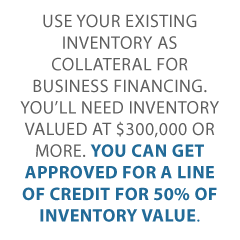
Use your existing inventory as collateral for business financing. You’ll need inventory valued at $300,000 or more. You can get approved for a line of credit for 50% of inventory value. Rates are usually 5 – 15% depending on type of inventory. Get funding within 3 weeks or less. It can’t be lumped together inventory, like office equipment.

But there may be restrictions on the type of inventory you can use. This can include not allowing cannabis, alcohol, firearms, etc., or perishable goods. There can be revenue requirements. There may also be minimum FICO score requirements.

Alternatives to Inventory Financing

There are a number of other ways to get financing for your online business. Your business – and you – have assets beyond inventory. You can tap these assets as collateral. You can use: a 401(k) or IRA, accounts receivable, or stocks or bonds. The 401(k), stocks, or bonds don’t have to be yours. You can work with a partner with these kinds of assets.

Securities-Based Financing

Use existing stocks as leverage to get business financing. Borrow as much as 90% of their value. You continue to earn interest on the stocks pledged as collateral. Closing and funding takes less than 3 weeks.

Rates can be as low as 1.6%. This is a working capital line of credit. You will have challenged personal credit.

Demolish your funding problems with 27 killer ways to get cash for your business.

401(k) Financing

Use your existing 401(k), or IRA as collateral for business financing. This program uses IRS proven strategies. You will pay no tax penalties.

You still earn interest on your 401(k). pay low rates, often less than 5%. Close and fund in less than 3 weeks. You can usually get up to 100% of what’s “rollable” within your 401(k).

Follow these steps. A new corporation is formed; a retirement plan is created to allow for investment into the corporation; funds are rolled over into the new plan. Then the new plan purchases stock in corporation and holds it. The corporation becomes debt free and cash rich.

Accounts Receivable Financing

Use your outstanding account receivables for financing. Get as much as 80% of receivables advanced ongoing in less than 24 hours. The remainder of the accounts receivable are released once the invoice is paid in full. Closing takes 2 weeks or less. Factor rates as low as 1.33%. Accounts receivable credit line with rates of less than 1% with no consumer credit requirement

Receivables should be with the government or another business. If you also have purchase orders, you can get financing to have those filled. You won’t need to use your cash flow to do so.

Amazon Corporate Credit Line

Get revolving or pay in full. You can authorize multiple buyers on a single account and download order history reports and pay by purchase order.

With the pay in full credit line, you get net 55-day billing terms to pay in full with no interest. You can set up primary and secondary accounts for multiple purchasers. And you will get a Dedicated Account Manager.

For the revolving credit line, you can make minimum payments or pay in full monthly. Pay 12.99% purchase APR (the minimum interest charge is $1). You get an option to apply as a personal guarantor to build business credit. And enjoy 24/7 Customer Service.

Amazon Lines of Credit and Working Capital Loans

If your business is eligible, you will see funding options when you log into Seller Central. Currently, lines of credit are offered by Marcus by Goldman Sachs. Loans come from Amazon Lending – specific terms are tailored to the business. Get access to loan funds within 5 days.

Kickfurther

You can finance your next inventory purchase with financing from customers and brand supporters and fundraise directly to them. The way it works is, customers buy through what’s called a Consignment Opportunity. Customers own the products they helped fund until they are sold by the brand. As soon as the products sell, the customer earns payments. Kickfurther also offers an online store for businesses to market and sell their products.

Shopify Capital

With Shopify Capital, you can get 12-month terms. Pay back with a percentage of daily sales. Borrow between $200 and $1 million. The total owed and daily repayment rate depend on risk profile.

OnDeck

OnDeck offers inventory loans and business lines of credit. Term loans runs $5,000 to $250,000, with 12-month terms paid back daily or weekly. Lines of credit run from $6,000 to $100,000. Pay back over 12 months, with automatic weekly payments.

Demolish your funding problems with 27 killer ways to get cash for your business.

Get to know Our Hybrid Credit Line Program

Check out this form of unsecured funding. Unsecured funding does not require collateral, but the lender’s risk is mitigated by higher interest rates. Our credit line hybrid has an even better interest rate than a secured loan. Yet you can get the money faster and easier than any type of traditional funding. Get business funding without having to supply bank statements or credit stubs. You can get funding in a few days rather than weeks without supplying any collateral or documents.

You can get some of the highest loan amounts and credit lines for businesses. Get 0% business credit cards with stated income. No financials required. These report to business CRAs. You can build business credit at the same time. This will get you access to even more cash with no personal guarantee.

You can often get a loan of 5 times the amount of current highest revolving credit limit account. This is up to $150,000. Easily five times what you could get on your own when applying for cards. Get cash out on this program as well.

Advantages

There will be NO impact on your personal credit with this type of financing. You need a good credit score or a guarantor with good credit to get an approval. With good personal credit, get unsecured credit cards with a personal guarantee. And with good business credit, get unsecured credit cards without a personal guarantee.

Check out business credit. It should be your goal to build business credit, even if you can get funding elsewhere. Business credit will help your company for years to come. Business credit is credit linked to your EIN and not your SSN.

This credit is available without a personal guarantee. It is available regardless of personal credit. You can get business credit immediately. Business credit is the only way to get money for a business when you don’t have collateral, cash flow, good personal credit, or a guarantor.

Demolish your funding problems with 27 killer ways to get cash for your business.

Ecommerce Business Inventory Financing: Takeaways

Due to current circumstances, online businesses are doing relatively well. You can get inventory financing for your ecommerce business. Or use personal or business assets as collateral for business loans. Amazon and Kickfurther offer even more options. Our hybrid credit line is a stellar choice if you or a guarantor have good personal credit. And don’t forget to build business credit, for even more money for your ecommerce business.

The post Ecommerce Business Inventory Financing appeared first on Credit Suite.

New comment by polygence in "Ask HN: Who is hiring? (March 2021)"

Coding mentor (for high school students) | paid/side-hustle/contractor | Remote | US citizen or work authorization

Polygence is looking for software engineers to mentor high schoolers in webdev, gamedev, app development (iOS and android), and more. Data analytics projects (especially sports analytics) are also quite popular!

Polygence serves tons of students with 2-5 years of coding experience who want to take on a passion project. We match them with a mentor to help guide them in their project (https://mentor.polygence.org/projects). You could be that mentor!! Students are generally 15-18 years old. Most have taken AP CS or equivalent and are comfortable in Java or Python. They love learning. And can’t wait to build fun projects.

Time commitment: varies (min. 2 hr/month)
Compensation: $75-$100/hour

About Polygence: https://mentor.polygence.org/
Interest Form: https://mentor.polygence.org/interest-form

The post New comment by polygence in “Ask HN: Who is hiring? (March 2021)” appeared first on ROI Credit Builders.

Best Shared Hosting Companies

Disclosure: This content is reader-supported, which means if you click on some of our links that we may earn a commission. Do you want to skip the read and get right to my top pick? The best shared hosting provider for most people is Hostinger. For those of you starting a new website from scratch, …

The post Best Shared Hosting Companies first appeared on Online Web Store Site.

How to Create The Perfect Call-to-Action

Sign up. Buy now. Learn more. None of these common call-to-action triggers will probably get you the desired result, because your target audience is more knowledgeable than ever before. If you want to learn how to write the perfect call-to-action that’ll captivate your target audience, educate them and increase your conversions, this in-depth article was written with …

The post How to Create The Perfect Call-to-Action first appeared on Online Web Store Site.

QuestBook (YC W21) Is hiring a lead fullstack engineer

Article URL: https://www.workatastartup.com/jobs/42968 Comments URL: https://news.ycombinator.com/item?id=26624793 Points: 1 # Comments: 0

The post QuestBook (YC W21) Is hiring a lead fullstack engineer first appeared on Online Web Store Site.

The post QuestBook (YC W21) Is hiring a lead fullstack engineer appeared first on ROI Credit Builders.

Top 25 Sports Card Blogs To Follow in 2021

Top 25 Sports Card Blogs Contents [show] ⋅About this list & ranking Sports Card Blogs Sports Collectors Daily The Cardboard Connection Beckett News All Vintage Cards | Vintage Sports Card Blog Cherry Collectables Just Collect Blog | Vintage Sports Cards & Memorabilia News The Knight’s Lance Sports Cards Rock Sports Card Info Upper Deck Blog Matt’s Wonderful […]

The post Top 25 Sports Card Blogs To Follow in 2021 appeared first on Feedspot Blog.

The post Top 25 Sports Card Blogs To Follow in 2021 appeared first on ROI Credit Builders.

New comment by clever123 in "Ask HN: Who is hiring? (April 2021)"

Coder | Senior Product Manager | Remote (US + Canada only)

We help engineers stay in a state of flow by removing a lot of the nonsense associated with traditional software development (like installing dependencies, requiring some specific OS, or needing some weird secrets). We’re a series B dev-tool startup with ~40 employees backed by some pretty sweet people in the tech space like RedPoint, Founders Fund, GGV, and a bunch of fantastic advisors to help us along the way!

Email clever@coder.com if you are interested in the Sr. Product Manager -> https://jobs.lever.co/coder/1b69e65f-3276-4d02-a6e8-06194f3e…

How to Run an Omnichannel E-Commerce Marketing Campaign

Think back to the last time you made a big online purchase. If you’re like most consumers, there’s a good chance you interacted with the brand multiple times on different channels using different devices before you paid.

The customer journey isn’t straightforward anymore (if it ever was). It’s a meandering path where customers visit brands on different platforms before converting. To successfully target and convert consumers across every channel and platform, you need a unified marketing strategy. That’s the crux of an omnichannel e-commerce marketing campaign.

This article walks you through precisely what omnichannel e-commerce looks like, why it is crucial for e-commerce brands, and how you can create your own killer omnichannel e-commerce marketing campaign.

What Is Omnichannel E-commerce?

Omnichannel e-commerce is a marketing approach that creates a unified customer experience across multiple platforms. Specifically, omnichannel retailers deliver the same experience across every channel and create a seamless experience that transcends individual platforms.

This is different from multichannel e-commerce, where brands sell across different channels but offer different experiences. While consumers may be able to shop on social media, a website, and a brick-and-mortar store, they can’t move seamlessly between them.

There is one other form of commerce: single-channel e-commerce. This is when brands only sell through one channel. That could be a traditional store, an online shop or a marketplace like Amazon. This approach limits brands to just one platform, which can be devastating if that platform makes changes.

With omnichannel e-commerce, customers hop from device to device, or platform to platform during the conversion process. As a brand, you need to keep up.

Why Is an Omnichannel E-commerce Strategy Important?

An omnichannel e-commerce experience sounds better than a multichannel or single-channel experience, right?

That’s reason enough to adopt an omnichannel approach, but it’s not the only reason you should. Omnichannel e-commerce provides a better customer experience and allows your brand to take advantage of new platforms, increase customer retention rates, and boost sales.

Omnichannel E-Commerce Strategies Provide a Better Customer Experience

Google reports that 85 percent of online shoppers start the purchase process on one device and finish it on another. Why does that matter?

Convenience rules when it comes to e-commerce; just ask Amazon. It’s not enough to offer a great selection, competitive pricing, and next-day delivery, however. Brands must show up where their customers are and offer a seamless experience when they switch devices or channels.

Take off your marketer’s cap for a second and remember that most consumers don’t view their shopping experience as separated. It’s all one journey to them, and that’s exactly how an omnichannel e-commerce experience approaches it.

As you can see from the infographic by Invesp below, customers can use an omnichannel experience in several different ways. They can:

  • check the availability of products
  • reserve or buy items and pick them up in-store
  • have constant access to their profile information
  • enjoy a personalized shopping experience regardless of platform
omnichannel e-commerce infographic

Omnichannel Is the Future of E-commerce

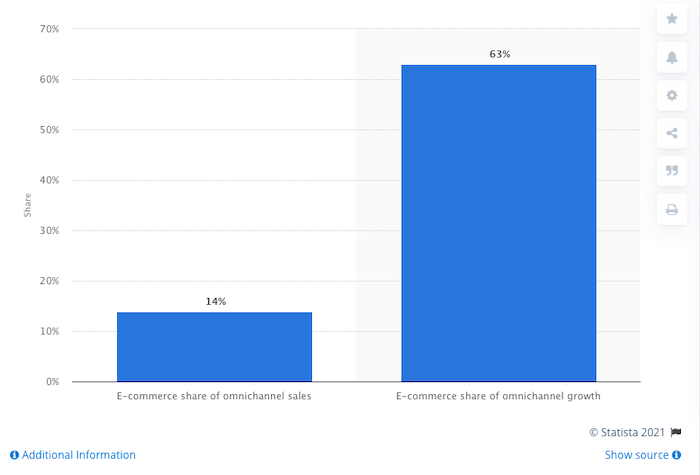
Want to future-proof your brand? Omnichannel is the way to go. Statista found e-commerce accounted for 14 percent of omnichannel sales in 2019, but it accounted for a whopping 63 percent of omnichannel growth—which means omnichannel is growing fast.

omnichannel e-commerce growth

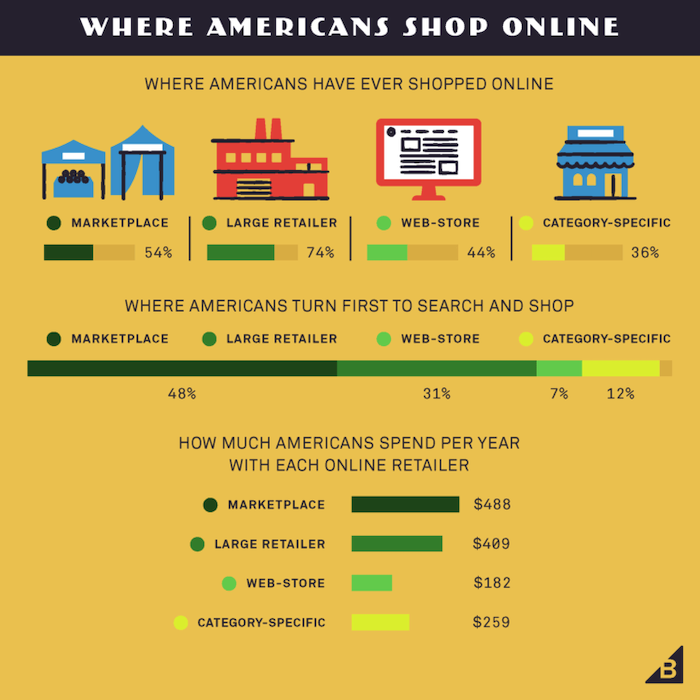
According to BigCommerce’s Omnichannel Retail report, consumers shop fairly evenly between different online stores, even though the bulk of spending happens on marketplaces like Amazon and large retailers.

omnichannel e-commerce sales distribution

Increase Customer Retention Rates and Sales

An omnichannel marketing strategy isn’t just good for customers; it can be incredibly profitable.

Customers keep coming back to stores that offer an omnichannel approach. A survey by Aspect Software finds organizations that leverage an omnichannel strategy see 91 percent better year-over-year customer retention rates than businesses that don’t. If you’re serious about generating repeat online sales, omnichannel marketing is the way to go.

Omnichannel customers are better customers in the long run, too. IDC finds these consumers have a 30 percent higher lifetime value than single-channel shoppers.

Research also shows 47 percent of shoppers who engage with brands on 10 or more channels purchase from their favorite brands at least once a week. That’s compared to 21 percent of shoppers who engage across one to four channels.

8 Tips for Building a Successful Omnichannel E-commerce Marketing Campaign

Omnichannel e-commerce marketing is essential for brick-and-mortar or digitally native brands that want to drive more e-commerce traffic and increase e-commerce sales in the years ahead.

Here’s what it takes to run a successful campaign.

Identify Each Channel’s Opportunities

Every channel is important in an omnichannel e-commerce strategy, but they play different roles. Begin by identifying where your customers spend the most time, how they interact with these channels, and the types of products they normally buy there.

Some channels are more suited to advertising particular products, while others may be better for customer service. For example, an enterprise software company probably won’t get many direct conversions from Twitter, but they can still engage prospective customers there.

Keep in mind, your omnichannel strategy shouldn’t include every single marketing platform. If none of your customers use TikTok, there’s no point creating a presence there. Omnichannel should focus on the channels your customers use.

Understand Your Customer’s Needs

An omnichannel approach should put your customers front and center. Every business likes to think they know their customers, but how much do you really know about them? Now is the time to find out.

Think about the channels where your customers hang out. What content do they like to see on those channels? When are they most likely to convert? These are the questions you have to answer.

You can use data to understand how customers interact with your brands across each channel, but don’t be afraid to speak with them directly through surveys and polls. This may help you uncover things you didn’t know about the buyer’s journey.

Personalize Ads and Messages

Customers expect more than an omnichannel experience; they expect personalization at every touchpoint on every channel. They want to land on your website and see the products they frequently buy. They expect the emails in their inbox to contain offers and marketing messages relevant to them.

The trouble is, 67 percent of marketers are not providing customers with contextual, personalized messages.

You don’t need to personalize your messaging for every individual customer, however. Instead, segment your audience into smaller groups that have the same traits. These traits can include:

  • demographics
  • shopping patterns
  • favorite channels
  • favorite products
  • spending amounts

Personalization strategies can even be implemented in stores. It may be a little more complicated recommending related products online, but setting up kiosks or equipping shopping assistants with mobile devices can help bring the online experience in-store.

Keep Your Brand Voice Consistent

Apple, Nike, Wendy’s; there are some companies with instantly recognizable brand voices. Why? Because they have an unfailing commitment to maintaining consistency across every channel.

It doesn’t matter if you see an Apple ad on TV or in print, read the copy on their website, or even watch one of their product launches. The language and tone of voice are exactly the same. That’s the secret to developing a great omnichannel e-commerce marketing strategy. The more consistent your messaging and tone of voice are, the less likely consumers are to get confused and fall out of your marketing funnel.

At the same time, they’ll find your message much more engaging. It’s one thing to be hit with a promotional message in an email. It’s another thing to see that same message on social media, your website, and in-store.

Your promotional strategies should also be consistent. It’s not an omnichannel marketing strategy if you’re running separate promotions in-store and online and aren’t allowing either shopper to use the other channels’ promotions.

Make Each Channel and Touchpoint Shoppable

With an omnichannel experience, customers should be able to purchase wherever they interact with your brand. Your online and brick-and-mortar stores are a given, but can they make purchases on social media channels or your app?

This wasn’t possible a couple of years ago. Thanks to some pretty significant updates on the major social media platforms, it is now possible to drive sales through Instagram, Facebook, and Pinterest.

Don’t stop there, though. Consider expanding your reach to marketplaces like Amazon and Etsy, if appropriate. As we saw in the breakdown of omnichannel e-commerce spending above, marketplaces have the second-largest share of shoppers and drive the most sales.

Sure, in an ideal world, it’s better if customers buy your products on your own website. But having customers purchase on Amazon allows you to engage with them and bring them to your website.

Keep Testing and Gathering Data

Your omnichannel e-commerce marketing campaign will need to evolve over time. Consumer habits change, new channels emerge, and existing platforms become less important. That’s why gathering data and continuing to test and refine your campaign is so important.

More data allows you to better optimize your campaign, and, ultimately, be more successful. Test your campaign as a whole and run live A/B tests on your personalized messaging to each customer segment. Tweaking headlines, body copy, and images can dramatically improve engagement and conversion rates.

Back It Up in the Back Office

There’s no point in developing a killer omnichannel marketing campaign if your backend operations can’t follow through on your promise.

Specifically, inventory visibility and management should be top of the list. Use an inventory management system that centralizes inventory across warehouses and physical storefronts, so no customer orders an out-of-stock product.

Shipping, fulfillment and returns are also important. Customers should have the ability to purchase their products in several ways, whether that’s having purchases delivered to their door or picking them up from their nearest store. The same goes for returns. In-store and online returns are essential components of a true omnichannel approach.

Conclusion

Omnichannel marketing for e-commerce stores is becoming the norm. Customers expect a seamless experience when switching between devices and channels, and it’s your responsibility to deliver it.

Omnichannel marketing significantly improves the customer experience, but it also drives better engagement, creates better customers, and leads to more sales. That puts it up there with some of the biggest factors of e-commerce success.

If you want to succeed with e-commerce, omnichannel marketing isn’t a strategy; it’s a requirement.

Want help setting up your marketing campaigns to align with your omnichannel e-commerce strategy? Let us know and our agency can help.

Which are the most important channels for your omnichannel e-commerce marketing campaign?

How to Run Effective eBay Ads

You want to get your products in front of the people who are going to buy them. When you get your products on eBay, you’re putting them in front of an audience of 185 million people, but with competition from over 1.7 billion listings, how can you make sure you stand out from the crowd?

One way to ensure you’re getting your products in front of the right audience is to make use of eBay ads. These are extremely easy to set up and can help propel you to the top of the search results, even in the most competitive categories.

How Do eBay Ads Work?

eBay ads can boost the visibility of your products by allowing them to feature at the top of the listings. With millions of products on the platform, eBay is a competitive place, and if you’re competing against hundreds of sellers all selling the same product, it can be difficult to stand out.

This is where eBay ads come in, allowing you to pay for your listing to feature at the top of the search results.

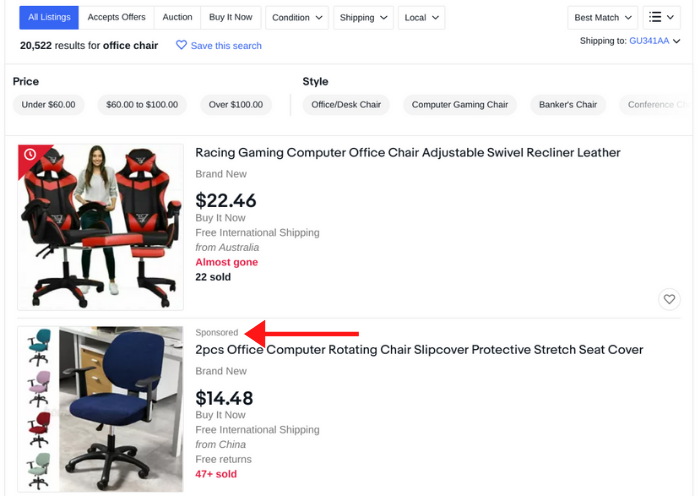
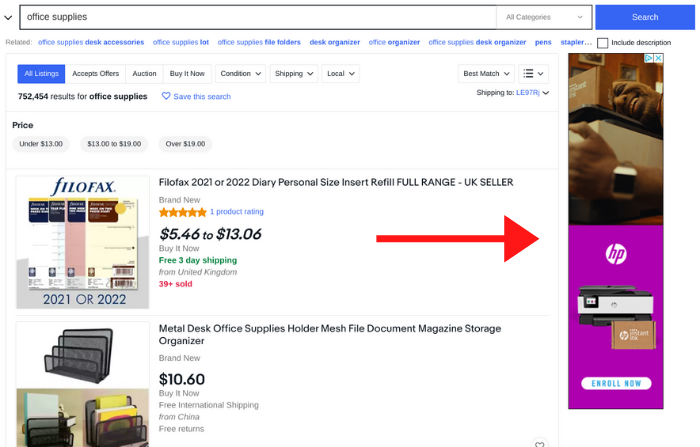
Example of eBay ads - promoted listing

In this sense, it’s a lot like advertising on Google. You set up your ads, and your product can be featured higher in the search results, based on the quality and relevance of your listing and how much you bid.

One interesting difference with eBay’s main ad option, promoted listings, is you only pay if your ad is successful. Unlike many platforms where you pay every time your ad is clicked, with eBay, you only pay for your promoted listing if it results in a sale within 30 days of someone clicking the listing.

This allows sellers to get a clear picture of their return on investment (ROI) and is a big benefit of selling on eBay.

3 Types of eBay Ads

eBay offers a few different types of ads to suit your business needs.

Promoted Listings

Promoted listings are used by over 940,000 sellers and are the most common way of advertising on eBay. They’re an excellent way to get your product listing to the top of the search results.

To be eligible for promoted listings, you must:

  • be in good standing (meeting eBay’s terms and conditions)
  • have “above standard” or “top-rated” seller rating
  • have recent sales activity

One of the most important aspects of selling products online is getting people to view your listings, and this ad type is a great way to gain access to eBay’s 185 million active users. By featuring at the top of the search results, you will bring more people to your product page, and then it’s up to you to optimize your product page to make the sale.

eBay offers great analytics to help you get the most out of your advertising, and the nice part is you only pay for your promoted listings once you’ve sold an item.

Display Ads

eBay now runs display ads across its network, giving you another way to reach your target audience. Similar to the display ads you can run on Google Ads, eBay’s display ads allow you to target users with interests in certain categories to drive more traffic to your listing:

  • business, office, and industrial
  • cars, motorcycles, and vehicles
  • clothes, shoes, and accessories
  • computers, tablets, and networking
  • garden and patio
  • health and beauty
  • home furniture and DIY

This expands your advertising options, meaning you’re not just limited to reaching people through the search function.

eBay ads - example of display ad

Display ads aren’t available through the seller hub; instead, you can speak directly to eBay about this option.

Classified Ads

Classified ads are a good option for people who want to take advantage of eBay’s reach but sell a product that isn’t necessarily suited to selling on the platform.

These ads are available in several categories:

  • business, office, and industrial: $9.95 for a 30-day listing
  • specialty services: $9.95 for a 30-day listing
  • travel: $9.95 for a 30-day listing
  • real estate: $150 for a 30-day listing

Your ad is shown, the user clicks on it, and then eBay puts you in contact with the buyer to negotiate the sale outside of the platform. This means you’re paying only for the ad, not the fees for selling on eBay, but it also means you don’t get any of the protections you get as an eBay seller.

eBay Advertising for Large Brands

eBay also offers a more bespoke advertising service for large brands.

This option offers big advertisers branding solutions to help optimize their product pages and acquire in-depth insights into customer motivations to help brands get the most out of the platform.

This option might offer great benefits, but it requires a big commitment to advertising spend to be accepted. If you’re a large brand looking to make eBay advertising an essential part of your marketing, then it’s worth reaching out to the eBay team and exploring the option further.

How to Set Up Your eBay Ad Campaign

Setting up eBay ads is quick and simple. In just five steps, you can create promoted listings and boost your product’s visibility at the top of the search results.

1. Log in to Your Seller Hub

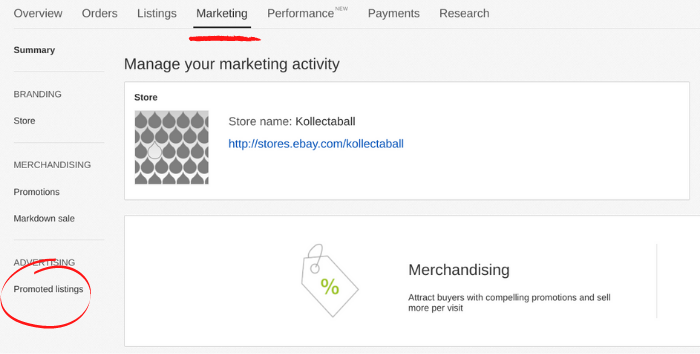
Your seller hub is where all your product listings live, and this is where you can create your eBay ad campaigns. Go to https://www.ebay.com/sh/, select “Marketing,” then “Promoted Listings” from the sidebar.

ebay ads - setting up promoted listings

2. Click “Create Your First Campaign”

If you’re new to promoted listings, you’ll be brought to a landing page that explains what they are and how they work. Click “Create Your First Campaign” to get started.

3. Choose How to List Your Promotions

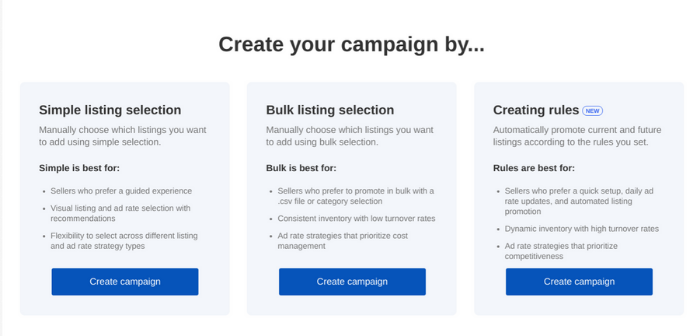
You have three different ways to list your promotions:

  • Simple listing selection: This allows you to promote your products individually, making good use of eBay’s smart recommendations.
  • Bulk listing selection: This option is for people who want to promote lots of products with consistent stock and low turnover rates.
  • Creating rules: Rules allow you to automatically promote current and future products. This option works well for sellers with dynamic inventory and high turnover rates.
eBay ads - creating your promoted listings

4. Apply Your Ad Rate

This is where you choose how much you wish to pay for your eBay ads. Represented as a percentage of the total sale value, you’ll notice that eBay gives you a recommended ad rate for your product.

These are normally a good place to start, but if you want to change it, you can use the slider to set it to anywhere between 1-100 percent of your sale’s value.

5. Review and Launch

Lastly, you need to name your campaign and review the details. You can also set a date for the campaign to begin and end. Once you’re happy with everything, click “Launch.”

Tips for Creating Effective eBay Ads

As with any form of advertising, it’s important to have a good return on ad spend (ROAS), and the way to achieve this is through optimization. It doesn’t matter how many people your ad reaches if you’re not using the right keywords or your listing is of poor quality. There are several elements you need to get right.

Use Relevant Keywords

Choosing the right keywords to reach your target audience is extremely important. People don’t always search in the ways you expect they might, so you need to understand your audience and do your keyword research.

As with Google Ads, it’s important to match user intent with your ads, which means getting the right keywords in your titles, descriptions, and throughout your product listings. Slight differences in your keywords can make a big difference in the success of your ads, so make sure you’re optimizing to meet the demands of your target audience.

While it’s important to make sure you’re using the right keywords, it’s also important to remember not to keyword stuff. eBay’s algorithms are smart, and they understand when you’re using language naturally and when you’re stuffing keywords solely for SEO purposes.

Include High-quality Images

It’s proven that high-quality images lead to more sales than average images.

When someone walks into a shop and buys a product, they get to see it with their own eyes and feel it in their hands. When they buy online, they don’t get this benefit. Instead, they’re reliant on your images and words to give them a good feel for your products. This is why your images are so important and can make a significant difference in the success of your ads.

High-quality images are likely to get more clicks and help boost your conversion rate.

Promote the Items That eBay Recommends

eBay faces huge competition for your advertising money. If it doesn’t deliver results, it knows you can easily go to Google, Amazon, Walmart, or any other number of advertising platforms to boost your sales.

To ensure this doesn’t happen, eBay uses its vast amount of data to recommend which items you should think about advertising. These “handpicked” recommendations are the products eBay believes are most likely to benefit from a promoted listing and have a “Recommended” tag next to them in your campaign manager.

Perfect Your Listing Title

When someone sees your ad in the search results, they don’t have a lot to go on. All they see is your title, a thumbnail image, pricing, and some details about shipping.

There aren’t many opportunities to earn someone’s click.

This means small details can make all the difference, and your title is a huge part of this. If you can create concise titles that match user intent, you can give yourself a much better chance of getting the right people to click your ad.

Sometimes people create product listings or blog content, and the title is an afterthought, but this is the first thing everyone looks at. They might just be a few words, but titles play a massive role in whether someone clicks your link and reads through your product listing.

Review Your Performance

One of the great things about advertising online is you have access to so much data. Information is power, and when you make the most of your analytics, you’ll find ways to optimize your eBay ads.

Head to the “Performance” tab in your promoted listings dashboard and make use of metrics such as impressions, clicks, and sales to evaluate how your eBay ads are performing. If you’re not getting the results you want, consider making changes to your titles, product page, bid price, and images. Make sure you keep checking the performance until you find the formula that works.

Conclusion

eBay ads give you an excellent opportunity to reach a targeted, engaged audience of buyers.

However, as with any e-commerce platform, there’s a ton of competition, and you need to be able to find ways to stand out from the crowd. eBay ads give you this opportunity, but you’ve still got to be creative with your titles and make sure your product listings are perfectly optimized to create sales.

For most sellers, promoted listings are going to be the best option to allow them to reach more customers, and they’re easy to set up and very effective. One of the nice things about this ad format is that you don’t pay until you see results, so you’ve got plenty of opportunities to optimize your process and make sure your eBay ads are working for you.

If creating your own ad strategy and optimizing your product descriptions or website isn’t up your alley, reach out to our agency. We can help!

Have you had success with eBay ads?

Truebill (YC W16) Is Hiring a Senior Machine Learning Engineers

Article URL: https://www.truebill.com/careers/

Comments URL: https://news.ycombinator.com/item?id=26892290

Points: 1

# Comments: 0